Product Strategy Final
 Call Kai
 Learn
Learn Practice Test
 Spaced Repetition
 Match
Match Flashcards
 Knowt Play
1/91

There's no tags or description
Looks like no tags are added yet.
Name | Mastery | Learn | Test | Matching | Spaced | Call with Kai |
|---|
No analytics yet
Send a link to your students to track their progress
92 Terms
Chapter 1:
What is a FLOP Analysis
A product can fail on 3 sections:
Failure in Launch
Failure in Operations (does it work)
Failure in Premise (was it a good product in the first place)
Chapter 1:
Factors that cause an innovative new product to succeed in the marketplace
Good understanding of the problem
Clear, shared vision forward
Visible senior management involvement
Creative and multi-functional team
Chapter 2:
What is a creative brainstorming technique?
Wishful thinking
Thinking about a problem that you have everyday that you want to change for fox
Chapter 1:
What is a failure in launch?
The product is designed and meets a defined market need
It has an appropriate set of features that are well engendered and manufactured
*during the launch marketing efforts fell through and the product didn’t get much attention by consumers
Chapter 1:
What is failure in operations?
The product is well designed and meets a defined market need
Successfully marketed during and after launch
*product is poorly designed or manufactured
Chapter 1:
What is failure in premise?
The product is well designed
The launch is successful
*the product isn’t what customers really wanted
Chapter 1:
What is something important to remember about the FLOP Analysis?
It is basically impossible for a product to fail in all 3 categories
It can only fail from 1 or 2
Chapter 1:
What are the 2 types of innovation
1) incremental innovation
2) disruptive innovation
Chapter 1:
What is incremental innovation
A small advancement in the market for that product
Ex: square to round buttons
Chapter 1:
What us disruptive innovation?
Bigger changes in the industry
Ex: analogue to digital
Chapter 2:
What is design thinking?
Identify and define user problems and create useful solutions for them
Chapter 2:
Learning from experience
Learning from trial and error so you can keep treating different solutions to the problem and see what works
Chapter 1:
What is the interactive model?
There is no starting point in the innovation process
Everyone works together and is intertwined
Chapter 1:
What is the fuzzy front end of new product development?
At the beginning there isn’t much of a market division. A lot of ambiguity and lack of clarity. Then at the end everything starts to narrow down what you need
Chapter 1:
What is the lift cycle and dominant designs
The launch of a new disruptive technology will spur innovation among competitors who do not want to become irrelevant and loose profit opportunities
Chapter 1:
What are the 3 pillars of strategy
Who - our customers are
What - products/services we should offer (or not)
How - do we deliver the products to our customers
Chapter 1:
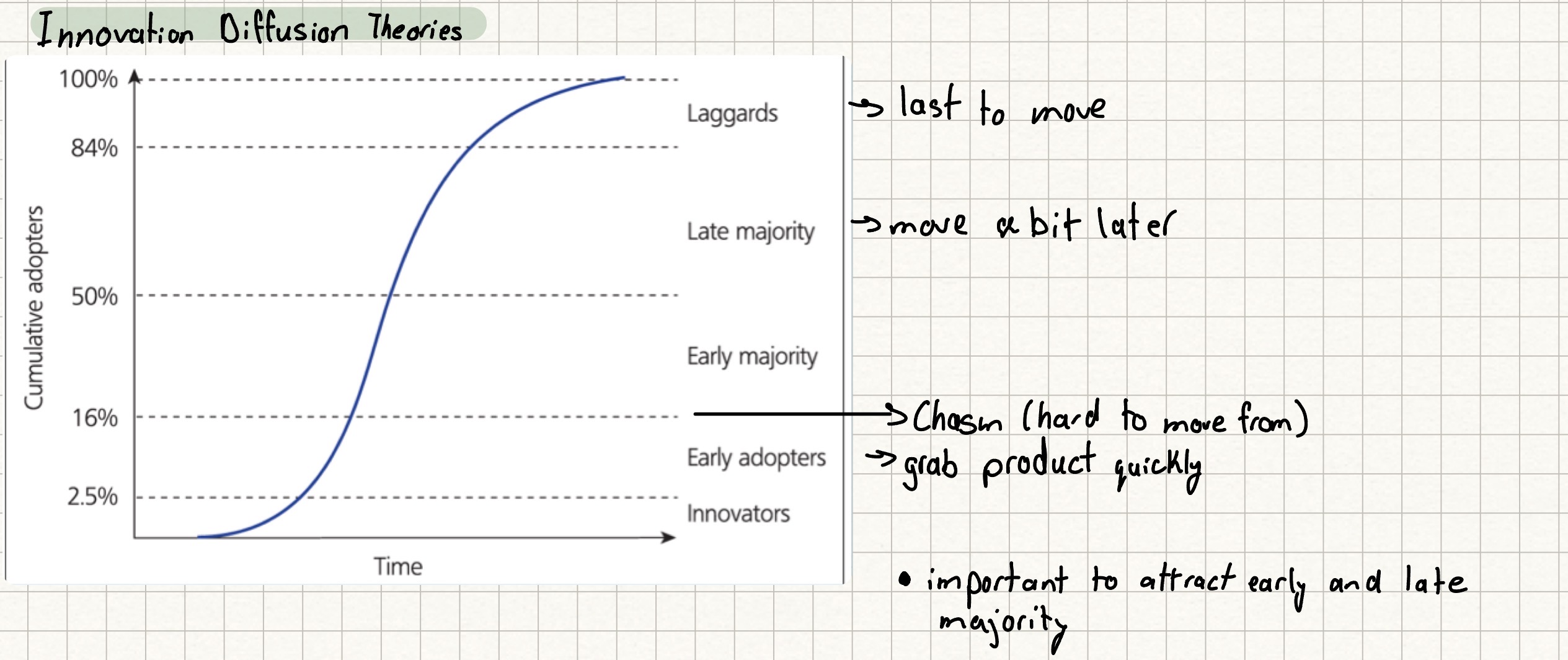
What is the innovation diffusion theory?
You have innovators who move quickly to new products and then you have the laggards that are harder to move
It’s important to attract early and late majority
Chapter 1:
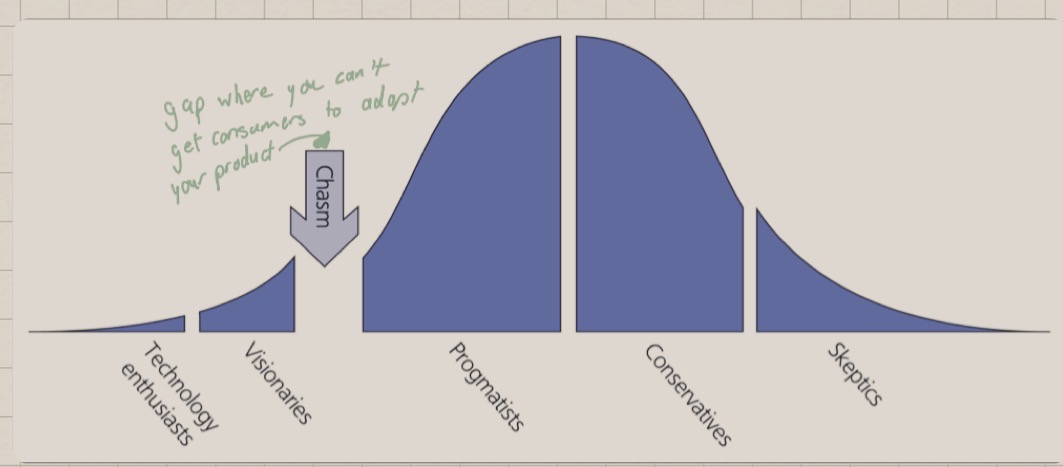
What is the valley of death?
The spot where companies innovations go to die
Chapter 1:
3 tips for crossing the chasm in the valley of death?
1) focus on the product features at the beginning stage
2) when you get to early majority, find a niche
3) be vocal about the customers who act as references
Chapter 1:
What is a SWOT Analysis?
Strengths (internal)
Weaknesses (internal)
Opportunities (external)
Threats (external)
Chapter 2:
What is the curb cut effect?
When you design a product for one intended niche, their are often others who end up benefiting from your product as well
Chapter 2:
What is industry attractiveness?
Micro and macro analysis of the market to determine if it is a good opportunity to invest in
Chapters 3:
What are the 3 types of data?
Primary data - info you get yourself
Secondary data - info you already have
Experimental data - info collected through experiments
Chapter 3:
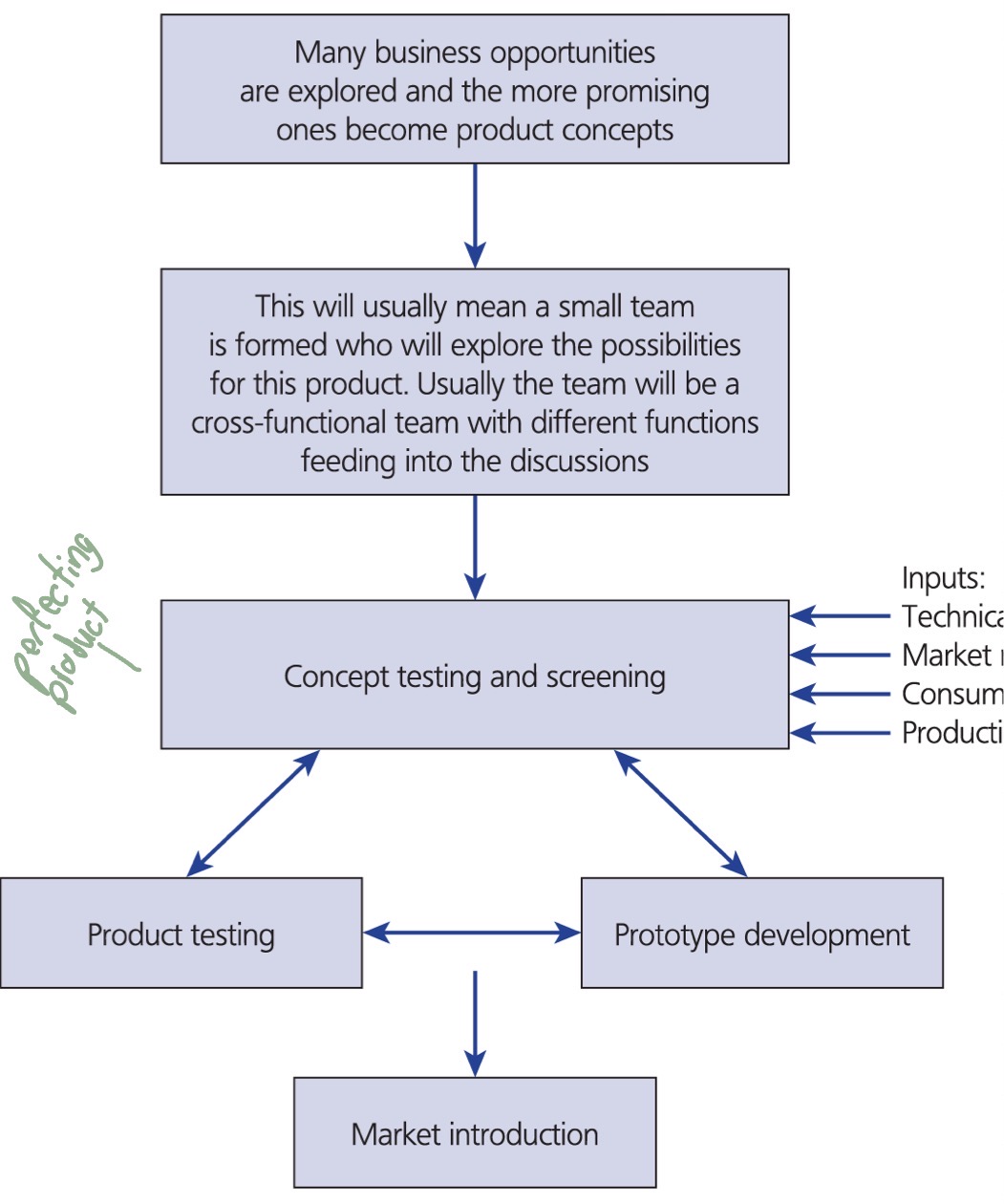
What is an iterative process?
When testing new concepts, their market research info that you collect will inform what customers want in your concept products
Chapter 3:
Why don’t some companies invest in marketing research and still release highly innovative products?
People don’t always know what they want
With disruptive innovation you can’t rely on marketing research as much, more for incremental innovation
Chapter 3:
What are primary market research techniques?
Concept testing
Test centres and mobile shops
Product use tests
Monadic vs paired comparisons
Chapter 3:
What is concept testing?
Bringing new concept of the product
Generate ideas of what it would look like
Ex: Starbucks testing non-dairy options
Chapter 3:
What is test centres and mobile shops?
Customers are brought to a hall or mobile unit and exposed to the product that is being tested
Then asked questions about the product without knowing the company name
Chapter 3:
What is a focus group?
A group of 6-12 people that are brought into a room and asked questions about a product and what they think about it
Chapter 3:
What is product use tests
Business to business settings
Businesses have limited time to test a new product for their operations
Chapter 3:
What is Monadic va. Paired Comparisons?
Monadic tests - consumers are given only one sample then asked their opinion
Paired comparisons - consumers are given 2 samples and asked to compair
Chapter 3:
What are secondary research techniques?
Competitor audits
Industry reports
Public forums
Pop quiz:
What is the most common reasons for failure?
Failure in premise and operations
Pop quiz:
Explain how smoke testing works.
Build a sample landing page that says “buy now” but when clicked it brings you to a launching soon page and to sign up for an email list for the product. This way you have a lost of people who are interested in your product
Pop quiz:
If Starbucks asked you to sample two different new oat lattes they were thinking of launching, what market research method would they be using?
Concept testing
Pop quiz:
Why did the McPlougham burger fail?
No market research was done to see if people would actually like it
Pop quiz:
Give 2 examples of experimental market research data
A/B testing
Smoke testing
Pop quiz:
For what type of innovation is market research a useful endeavor?
Incremental innovation
Pop quiz:
Explain the pros and cons of industry reports vs public forums as a secondary source of information
Pro - credibility
Con - expensive & old data
Pop quiz:
Examples of 3 primary research data
Product testing
Concept testing
Test centres
Pop quiz:
Explain what a competitor audit is
Reviews on a website
Pop quiz:
What is the optimal number of people in a focus group?
6-12
Pop quiz:
Give 2 examples of secondary research data
Industry reports
Competitor Audit
Pop quiz:
Which market research method requires that you rebuild at least 2 different versions of your app or website?
A/B testing
Pop quiz:
Give an example of a product that innovated incrementally through the packaging of their product, rather than the product itself?
Fruit Shoot juice
Pop quiz:
What is the installed base effect?
A barrier that new innovations have to overcome when educating consumers about a radical innovation/technology/product
Ex: keyboard
Chapter 4:
What’s is in a business model?
Value proposition
Market segment
Value chain structure
Revenue streams
Competitive strategy
Chapter 4:
What is the value chain?
A firms activities will capture part of the value that it creates in the chain
Chapter 4:
What is a revenue stream?
All the mechanisms that firms have to bring in revenue
Chapter 4:
What is competitive strategy?
How the company will attempt to develop a sustainable competitive advantage
Chapter 4:
What are the 3 sections of competitive strategy?
Operational excellence - appropriate low costs, lean operations
Customer intimacy - having a great relationship with your customers
Product leadership - extreme focus on high quality products
Chapter 4:
What are the 4 levels of product differentiation?
The core product
The expected product
The augmented product
The potential product
Chapter 4:
What is STP analysis?
Analysis based on:
Segmentation
Targeting
Positioning
Chapter 5:
When should you ask consumers for opinions on your product?
Looking at the fuzzy front end you look at it in:
Ideation ❎
R&D✅
Prototyping ✅
Launching ❎
Post - launch ✅
Chapter 5:
What to do when your product fails on operations or premise?
Listen to your customers and incorporate their feedback into the new version of the product
Chapter 5:
Why is customer feedback important?
It validates whether your product is effectively addressing their needs
It your product east to use?
Is it worth the time, money and effort to customers?
Chapter 6:
Explain elasticity of demand for a product
If high = 1 (Inelastic demand)
Ex: insulin
If low = 0.1 (elastic demand)
Ex: toilet paper
Chapter 6:
What are the 3 C’s of Marketing: Pricing Considerations?
Company - cost of goods, payback for R&D
Customer - customer value
Competition - market share, product features
Chapter 6:
What is Cost Plus Pricing?
Taking fixed and variable costs, then adding a profit margin
Chapter 6:
What is competitive Pricing?
Firms set the price based solely on what their competitors are charging
Ex: gas stations
Chapter 6:
What is value based pricing?
customers are willing to pay a higher price for a good
Ex: Starbucks
Chapter 6:
What is premium pricing?
High price used for a unique brand
No extra benefits in using the product, except brand recognition
High on customer intimacy
Ex: luxury car
Chapter 6:
What is economic pricing?
No-frills pricing strategy to keep cost as low as possible and promote being frugal
Competing using operational excellence strategy
Chapter 6:
What is penetration pricing
The price is set low when it first enters the market then slowly increases as market share increases
Ex: Netflix
Chapter 6:
What is price skimming?
Firms set a high initial price to profit off the earliest adopters, then firms gradually decrease the price
Chapter 6:
What is high-low pricing?
Things always go on sale
Used to trigger the dopamine effect people get when they buy something on sale
Ex: Gap or Old Navy
Chapter 6:
What is Psychological pricing?
Having the price end in $0.99
Makes the customer think they are paying less
$5 or $4.99
Chapter 6:
What is promotional pricing?
Offering coupons and discounts to help move the product along the sales funnel
Intentionally creating scarcity
Chapter 6:
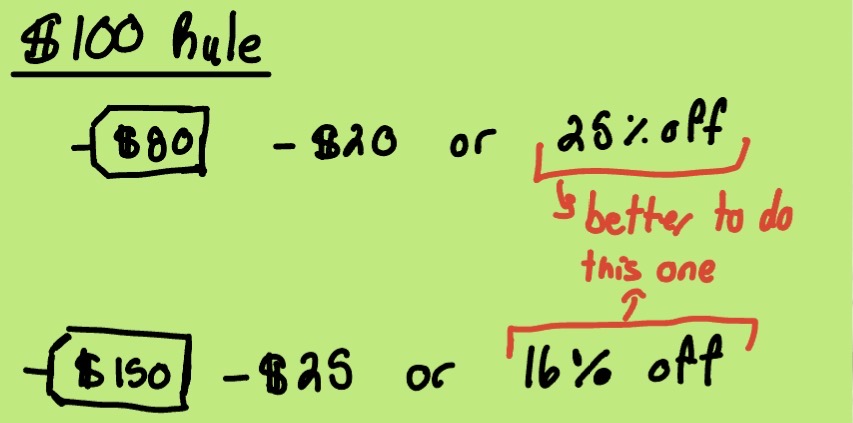
What is the $100 Rule?
Chapter 6:
What is product line pricing?
The pricing ladder that encourages consumer to trade up
Decoy effect - have a second higher option to make the first one appear cheaper
Ex: regular was = 5$ but super wash = 10$
Chapter 6:
What is optional product pricing?
When companies attempt to increase the amount that customers spend once they start to buy
The optional extra products increase the overall transaction price
Ex: snacks and popcorn at a movie theatre
Chapter 6:
What is captive product pricing?
Bait-and-hook revenue
The products have mandatory complements and charge much more for the complement
Ex: printer and ink
Chapter 6:
What is product bundle pricing?
Selling an interesting product that is bundled with less interesting products
Chapter 6:
What is geographic pricing?
Variations in price in different parts of the works
Ex: alcohol
Chapter 6:
What is the Big Mac index?
Purchasing price partly and currency values globally
Ex: a Big Mac costs different prices in different parts of the world
Chapter 6:
What is hourly pricing strategy?
Billing hourly or by the minute based on a persons time
Ex: lawyers or contractors
Chapter 6:
What is the Picasso principle?
Your worth in your field is worth more then the amount of time it took you to complete a project
Ex: a painting took you 5 minutes but it took you 40 years to learn how to paint like that
Chapter 6:
What is project-based pricing?
Flat fee for fixed pricing where a service provider gives a specific rate for a specific project
Chapter 6:
What is freemium pricing?
The base version of something is free but the premium value costs money
Ex: ChatGPT
Chapter 6:
What is subscription pricing?
A subscription that providers the first month free or discounted before charging the initial price
Knowing most people will forget to cancel
Chapter 6:
What is dynamic pricing?
Surge pricing
Price changes depending on demand or time of day
Chapter 6:
What are key metrics for your space tourism company?
Your costs
Competitors
Capabilities
Chapter 7:
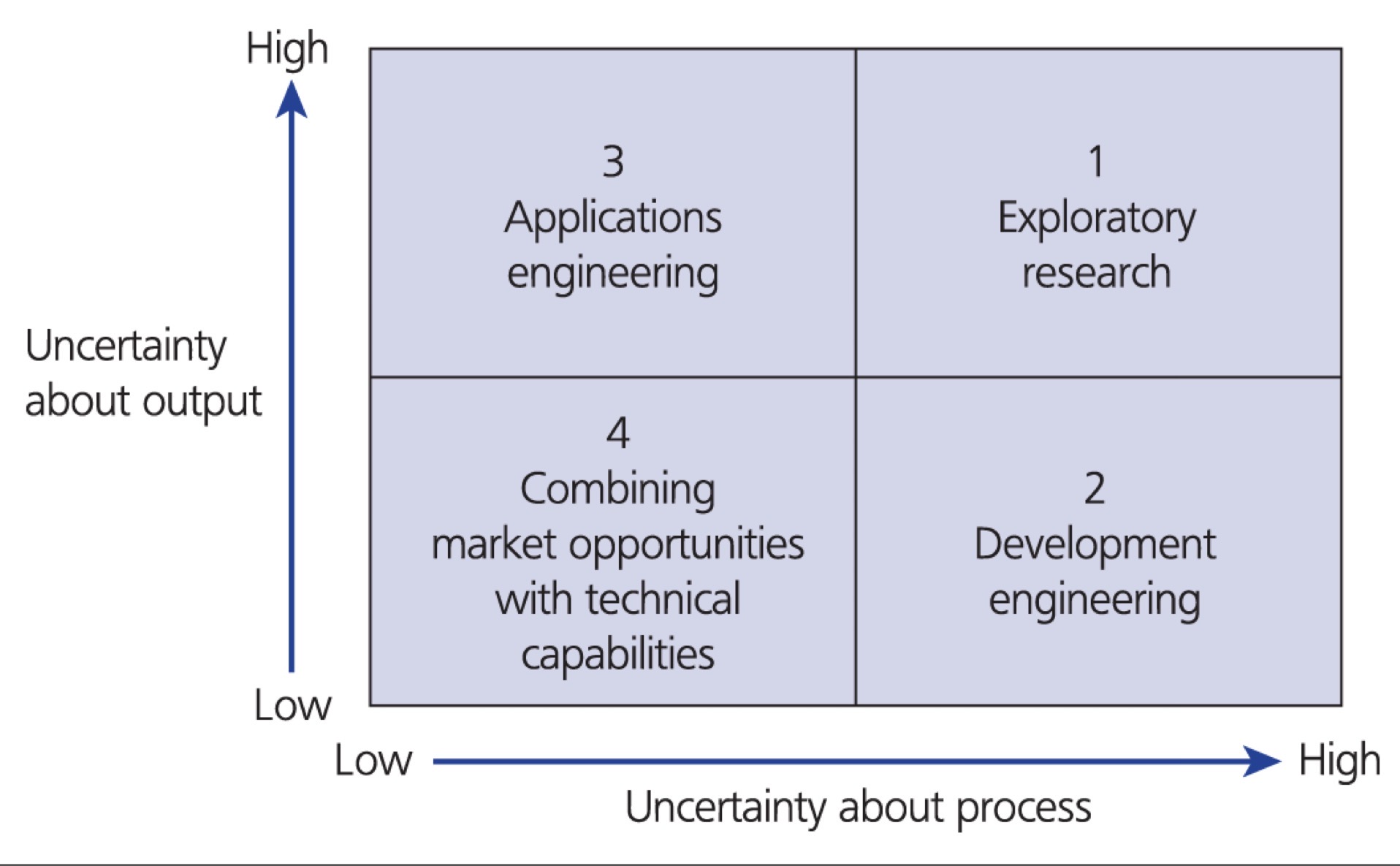
What is the Pearson’s Uncertainty map
1 - don’t know final product or how to get there
2 - know the outcome, but not how to get there
3 - not sure product, but know how to get there
4 - final product and steps are known
Chapter 7:
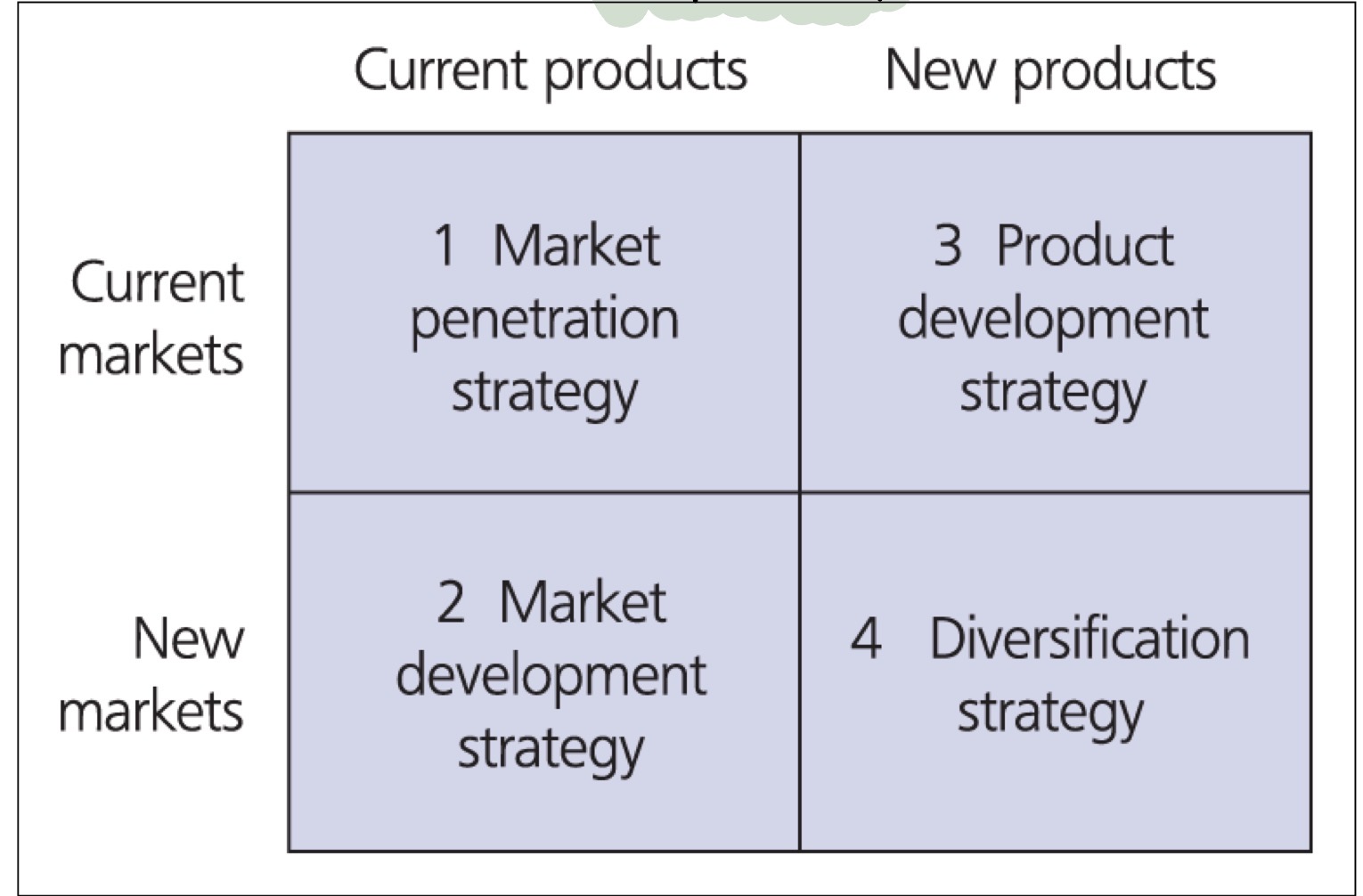
What is the NDP as a strategy for growth?
1 - current product and current markets
2 - current products and new markets
3 - new products in current markets
4 - new products in new markets
Chapter 7:
What is Ansoff’s Matrix?
Show us how growth is possible when current and new products are applied to current and new markers
Chapter 8:
What is a social enterprise?
Mission-driven and financially sustainability
Uses business solutions to tackle social/environmental issues
Chapter 8:
What are social enterprise business models?
Fee-for-service
Cross-compensation
Independent support
Market intermediary
Cooperative
Employment and skill training
Sample exam questions:
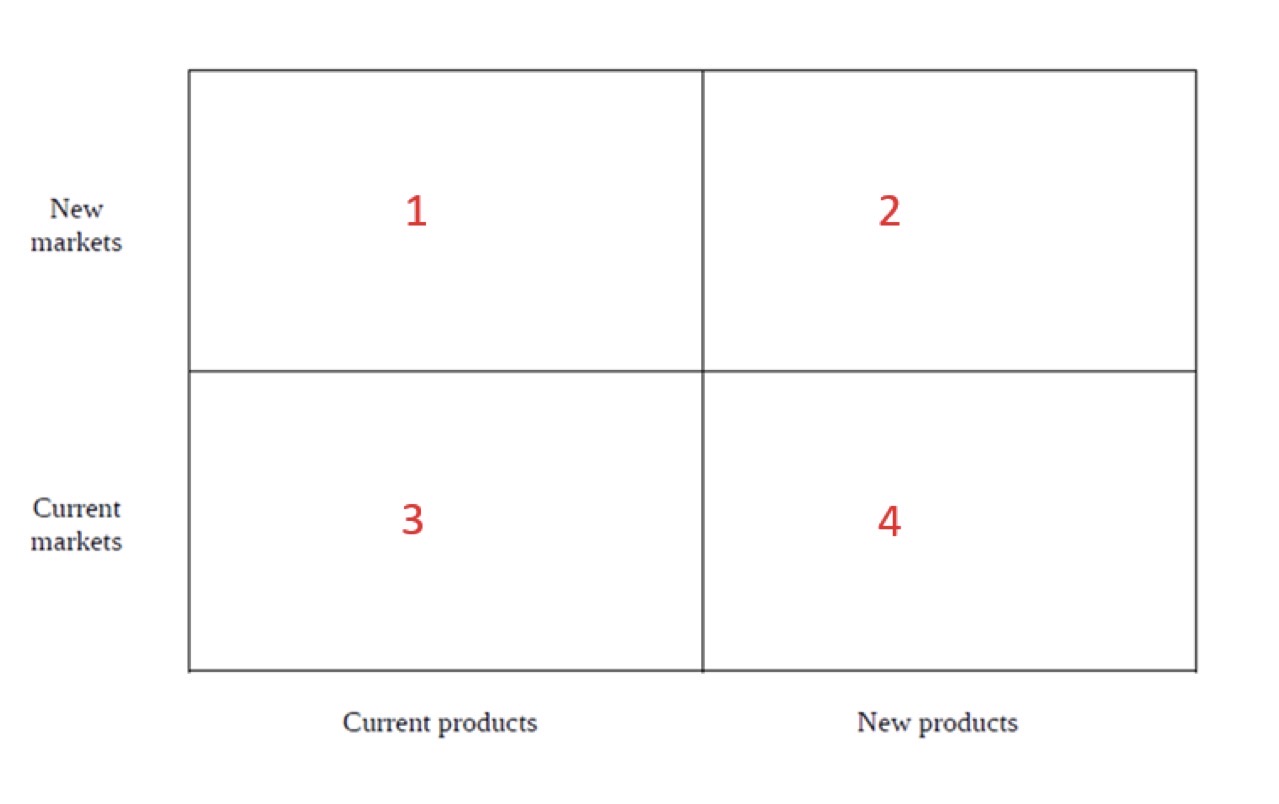
In Ansoff’s Matrix, in which quadrant would one classify the cure for cancer?
A) quadrant 1
B) quadrant 2
C) quadrant 3
D) quadrant 4
E) none of the above
B) quadrant 2
Sample exam question:
How does innovation occur?
A) Serendipity and random chance.
B) After R&D, businesses release new innovations into the marketplace, hoping they catch on.
C) Consumers demand new features, which gets attention from businesses who develop products in response to this demand.
D) There is an endless cycle of feedback between advances in technology, science, etc. and the needs of society that creates push and pull factors between consumers and businesses.
E) All the above are true.
E) All the above are true.
Sample exam question:
The _______________ refers to the competitive advantage that a product gains because many customers already use it, creating barriers to entry for new, innovative technologies.
A) Fuzzy front end
B) Installed base effect
C) Concept test
D) Valley of death
E) None of the above are correct
B) Installed base effect
Sample exam question:
___________ was a product that failed in 2019. In a SWOT analysis, it’s Strengths were its aesthetic appeal and convenience features for users. Its main Weaknesses were privacy concerns for users and a high price (approx. $900). What product was this?
A) Jibo
B) Juicero
C) Google Glass
D) Quibi
E) Apple Newton MessagePad
A) Jibo
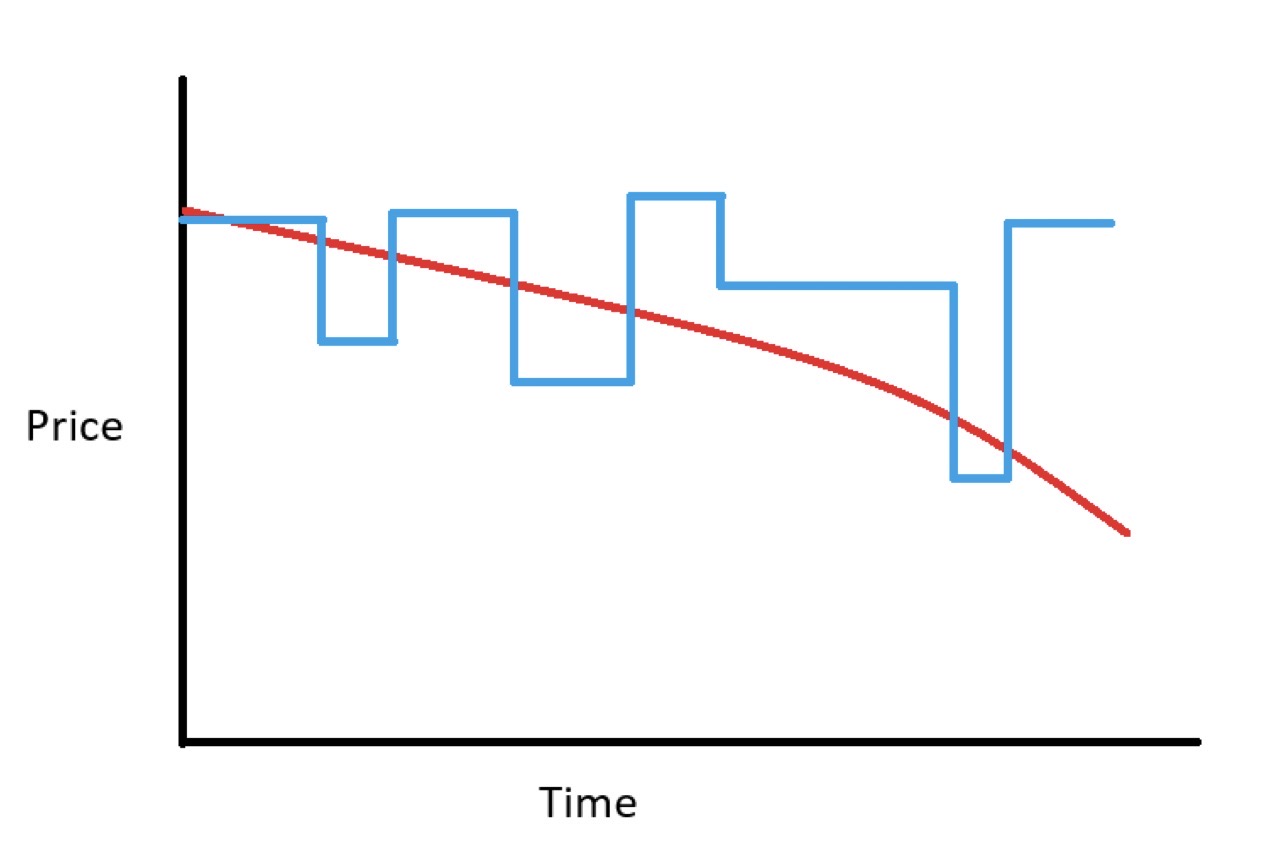
Sample exam question:
Identify the pricing strategies in the graph at right.
A) Value-based and penetration
B) Product line and freemium
C) Dynamic and captive
D) Cost-plus and economy
E) Price skimming and high low
E) price skimming and high low