Comprehensive Genetics: Mapping, Chromosome Architecture, DNA Replication, Transcription, RNA Processing, Translation, and Sequencing Technologies
 Note
 Call Kai
 Learn
 Practice Test
 Spaced Repetition
 Match
 Flashcards
 Knowt Play
1/70

Earn XP
Description and Tags
Vocabulary practice flashcards covering genetic linkage mapping, GWAS, DNA and chromatin architecture, DNA replication, transcription, RNA processing, translation, and DNA sequencing technologies.
71 Terms
Genetic linkage mapping
A mapping approach used to locate causative genetic variation for traits of interest by measuring the recombination frequency between an unknown genomic position producing a phenotype and known genetic or sequence markers.
Variable Number Tandem Repeat (VNTR)
A type of sequence variation consisting of a short DNA sequence repeated several times in tandem, where different alleles vary in repeat number and can be detected by PCR amplification followed by gel electrophoresis.

Single Nucleotide Polymorphism (SNP)
A single base-pair position in genomic DNA at which different sequence alternatives (alleles) exist; in humans, they occur on average once every ∼1200 nucleotides, are predominantly biallelic, and serve as markers of known chromosomal positions.

Polymerase Chain Reaction (PCR)
A technique for amplifying a specific target DNA sequence from a template mixture using complementary oligonucleotide primers that define the amplicon ends, resulting in exponential amplification of 2n target copies after n cycles.
Gel electrophoresis
A method for separating charged molecules, such as DNA, across an agarose or polyacrylamide matrix via an applied electric current, resolving fragments by molecular weight (length in base pairs) and topology, with the smallest, most compact fragments migrating fastest toward the positive pole.
LOD score (log of the odds ratio)
A statistical metric in genetic linkage mapping calculated as lod=log10[P(observing outcome∣unlinked at r=0.5)P(observing outcome∣linked at estimated r)], where a threshold of lod>3 (1000× greater likelihood of linkage) typically indicates statistical significance.
Genome-Wide Association Study (GWAS)
A method for mapping causative genetic variation for complex or polygenic traits across a population of unrelated individuals by statistically testing for associations between the trait and thousands to millions of SNPs at known locations.

Linkage disequilibrium (LD)
The non-random association of alleles at two different loci within a population, occurring when physically close loci rarely undergo crossing over and are inherited together at higher frequencies than expected by chance.

Manhattan plot
A scatter plot used to summarize GWAS findings, displaying genomic chromosome coordinates on the x-axis against −log10(P value) on the y-axis, highlighting statistically significant susceptibility loci that breach thresholds such as P<5×10⁻⁸.
Common disease, common variant hypothesis
The hypothesis underlying GWAS stating that many common polygenic diseases of medical relevance are caused by common genetic variants present at relatively high frequencies throughout the population.
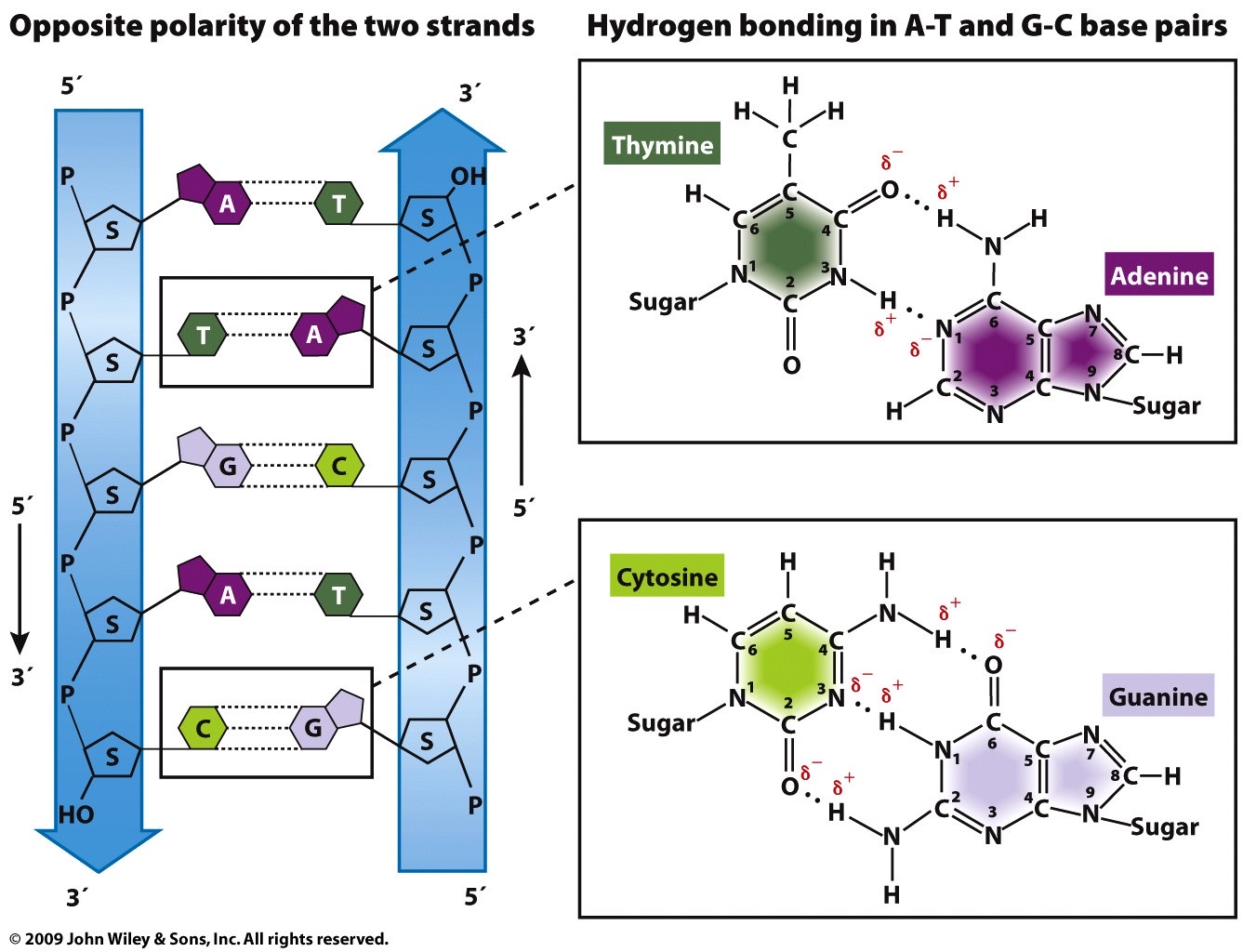
B-form DNA
The predominant in vivo conformation of double-stranded DNA, characterized as a right-handed double helix with regular spacing of 10.5base pairs per helical turn and asymmetrical major and minor grooves.
Major groove
The wider groove of the DNA double helix exposing a distinct pattern of hydrogen bond donors, acceptors, and nonpolar groups for each of the four base pairs, allowing sequence-specific binding proteins like transcription factors to read the sequence without unwinding the helix.
Topoisomers
Molecules of DNA that share the exact same nucleotide sequence but differ in their linking number, or the number of times one strand winds around the helical axis, occurring exclusively in topologically constrained DNA.

Supercoiled DNA
A topologically strained form of DNA that is either overwound (positively supercoiled, >1turn per 10.5bp) or underwound (negatively supercoiled, <1turn per 10.5bp); most living organisms store their genomic DNA in a negatively supercoiled state.
Fluorescence in situ hybridization (FISH)
A molecular cytogenetic technique utilizing fluorescently labeled single-stranded nucleic acid probes that hybridize to complementary sequences within cells or on chromosomes to visualize their specific physical location.

Chromosome territories
Specific, non-overlapping spatial domains within the interphase nucleus occupied by individual, decondensed eukaryotic chromosomes.
Centromere
A specialized, constricted chromosomal region that serves as the attachment site for spindle fibers during cell division and separates a chromosome into a short (p) arm and a long (q) arm.
Heterochromatin
Highly condensed, transcriptionally inactive chromatin that stains darkly on cytogenetic maps, often localized at centromeres and telomeres.
Euchromatin
Less condensed, transcriptionally active chromatin that stains lightly in cytogenetic banding patterns and contains the majority of active genes.
Nucleosome core particle
The fundamental repeating structural unit of chromatin, composed of an octamer of basic histone proteins (two copies each of H2A, H2B, H3, and H4) wrapped by 146base pairs of DNA in a 1.65-turn superhelix.
Histone H1
A basic linker histone that binds to the linker DNA (30–50base pairs in mammals) and nucleosome exterior, acting as a clamp that facilitates compaction of the 10-nm 'beads-on-a-string' fiber into the 30-nm solenoid fiber.

Solenoid (30-nm fiber)
A higher-order chromatin structure formed when the 10-nm nucleosome fiber coils into a spiral or solenoid filament with a diameter of approximately 30–34nm, dependent upon the presence of histone H1.
Scaffold proteins
A network of non-histone proteins that anchor looped chromatin loops (300-nm fibers) to maintain the structural architecture and compact morphology of metaphase chromosomes.
Position effect
The alteration of gene expression levels caused by moving a gene to a different genomic neighborhood with an altered chromatin condensation status, exemplified by variegated eye color in Drosophila when the white gene is relocated near centromeric heterochromatin.

Terminal deletion
A chromosomal aberration resulting from a single break in a chromosome that causes the detachment and loss of an acentric terminal fragment containing the telomere, as seen in cri-du-chat syndrome.
Paracentric inversion
A structural chromosomal mutation in which a segment of DNA is flipped 180∘ without including the centromere, located entirely within one chromosomal arm.
Pericentric inversion
A structural chromosomal aberration where a segment of DNA is inverted 180∘ and spans across the centromere, involving breakages in both the short (p) and long (q) arms.

Inversion loop
A characteristic looping configuration formed during synapsis in prophase I of meiosis in an inversion heterozygote, allowing homologous regions of the inverted and non-inverted chromosomes to pair.

Robertsonian translocation
The most common chromosomal rearrangement in humans (∼1 in 800 live births), wherein the long arms of two acrocentric chromosomes (such as chromosomes 13 and 14) fuse at a repetitive hotspot (e.g., SST1), leaving an individual with 45 chromosomes.
Synteny
The conserved order and physical linkage of homologous genes along chromosomal segments across two or more different species, inherited from a common ancestor.
Aneuploidy
A numerical chromosome abnormality characterized by an atypical chromosome count that is not an exact multiple of the basic haploid set (e.g., monosomy or trisomy), resulting from nondisjunction during cell division.

Polyploidy
A condition in which an organism possesses three or more complete sets of chromosomes (3n, 4n, 6n, etc.); it can arise within a single species (autopolyploidy) or via cross-species hybridization followed by nondisjunction (allopolyploidy).

Semiconservative replication
The biological mechanism of DNA duplication in which the two parental strands unwind, each serving as an intact template for synthesizing a new complementary daughter strand, producing two molecules each with one parental and one new strand.

DNA polymerization reaction
The enzyme-catalyzed reaction where the terminal 3′-OH group of a growing primer or strand mounts a nucleophilic attack on the α-phosphoryl group of an incoming dNTP, creating a phosphodiester bond and releasing inorganic pyrophosphate (PPi).

Kinetic selectivity
The catalytic property of DNA polymerases whereby phosphodiester bond formation proceeds markedly faster when the incoming dNTP correctly base pairs with the template, resulting in an initial mismatch incorporation rate of only ∼1 in 105.

3′→5′ exonuclease activity
The proofreading domain of replicative DNA polymerases (such as bacterial DNA Pol I and Pol III) that hydrolyzes and removes mispaired nucleotides from the 3′ end of the nascent chain, reducing the error rate to ∼1 in 109.

OriC
The approximately 245bp replication origin in Escherichia coli, comprising three AT-rich 13-mer consensus tandem repeats where strand opening begins and four 9-mer consensus repeats recognized and bound by DnaA.
DnaA
The bacterial initiator protein that specifically binds to the 9-mer consensus arrays in OriC, oligomerizing to bend the DNA duplex and induce strand unwinding at the adjacent AT-rich 13-mer array.
Single-Stranded Binding Protein (SSB)
A protein that binds cooperatively to exposed single-stranded DNA during replication to prevent hairpins and re-annealing of the parental strands.
DNA primase (DnaG)
A bacterial RNA polymerase that synthesizes short RNA primers de novo on single-stranded template DNA, providing free 3′-OH groups needed by DNA polymerases.
DNA Polymerase III
The primary multisubunit replicative enzyme in E. coli responsible for elongating leading and lagging strands via 5′→3′ synthesis, achieving high processivity via association with the sliding clamp.
Okazaki fragments
Short, discontinuously synthesized DNA fragments produced on the lagging template strand during replication, each initiated with an RNA primer and elongated in the 5′→3′ direction.

DNA Polymerase I
A single-polypeptide bacterial enzyme possessing 5′→3′ polymerase, 3′→5′ proofreading exonuclease, and unique 5′→3′ exonuclease activity, which removes RNA primers and replaces them with deoxyribonucleotides.
DNA ligase
An enzyme that seals single-stranded nicks in double-stranded DNA by catalyzing phosphodiester bond formation between adjacent 3′-OH and 5′-phosphate groups, joining Okazaki fragments together.
Telomerase
A ribonucleoprotein reverse transcriptase enzyme that elongates the 3′ ends of eukaryotic parental strands at telomeres using an internal RNA template component, solving the end replication problem in germ cells and stem cells.
T-loop
A protective loop structure at the terminus of linear eukaryotic chromosomes formed by the single-stranded 3′ telomeric overhang invading the double strand, stabilized by the shelterin protein complex to guard chromosome ends from DNA damage pathways.

Sigma (σ) subunit
A bacterial transcription initiation factor that associates with the RNA polymerase core enzyme to form the holoenzyme, conferring sequence-specific binding to the −35 and −10 promoter consensus elements.

Intrinsic termination
A bacterial transcription termination mechanism that occurs without protein factors, driven by an inverted repeat that forms an RNA hairpin followed by a run of uracils, stalling RNA Pol and destabilizing the weak A-U hybrid duplex.
Rho-dependent termination
A prokaryotic transcription termination mechanism in which the hexameric Rho RNA helicase binds a cytosine-rich rut sequence on the nascent transcript, translocates toward stalled RNA polymerase, and unwinds the RNA-DNA hybrid.

TATA box
A conserved eukaryotic core promoter cis-regulatory element located around −25 to −30bp upstream of the transcription start site, recognized and bound by the TATA-binding protein (TBP) subunit of TFIID.
Pre-Initiation Complex (PIC)
The assembly of RNA Polymerase II and general transcription factors (TFIID, TFIIA, TFIIB, TFIIF, TFIIE, and TFIIH) at eukaryotic core promoters required for promoter melting and transcription initiation.
Electrophoretic Mobility Shift Assay (EMSA)
A laboratory method, also called a band shift assay, used to detect sequence-specific DNA-protein interactions based on the slower migration of protein-bound DNA fragments through a native gel compared to free DNA.

RT-PCR (Reverse Transcriptase PCR)
A gene expression assay where reverse transcriptase converts an RNA template into complementary DNA (cDNA), which is subsequently amplified by PCR to detect and quantify specific transcript levels.

RNA-Seq
A high-throughput next-generation sequencing approach that sequences fragmented cDNA libraries to profile, map, and quantitatively measure the entire transcriptome of a biological sample.

5′ 7-methylguanosine (7mG) cap
A modified guanine nucleotide added via an unusual 5′–5′ triphosphate linkage to the 5′ end of eukaryotic pre-mRNA, required for nuclear export, transcript stability, and ribosome recruitment.

Polyadenylation
The post-transcriptional process in eukaryotes where pre-mRNA is endonucleolytically cleaved downstream of an AAUAAA signal and extended by poly-A polymerase with an unencoded stretch of 30–200 adenines to promote translation and mRNA stability.
Spliceosome
A large nuclear ribonucleoprotein complex composed of five small nuclear ribonucleoproteins (snRNPs: U1, U2, U4, U5, U6) that catalyzes the precise excision of introns and ligation of exons from eukaryotic pre-mRNA.

Lariat intron
The excised intron intermediate formed during pre-mRNA splicing when the 5′-phosphate of the intron forms an atypical 2′–5′ phosphodiester bond with the 2′-OH of an internal branch point adenosine.
Alternative splicing
A regulatory mechanism in eukaryotes in which different combinations of splice sites are utilized within a primary transcript to generate multiple distinct mature mRNAs and protein isoforms from a single gene.

Peptide bond
A covalent amide bond formed via a condensation reaction between the carboxyl group of one amino acid and the amino group of another, establishing a polypeptide backbone synthesized in the N→C direction.

Alpha (α) helix
A common protein secondary structure characterized by a right-handed spiral coil stabilized by hydrogen bonds between the backbone carbonyl oxygen of amino acid n and the amide hydrogen of amino acid n+4, with side chains projecting outward.

Aminoacyl-tRNA synthetase
An enzyme family responsible for charging each tRNA by covalently coupling the appropriate amino acid to the 3′-OH of the tRNA acceptor stem, functioning as the primary molecular interpreter of the genetic code.

Shine-Dalgarno sequence
A purine-rich bacterial mRNA cis-element situated upstream of the start codon that pairs with a complementary sequence in the 16S rRNA of the small ribosomal subunit to align the ribosome on the initiation site.
Kozak consensus sequence
The consensus sequence surrounding the AUG start codon in eukaryotic mRNA that is recognized by the scanning small ribosomal subunit and initiation factor complex to designate the precise site of translation initiation.

EF-Tu
A bacterial translation elongation factor that binds GTP and aminoacyl-tRNA, facilitating delivery of the correct charged tRNA to the ribosomal A site and hydrolyzing GTP prior to peptide bond synthesis.
EF-G
A prokaryotic elongation factor that uses GTP hydrolysis to drive ribosomal translocation, advancing the mRNA and shifting deacylated and peptidyl-tRNAs through the A, P, and E sites.

Release Factor 1 (RF-1)
A bacterial translation termination protein that specifically recognizes UAA and UAG stop codons in the ribosomal A site, activating ester bond cleavage between the completed polypeptide and the P-site tRNA.
Wobble hypothesis
The principle stating that non-Watson-Crick base-pairing is permitted at the 3′ position of a codon and the 5′ position of a tRNA anticodon, enabling a single tRNA species to recognize multiple synonymous codons.

Sanger sequencing
A low-throughput, enzymatic chain-termination sequencing method utilizing DNA polymerase, dNTPs, and low concentrations of fluorophore-labeled dideoxynucleotides (ddNTPs) that terminate elongation due to the lack of a 3′-OH group.

Reversible terminator sequencing
A next-generation sequencing-by-synthesis method (such as Illumina) where all four dNTPs carry distinct cleavable fluorescent tags and a chemically reversible 3′-OH blocking group, enabling massively parallel single-base addition and imaging cycles.
Third-generation sequencing
Single-molecule, long-read sequencing technologies (such as PacBio SMRT and Oxford Nanopore) capable of generating reads of 104 to 106nucleotides, which span complex repetitive regions and large structural chromosomal rearrangements without prior PCR amplification.