bio 2 - ch 36 climate and biosphere (post)
 Call Kai
 Learn
Learn Practice Test
 Spaced Repetition
 Match
Match Flashcards
 Knowt Play
1/70

There's no tags or description
Looks like no tags are added yet.
Name | Mastery | Learn | Test | Matching | Spaced | Call with Kai |
|---|
No analytics yet
Send a link to your students to track their progress
71 Terms
climate
prevailing weather conditions in a particular region
dictated by temp and rain which are influenced by: variations in solar radiation, topography and proximity to water
topography
the physical features or “the lay” of the land
ie mountains
biome
a particular mix of plants and animals that are adapted to living within a specific range of environmental conditions in a given area
characterized by climate and geography
defined by mean annual temperature and mean annual precipitation
terrestrial ecosystems
Distribution of the biomes and their corresponding communities of organisms is determined by three things
differences in climate
water
defining topographical features
biomes change with altitude and latitude due to temp
tundra biome
permafrost
very cold and dark most of the year—short growing season, precipitation is minimal
vegetation for short growing season
lichens, short grasses, mosses, dwarf shrubs
animals - few live all year round
where is the tundra biome found?
encircles the arctic region just south of the ice covered polar seas in the Northern Hemisphere and covers about 10% of Earth’s land surface
animals that live in a tundra
Ptarmigans, musk ox, migratory birds, caribou, reindeer, and wolves
permafrost - tundra biome
is the layer below the topmost layer of Earth that is always frozen
prevents water drainage; bogs and pools form in the summer
pattern of biome distribution
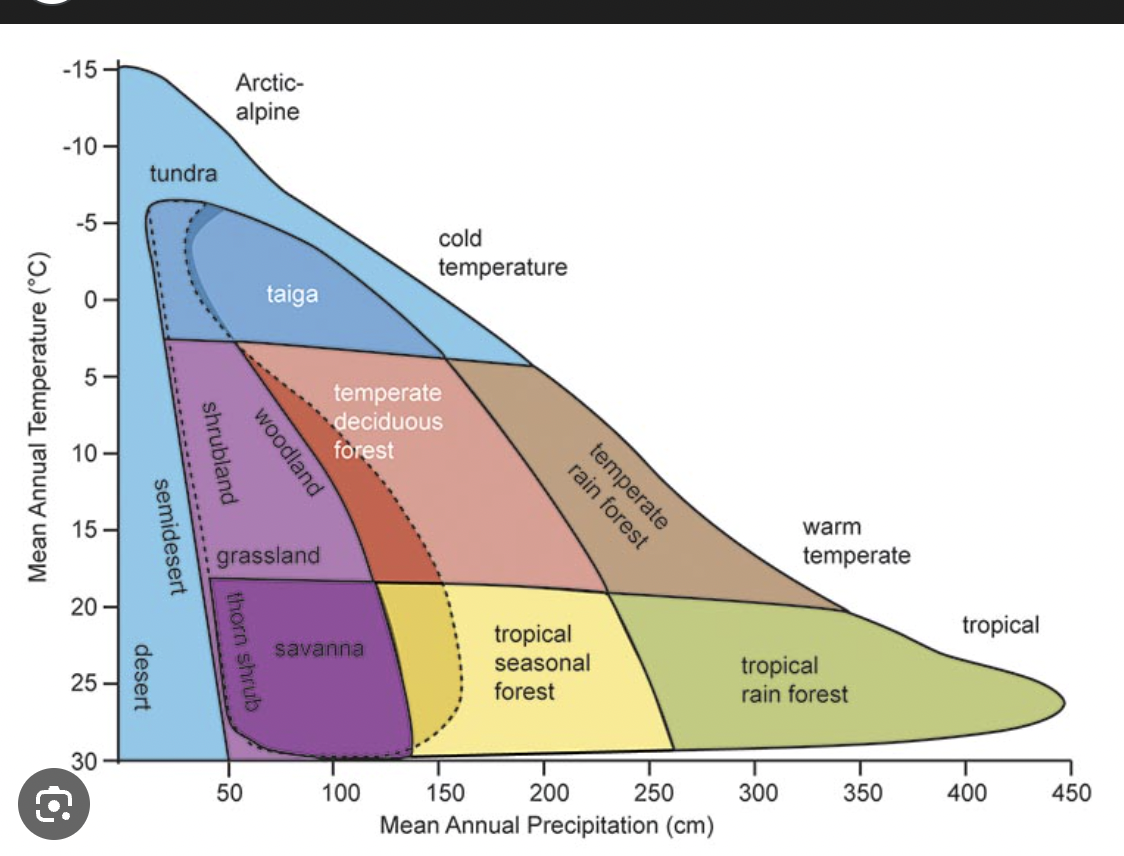
coniferous forests
they have long, cold, snowy winters with warm and humid summers
temperate rain forests
taiga
montane ___ forests
where are coniferous forests found
in the taiga and montane along the Pacific coast of NA as far south as northern CA
montane coniferous forests
a second location of coniferous forest biome
•Near mountaintops just above deciduous forest
•Wolverine and mountain lion in montane coniferous forest
taiga - coniferous forests
have the cone bearing trees like spruce, fir, and pine - well adapted to the cold
animals that live near lakes and streams: Bears, deer, moose, beavers, muskrats, wolves, birds
where can taiga coniferous forests be found?
in the northern part of NA and Eurasia
temperate rainforest - coniferous forests
Plentiful rainfall
rich soil
have some of the tallest conifer trees
Coastal redwoods
Small sections are considered
Mosses and ferns grow on tree trunks
where can temperate rainforest - coniferous forests be found?
found on the western coast of the United States and Canada
temperate deciduous forest
moderate climate with high rainfail
well defined seasons
tress like oak, beec, and maple
tall ones form canopy
understory trees - ones just below tallest ones
fruit , nuts, and berries
lichens and ferns
lots of ground animals and amphibians and reptiles
where can temperate deciduous forests be found?
found south of the taiga in eastern NA, eastern Asia, and much of Europe
where can tropical rain forests be found?
found in areas of SA, Africa, and the Indo-Malayan region
tropical rain forest
most common type of tropical forests
lots of rain
uniformly warm
lots of species diversity
complex structure with many levels of life
densely populated
insects, tree dwellers, birds, amphibians, reptiles, primates, and carinvores
epiphytes
plants that grow on other plants
Have own roots and absorb materials from canopy
soil in tropical forests
Soil is not as rich as that of temperate deciduous forest
•Nutrients rapidly recycled
•Removing trees for agriculture causes erosion
shrublands
tend to occur along coasts that have dry summers and receive most of their rainfall during the winter
lots of shrubs that are small with thick evergreen leaves coated with a waxy material to prevent loss of moisture
withstand arid conditions
regrow after fires quickly
heat needed for some seed germination
chaparral - shrub in Mediterranean shrubland, Cali, South Africa, and Australia
animals: include coyotes, jackrabbits, lizards, deer, roadrunners, gophers, and other rodents
grassland
enough rain for grass but not for forests but too much for desserts
have crops like wheat, corn, and soybeans - natural ones have declined as such
includes temperate grasslands and savannas
well adapted to changing environments
can handle some grazing, flooding, drought, and fire
grass growth is seasonal
in areas with more rainfall there can be tall grass but if not its short
temperate grasslands
includes: russian steppes, american pampas, and NA prairies
•Bison and pronghorn antelope once were abundant in prairies
•Now, mice, prairie dogs, and rabbits typically live below ground
•Aboveground, hawks, snakes, badgers, coyotes, and foxes feed on the smaller animals
savannas - type of grassland
grassland with some trees
relatively cool, dry season followed by a hot and rainy season
acacia
african savanna
variety in big herbivores
carnivores
acacia
a typical savanna tree, sheds its leaves during the dry season
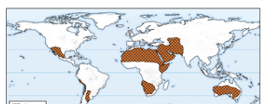
desert
usually found at latitude of about 30 degrees in both hemispheres (N and S)
days are hot because of little clouds cover but nights are cold because heat escapes to the atmosphere easily
some have wet periods and dry periods
some have vegetation
Succulent, spiny cacti and nonsucculent woody shrubs (sagebrush and ocotillo)
Exception: The Sahara has little or no vegetation
animals in the desert
•Many are nocturnal, to avoid heat
•Reptiles and insects have waterproof outer coverings to conserve water
•Insects may pass through all stages of development while there is rain
•Reptiles and snakes are typical desert vertebrates
Other animals include some running birds, rodents, coyotes, and hawks
What are the two types of aquatic ecosystems?
freshwater (inland) ie lakes
saltwater (marine) ie oceans
what is brackish water?
a mix of fresh and salt water - coastal ecosystems
mountain streams and riveres
are bodies of freshwater found in high elevations.
Frozen precipitation at high elevations melts and flows down toward the sea
Cold and tend to be low in nutrients and biodiversity
As the water makes its way to lower elevations, it accumulates nutrients and becomes warmer
Species: mayflies and trout
lakes
fresh water
Classified by nutrient abundance
Oligotrophic (nutrient-poor) lakes—small amounts of organic matter
Low productivity
Eutrophic (nutrient-rich) lakes—plentiful amounts of organic matter
High productivity due to location near nutrient-rich regions
May be enriched by agricultural or urban runoff
Eutrophication can be caused by large inputs of nutrients
deep lakes in the summer
•the surface layer that is warmed (24°–25°C) due to solar radiation and is less dense
•Thermocline—the middle layer decreases 1°C per meter of depth
•Hypolimnion—the cold, lowest layer (5°–8°C)
*the differnces in temp prevent “mixing”
fall overturn in lakes
Upper epilimnion becomes cooler than hypolimnion
Surface water sinks and deep water rises
This continues until the temperature is uniform throughout the lake
Wind assists water circulation, so mixing occurs
In winter, floating ice prevents further water cooling below, which stays at 4°C
Aquatic organisms can live through the winter
spring overturn in lakes
As ice melts, cooler water on top sinks below warmer water
This continues until the temperature is uniform throughout lake
Winds aid in circulation and mixing
As surface waters absorb solar radiation, thermal stratification occurs by summer
lakes influence on seasonal distribution of fish and other aquatic life
caused by vertical stratification and seasonal change of temperatures in a lake basin
Cold-water fishes move to the deeper water in summer, upper water in winter
Phytoplankton growth at the surface is most abundant after mixing
Phytoplankton use up nutrients in epilimnion during the summer and release oxygen
Decomposition in hypolimnion uses up oxygen and releases nutrients
wetlands
areas that hold some amount of water during part of the year; classified by their vegetation
marshes
•Frequently or continually inundated by water
•Rushes, reeds, and other grasses provide excellent habitats for waterfowl and small mammals.
•One of the most productive ecosystems on Earth
swamps
Dominated by either woody plants or shrubs
•Common swamp trees include cypress, red maple, and tupelo.
The American alligator is a top predator
bogs
Characterized by acidic waters, peat deposits, and sphagnum moss
They receive most of their water from precipitation and are nutrient-poor
•Cranberries, orchids, and insectivorous plants such as Venus flytraps and pitcher plants
Moose in northern USA and Canada
wetlands and their value
purify waters by filtering them and by diluting and breaking down toxic wastes and excess nutrients
absorb storm waters and overflow from lakes and rivers, protecting farms, cities, and towns from the devastating effects of floods
Humans have historically channeled and diverted rivers and filled in wetlands → hurt ecosystems
life zones
used for lakes and ponds
littoral zone
limnetic zone
profundal zone
benthic zone
littoral zone - life zones
shallow edge zone of a pond or a lake
•Aquatic plants rooted; microscopic organisms cling to plants and to rocks; insect larvae
limnet zone - life zones
open water, lit by sunlight
•Fishes, plankton (microscopic phytoplankton and zooplankton), water striders (surface)
profundal zone - life zones
deep, dark water
•Zooplankton, fishes, insect larvae, pike predators
bethnic zone - life zones
lake bottom
•Includes the benthos: crayfishes, snails, clams, worms, insect larvae
estuary
a partially enclosed body of water where fresh and saltwater mix
Abundance of nutrients, but rapid changes in salinity
Feeding grounds of many birds, fishes, shellfishes
“nurseries” → Half of all marine fish mature in estuaries
types of estuaries
Coastal bays, tidal marshes, fjords, some deltas, and lagoons
Associated with salt marshes, mudflats, mangroves
seashores
Rocky or sandy and are constantly bombarded by the sea
littoral zone
littoral zone of seashores
between high and low tidal marks— divided into three zones
upper portion of littoral zone of seashores
barnacles are attached tightly to stone
midportion of littoral zone of seashores
brown algae known as rockweed may overlie the barnacles
lower portion of littoral zone of seashores
oysters and mussels are attached to the rocks by filaments
Limpets and periwinkles
below littoral zone of seashore
macroscopic seaweeds anchor to the rocks
Animals that live on sandy shores cannot attach to shifting and unstable surfaces → bury themselves
Some remain underground, others surface at night to feed
Ghost crabs and sandhoppers feed at night at low tide
Sandworms and sand (ghost) shrimp remain within the burrows and feed on detritus
oceans
Have a major role in redistributing heat in the biosphere
Air takes on the temperature of the water below, and then warm air moves from the equator to the poles
Influence the wind patterns
oceans in the Northern Hemisphere
currents circulate clockwise
moves warm water from equator to poles
The Gulf Stream brings tropical Caribbean water to the east coast of North America and higher latitudes of western Europe
Without the Gulf Stream, Great Britain would be as cold as Greenland
oceans in the Southern Hemisphere
Currents circulate counterclockwise
The Humboldt Current circulates cold, nutrient-rich water northward along the West Coast of South America
An upwelling occurs when cold offshore winds cause nutrient-rich waters to rise and take the place of warm, nutrient-depleted water
Waters enriched by upwelling support fisheries of Peru and Chile
When the Humboldt Current is not as cool, stagnation occurs, and fisheries decline
pelagic division
Organisms in the open waters of the ocean can be classified in this division and in provinces
Neritic province—shallow waters over continental shelf
Oceanic province—open water, several depth zones
neritic province - pelagic division
Abundant sunlight and inorganic nutrients allow a large concentration of organisms
•Phytoplankton provide food for zooplankton and small fishes
The small fishes are food for larger fishes
coral reefs
coral reefs
areas of high biological abundance in shallow, nutrient-poor, tropical waters
They include calcareous red and green algae and colonies of stony corals
Many corals contain symbiotic zooxanthellae
coral reefs populations - pelagic division
The crevices and caves provide shelter for filter feeders (sponges, sea squirts) and scavengers (crabs and sea urchins).
Many small fishes live there; some feed directly on corals, others feed on plankton or detritus.
Larger fishes, such as snapper, feed on smaller fishes.
Top predator fishes include the shark, barracuda, and moray eel.
oceanic province - pelagic division
This province lacks the inorganic nutrients of the neritic province, but sunlight is available.
•Has a lower concentration of phytoplankton
epipelagic zone
mesopelagic zone
bathypelagic zone
epipelagic zone of oceanic province in pelagic division
photosynthesizers are eaten by zooplankton, which are eaten by herring and bluefishes, which are, eaten by larger mackerels, tunas, and sharks
•Whales and other mammals also occur here
mesopelagic zone of oceanic province in pelagic division
carnivores such as squids and lantern fishes
bathypelagic zone of oceanic province in pelagic division
complete darkness
•Carnivores and scavengers
benthic division
includes organisms that live in or on the oceanic soil
sublittoral zone
bathyal zone
abyssal zone
sublittoral zone of benthic division
continental shelf
•Seaweed, algae, clams, worms, crabs, sea stars
bathyal zone of benthic division
continental slope underwater - seafloor
high pressure and low temps in total darkness
Organisms depend on detritus that falls from above
sponges, echinoids, sea stars all adapted to scarce food and muddy sediments
abyssal zone zone of benthic division
abyssal plain
High pressure and cold water
Many invertebrates live at soil-water interface
•Sea lilies, sea cucumbers, tube worms
oceanic ridges in abyssal plain - benthic division
Along axes of the ridges, crustal plates spread apart.
•Molten magma from Earth’s core rises.
Seawater percolates through hydrothermal vents.
Seawater is heated, causing sulfate to react with water and form hydrogen sulfide (H2S).
Free-living or mutualistic chemoautotrophic bacteria use electrons from (H2S) to reduce bicarbonate to organic compounds to support this ecosystem.
•Includes huge tube worms and clams