applied themes in ageing
 Call Kai
 Learn
Learn Practice Test
 Spaced Repetition
 Match
Match Flashcards
 Knowt Play
1/37

There's no tags or description
Looks like no tags are added yet.
Name | Mastery | Learn | Test | Matching | Spaced | Call with Kai |
|---|
No analytics yet
Send a link to your students to track their progress
38 Terms
what is the main theoretical reasoning behind completing mental exercise
WM capacity constrains a wide range of cognitive functions, including fluid intelligence → expanding WM capacity should also benefit the cognitive functions that it constrains
what is a problem with the theoretical reasoning behind completing mental exercise
though WM abilities are correlated with other cognitive functions, this doesn’t mean there is a causal link between them → we need to therefore investigate whether general cognitive function can directly be improved through WM training
how did Singh-Manoux et al. (2003) assess levels of mental exercise day-to-day
gave participants a battery of cognitive tasks, as well as asking participants what leisure activities they participated in - these were categorised as either low cognitive effort (e.g. going to pub/gardening) or high cognitive effort (e.g. reading)
what were the results of Singh-Manoux et al. (2003)’s study + what did it control for
found stronger positive correlations between high cognitive leisure activities + cognitive ability, compared to correlations between low cognitive effort leisure + ability
this held even when controlling for SES, age + education → suggests regular cognitive effort is associated with better cognitive outcomes
what two hypotheses on mental exercise outcomes on ageing does Salthouse (2006) put forward
differential preservation hypothesis
preserved differentiation hypothesis
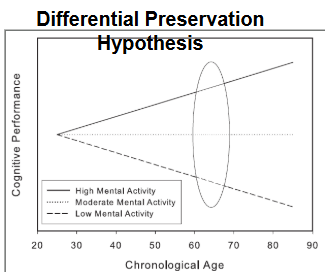
what is the differential preservation hypothesis
mental activity is a factor that protects against age-related decline in mental ability → this suggests that everyone starts a the same level, then engaging in high-effort cognitive activities causes cognitive functioning to increase + vice-versa
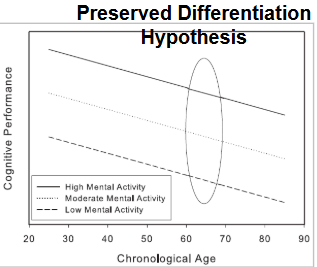
what is the preserved differentiation hypothesis
mental activity is at least partly a manifestation of one’s prior level of mental ability → suggests that people have varying starting rates of change, and regardless of how good one is intuitively at cognitive tasks, everyone experiences cognitive decline
what are 5 major methodological issues in the training literature
what training conditions (e.g. duration + number of sessions) are needed in order for condition to be effective
whether assignment is random or systematic → random assignment often cannot be implemented in whole-school environments
how to account for pre-test differences in function → participant effects account for lots of variance in results
whether active or passive control groups are more appropriate → passive controls run risk of unsystematic variation in experimental group being measured, but active control groups need to elicit same level of enthusiasm without being mentally-stimulating
adaptive procedures → whether to make tasks harder when participants adapt to them, or keep them at same difficulty level
what are 4 major practical issues in the training literature
publication bias → papers are more likely to be published if they find an effect than if results are insignificant, and replication studies are often not published (particularly important for cognitive training)
how maintenance of any training gains long-term can be assessed
initial cognitive ability as a potential moderator of the intervention
near + far transfer effects
what is near transfer + an example of it
near transfer is the assessment of whether positive effects from cognitive training on a task is found when completing a different task that measures the same cognitive ability
e.g. initial WM training through an N-back task → follow up by completing digit span task
what is far transfer + why is it the gold standard of mental exercise research
the assessment of whether positive effects from cognitive training on a particular task are found when completing a different task that represents a related but distinct construct
e.g. initial WM training through an N-back task → follow up by completing a reasoning task
for training to have a generalisable benefit, it needs to transfer to situations different from the training itself, as it suggests we identified a causal mechanism that underpins a range of behaviours
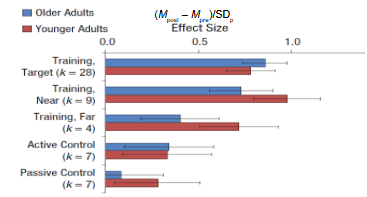
what did results of Karbach & Verhaeghen (2014)’s meta-analysis of near + far transfer of mental exercise suggest
found a large effect size of completing trained tasks + near transfer tasks, as well as a medium effect size for training far tasks + no age differences in the effectiveness of training programmes
suggests general cognition dies improve with far tasks, so cognitive tasks are beneficial
also found improvement in active + passive controls → indicates placebo effect
what 4 issues did Melby-Lervåg & Hulme (2016) find with Karbach & Verhaeghen (2014)’s study on the efficacy of mental training
the far transfer task = reasoning + task-switching merged (didn’t measure one distinct construct → task switching is EF, which is a near-transfer)
did not correct for baseline differences between groups
unclear which studies were used in the meta-analysis
there was one major outlier in results
what did Melby-Lervåg & Hulme (2016) find when correcting for these issues
removed 13 studies from the original analysis (k = 17) that were not properly conducted, and with those leftover found very few gains
found mild positive effects when compared to passive controls, but very little evidence for effect in comparison to active controls
shows when making more conservative choices e.g. in controlling for outliers + what constitutes as ‘far transfer’, there is very little evidence for far-transfer
what have more recent meta-analyses on cognitive training of WM found (Sala et al., 2019; Hou et al., 2020)
one found smaller effects for near + far transfer tasks, but null when compared to active controls
another found significant long-term effects for near transfer, but weaker-null effects for far transfer tasks
overall suggests that effectiveness of mental exercise on far transfer is doubtful, and clear benefits are only seen on trained tasks
what were Rowe + Kahn (1987)’s 3 characteristics for successful aging + what could this suggest is important in relation to cognitive ability
high cognitive + physical function
low probability of disease + disability
active engagement in life
the third suggests, along with Singh-Manoux et al. (2003)’s study on high-cognitive leisure activities, that an engaging + healthy lifestyle may have more of an impact on cognitive function than specific training
what is the WHO (2015)’s definition of healthy ageing
sustaining functional ability in everyday life → being mobile, maintaining relationships + lifelong learning
what did Sala + Guye et al. (2019) find in relation to healthy lifestyles + ageing
engaging in leisure activities is positively related to all 3 indicators of successful ageing (cognitive function, physical function + mental health), including sports + gaming
what was Park et al. (2013)’s 2-phase method of assessing the effect of training lifestyle on cognitive function
assessed whether changes someone’s lifestyle would reap cognitive benefits:
intervention phase → participants were placed into each condition for 15 hr/week structured activities for 3 months:
productive engagement → photography, quilting or both (high cognitive demand
receptive engagement → social group (low cognitive demand) + placebo (low social + cognitive demand)
control group (no contact)
test phase → participants completed a cognitive battery (far transfer) assessing:
processing speed → digit comparison
cognitive control → Flanker task
EM → recall + recognition memory
visuospatial processing → CANTAB
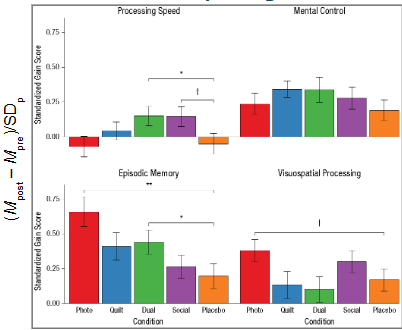
what were Park et al. (2013)’s results
the only notable effect was the photography lifestyle conduction producing better episodic memory on average → theoretical explanations for these findings are unclear
what are 3 issues with Park et al. (2013)’s research
lifestyle = a long-term, all-encompassing concept → adding 15 hours of content a week, while a substantial amount, is a small change + unlikely to be continued
lifestyles can be highly diverse so for generalisable research, large sample would be necessary to account for individual differences
lifestyles are chosen by each individual (to a certain extent), rather than imposed by external factors,
in what way are conclusions from ageing research disconnected from real life + what does this suggest
middle/older aged people are overrepresented as CEOs, even though top reasoning ability is most evident in younger ages → suggests age-related declines can occur in important cognitive abilities without major consequences for functioning in society
what did Verhaeghen et al. (2012) find in terms of how older people are rated by coworkers
even though age was negatively correlated with cognitive abilities, there was no correlation found between age and job performance measures, even though these must take into account cognitive abilities
in what 3 factors may there be age-increases in performance
along with semantic memory, there may be increases in:
concern for others
wisdom
expertise (specific knowledge in a domain)
what 3 findings support concern for others increasing in older adulthood
negative behavioural tendencies (e.g. criminal behaviour) decline steeply through adulthood (Cornelius et al., 2017)
prosocial traits + behaviours increase across adulthood (Roberts et al., 2006)
charitable giving + volunteering increase up to ~70 years old (Freund & Blanchard-Fields, 2014)
confound may be having more free hours due to retirement, though the finding still stands when controlling for this
what is wisdom
expert knowledge about the fundamental questions regarding the meaning + conduct of life → less factual knowledge, more of a combination of emotional + cognitive knowledge
what are the 5 factors within the Berlin Wisdom Paradigm (Baltes & Smith, 1990)
factual knowledge
procedural knowledge
life-span contextualism → framing current events in context of previous ones; essentially lessons learnt
value relativism + tolerance → tolerance of the views of others
awareness + management of uncertainty
what did Staudinger and Baltes (1996) find when associating wisdom + age
found no significant correlation (r = -.07) between self-rated wisdom + age → this may be due to wisdom being context dependent rather than general
how did Thomas & Kunzmann (2013) study rates of wisdom in younger + older participants + what were the findings
participants were shown video clips depicting life problems concerning marital conflict + suicide, and asked to give advice
no difference was shown in wisdom scores discussing suicide, but because marital conflict is more relevant to younger adults, they show greater wisdom for this topic
shows there is no association between age + wisdom, and it changes situationally
what is expertise
knowledge in a specific domain that is verified/less accessible to others
what does Strittermatter et al. (2020)’s study on domain-specific expertise demonstrate
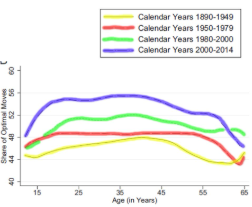
study analysed 125 years worth of chess games + compared individual moves in each gaim against an optimal move suggested by a chess engine
found optimal performance increases with age until early 20s + plateaus until around 35 years, where it then declines
this demonstrates the Flynn effect, where people over multiple generations get better on average at tasks → lowest ends of the distribution are improved
shows expertise is well preserved over time, even if it declines later in life
what did Castel (2007) study regarding generalisability of expertise + how
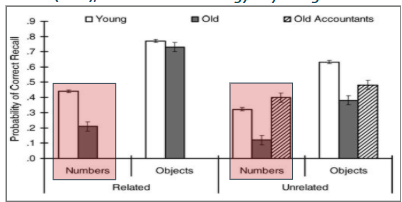
whether expertise could be used to support broader cognitive function through improving associative binding → ability to remember arbitrarily-paired pieces of information
participants were asked to remember sentences with arbitrary numbers, objects + locations
participants were either younger adults, older adults, or older adults who were also accountants
what were Castel (2007)’s findings + what does this suggest
found young adults were twice as likely to remember info than general older adults due to associative binding decreasing with age
however there was no drop-off in associative binding for people trained as accountants → numerical (domain-specific) expertise acted as a protective factor, meaning they performed better at that aspect than young adults
what did Taylor et al. (2005) study regarding expertise + what 2 different levels are there
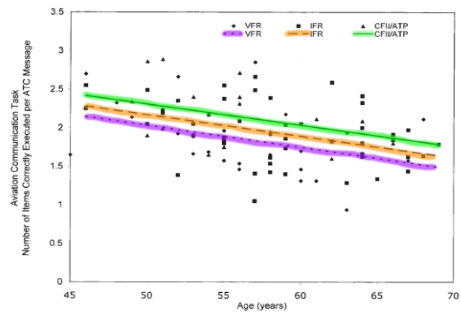
studied whether the level of expertise of air-traffic controller (a cognitively demanding job) moderate the effect of age on aviation communication performance → this is split into 3 levels:
VFR (lowest) → flying under visual conditions
IFR (middle) → instrument rated, allows pilot to fly in clouds
CFII/ATP (highest) → certified flight instructor of pilots in training
what were Taylor et al. (2005)’s findings + what does this suggest
found clear effect of both expertise and age → shows while not steep, expertise does not buffer against age-related decline (no interaction)
how do the factors in Taylor et al. (2005)’s study relate to WM
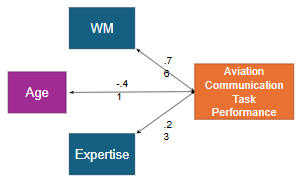
Taylor et al. found significant correlations between performance and age, WM + expertise, and when accounting for WM + expertise, variance contributed by age significantly diminishes
shows that the relationship between age + aviation (job) performance is explained independently by WM + expertise
in what 4 other ways can we explain the disconnect between age-related decline in lab vs sustained, good, real-world performance (Salthouse, 2011)
we seldom need to perform at our absolute maximum level → only what’s required
in many roles, there’s a shift with age from novel processing (fluid) to relying on accumulated knowledge (crystallised)
cognition is not the only determinant of life success → prosocial behaviour, in which old people generally excel, is more likely to dictate job performance
we can often make accommodations to adapt to change + conceal deficits, e.g. making use of environment/technology
overall, what are the effects of ageing in real-world settings, and how does this connect to basic lab research
prosocial behaviour increases with age, and wisdom-related knowledge and age gains in expertise appear to be domain-specific
disconnects between real life and lab may result from these factors, as well as support structures + other non-cognitive factors that are absent in the lab