Edexcel A-level Chemistry Organic Reactions
 Call Kai
 Learn
Learn Practice Test
 Spaced Repetition
 Match
Match Flashcards
 Knowt Play
1/50

There's no tags or description
Looks like no tags are added yet.
Name | Mastery | Learn | Test | Matching | Spaced | Call with Kai |
|---|
No analytics yet
Send a link to your students to track their progress
51 Terms
Alkane → Halogenoalkane
Free radical substitution
Presence of UV light
INITATION
PROPIGATION
TERMINATION
Can be further substutions
mechanisms required
Alkene → Alkane
H₂(g)
Nickel catalyst
150°C
(addition/reduction)
Alkene → Dihalogenoalkane
Halogen - Cl₂, Br₂
RT, no UV light
(electrophilic addition)
Mechanism Required
Alkene → Diol
Acidified potassium manganate, H⁺/MnO₄⁻
Purple solution decolourises
Purple → colourless
MnO₄⁻ → Mn²⁺
(addition reaction)
Alkene → Alcohol
Steam, 300°C, 60-70atm
Phosphoric (V) acid catalyst (conc. H₃PO₄)
(hydration)
Alkene → Halogenoalkane
Hydrogen halide - HCl, HBr
RT
(electrophilic addition)
Mechanism required - minor/major products
Bromine water, BrOH
Bromine water decolourises
Brown → colourless
(addition reaction)
Alcohol → Alkene
Acid catalyst, e.g H₃PO₄
(elimination/dehydration)
Halogenoalkane → Alkene
Ethanolic potassium hydroxide, KOH(ethanol)
Ethanol used as a solvent
Heat under reflux
OH⁻ ion acts as a base
CH₃-CHBr-CH₃ + OH⁻ → CH₃=CH-CH₃ + H₂O + KBr
(elimination reaction)
Chlorination of 1°/2° alcohols
Phosphorous(V)chloride
CH₃CH₂OH ₊ PCl₅ → CH₃CH₂Cl + POCl₃ + HCl
Produces steamy/misty fumes HCl
Vigorous at RT
(substitution reaction)
Other halogenating compounds can be used e.g SOCl₂
Chlorination of 3° Alcohols
Shake with conc. HCl at RT
(CH₃)₃COH + HCl → (CH₃)₃CCl + H₂O
CP6 - chlorination of
2-methylpropan-2-ol
Bromination of Alcohols
50/50 conc. H₂SO₄/KBr
Warmed with alcohol
Reaction to form reagent:
KBr + H₂SO₄ → KHSO₄ + HBr
Reaction with HBr:
CH₃CH₂OH + HBr → CH₃CH₂Br + H₂O
Iodination of Alcohols
Red Phosphorus and I₂
Heat under reflux
Reaction to form reagent:
2P + 3I₂ → 2PI₃
Reaction with phosphorous(III)iodide
3CH₂CH₃OH + PI₃ → 3CH₂CH₃I + H₃PO₃
Halogenoalkane → Alcohol
Aqueous potassium hydroxide, KOH(aq)
Heat under reflux
Nucleophile (OH⁻, stronger than H₂O)
(Nucleophilic substitution)
Mechanism required (SN1 and SN2)
Halogenoalkane → Nitrile
KCN is aqueous ethanol
Heat under reflux
CN⁻ (nucleophile)
*example of increasing length of the carbon chain
Halogenoalkane → 1° amine
NH₃ dissolved in ethanol
Heat in a sealed tube (prevents NH₃(g) escaping)
Two step process:
NH₃ acting as a nucleophile producing a salt
(nucleophilic substitution)
Then NH₃ acts as a base → nitrile + NH₄⁺
(acid-base reaction)
Overall: CH₃CH₂Cl + 2NH₃ → CH₃CH₂NH₂ + NH₄⁺Cl⁻
Mechanism required
1° Alcohol → Aldehyde
Acidified potassium dichromate, H⁺/KCr₂O₇ (limited)
Distillation with addition
(oxidation)
2° Alcohol → Ketone
Acidified potassium dichromate, H⁺/KCr₂O₇
Heat under reflux
(oxidation)
3° Alcohol → ?
Cannot be oxidised
Carbonyl Compound → Hydroxynitrile
HCN is the presence of KCN(aq)
(Nucleophilic addition)
Forms pair of enantiomers
Mechanism required
Ketone → alcohol
LiAlH₄ in dry ether
(reduction)
Aldehyde → Carboxylic acid
Excess H⁺/KCr₂O₇
Heat under reflux
(oxidation)
n.b orange → green
Cr₂O₇²⁻ → 2Cr³⁺
Carboxylic acid → Alcohol
LiAlH₄ in dry ether
RT and pressure
(reduction)
Carboxylic acid → Carboxylate Salt
acid + metal → salt + hydrogen
acid + metal hydroxide → salt + water
acid + metal carbonate → salt + water + CO₂
Carboxylate salt → Carboxylic acid
add dilute acid
Carboxylic acid → Ester
Alcohol
strong acid catalyst, H₂SO₄
Heat under reflux
CH₃COOH + CH₃CH₂OH ⇌ CH₃CO₂CH₂CH₃ + H2O
reversible reaction, yield is low
Ester → Carboxylate salt
Alkaline hydrolysis
NaOH(aq)
Heat under reflux
Reaction goes to completion
→ Carboxylic acid, add dilute acid
Ester → Carboxylic acid
Acid Hydrolysis
Heat under reflux with a dilute acid
strong acid catalyst, H₂SO₄
Reaction is reversible
Carboxylic Acid → Acyl Chloride
Phosphorous(V)chloride,
CH₃COOH ₊ PCl₅ → CH₃COOCl + POCl₃ + HCl
Produces steamy/misty fumes HCl
Vigorous at RT, conditions must be anhydrous
POCl₃ and acyl chloride can be separated by fractional distillation
(substitution reaction)
Carboxylic acid → Acyl Chloride (2)
Thionyl chloride, SOCl₂
RT
CH₃COOH + SOCl₂ → CH₃COOCl + SO₂ + HCl
Both gases given off ∴ no need for fractional distillation
Acyl Chloride → Carboxylic acid
Vigorous at RT with cold water
Steamy/misty fumes HCl produced
Acyl Chloride → Ester
React with alcohol
RT
Produces steamy/misty fumes of HCl
CH₃COOH + CH₃CH₂OH → CH₃COOCH₂CH₃ + HCl
Better than reacting with a carboxylic acid because reaction is not reversible
Acyl Chloride → 1° amide
Conc. NH₃(aq)
RT
CH₃COOH + NH₃ → CH₃CONH₂ + HCl
NH₃ then acts as a base
HCl + NH₃ → NH₄Cl
White smoke of NH₄Cl is produced
Acyl Chloride → N-substituted amide
React with a 1° amine
RT
Forms an N-substituted amide and HCl
(addition-elimination reaction)
1° amine → 2° amine
Further substitution reactions with ammonia
To get mainly the quaternary ammonium salt use excess halogenoalkane
To get mainly 1° amine use excess NH₃
Mixture of products is likely
Nitrile → 1° amine
LiAlH₄ in dry ether
CH₃CN + 4[H] → CH₃CH₂NH₂
(reduction)
or...
H₂(g)
Nickel catalyst
High temp, high pressure
Nitrile → Carboxylic acid
Preparation by hydrolysis
acidic/alkaline
To purify fractionally distillate
Acid hydrolysis
Reflux with dilute acid (HCl, H₂SO₄)
Alkaline hydrolysis
Reflux with dilute NaOH
→ add dilute acid
...
...
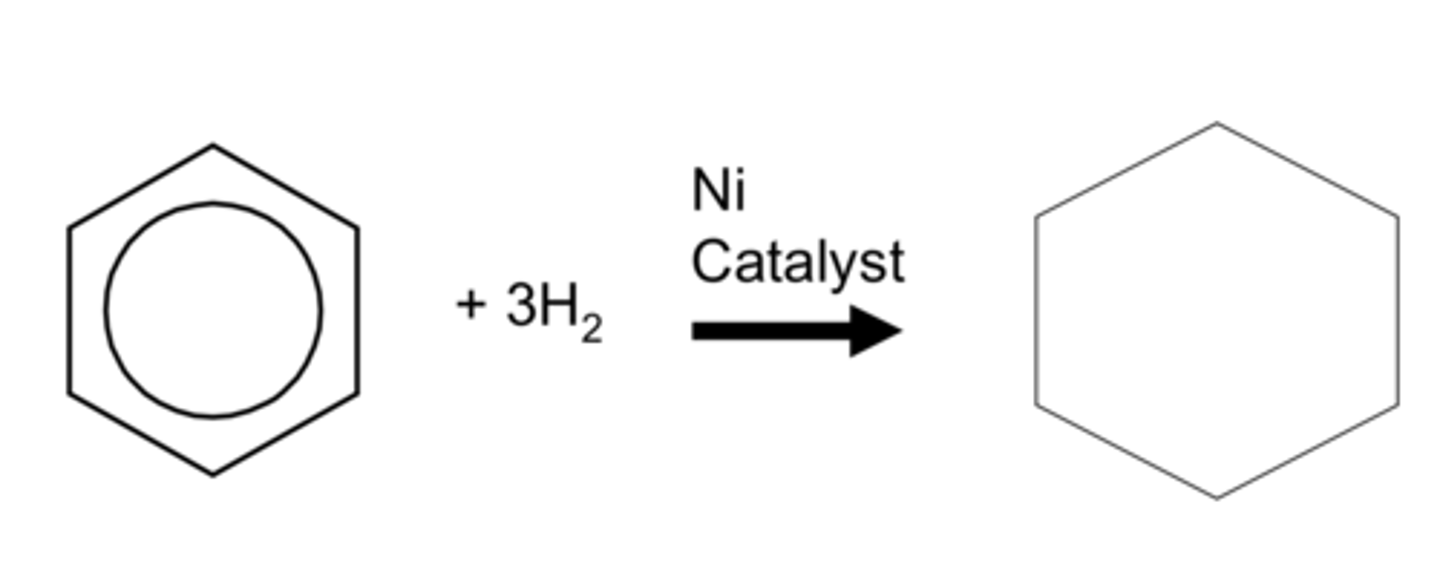
Benzene → Cyclohexane
H₂(g)
Nickel Catalyst
200°C, 30atm
Benzene → Chlorobenzene
Cl₂ and a halogen carrier
(halogen carrier polarises the Cl₂/Br₂)
Formation of electrophile:
AlCl₃ + Cl₂ → AlCl₄⁻ + Cl⁺
C₆H₆ + Cl₂ → C₆H₅Cl + HCl
Catalyst is regenerated:
H⁺ + AlCl₄⁻ → AlCl₃ + HCl
(electrophilic substitution)
Mechanism required
Benzene → Bromobenzene
Br₂ and a halogen carrier (catalyst)
Catalyst created in situ by reacting ion fillings with dry ether
Formation of electrophile:
FeBr₃ + Br₂ → FeBr₄⁻ + Br⁺
C₆H₆ + Br₂ → C₆H₅Br + HBr
Catalyst is regenerated:
H⁺ + FeBr₄⁻ → FeBr₃ + HBr
(electrophilic substitution)
Mechanism required
Benzene → Nitrobenzene
Conc. nitric acid in the presence of a sulphuric acid catalyst
In situ forms the electrophile, NO₂⁺ (nitronium ion)
Formation of the electrophile:
HNO₃ + 2H₂SO₄ → NO₂⁺ + 2HSO₄⁻ + H₃O⁺
H₂SO₄ catalyst is reformed:
H⁺ + HSO₄⁻ → H₂SO₄
(electrophilic substitution)
Mechanism required
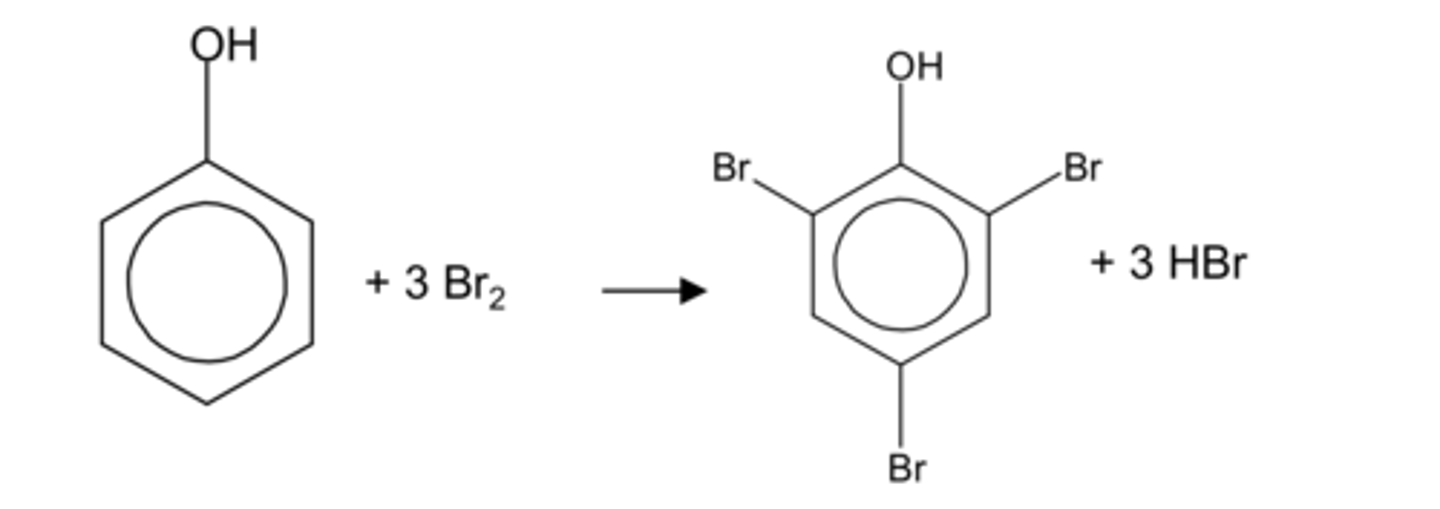
Phenol → 2,4,6-tribromophenol
Bromine water
RT
Product is a white solid
(-OH group is 2,4 directing)
Benzene → Alkybenzene
FRIEDAL-CRAFT REACTION
Chloroalkane (RX) in the presence of anhydrous
aluminium chloride catalyst
Heat under reflux
Dry inert solvent (ether)
Formation of the electrophile: (CH₃CH₂⁺)
AlCl₃ + CH₃CH₂Cl → CH₃CH₂⁺ + AlCl₄⁻
H⁺ produced reacts with AlCl₄⁻ → reform catalyst + HCl
(electrophilic substitution)
Mechanism required
Benzene → Phenylketone
FRIEDAL-CRAFT REACTION
Acyl chloride (RCOX) in the presence of an anhydrous
aluminium chloride catalyst
Heat under reflux 50°C
Dry inert solvent (ether)
Formation of the electrophile: CH₃CO⁺
AlCl₃ + CH₃COCl → CH₃CO⁺ + AlCl₄⁻
H⁺ produced reacts with AlCl₄⁻ → reform catalyst + HCl
(electrophilic substitution)
Mechanism required
Nitrobenzene → Phenylamine
Sn (Tin) and HCl
Heat under reflux
(reduction)
C₆H₆NO₂ + 6[H] → C₆H₆NH₂ + 2H₂O
produces phenyl ammonium ion (∴ add NaOH)
C₆H₆NH₃⁺ + OH⁻ → C₆H₆NH₂ + H₂O
Best separated by steam distillation
... Or
Can use Fe and HCl
Halogenoalkane → Grignard Reagent
R-Br + Mg→ R-Mg-Br
halogenoalkane is dissolved in dry ether then reacted with magnesium
heat under reflux
Grignard Reagent → 1° Alcohol
React with methanal
RMgX + HCHO → RCH₂OH + Mg(OH)X
added dilute acid to obtain desired product (H₂O/H⁺)
extends the carbon chain by 1 C
Grignard Reagent → 2° Alcohol
Reaction with an aldehyde (not methanal)
RMgX + CH₃CH₂CHO → CH₃CH₂C(OH)R +Mg(OH)X
added dilute acid to obtain desired product (H₂O/H⁺)
extends the carbon chain by variable amount
Grignard Reagent → 3° Alcohol
React with a ketone
RMgX + CH₃COCH₃ → (CH₃)₂RCOH + Mg(OH)X
added dilute acid to obtain desired product (H₂O/H⁺)
extends the carbon chain by variable amount
Grignard Reagent → Carboxylic acid
React with CO₂, then hydrolysis using a dilute acid
RMgX + CO₂ → RCOO⁻[MgX]⁺ → RCOOH + Mg(OH)X
added dilute acid to obtain desired product (H₂O/H⁺)
extends the carbon chain by 1 C