Paper 1
 Call Kai
 Learn
Learn Practice Test
 Spaced Repetition
 Match
Match Flashcards
 Knowt Play
1/62

There's no tags or description
Looks like no tags are added yet.
63 Terms
What are the 8 energy stores?
Thermal
Kinetic
Gravitational Potential
Elastic Potential
Chemical
Magnetic
Electrostatic
Nuclear
What are the 4 ways energy is transferred?
Mechanically (By a force doing work)
Electrically (Work done by moving charges)
Heating
Radiation (Light or sound waves)
What is the formula for kinetic energy?
E = ½ MV²
M = Mass
V = Speed
What is the formula for gravitational potential energy?
E = MGH
M = Mass
G = Gravity = 9.8
H = Height
What is the formula for elastic potential energy?
E = ½ KE²
K = Spring Constant
E = Extension
What is the formula for Specific Heat Capacity?
ΔE = MCΔθ
ΔE = Change in thermal energy
M = Mass
C = Specific Heat Capacity
Δθ = Temperature Change
What is the conservation of energy principle?
Energy can be transferred usefully, stored or dissipated, but can never be created or destroyed.
What is the formula for power?
P = E/T
P = Power
E =Energy Transferred
T = Time
What is Conduction?
The process where vibrating particles transfer energy to neighbouring particles.
What is Convection?
The process where energetic particles move away from hotter to cooler regions.
Which do radiators work?
They create convection currents.
This is where energy is transferred from the radiator to nearby particles through conduction. Then the warm air rises (as its more dense) and heats the surroundings whilst the cold air sinks and gets heated by the radiator.
What are two ways ti reduce unwanted energy transfers?
Lubrication - Using lubricants to reduce frictional forces from objects rubbed together.
Insulation - Using different materials and methods to reduce heat escaping.
What is the formula for efficiency?
Efficiency = Useful Output / Total Input
What are three non-renewable energy sources?
Any fossil fuels or nuclear fuels
Coal
Oil
Natural Gas
Uranium
Plutonium
What are 5 Renewable energy soruces?
Solar
Wind
Wave
Hydro-Electric
Biofuel
Tide
Geothermal
What is a Electric Field?
A region where a charge experiences a force.
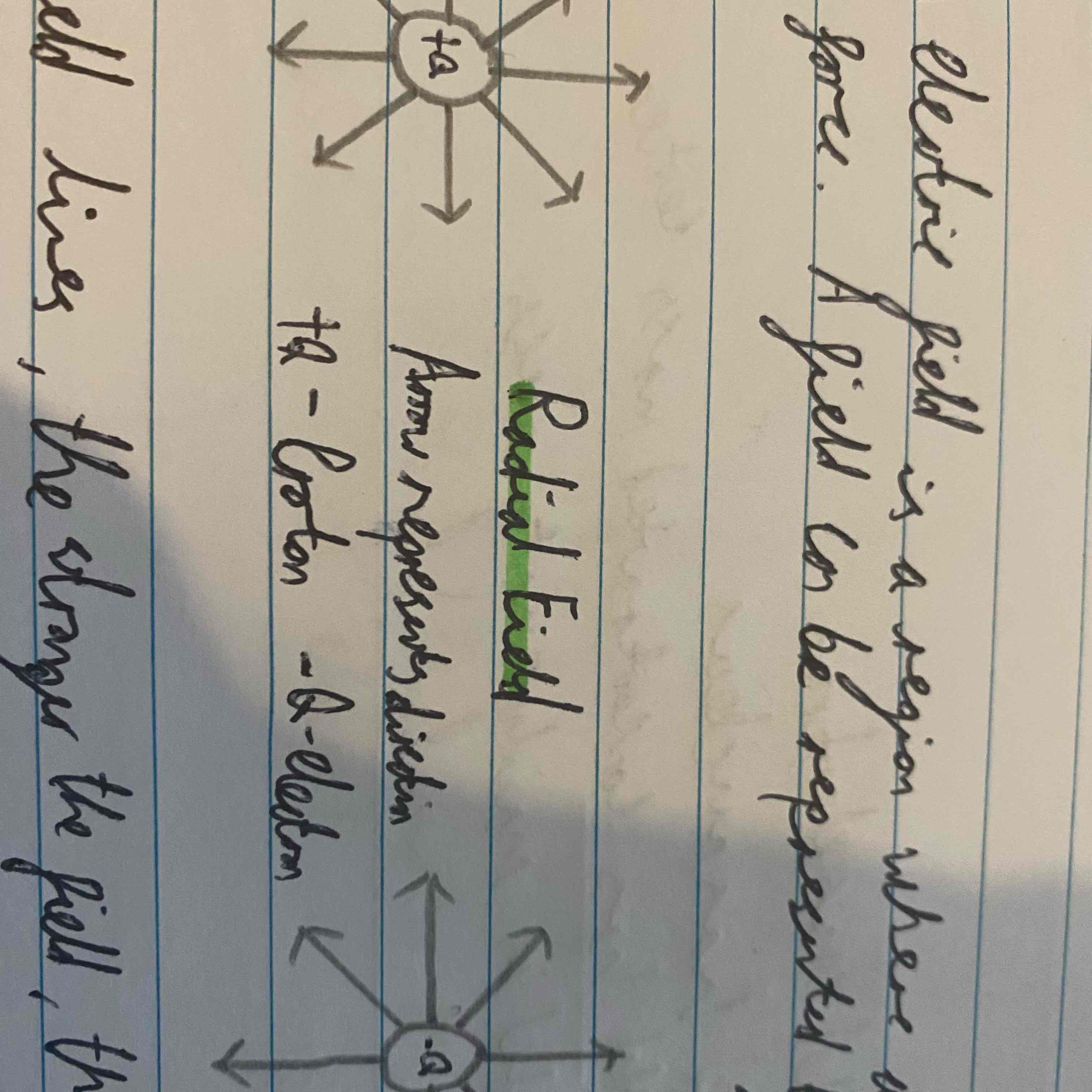
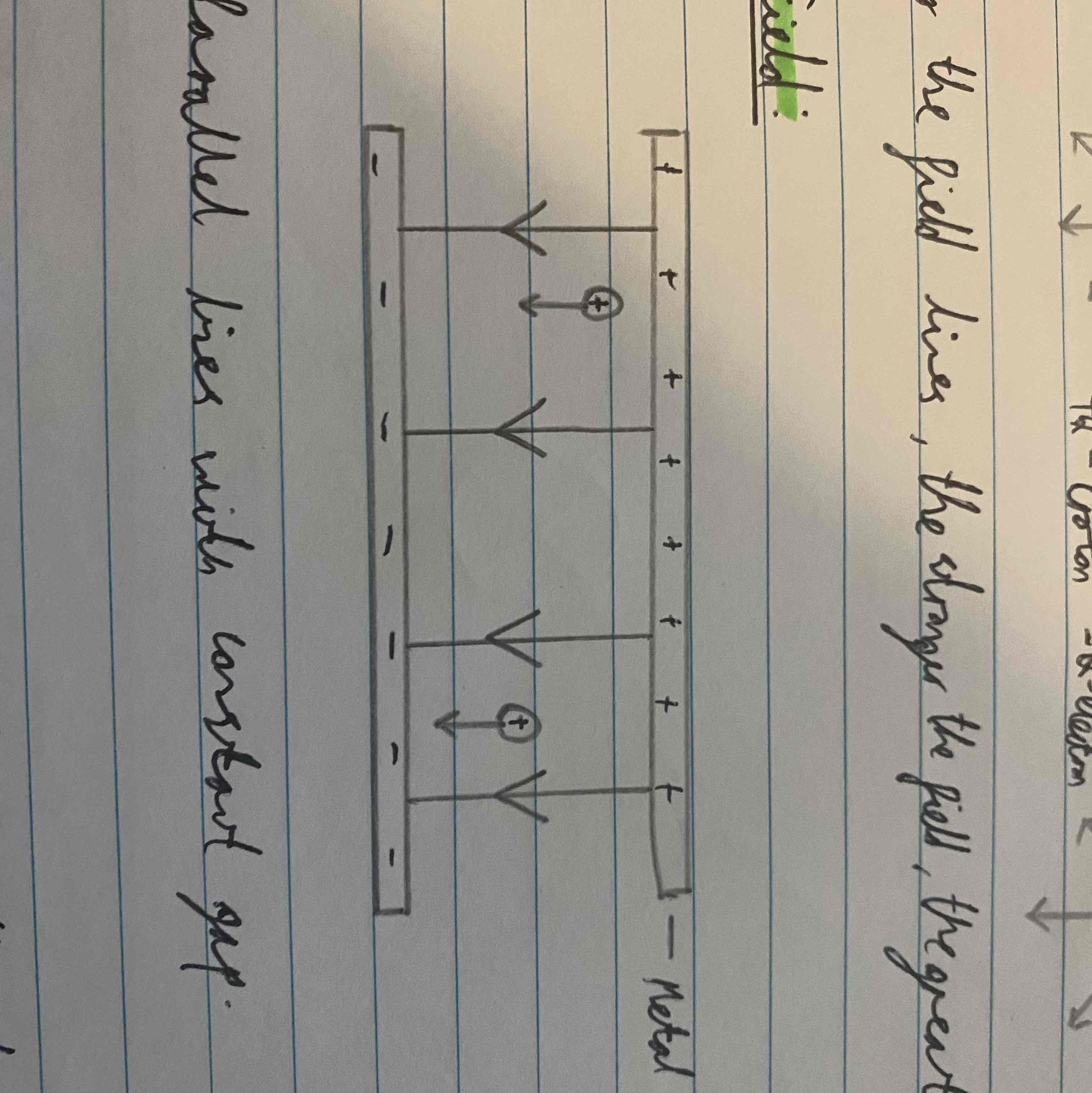
What are two types of fields?
Radial field - The closer the field lines the stronger the field, the greater the force.
Uniform Field - Parallel lines with a constant gap.
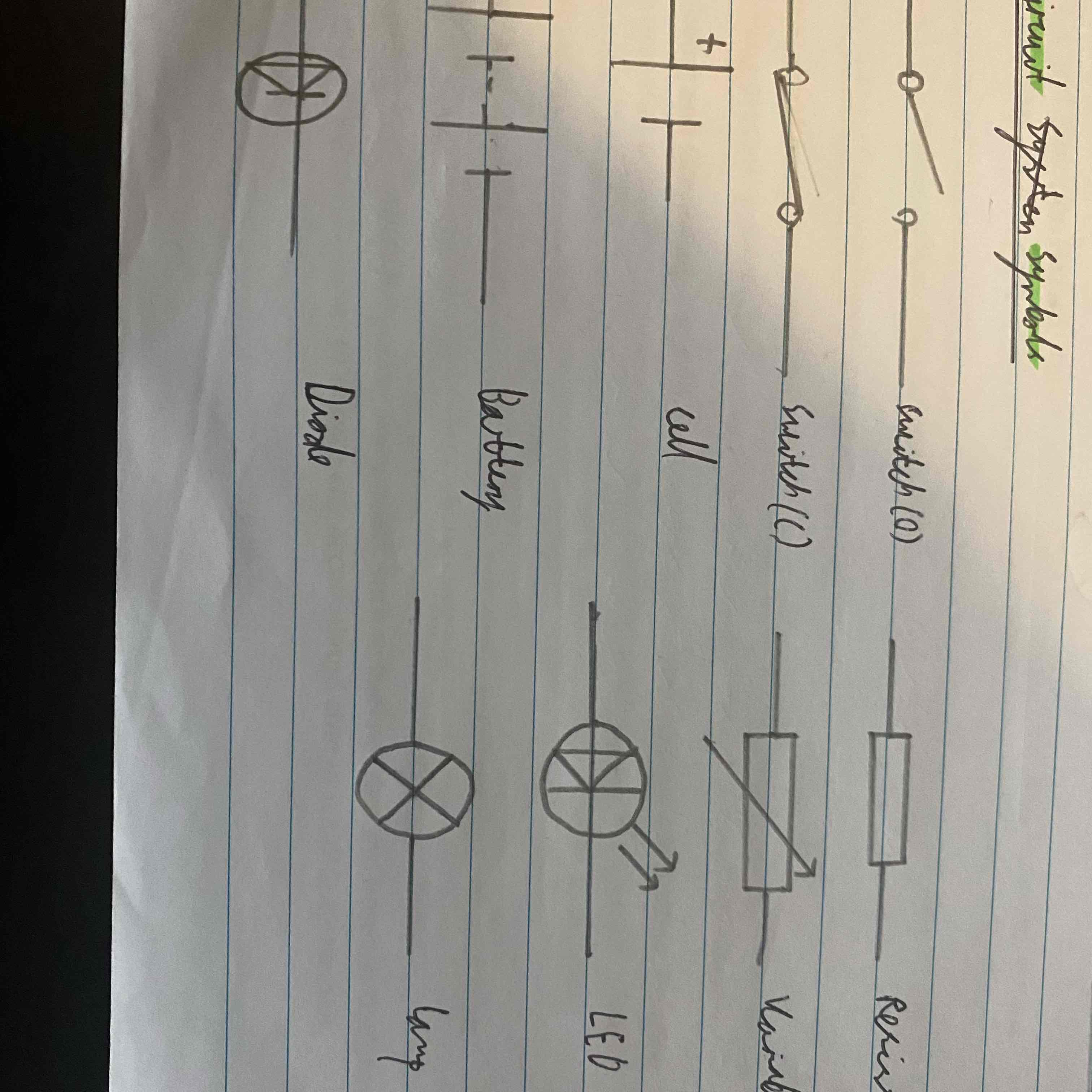
What are the symbols for:
Switch, Cell, Battery, Diode, Resistor, Variable Resistor, LED, Lamp?
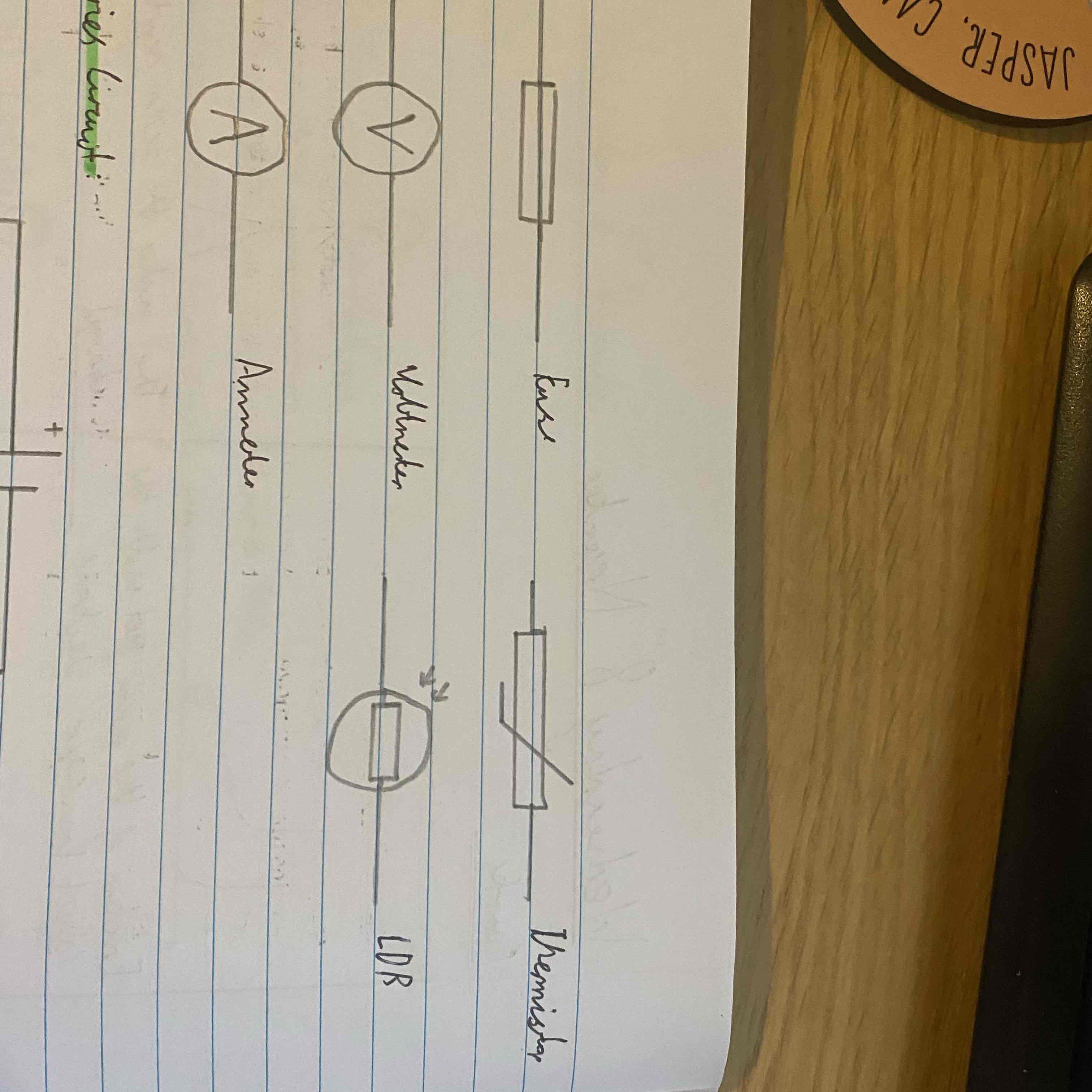
What are the symbols for:
Fuse, Voltmeter, Ammeter, Thermistor, LDR?
What is potential difference + Formula?
The amount of energy given or taken from the circuit per unit of charge flowing. V=E/Q
What is Ohm’s Law?
V=IR
What is the relationship between current and voltage?
Current is directly proportional to the voltage.
How does temperature affect resistance?
It increases the resistance of the wire(Explain with kinetic and electrons) and can cause it to overheat.
What is forward biased?
When a diode has a low resistance.
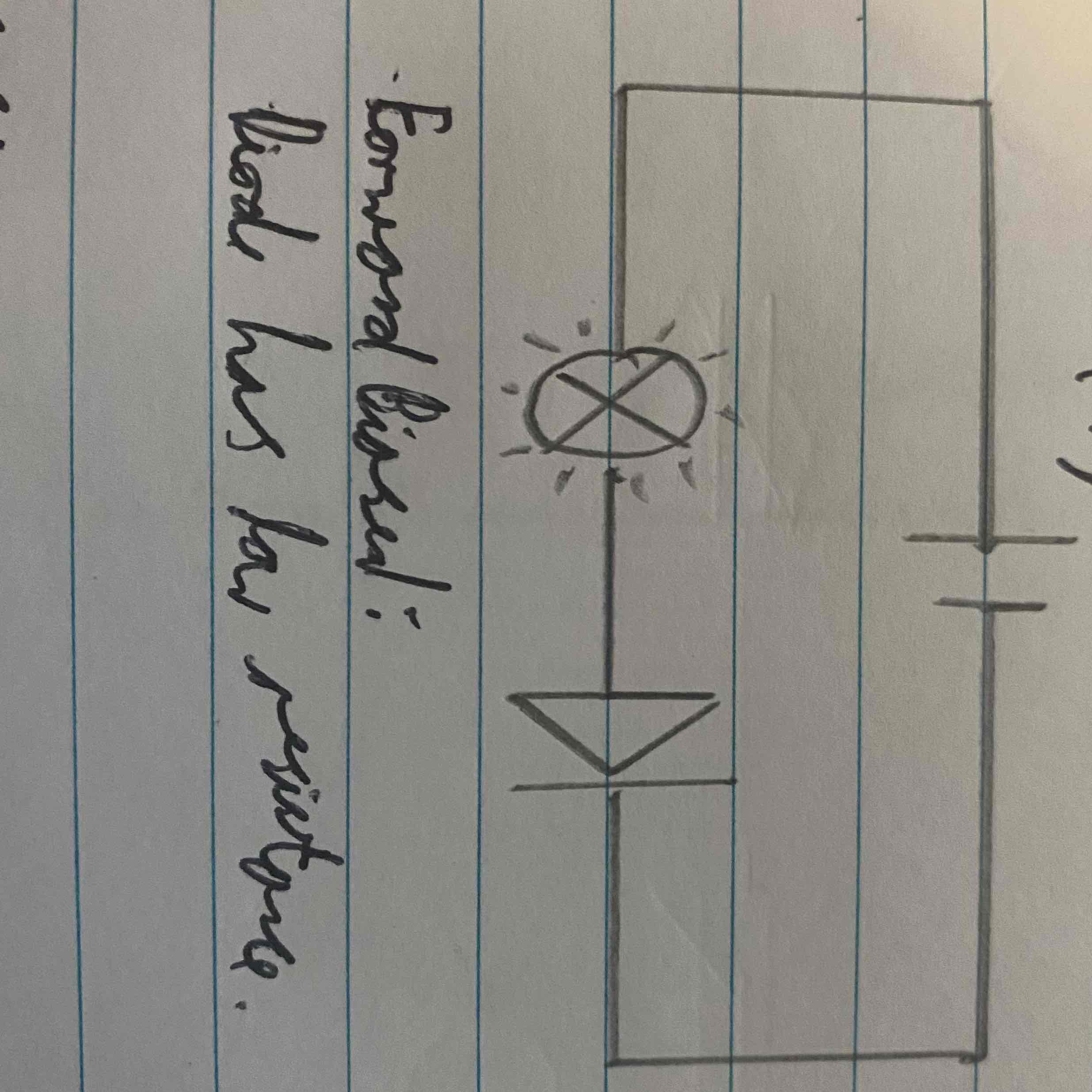
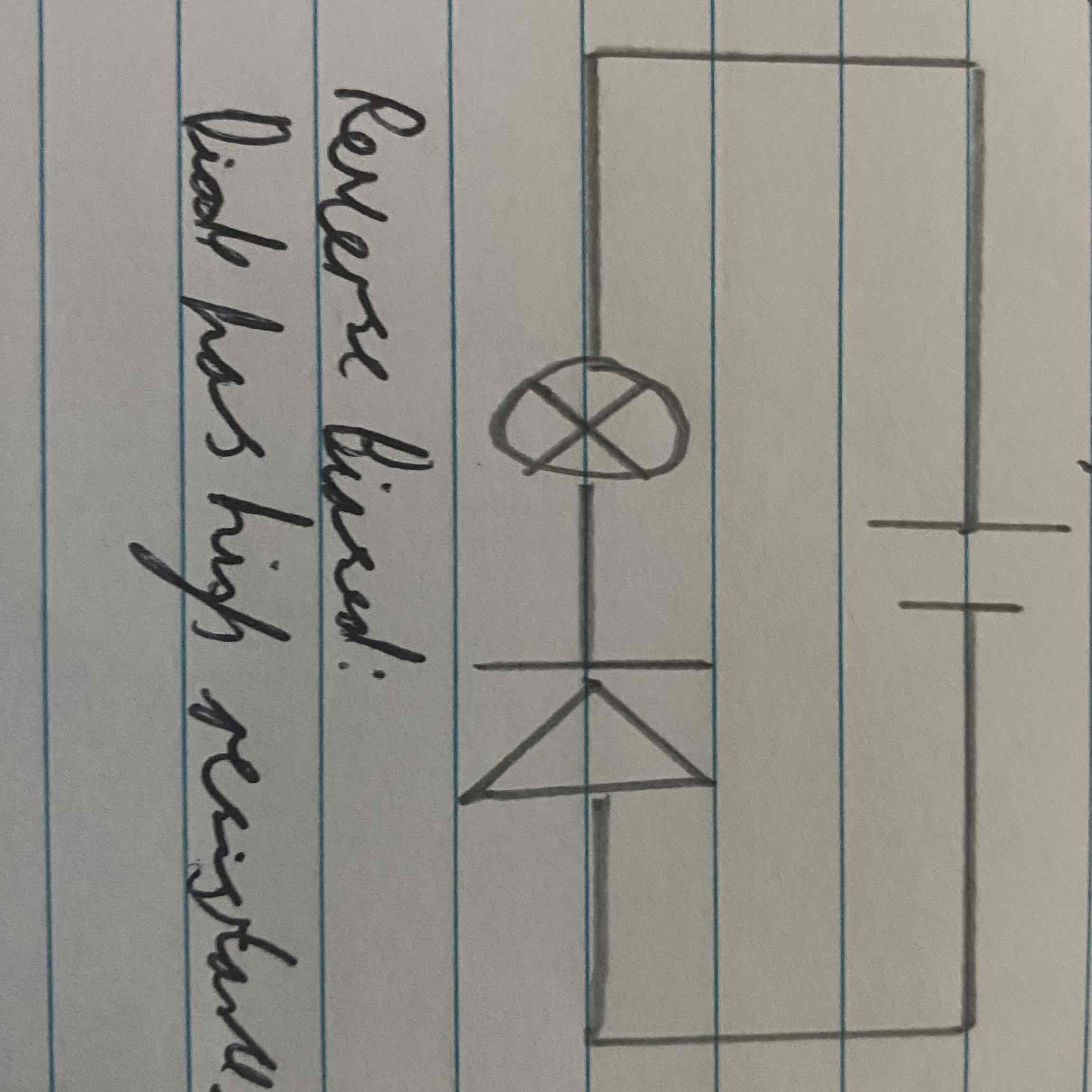
What is reverse biased?
When a diode has a high resistance.
How does the length of a wire affect the resistance?
The resistance is directly proportional to the length.
What is the relationship between light intensity and resistance when using a LDR?
The resistance is directly proportional to the light intensity,
What is the formula for power?
Power(W)=Energy(J)/Time(s)
Or
P=IV
Or
P=I²R
What is the formula for efficiency?
Efficiency=Output/Useful Input
What is the formula for frequency?
Frequency(Hz)=1/Time for 1 cycle(s)
What is the Mains Voltage?
230V
Label a Three Pin Plug
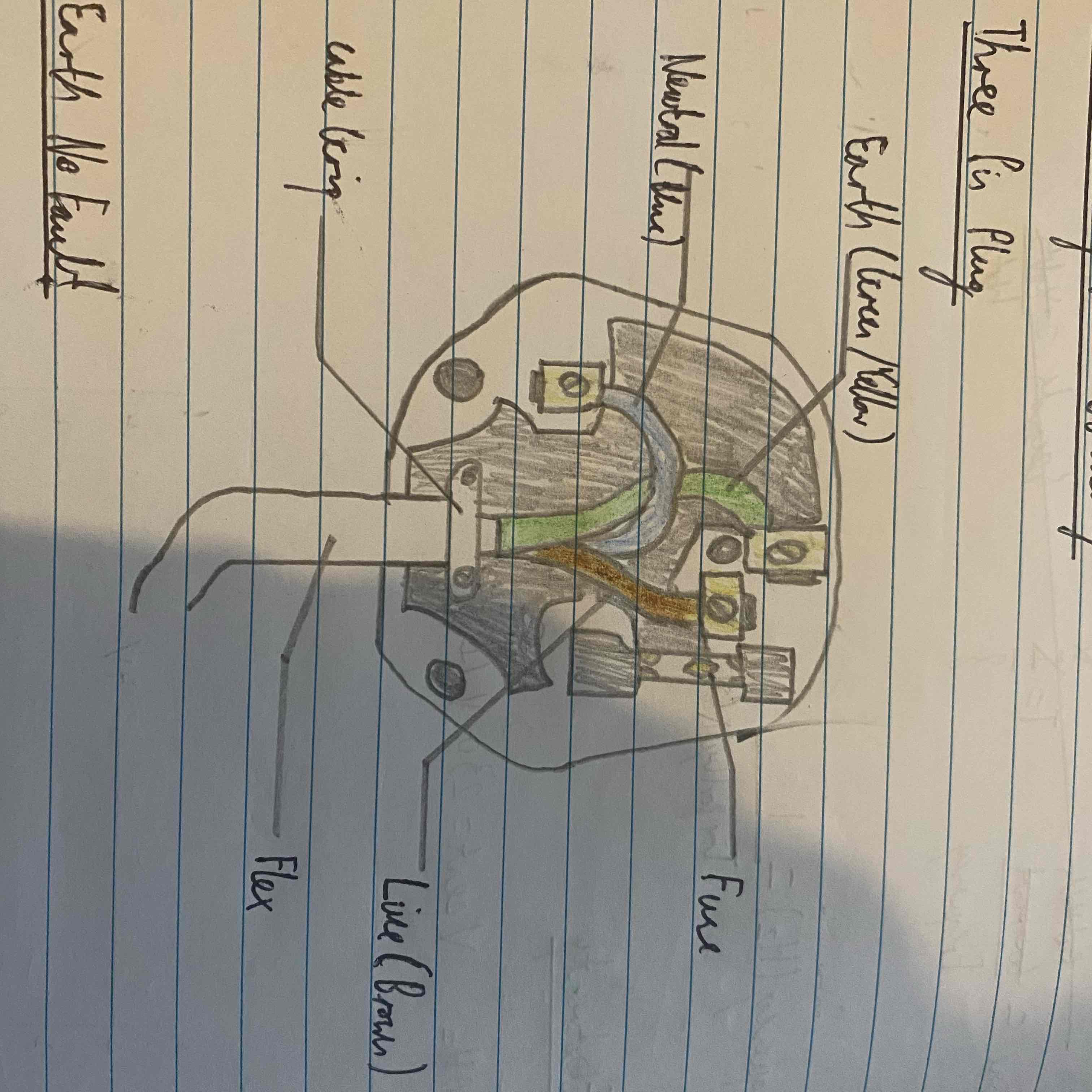
What happens if there is an earth wire and a fault?
The earth wire redirects the current so you are safe and blows the fuse so the circuit stops.
What happens if there is a fault and no earth wire?
You will most likely die.
How do you workout what fuse to use?
Calculate the current and choose between 3A, 5A, 10A and 13A. Choose the one above the current.
Describe a diagram of the National Grid?
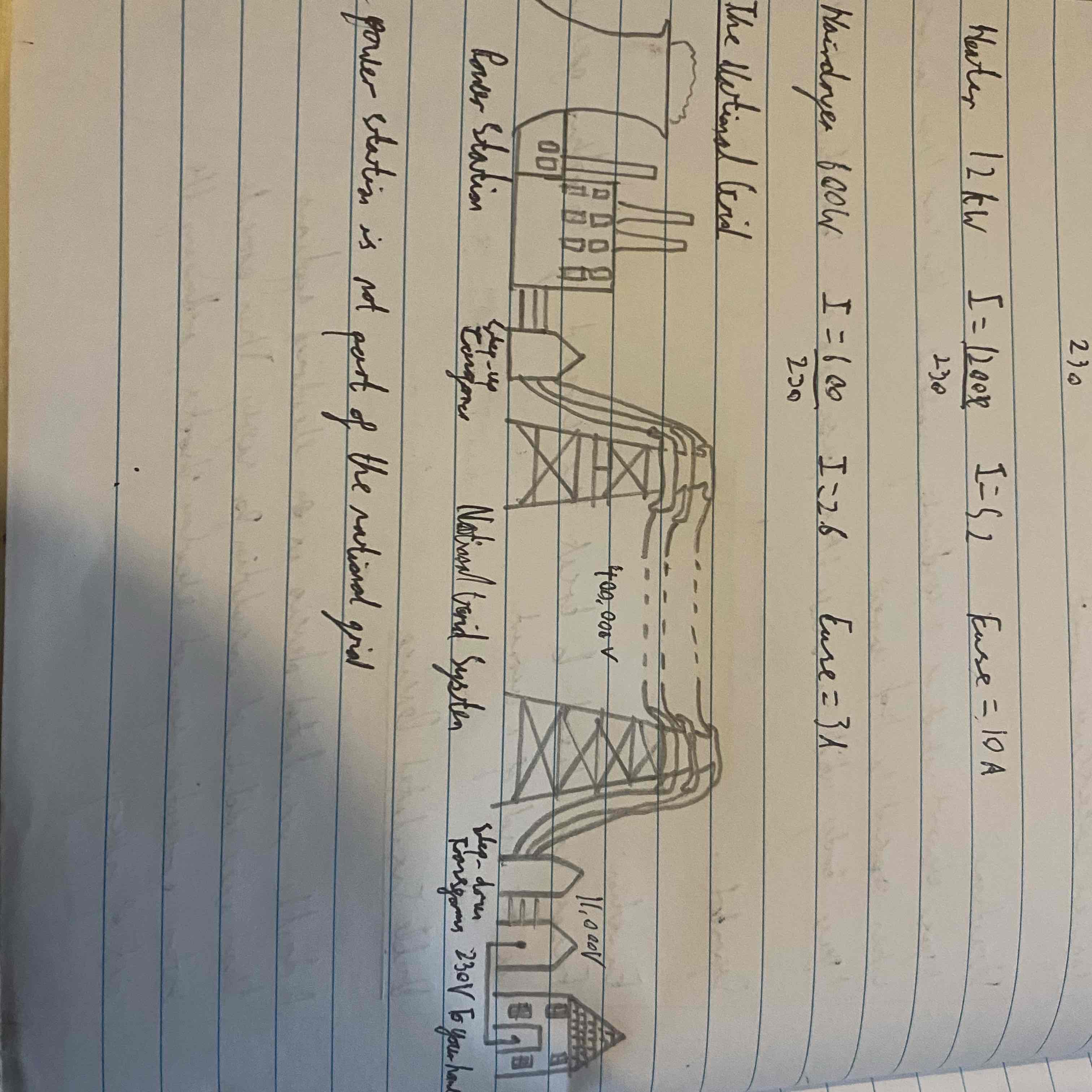
What is the formula for density?
Density = Mass / Volume
What are some properties of a solid?
Strong forces of attraction
Fixed, Regular arrangement
Vibrate on a fixed position
High density
What are some properties of a liquid?
Weaker forces of attraction
Particles are close and can move past eachother
Irregular Arrangement
More energy
Random
Less dense
What are some properties of a gas?
Almost no forces of attraction
Lots of energy
Free to move
Random but fast
Low density
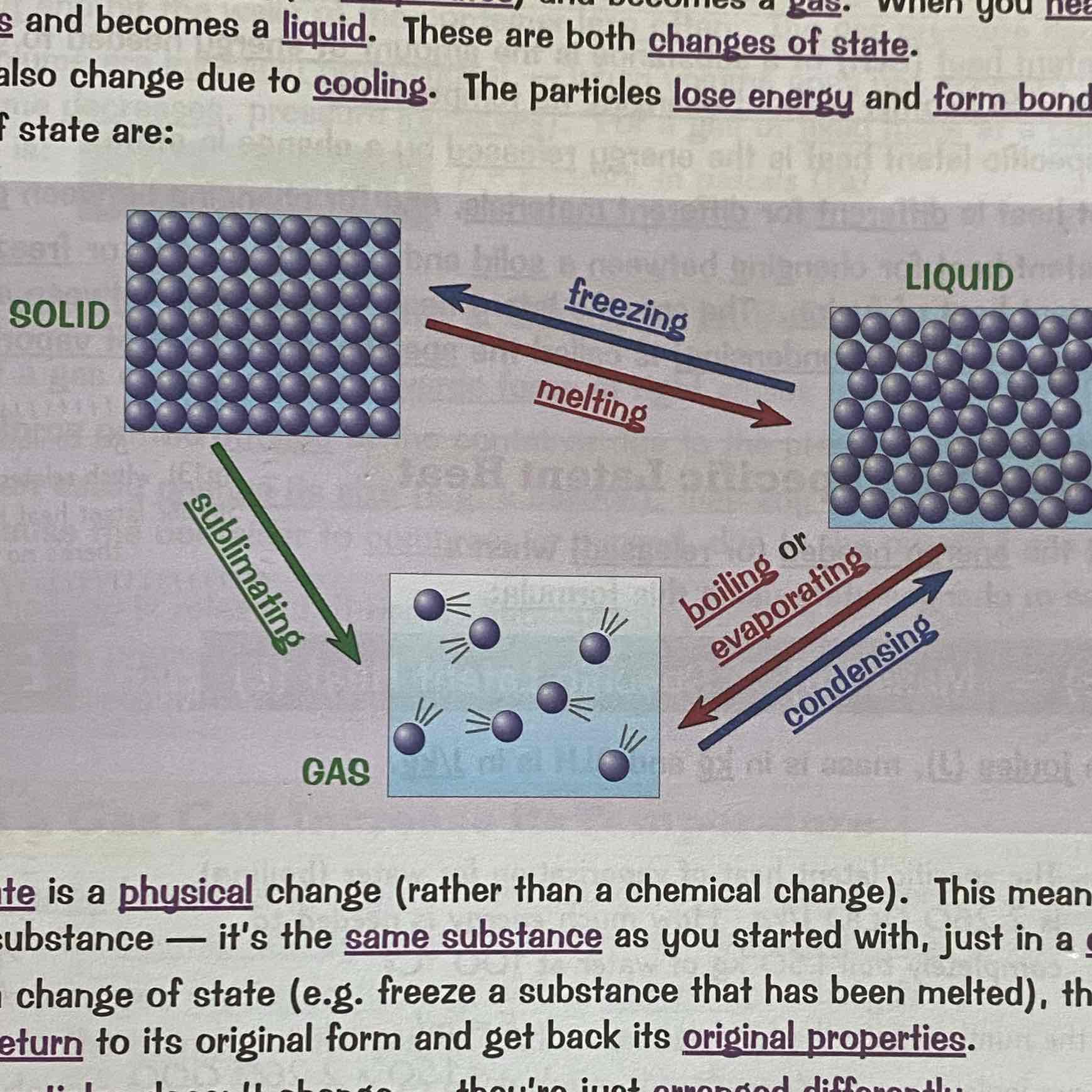
What are the changes of state?
See image:
What is specific latent heat and formula?
The energy needed for a 1kg mass to change state without changing its temperature.
E = ML
E = Energy
M = Mass
L = Specific Latent Heat
What is the specific latent heat called for solids, liquids and gases
Solid Liquid - Specific latent hear of fusion
Gas - Specific latent heat of vaporisation
How does temperature affect kinetic energy?
The higher the temperature, the higher the kinetic energy store. So the higher the temperature of the gas, the higher the speed of the particles.
How can pressure be increased?
There needs to be more collision for a higher pressure
Faster particles
Increased temperature
How does volume affect pressure?
Volume is inversely proportional to pressure.
How can pressure change volume?
If there is pressure outside the object and if the object can easily change shape (ballon) then a change in pressure can compress or expand the object.
How does work/force affect temperature?
If you transfer energy by applying a force then you do work. This increases the gas’ internal energy and therefore increases its temperature.
What are the 4 things emitted during radioactive decay?
Alpha Radiation, Beta Radiation, Gamma Radiation and Neutrons.
What are the properties of Alpha Radiation?
Small range in air (10cm)
Bad penetration (Paper)
Gets detected in fields
Very strong ionisation strength
What are the properties of Beta Radiation?
Moderate range in air (1m)
Moderate penetration (Aluminium)
Gets detected in fields
Strong ionisation strength
What are the properties of Gamma Radiation?
Unlimited range in air
Strong penetration (Lead)
Doesn’t get detected in fields
No ionisation strength
What are the symbols for the different types?
Alpha - <>< (Also a helium nucleus)
Beta - Slanted B with a longer line (Also a fast moving electron)
Gamma - Same as alpha but on its side (Not a particle)
What is Half Life?
The time it takes for the number of radioactive nuclei in an isotope to halve.
What is Irradiation?
When an object is exposed to nuclear radiation. This could be to kill bacteria or sterilise hospital equipment.
What is contamination?
The unwanted radioactive atoms on a person or object.
How is this Irradiation and Contamination dangerous?
Irradiation is dangerous as high levels from beta and gamma can penetrate the body unlike alpha.
Contamination is dangerous as alpha can do damage in a localised area unlike beta and gamma, which often pass out the body.
Background Radiation and sources?
The low-level radiation that is around at all times from different sources.
Radioactivity from building materials.
Radiation from the sun and space.
Radiation from human nuclear causes.
Amount of radiation and half life?
Nuclei with a long half-life give out lots of radiation over time, damaging an area for much longer.
Nuclei with a short half-life give out lots of radiation making it dangerous, but doesn’t take long to become safe.
What is radiotherapy?
The process where cancer cells are destroyed by large amounts of radiation.
What is brachytherapy?
The process where a small reactive source is placed in a tumour to give a high dose if radiotherapy to that specific area.
What is nuclear fission?
The splitting of a large unstable nucleus (uranium or plutonium) to release energy and two or three neutrons.
This can cause a chain reaction if there is more uranium or plutonium for the newly released neutrons to hit until there is no uranium or plutonium left.
What is nuclear fusion?
The joining if two small light nuclei (hydrogen and helium) to form a heavier nucleus. This produces a lot more energy then fission but is much more expensive.