Marine Bio Exam 4 STUDY GUIDE QUESTIONS
 Call Kai
 Learn
Learn Practice Test
 Spaced Repetition
 Match
Match Flashcards
 Knowt Play
1/77

There's no tags or description
Looks like no tags are added yet.
Name | Mastery | Learn | Test | Matching | Spaced | Call with Kai |
|---|
No analytics yet
Send a link to your students to track their progress
78 Terms
FISH STUDY QUESTIONS
Contrast the anatomy and physiology of bony and cartilaginous fishes
Bony fishes have skeletons made of bone, swim bladders for buoyancy, and gills covered by an operculum
Cartilaginous fishes like sharks and rays have skeletons made of cartilage, no swim bladder, and exposed gill slits
What are the differences between bony and cartilaginous fish anatomy (TAIL)
Bony fish: tail homoceral (upper lobe about equal length to lower lobe
Cartilaginous: heteroceral (upper lobe longer than lower lobe)
Identify and describe the function of the various fins found in fishes
Caudal fin propulsion and speed
Dorsal fin stability, steering
Anal fin stability, steering, reduce drag
Pectoral fins steering and lift
Pelvic fins balance and maneuvering
Describe examples of how the body form of a fish supports particular lifestyles
Fusiform: torpedo-shaped → fast swimmers (tuna)
Depressiform: flatenned top to bottom → live seafloor (sea moth)
Compressiform: flattened side to side → quick manuvering & fit in narrow spaces (flatfish)
Anguliform: long cylindrical serpentine → slithering crevices (freshwater eel)
Teeniform: ribbon like more vertically compressed (gunnel)
Filiform: thread like /long thin (snipe eel)
irregular: complex specialized → camouflage
ostraciiform: box like/triangular → rigid armour like scales
Globiform: sub spherical defensive shape→ inflate to deter predators
Describe how fish swim and what impact the shape of the caudal fin has on speed and maneuverability
throwing their bodies into undulatory waves that pass from head to tail
streamlining rigid bodies packed full of swimming muscles with high metabolic rates and regional endothermy :contribute to high speed
Forked/lunate tails fast sustained swimming (concentrated movement at rear)
Rounded tails slow but high maneuverability
Describe gas exchange in fish and how the respiratory system is specialized
Water moves into mouth and flows over gills in one direction
can be enhanced by ram ventillation
gill arches support rows of gill filaments that bear lamellae(thin membranes increase surface area)
arrangement of capillaries allows Blood flow opposite direction → countercurrent exchange
Maximizes oxygen absorption efficiency
What is the function of the lateral line system? What is the function of the ampullae of Lorenzini?
Lateral line detects vibrations and movement in water
Ampullae of Lorenzini detect electrical fields in prey
What are some potential benefits of schooling and what sensory structures are used for schooling?
Benefits: protection, confusion of predators, drag reduction, reproduction, feeding/hunting
Uses vision and lateral line
Describe reproduction in fishes.
internal fertilization common in cartilaginous fishes (male use claspers to inseminate female/ but also in some bony fishes)
External fertilization common, many groups of bony
development: ovoviviparous(EGG, most common) viviparous(LIVE BIRTH, least common)
Define sequential hermaphroditism, protandry and protogyny
Sequential hermaphroditism changing sex during life
Protandry male to female
Protogyny female to male
Give an example of protandry and protogyny and explain why it is favorable
clownfish protandry: if female is removed, adult male will change into female, next individual matures into adult male
wrasses protogyny: if male is removed, largest female changes to male within 2 weeks
Advantage maximizes reproductive success based on size or social structure
Size advantage model: reproductive success at a given size of one gender becomes higher than if the individual remained the other gender
Define fish stocks
Fish stock: population that has nearly complete reproductive separation from other populations of the same species
define maximum sustainable yield
highest catch that can be continued year after year without threatening the stock (allow stock to maintain constant population size)
What is the relationship between stock growth and maximum sustainable yield
Bell shaped curve, they are directly related. MSY occurs at moderate levels of effort (underutilization and overfishing both decrease)
How does fishing effort relate to catch size, stock health, and MSY
Increased effort increases catch until Maximum sustainable yeild and then causes decline
Overfishing reduces stock health
what is an example organism of overfishing and stock
atlantic cod
what are some of the collateral damage effects of fishing
destroy reefs
destroy seamounts
destroy deep coral reef communities and even soft bottoms
bycatch: organisms unintentionally caught and killed
Describe different fishing techniques and their impacts
Trawling: damages seafloor
Longlining: bycatch issues
Gillnets: entangle non-target species
purse seine: targets large schools of fish → overfishing
What is meant by “fishing down the food web?”
large top level carnivores get overexploited → move down to next level of the food chain and begin to exploit those species
cascading effects
How did removal of large sharks impact scallop fisheries?
Loss of sharks increased ray populations
Rays overconsumed scallops causing fishery collapse
Why is fisheries management challenging and strategies for sustainability
hard to estimate maximum sustainable yield
real fisheries are more complex than the simple models such as the catch effort curve
Strategies: set catches somewhat lower than estimated limits just to be on the safe side (but difficult for fisherman who rely on fishing for income)
how can you manage fisheries after catch level is set
limit by closing season when target is reached
limit the length of the season
limit number of boats or fishers
limit areas open to fishing
limit size and power of boats
limit, ban, strictly regulate certain fishing techniques
How can you make sustainable seafood choices?
Follow guides like Monterey Bay Aquarium Seafood Watch
Choose certified sustainable seafood (different fish = different levels of sustainability)
🐢 SEA TURTLE STUDY QUESTIONS
Describe general anatomy and physiology
Two part bony shell to protect(Plastron: ventral underside / Carapace: top shell dorsal)
The Rhampotheca: different types of hard, keratinous, toothless beak for feeding
shell structure: either hard and bony or thick oily leathery (leatherback turtle)
GENERAL seaturtle adaptations
Feeding: Rhampotheca (keratinous beak)
respiration: rapid gas exchange in single breath/ hold breath
Osmoregulation: salt glands
Distinguish between different species
Green sea turtle herbivorous
Loggerhead sea turtle strong jaws
Leatherback sea turtle largest and no hard shell
identification key
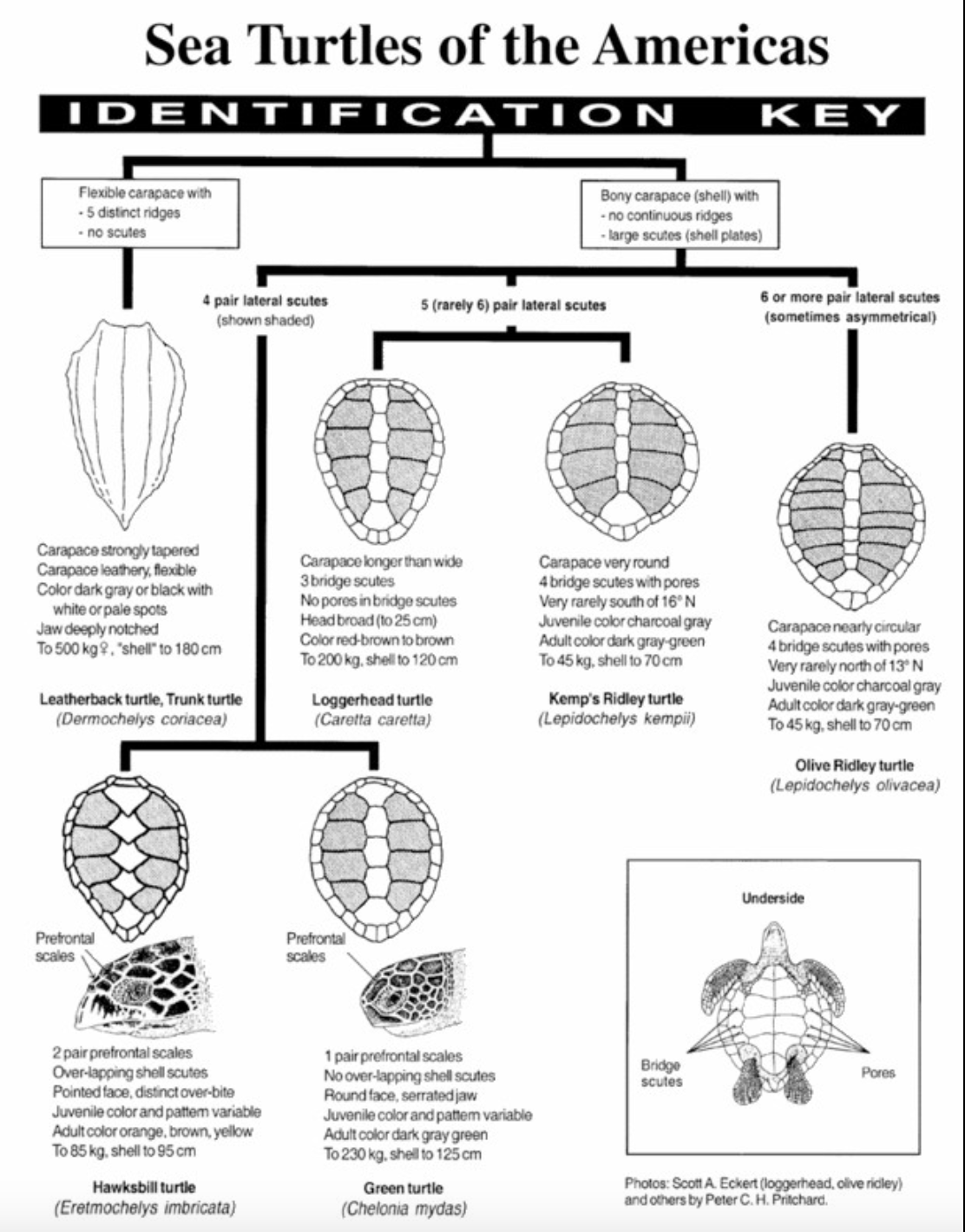
What adaptations are seen in leatherbacks
Thick fat and oil layers retain heat
feed on jellyfish
greatest range of any sea turtle
long-distance migration/ survival in colder temps: very long flippers, shell ridges, large mass, countercurrent heat exchange, subcutaneous fat
different types of sea turtles
leatherbacks
green turtle, chelonia midas: herbivourus adults, one widely exploited
loggerhead, caretta caretta: adult head larger than other species, strong thick jaw
Hawksbill, eretmochelys imbricata: narrow hawk like beak, feed on invertebrates
flatback, natator depressus: flattened carapace
kemps ridley, lepidochellys kempii: smallest & most endangered, one major nesting together
olive ridley, lepidochellys olivacae: likely most abundant species, nest in arribadas
What is an arribada and benefits
Mass nesting event
Benefits predator saturation and increased survival
Briefly describe life history
Hatch on beaches → ocean juvenile stage → adult migration → return to nest
Mating process
copulation in water (insertion)
female may mate with several male
sperm stored for duration of nesting season
female return to natal beach to lay eggs
may lay several clutches of eggs during season but wont reproduce every season
Nesting process
female emerge from water
search for nest site above high tide
dig
eggs deposited
fling sand , disguise nest
return to sea and may nest several more times during season
hatchlings process
average incubation: 50-75 days
24 hour frenzy state making way to water , enter sea, swim offshore to safer deeper waters
what cues do sea turtles use to orient during different phases of their life cycle
Visual Cues: Upon emerging, hatchlings use the bright, low horizon over the ocean to move away from dark, elevated silhouettes (dunes/vegetation).
Wave Direction: They swim into waves to move away from the shore.
Magnetic Compass: Earth's magnetic field as a compass to maintain an eastward (or appropriate direction) heading.
How does temperature affect development and sex
Warmer temperatures produce females
Cooler produce males
What environmental cues do sea turtles use
Visual cues toward ocean
Wave direction offshore
Magnetic fields for migration
Describe experimental design for magnetoreception
Hatchlings exposed to magnetic fields in lab
Orientation changes based on field direction
What are some threats to sea turtles
destruction and alteration of nesting and foraging habitats
vessel strikes
incidental capture/ entanglement in debris
pollution
poaching of eggs or adult turtles
disease
climate change/ sea level rise
🐦 SEABIRDS STUDY QUESTIONS
How are seabirds adapted to life near ocean
water proof feathers
many have salt glands / salt secretion
long wings for gliding
webbed feet for swimming and diving are common
breed in colonies
many migrate considerable distances
seabirds life history timelines compared to songbirds
Reach sexual maturity later: 2-9 years vs. 1-2
years
• Have smaller clutch sizes: 1-5 eggs vs 4-8 eggs
• Longer incubation periods: 20-69 days vs 12-18
days
• Longer time to fledging: 30-280 days vs. 20-35
days
• Longer maximum lifespan: 12-60+ years vs. 5-15
years
What types of seabirds are in each order
Sphenisciformes: penguins
Procellariformes: albratrosses, petrels, shearwaters, fulmars
Charadriiformes: puffins, skimmers, gulls, terns, sandpipers, plovers
Pelecaniformes: pelicans
Suliformes: boobies, gannets, cormorants, frigate birds
Sphenisciformes key features
southern hemisphere (many antarctic, subantarctic)
blubber , thick layer of feathers
countercurrent heat exchange / huddle
flightless/ swim using wings
solid bones = less bouyant
procellariformes key features
most of their lives at sea
large external nostrils/ sensitive to krill and phytoplankton odors
albatrosses (long wing span/ travel great distances)
charadriiformes key features
most diverse group
gulls: predators and scavengers , successful in company of humans
puffins: cold water diving, heavy specialized beaks hold fish
terns: smaller more marine than gulls , arctic= migrate 10,000 miles
threats to seabirds
bycatch
contaminants/ pollutants , oil spills, chemicals
plastic pollution
coastal development = loss of nesting and feeding habitat
toxic algal blooms
climate change
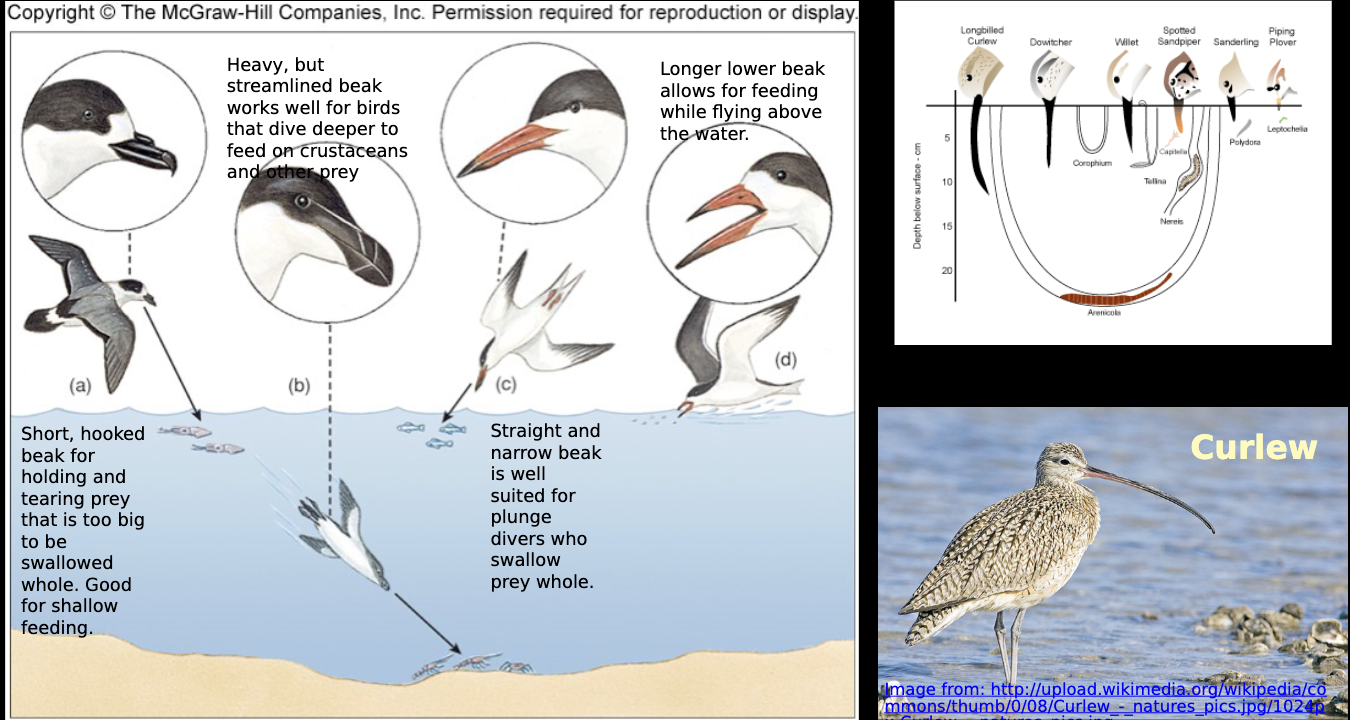
Beak shape and feeding style
A: short, hooked beak for holding and tearing prey that is too big to be swallowed whole. good for shallow feeding
B: Heavy, but streamlined beak. works well for birds that dive deeper to feed on crustaceans and other prey
C: straight, and narrow beak is well suited for plunge divers who swallow prey whole
D: Longer lower beak allows for feeding while flying above the water
E: (curlews) Exceptionally long sensitive downturned beak to probe deep into mud to capture prey
Feeding strategies of specific seabirds
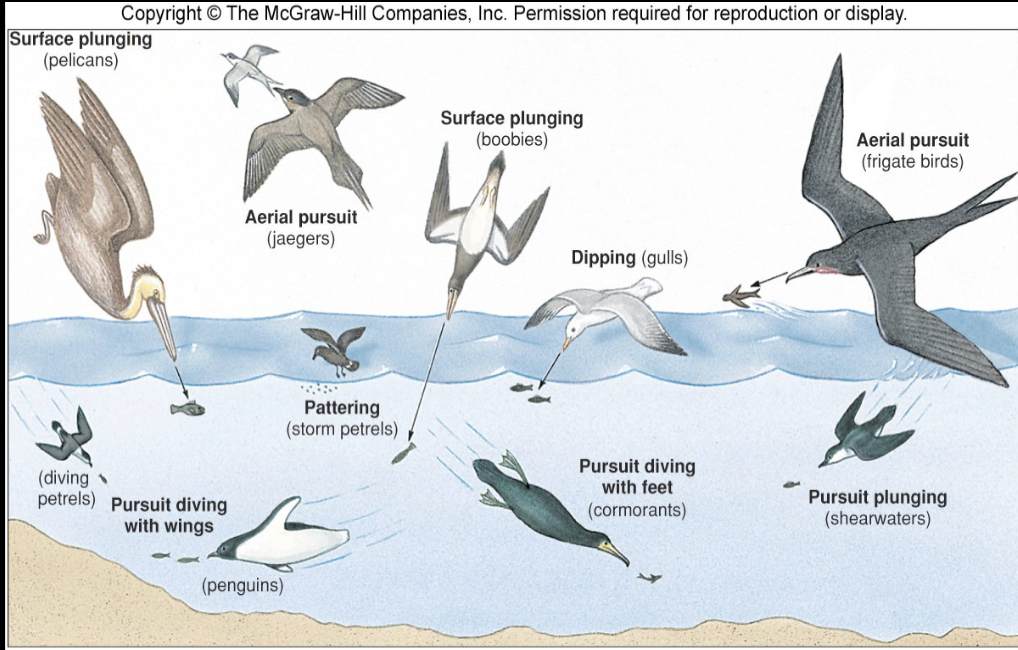
Shorebirds foraging: Birds walk along shorelines probing or picking prey from sand/mud
plunge diving: Birds dive from the air straight into water to catch prey
pursuit diving with feet: Birds use their feet to propel themselves underwater while chasing prey
pursuit diving with wings: Birds use their wings like flippers to “fly” underwater
surface plunging: Birds dip or grab prey from the water surface without fully diving
aerial pursuit: Birds catch prey in midair while flying
skimming: Birds fly low over water with lower bill slicing the surface to catch prey
🐳 MARINE MAMMALS STUDY QUESTIONS
Main marine mammal orders and example animals
carnivora : suborder pinnipedia = true seals, sea lions, fur seals, walruses / polar bears and sea otters
sirenia: manatees , dugongs
cetacea: suborder mysticeti = baleen whales / suborder odontoceti = toothed whales
General adaptations for marine life
thermoregulation: endothermic and homeothermic/ blubber in most/ countercurrent heat exchange/ thick fur in some
reproduction: viviparous = embryo recieve nutrients through placenta , newborns fed milk from mammary gland, low numbers of offspring with lots of parental care
swimming: streamlined, hydrodynamic bodies, spindle shaped, smooth skin, blubber, reduced hair in many, internal genitals, appendages for swimming
Adaptations of mammalian dive reflex / why each beneficial for diving
respiratory adaptations : apneustic breathing , exchange much higher proportion of air in lungs with each breath, collapsable lungs and ribcages
increased storage of oxygen: larger blood volume , large spleen can store and release additional red blood cells during dives, high levels of myoglobin
reduced utilization of oxygen: reduction in metabolic rate, peripheral vasoconstriction= shunting blood flow to brain and heart, bradycardia
Describe anatomy of pinnipeds, polar bears, sea otters, manatees, dugongs
Pinnipeds: Streamlined body, Blubber insulation, Flippers (modified limbs), Walrus tusks (some species)
Polar bears: Thick fur + fat layer, Black skin, Large paws (partially webbed)
Sea otters: Dense fur (no blubber), Webbed hind feet
Manatees: Large, rounded body, Paddle tail, Flippers
Dugongs: Streamlined body, Fluked tail, Flippers
Distinguish between true seals and sea lions
true seals no ear flap , sea lions ear flap
true seals propel with tail/ short flippers , sea lions propel with long strong flippers
true seals flop on belly on land , sea lions can walk with flippers
true seals fatter , sea lions more streamlined
what do crabeater seals eat
antarctic krill
what adaptations facilitate crabeater seals feeding behavior
specialized lobed (lobodontine) teeth that interlock to form a sieve-like filter. They fill their mouths with water and krill, then push the water out, trapping the krill inside
where are weddell seals found
coast of antarctic
what role do leopard seals play in foodweb
apex predators :bridging the gap between top-level carnivores and lower-trophic levels
feeding behavior of walruses
benthic feeders, using whiskers and tusks to dig up and locate prey in shallow, dark seafloor sediment
reproductive behavior of elephant seals
intense male competition: one alpha male mate with all the females and challenge many males daily. if beaten by new male that male becomes alpha
fighting: males will ram heads/ teeth into eachother until one gives up
compare and contrast mysticetes and odontocetes/ distinguishing features
mysticetes: baleen filter feeders, two nostril holes in blowhole
odontocetes: toothed predators echolocate
how are cetaceans adapted for marine life
tail: fluked = up and down propel
streamline body
flippers for steering / some have dorsal fin for stability
reproduction: slow growing, long baby developing in uterus period, typically born tail first to help maintain oxygen connection, members of group help push whale to surface
feeding behaviors of rorquals, right whales/bowhead whales, gray whales
rorquals: engulfment (big throat furrows, swim forward open mouth gulp water and then raise tongue push water out through baleen and then swallow food left)
right whales/ bowhead whales: skimming (swim forward with mouth open shut mouths push tongue up push out water and swallow trapped food in baleen)
bubble nest feeding
gray whales: eats invertebrates at the bottom (still baleen but swim to bottom move head on sediment to stir up and then strain that material out)
what has lead to low population size of north atlantic right whales / how did it get its name
“right” whale to hunt: slow-moving, lived near the coast, floated after death, and yielded high volumes of valuable oil.
lead to brink of extinction
long time to reproduce: Sexual maturity ~10 year, females produce 1 calf, Current interval between calves is 7-10 years (3 years would be healthy/ expected
ship collisions
entanglement in fishing gear
what lead to decline of vaquitas
Critically endangered due to overfishing getting caught in nets
Only about 10 left
Entanglement in gill nets for endangered totoaba is the major cause of decline
what are callosities observed on right whales
thickened, rough patches of skin on right whales’ heads, appearing white or yellowish due to colonies of whale lice
why are whales widely hunted
Oil, blubber, baleen products, tissues, meat food : all used for different household products
function of echolocation / which whales echolocate
Clicks are produced by pushing air from sacs in the nasal
passages through the phonic lipsevaluate environment and catch prey
sound waves bounce of things and tell them how far away/ what around them
toothed whales odontoceti echolocate: killer whales beluga whales, narwhales, dolphins, porpoises , sperm whale
what is the melon
Fatty organ on head focuses sound in echolocation to regulate and focus signal
The melon acts as an acoustic lens to focus sound into a beam
what is the narwhal tusk and its functions
one long tooth
believed to stun prey to eat
possible mating display
distinguish between dolphins and porpoises
Dolphins curved dorsal fins longer snouts
Porpoises smaller blunt faces
what is amergris? what are possible functions of spermaceti organ in sperm whales
Ambergris waxy substance in sperm whales
Spermaceti organ aids buoyancy and sound
why do some whales migrate
take long distance migrations from summer (peak productivity) in polar regions and then move into more equatorial areas and thats where they give birth
what regulations help protect marine mammals
The United States passed the Marine Mammal Protection Act in 1972
Protects all marine mammals (not only whales)
Prohibits (with certain exceptions) the "take" of marine mammals in U.S. waters and by U.S. citizens on the high seas, and the importation of marine mammals and marine mammal products into the U.S.
“Take” = touching, killing, injuring, collection or harassment of marine mammals