6.1, 6.2, and 6.4 - The Great War (WWI)
 Call Kai
 Learn
Learn Practice Test
 Spaced Repetition
 Match
Match Flashcards
 Knowt Play
1/46

Earn XP
Description and Tags
Name | Mastery | Learn | Test | Matching | Spaced | Call with Kai |
|---|
No analytics yet
Send a link to your students to track their progress
47 Terms
Major powers in Europe pre-WWI
England, France, Russia, Germany, Italy, and Austria-Hungary
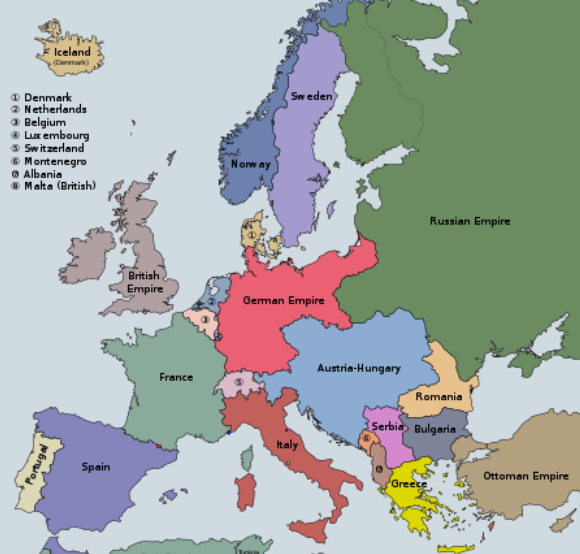
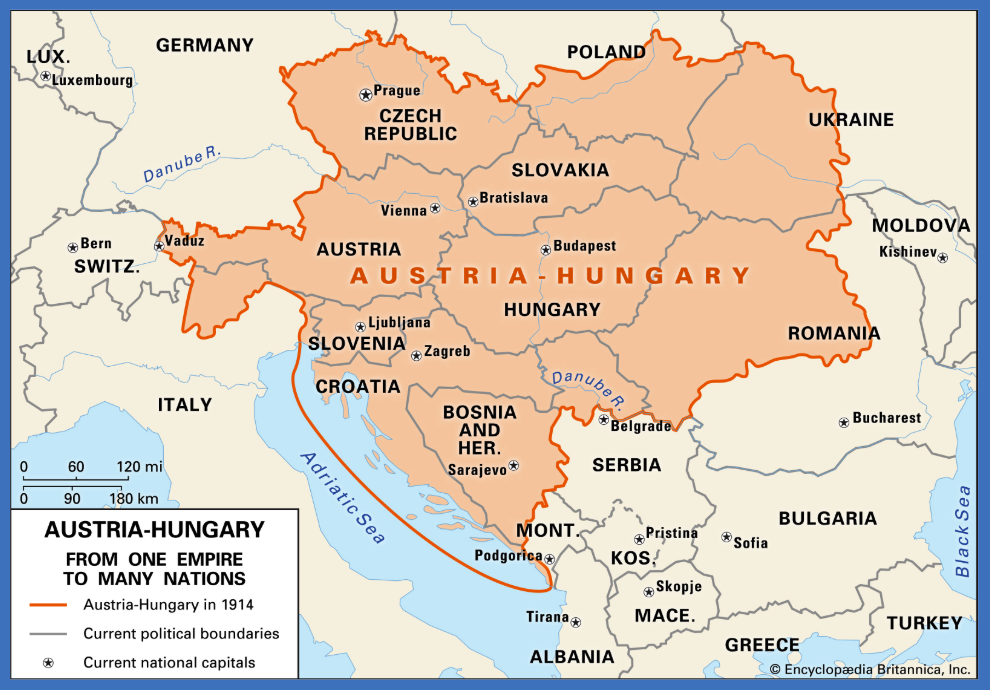
Austria-Hungary
Encompassed a multitude of different ethnic and language groups
encompassed ethnic/language groups such as Czechs, Slovaks, Hungarians, Romanians, Bulgarians, & Slavs
state that contains many nations
Ruled by Franz Joseph, with his nephew, Archduke Franz Ferdinand as the heir to the throne
Run by the Hapsburg family
perhaps the most powerful family in the world at the time.
Ottoman Empire
The Ottomans were slowly declining
They had already lost all of their territory in Africa, and were losing most of their land in Eastern Europe (the Balkans)
The Balkan states fought 2 separate wars in 1912 and 1913
Balkan Wars
First war = Balkan states came together to form the Balkan League to defeat the Ottoman Empire (basically a war for independence)
Second war = Balkan states begin to fight each other for the spoils of war
In the end, these wars expanded Serbia and created an independent Albania
MAIN Causes of WWI
Militarism
Alliances
Imperialism
Nationalism
Militarism
Glorifying military power and keeping a strong army
Having a large and strong standing army made citizens feel patriotic
but it also concerned peace advocates, who worried that it would turn any small conflict into war
Always being ready to use the army aggressively to protect or advance the nation’s interest
When you have a huge military, there’s pressure to use it. Generals in each country developed highly detailed plans of mobilization. This made diplomacy harder.
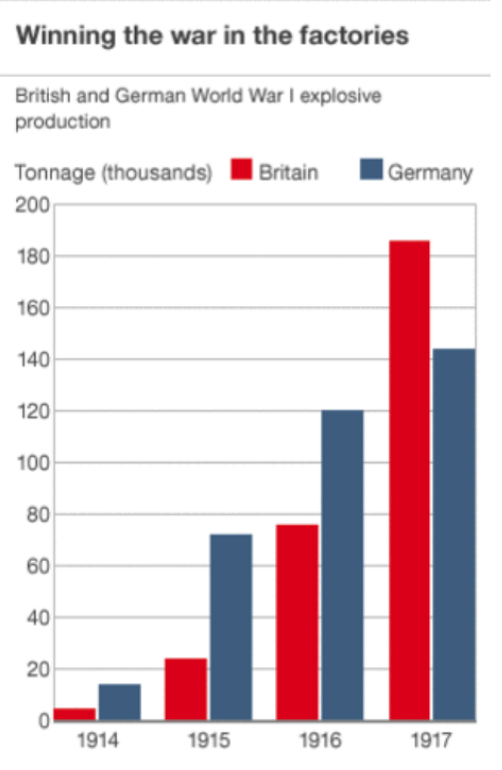
Militarism in Europe pre-WWI
For over a century, Britain had the largest navy, but Germany decided to challenge that and began building a massive fleet of warships → Britain responds by building MORE ships → Germany does the same → so on and so forth
It wasn’t just navies, every major power was expanding their armies
Russia had 6 million soldiers
Germany had 4 million soldiers
France increased length of military service
Growth of German Empire
Otto von Bismarck - Prime Minister of Prussia / Iron Chancellor
The guy who organized the Berlin Conference
Goal - make Germany the strongest industrial and military power
unified the German states in the 1860s and 70s
Franco-Prussian War (1870-1871) & Alsace-Lorraine
After unification of Germany, Bismarck turns back to peacemaking
believed the biggest threat to peace was France. So, he made alliances with Austria-Hungary, Italy, and Russia
1890 - Kaiser Wilhelm II got rid of Bismarck and further militarized Germany
let the agreement with Russia lapse. This pushed Russia to ally with a longtime rival, France
Franco-Prussian War (1870-1871)
a united Germany emerged victorious & powerful, and they seized the economically and culturally valuable Alsace-Lorraine from France
Prussia
German State
Alliance
Agreement between nations to aid and/or protect one another
Defensive alliance
Agreement to come to aid if other country is attacked
Non-aggression pact
Agreement not to attack one another
Entente
Informal alliance
Neutral
Staying out of it; only obligation is to not get involved (unless attacked)
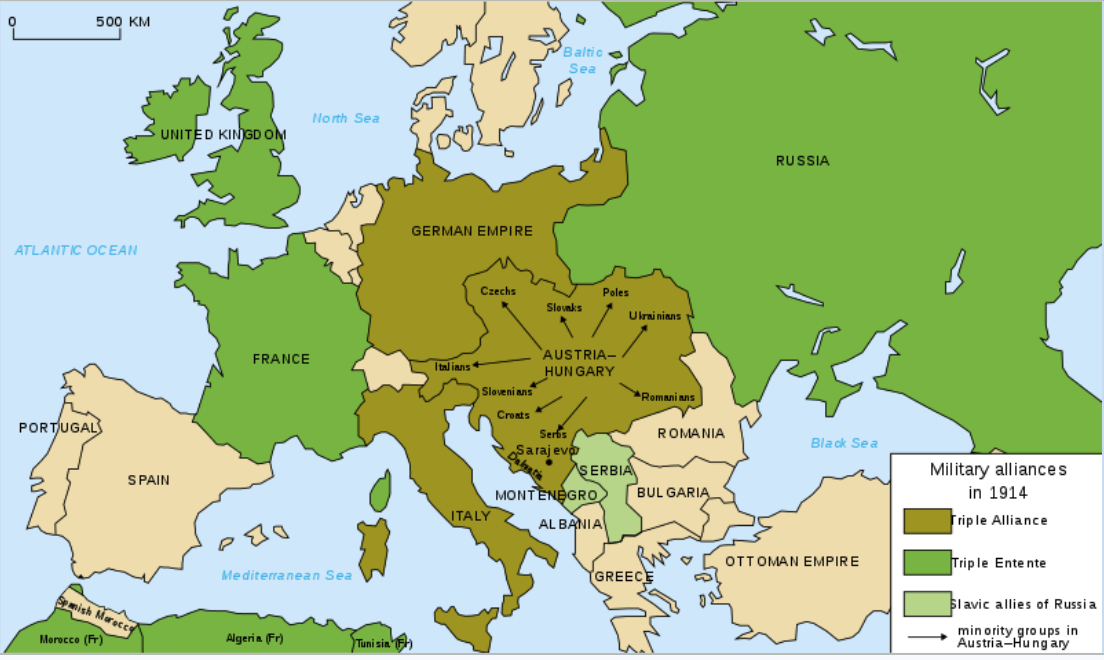
Intricate and sometimes secret alliances
Austria-Hungary had an agreement with Germany who had an agreement with Italy. Meanwhile, the Ottoman Empire was allied with Germany against Russia
Serbia had an agreement with Russia who had and agreement with France who had an agreement with Great Britain who had an agreement to protect Belgium’s neutrality
Triple Alliance
Germany forms Dual Alliance in 1879 with Austria-Hungary (“blank check”) - then Italy joined a little more informally
Triple Entente
Due to Germany’s shipbuilding campaign, Great Britain forms entente with France and Russia
Russia has agreements to protect Slavic allies (Serbia and Montenegro)
Belgium is neutral, and Britain has agreed to protect their neutrality
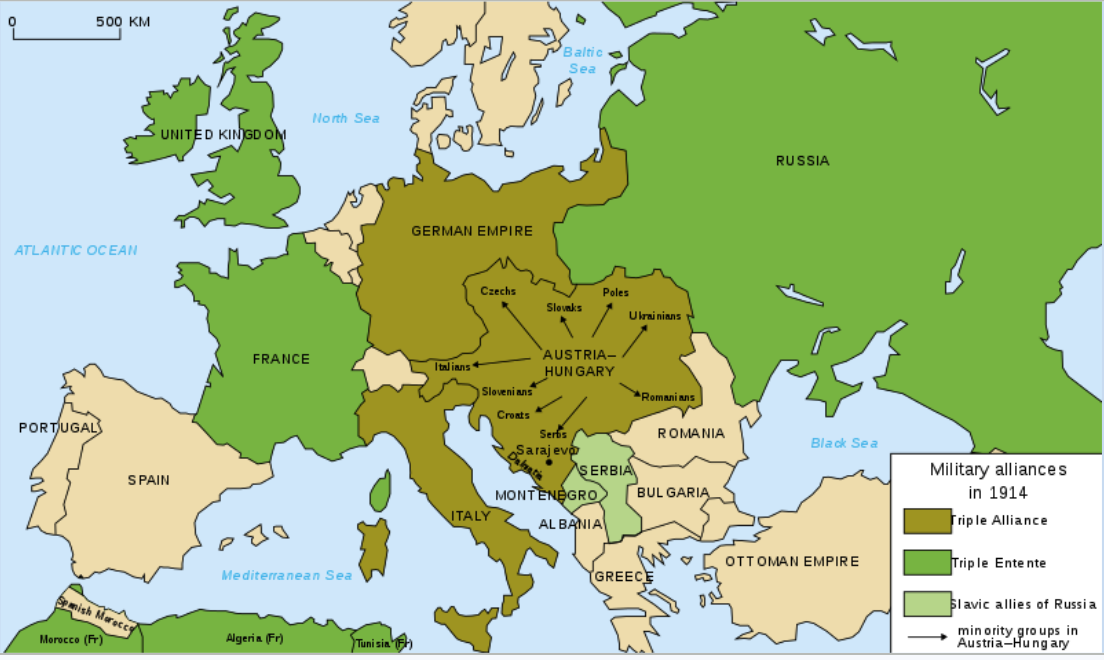
Imperialist Rivalries
Industrial growth → COMPETITION!
Competition over colonial markets and resources
Imperialism meant that European powers were already suspicious of one another.
They were looking for ways to gain advantage over their rivals. Any opportunity to weaken their competitors, they would take
Germany’s aggressive pursuit of colonies disturbed England and France
Nationalism
State borders = Nation borders
Intense pride in nation
The Black Hand
People wanted to expand to show that their country was the best
The Balkans = “Powder Keg of Europe”
The Balkans
Nationalism
Ethnic rivalries among the Balkan peoples
Serbia wanted the region to unite all Serbs under one nation (Pan-Slavism)
Both Russia & Austria-Hungary wanted to control the Balkans
Austria-Hungary annexed Bosnia & Herzegovina in 1908
The Black Hand
The Black Hand was a secret Serbian nationalist organization founded in 1911
Goals:
Unite all Slavs (Serbs, Croats, Bosnians, etc.) into one large Serbian state
Drive Austria-Hungary out of the Balkans completely
Use violence and terrorism to achieve these goals (believed diplomacy would fail)
Assassination of Archduke Franz Ferdinand
Archduke Franz Ferdinand (heir to the throne of Austria-Hungary) visits Sarajevo (capital of Bosnia & Herzegovina) with his wife in June 1914
Threw a parade
Black Hand believes assassinating the Archduke will lead to Bosnia’s independence and a Slavic state, but this ends up being the event that starts WWI.
Teenaged Bosnian Serb nationalist Gavrilo Princip, member of Young Bosnia & the Black Hand, assassinated the Archduke and his wife on June 28, 1914
“The Shot Heard Around the World”
July Crisis
Following the assassination of Archduke Franz Ferdinand and his wife, Austria-Hungary blamed Serbia for the assassination, and issues them an impossible ultimatum.
Everyone begins gearing up for a possible war.
Guns of August
Serbia is unable to fulfil ultimatum, so AH declares war.
Mobilizations at the beginning of August → Domino effect from Alliance system
chain reaction of war declarations
Mobilization
Young men were eager to go to battle to prove their courage. No one had experience a major European war in 50 years and clearly had forgotten how terrible war could be. They had no idea what they were in for.
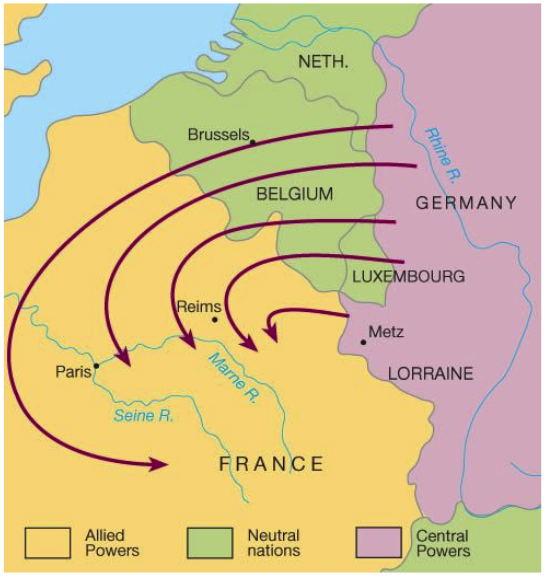
Schlieffen Plan
Germany’s plan to avoid a two-front war was to quickly defeat France in the West and then head East to fight Russia
Relied on German speed and slow Russian mobilization
couldn’t go through the Germany/France border because of heavy fortifications after the Franco-Prussian war
Decided to go through the North (through Belgium) to surprise the French
Belgium takes this as a declaration of war (and a threat to their neutrality), so they enter the war, and so does Great Britain
Due to Britain's agreement to protect Belgium’s neutrality
The Allied powers in 1918
Great Britain, France, Russia, Japan, and Italy (who believed their former alliance (Germany) unjustly started a war)
The Central powers in 1918
Germany & Austria-Hungary, then joined by Bulgaria & the Ottomans (who hoped to regain lost territories)
First Battle of the Marne
Early September of 1914, Allies regrouped and attacked the Germans in the valley of the Marne river
First major clash on the Western Front
Germans were forced to retreat
Western Front
German border with France
front extending from the Belgian coast through northern France to the Swiss border
Quickly turned to stalemate
no one winning or losing
Eussa was ready faster than expected so the Germans had to split their forces
Trench Warfare
Soldiers fought each other from trenches
Primarily on the Western front
Huge losses of human life for small gains in territory
Life in the trenches was pure misery: mud, rats, no fresh food, impossible to sleep
Many were dug by Chinese laborers
No Man’s Land
area between the opposing trenches
Miles in width and an average of about 250 yards across
Littered with barbed wire, corpses, and landmines
Battle of the Somme
July-November 1916
Near Verdun the Germans were pressuring French forces
Western front
British and French against the Germans
Most deadly battle
On the 1st day over 20,000 British soldiers were killed
each side had over half a million casualties
the British gained only 5 miles
Eastern Front
Along the borders of Germany/Austria-Hungary and Russia
Russia and Serbia vs Austria-Hungary and Germany
Much more mobile war than on the Western Front
little to no trench warfare
Russia’s involvement in the war was critical to the Allies
made the war a 2-front war for Germany
Russia in WWI
Even though they had the largest army they were behind with technology, lacked supplies
Lacked strong leadership so tactics weren’t good
The Ottomans still controlled the Black Sea to it was hard for the Allies to get supplies to Russia
Russians had some initial success pushing into German territory
The Germans crushed the Russians in the Battle of Tannenberg
the Russians had to fully retreat from the area and lost 30,000 soldiers over four days.
Gallipoli
Turkey cut off the Allies’ supply route through the Dardanelles
By securing the Dardanelles, the Allies believed that they could take Constantinople, defeat the Turks, and establish a supply line to Russia.
The effort to take the Dardanelles strait began in February 1915. It was known as the Gallipoli campaign. By May, Gallipoli had turned into another bloody stalemate.
British, Australian, New Zealand, & French troops against Turkish troops led by German officers
Both sides dug trenches, from which they battled for the rest of the year. In December, the Allies gave up the campaign and began to evacuate. They had suffered about 200,000-250,000 casualties.
Result:
200,000 Allied casualties after a failed land assault
Bloody stalemate/trench warfare → Allies give up
U.S. Entry into WWI
Unrestricted submarine warfare = German policy saying that their submarines would sink without warning any ship in the waters around Britain
Germans sunk a British passenger ship with 128 Americans on it
President Woodrow Wilson said if Germans don’t stop unrestricted submarine warfare, America will enter WWI
Stopped until 2 years later
In February 1917, British officials intercepted a telegram written by Germany's foreign secretary, stating that Germany would help Mexico "reconquer" the land it had lost to the United States if Mexico would ally itself with Germany.
On April 2, 1917, President Wilson asked Congress to declare war
Total War
Whole society contributes to the war effort
Home Front
people at home are a part of the war effort
converting factories
rationing
women working
Propaganda
Publicized information, especially of a biased or misleading nature, designed to influence our opinions and behaviors to support a cause or point of view
Russo-Japanese War
Meiji restoration allows Japan to beat Russia easily
News of repeated Russian losses sparked unrest at home
“No War, No Peace” (1918)
Leon Trotsky
stop fighting the Germans, but don’t accept peace terms
The Germans invade Russia which is all but defenseless as virtually the entire army has deserted
The Bolsheviks accept the dictated peace of Brest-Litovsk and exit WWI (Treaty of Brest-Litovsk)
Second Battle of the Marne (July 1918)
Germans now able to send all of their troops to the Western Front
Initially pushed the front back to the Marne
However, German men and supplies have been exhausted
Allies launch a counterattack
Addition of American troops and 350 tanks
Advanced towards Germany
Allies win
Final Battle of WWI
The Big Four
Woodrow Wilson (United States)
Georges Clemenceau (France)
David Lloyd George (Great Britain)
Vittorio Orlando (Italy)
Meet at 1919 Paris Peace Conference and shaped the Treaty of Versailles
Treaty of Versailles
Signed on June 28th, 1919 (5 years to the day of the assassination).
Even though Wilson signed the treaty, the U.S. congress refused to ratify it, and thus they didn’t join the League of Nations.
War Guilt:
Sole responsibility for the war placed on Germany’s shoulders
Reparations:
Germany forced to pay the Allies $33 billion in reparations over 30 years
Military Power:
Limit set on the size of the German army
Germany prohibited from importing or manufacturing weapons or war materials
Germany forbidden to buy submarines or have air force
Colonies:
Germany returns Alsace-Lorraine to France → French border extended to west bank of Rhine River
Germany surrenders all of its overseas colonies in Africa and the Pacific
League of Nations:
International peace organization; Germany and Russia initially excluded
League of Nations mandates
The Allies didn’t think relinquished colonies were ready to rule themselves
Mandate = administrative oversight to “prepare” them for self-rule
Divided based on location and level of political/economic development
Class A: Former Ottoman territories
Class B: Former German colonies in Africa
Class C: Former German colonies in the Pacific