N.M.R spectroscopy
 Call Kai
 Learn
Learn Practice Test
 Spaced Repetition
 Match
Match Flashcards
 Knowt Play
1/42

Earn XP
Description and Tags
Name | Mastery | Learn | Test | Matching | Spaced | Call with Kai |
|---|
No analytics yet
Send a link to your students to track their progress
43 Terms
What is N.M.R spectroscopy used for?
Determining the structures of molecules.
What are the two types of nmr spectroscopy?
Proton (1H) nmr.
Carbon 13 (13C) nmr.
What does carbon 13 nmr tell us about the arrangement of atoms in a molecule?
Carbon 13 nmr tells us how carbon atoms are arranged in a molecule.
What does proton nmr tell us about the arrangement of atoms in a molecule?
Proton nmr tells us how hydrogen atoms are arranged in a molecule.
True or false? If an atomic nucleus has an odd number of nucleons (protons and neutrons) then it has nuclear spin.
True.
True or false? Nuclear spin creates a strong magnetic field.
False. NUCLEAR SPIN CREATES A WEAK MAGNETIC FIELD.
How does nmr work in terms of magnetic fields?
It detects how the weak magnetic fields generated by nuclear spin are affected by a larger, external magnetic field.
Why are 1H and 13C used for nmr?
They both have an odd number of nucleons in their nuclei so will have nuclear spin and therefore have a weak magnetic field.
Is 12C or 13C more abundant?
12C
True or false? Nuclei spin in random directions.
True.
True or false? Nuclei continue spinning in random directions even when an external magnetic field is applied.
False. WHEN AN EXTERNAL MAGNETIC FIELD IS APPLIED, NUCLEONS EITHER ALIGN WITH THE MAGNETIC FIELD OR AGAINST THE MAGNETIC FIELD.
Compare the energy of the nuclei that spin in the direction of the magnetic field versus the nuclei that spin against the direction of the magnetic field.
The nuclei that spin in the direction of the magnetic field have a lower energy than the nuclei that spin against the direction of the magnetic field.
How does nmr work in terms of radio waves?
1) nmr sends out radio waves.
2) At a specific frequency of these radio waves, nuclei that are aligned with the external magnetic field absorb the energy causing them to flip direction (go against direction of magnetic field) and increase in energy.
3) Nuclei with higher energy can also emit radio waves and drop in energy.
4) There are initially more nuclei aligned with the magnetic field, so more energy is absorbed than emitted.
5) nmr measures the amount of energy absorbed.
What does the energy absorbed by a nucleus depend on?
It depends on the environment that the nucleus sits in.
How can a nucleus be shielded from an external magnetic field?
It can be shielded by electrons surrounding it aka the environment it is in.
True or false? A more electronegative element near a carbon will decrease the electron shielding on the carbon.
True.
True or false? Only the adjacent atoms bonded to the carbon will affect the electrons shielding on the carbon.
False. THE ENTIRE MOLECULE AND HOW IT SURROUNDS THE CARBON WILL AFFECT THE ELECTRON SHIELDING ON THE CARBON.
Name and give the formula of the chemical used as a standard when looking at chemical shift in nmr spectra.
Tetramethylsilane (TMS) (Si(CH3)4).
Why is a standard for chemical shift used in nmr?
It is really difficult to accurately measure chemical shift without a standard, a standard means you can then compare chemical shift within different molecules too making it easier to identify them.
Draw the displayed formula of TMS.
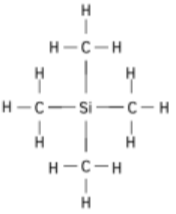
Why is TMS used as a standard in nmr?
TMS contains 12 hydrogens in identical environments, so will produce a single large peak for that far from peaks caused by the sample.
It is inert, non-toxic, and volatile so easy to remove from the sample.
What is chemical shift?
The difference between the TMS peak and the peaks produced by the sample.
What is the chemical shift of the TMS peak?
0 ppm.
What is chemical shift measured in?
Parts per million (ppm).
True or false? TMS is used to calibrate nmr machines when analysing samples.
True.
What does the number of peaks on a carbon 13 nmr spectrum tell us about a molecule?
The number of different carbon environments in a sample.
The nearer to an electronegative element in a molecule (so the lower the electron shielding), the … the chemical shift.
Greater.
True or false? It is easier to predict the nmr spectra of cyclic compounds than those of non-cyclic compounds.
False. IT IS HARDER TO PREDICT THE NMR SPECTRA OF CYCLIC COMPOUNDS THAN THOSE OF NON-CYCLIC COMPOUNDS.
Talk me through how to work out the structure of a molecule when you have it’s nmr spectrum (carbon 13) and formula.
1) Draw out all the possible molecules this formula could give.
2) Work out how many environments are shown in the nmr spectrum.
3) Work out how many carbon environments are in each molecule, rule out any that don’t have a matching environment to the number shown by the nmr spectrum.
4) Look at how many carbons are bonded to electronegative elements in each molecule, choose the molecule that best matches the spectrum.
What does proton nmr tell us about a molecule?
How many different hydrogen environments there are.
How many hydrogens are in each hydrogen environment.
What does the number of peaks tell us about a molecule in proton nmr?
The number of peaks equals the number of different hydrogen environments in the molecule.
What are integration ratios/integration traces and what do they tell us?
The ratio of the area under each peak in the nmr spectrum. They tell us the relative number of hydrogens in each hydrogen environment.
True or false? Integration numbers can sometimes be decimals.
True.
What is splitting pattern?
When peaks on a proton nmr spectrum split into multiple smaller peaks.
What does splitting pattern tell us?
The number of hydrogens in the carbon environment adjacent to the environment responsible for the peak.
Give the rule for splitting pattern.
n + 1
(n = number of hydrogens in environment adjacent to one responsible for the peak).
What do you call a peak with no splitting pattern? How many hydrogens are in the adjacent environment?
Singlet. No hydrogens in adjacent environment.
What do you call a peak split into two? How many hydrogens are in adjacent environment?
Doublet. One hydrogen in adjacent environment.
What do you call a peak split into three? How many hydrogens are in the adjacent environment?
Triplet. Two hydrogens in adjacent environment.
What do you call a peak split into four? How many hydrogens are in adjacent environment?
Quartet. Three hydrogens in adjacent environment.
In proton nmr why are sample dissolved in non-hydrogen based solvents?
This would confuse and show up on the spectrum.
What sort of solvents are used for samples in proton nmr and why?
Deuterium (2H) based solvents, as there is an even number of nucleons in the nucleus of deuterium it will have no effect on the spectrum produced.
What solvent is often used in carbon 13 nmr and why?
Tetrachloromethane. The number of nucleons in the carbon nucleus is even so it won’t appear in the spectrum.