Physiology Unit 4
 Call Kai
 Learn
Learn Practice Test
 Spaced Repetition
 Match
Match Flashcards
 Knowt Play
1/122

There's no tags or description
Looks like no tags are added yet.
Name | Mastery | Learn | Test | Matching | Spaced | Call with Kai |
|---|
No analytics yet
Send a link to your students to track their progress
123 Terms
heart rate times stroke volume
How is cardiac output calculated?
it increases
During exercise, what happens to cardiac output?
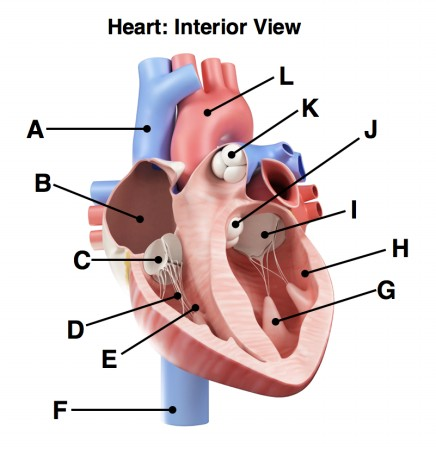
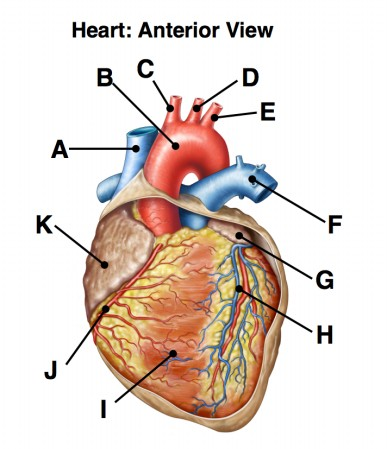
Superior vena cava
Identify the vein labeled “A”:
6;2
There are __ large veins carrying blood to the heart and _ large arteries carrying blood away from the heart.
Aortic semilunar; Aorta
The left ventricle pumps oxygenated blood through the _____ valve and to the _____.
Left Ventricle
After blood flows past the bicuspid valve, it next enters this chamber:
Right ventricle
After passing through the tricuspid valve, a drop of blood would next enter this chamber:
Epicardium
The visceral layer of the serous pericardium is also known as the:
True
The heart is the size of a fist, found in the mediastinum, left of the midline.
Pulmonary circuit
The circuit involving the right ventricle pumping blood to the lungs is the:
Coronary circuit
This very short circuit supplies and drains the heart muscle:
Ventricles
The lower chambers of the heart, the pumping chambers, are known as:
Interatrial septum
The wall separating the 2 upper chambers is known as the:
leader of a marching band
The cardiac conduction system is much like:
return
Veins always _____blood to the heart.
waste
Carbon dioxide is the other respiratory gas (besides oxygen) carried in the blood. It is produced as a byproduct from the chemical reaction of cellular respiration. Based on this information, classify carbon dioxide:
QRS complex
Which portion of the ECG tracing is due to depolarization of the ventricles?
Purkinje fibers
Portion of the cardiac conduction system found in the ventricles, which allows the ventricles to contract in a coordinated manner:
systole
The contracting phase during the cardiac cycle is known as:
diastole
During this low pressure phase, the semilunar valves close to prevent the backflow of blood into the ventricles from the great vessels. The second heart sound is heard.
Papillary muscles
Identify the structure labeled G
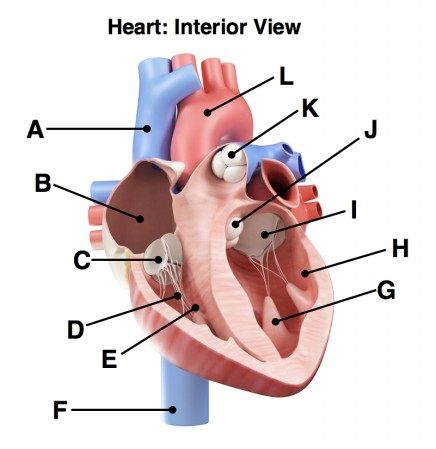
Bicuspid
Identify the atrioventricular valve labeled I:
roads
Let’s now look at the major arteries and veins that supply much of the body. It will be like naming all the _____ in the city.
Superior Vena Cava
Identify the structure labeled A
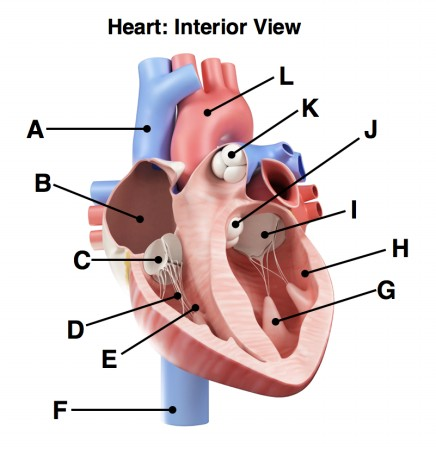
Right atrium
Identify the structure labeled B
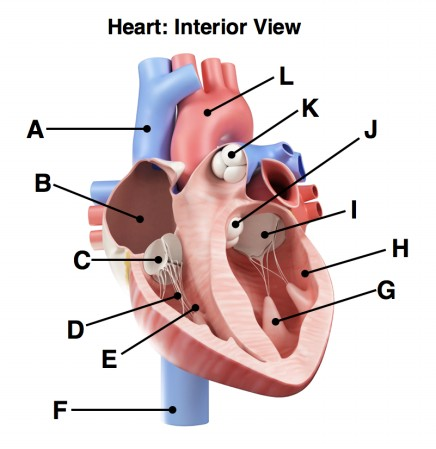
Tricuspid
Identify the structure labeled C
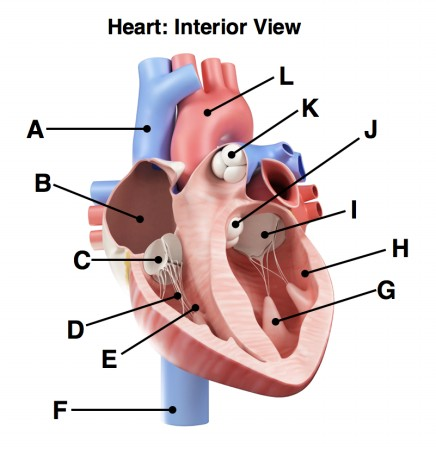
chordae tendinae
Identify the structure labeled D
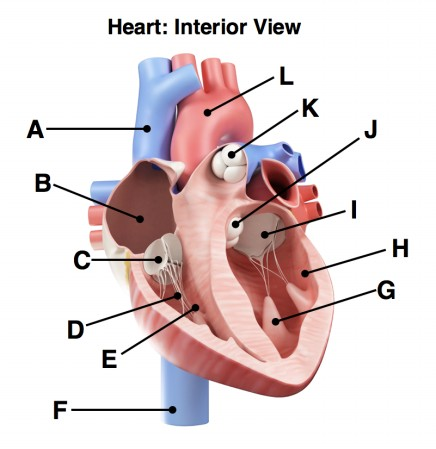
Aortic semilunar
Identify the structure labeled J
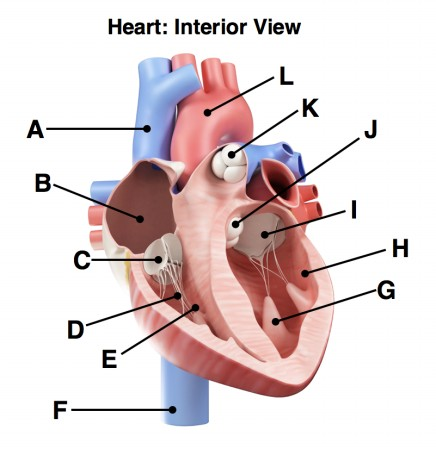
pulmonary semilunar
Identify the structure labeled K
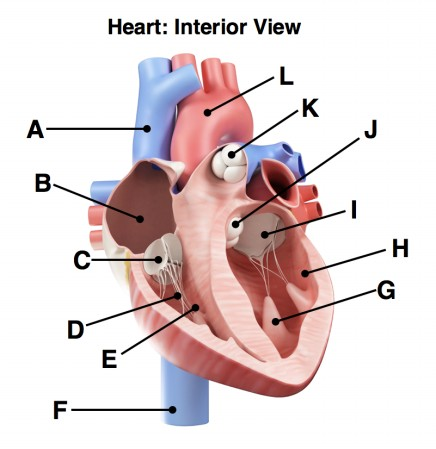
Left Subclavian
Identify the structure labeled E
Axillary artery
Once the subclavian artery travels into the armpit region, its name changes to:
Coronary arteries
These blood vessels supply oxygenated blood to the heart muscle itself:
Left Subclavian artery
This branch of the aortic arch travels under the clavicle and supplies oxygenated muscle to the left upper limb.
Common Iliac arteries
The abdominal aorta branches or splits into these terminal branches:
True
Capillaries interconnect, almost like a spider web, in order to supply an area of tissue with nutrients and oxygen.
BP will increase
Cardiac output and peripheral resistance have direct effects on blood pressure. What will happen to blood pressure when cardiac output increases?
BP will decrease
Cardiac output and peripheral resistance have direct effects of blood pressure. What will happen to blood pressure when peripheral resistance decreases (vasodilation)?
veins
Which vessels have valves in their tunica intima, to prevent the backflow of blood?
veins
Which vessels carry blood toward the heart?
arteries
Which vessels retain a tubular shape and are able to withstand high pressure?
Subclavian vein
This vein specifically drains deoxygenated blood from the upper limb:
Median Cubital vein
This superficial “connecting” vein in the crux of the elbow is often the site of venipuncture:
Brachiocephalic vein
The jugular vein merges with the subclavian vein to form the:
Femoral vein
This large vein in the anterior thigh drains deoxygenated blood from the lower limb. As it descends, its name changes to external iliac vein.
120 mm Hg
Which of the following is considered the high end of normal systolic pressure?
Diastolic pressure
Which is the lowest pressure in the arteries?
80 mm HG
Which is considered a normal reading for diastolic pressure?
Peripheral Resistance decreases
What happens to peripheral resistance when the diameter of the blood vessel lumen increases?
Peripheral Resistance increases
What happens to peripheral resistance when the viscosity, or thickness, of the blood increases?
Aorta
Identify the structure labeled B
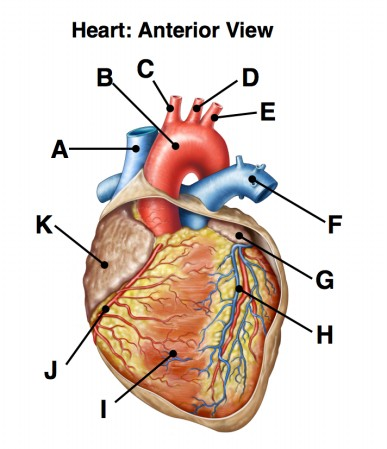
Brachiocephalic
Identify the structure labeled C
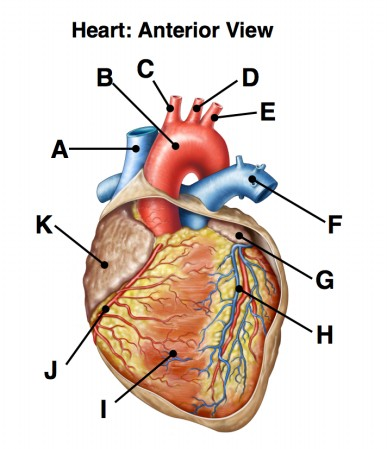
left common carotid
Identify the structure labeled D
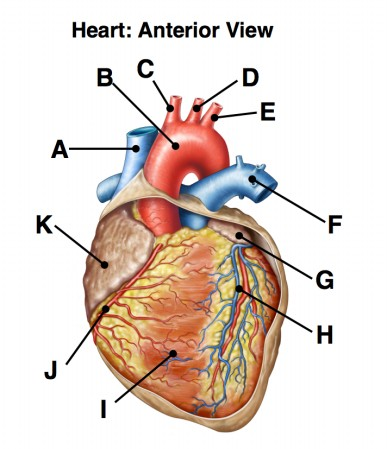
left Pulmonary artery
Identify the structure labeled F
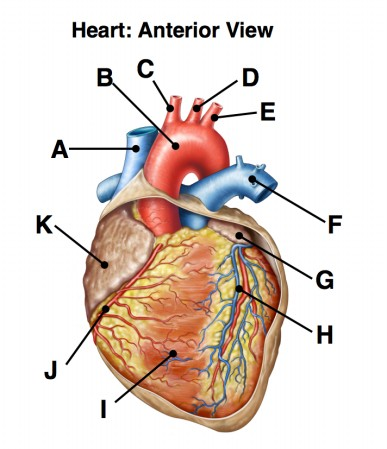
Right atrium
Identify the structure labeled K
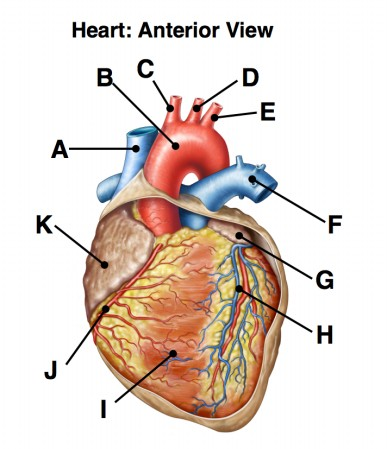
Coronary arteries
Identify the structure labeled J
46%
Which of the following is a normal value for hematocrit?
low red blood cell numbers, anemia
What may a hematocrit of 30 % indicate?
hematocrit
The percentage of red blood cells in our blood is known as the:
Thrombocytes
Another name for platelets is:
bleeding and bruising
Thrombocytopenia means low platelet numbers. What would be a symptom in someone who has thrombocytopenia?
fibrinogen
This plasma protein functions in blood clotting:
water
Which of the following is the main component of plasma?
True
Nutrients, salts and wastes are also found in the plasma.
low air pressure, harder to capture oxygen, make more red blood cells
Why does hematocrit rise when you go skiing in the mountains?
True
Blood is a connective tissue consisting of the non-living plasma and the living cells.
plasma
Nitrogenous waste from normal protein breakdown includes uric acid and urea. It is not good to have too many (ammonia is toxic at high levels). The blood _____ continuously transports these toxic compounds to the kidneys for elimination, all part of homeostasis.
to fight against infection
The overall role of leukocytes is:
Neutrophil
This is the most abundant leukocyte, and the first to respond to an infection. It acts to destroy bacteria.
a bacterial infection
A person has a fever, sore throat, and an increased number of neutrophils in their blood. They most likely have:
carbon dioxide
In addition to transporting oxygen, which binds to the iron of the heme portion, hemoglobin can also transport:
transport oxygen
What is the main function of erythrocytes?
the iron of heme
Oxygen binds to this portion of hemoglobin:
AB
A person who has both A and B antigens or their red blood cell membranes would be blood type:
Erythrocytes
Red blood cells are also known as:
garbage truck
The lymphatic system is like a _____ _____ picking up interstitial fluid.
lymphatic
The thymus gland is a ________ organ.
small intestine
The Peyer’s Patches are lymphatic organs in the _________.
Subclavian veins
Both the right lymphatic duct and the thoracic duct will return the lymph to venous blood. They do this at the:
right lymphatic duct
Lymph from the right upper limb or right side of the head is collected by the:
True
The thoracic duct collects 75 % of the lymph from the body while the right lymphatic duct collects 25 %.
Tonsils
This is a ring of lymphatic tissue in the pharynx, which functions to trap and remove pathogens coming in air or food:
Lymph nodes
These tiny lymphatic organs are found clustered along the lymphatic vessels and they cleanse the lymph, removing pathogens and cancer cells.
Spleen
This is the largest lymphatic organ, and its functions to cleanse the blood of pathogens and old red blood cells.
lymphocyte number increases
If lymphocytes, proliferate due to an infection, this means:
Appendix
Peyer’s patches have the same function as _____ to prevent bacteria from penetrating the wall of the digestive tract.
mediastinum
The thymus is located in the:
dead leukocytes
What are the white spots on the tonsils when you have a sore throat?
bone marrow and thymus
Lymphocytes are made and mature in the:
to drain excess tissue fluid
There is a type of swelling in the leg is known as lymphedema. It can occur if lymphatic vessels in the leg are blocked or damaged. This is because one function of lymphatics is:
True
The lymphatic system consists of lymphatic organs and lymphatic vessels.
fats
Which of the following dietary nutrients are absorbed into the lymphatics?
interstitial fluid
Lymph is found inside lymphatic vessels. When that fluid was in the tissue spaces, it was called:
valves in their walls
Lymphatic vessels are similar to veins in that they transport lymph towards the heart and also they have:
different
Lymphatic capillaries are blind ended, meaning they have a beginning, and are therefore ________than blood capillaries, which are a link between arteries and veins.
holes (fenestrations) in their walls
Since lymphatic capillaries are closed at one end (they are blind ended), there must be a way for substances to enter into them. Interstitial fluid enters these vessels by way of:
lymph nodes
These bean shaped organs are scattered along the lymphatic vessels and they function to clean the lymph (eg. remove pathogens):
albumin
This plasma protein contributes to the osmotic pressure of the blood, meaning it helps hold water in the blood.
Plasma
The non-living, non-cellular component of blood is known as the:
platelets
We need __________every day to clot the leaks in the tiny capillaries just due to normal wear and tear.
connecting, connective
The blood in your toes, will go to your heart and then to your head, etc. It’s _____ all those tissues making it a fluid _____ tissue.