Climate Change Impacts the Deep Sea
 Call Kai
 Learn
Learn Practice Test
 Spaced Repetition
 Match
Match Flashcards
 Knowt Play
1/52

There's no tags or description
Looks like no tags are added yet.
Name | Mastery | Learn | Test | Matching | Spaced | Call with Kai |
|---|
No analytics yet
Send a link to your students to track their progress
53 Terms
The deep sea faces multiple threats including
over-extraction (living and non-living), pollution, and climate change
These anthropogenic impacts on the deep sea are likely to be _, and should be considered together
synergistic
How do synergistic impacts affect an organism's capacity?
Multiple threats tax organisms so heavily that they exhaust their capacity for adaptation, making the overall impact much worse than individual threats added together
Why is it important to consider deep-sea impacts together rather than individually?
Because they are synergistic; looking at one threat in isolation underestimates the true damage to the community.
Larval transport is likely to be impacted by both
mineral extraction and climate change → the way larva move from one place to another will be impacted by physical activities of mining and by the chemical and temperature changes associated with climate change
If you identify key habitats and you prevent fishing or other activities in certain marine protected areas, then it can lead to
more fish being available and increased fisheries yield outside of that MPA
There is a lot of carbon in the atmosphere, and a lot of it is dissolved in
the ocean
There is lots of organic carbon in bodies of organisms in
the ocean and on land. And the fluxes being the movement between those different reservoirs.
What are the three primary reservoirs of carbon mentioned?
1. The atmosphere
2. Dissolved in the ocean
3. Organic carbon in the bodies of organisms (land and sea).
In the context of the carbon cycle, what is a Flux?
The movement of carbon between different reservoirs.
Human emissions, in particular burning fossil fuels is moving a lot of inorganic carbon, mostly
carbon dioxide, moving that carbon from long term storage below the ground in coal, oil, natural gas, putting it in the atmosphere.
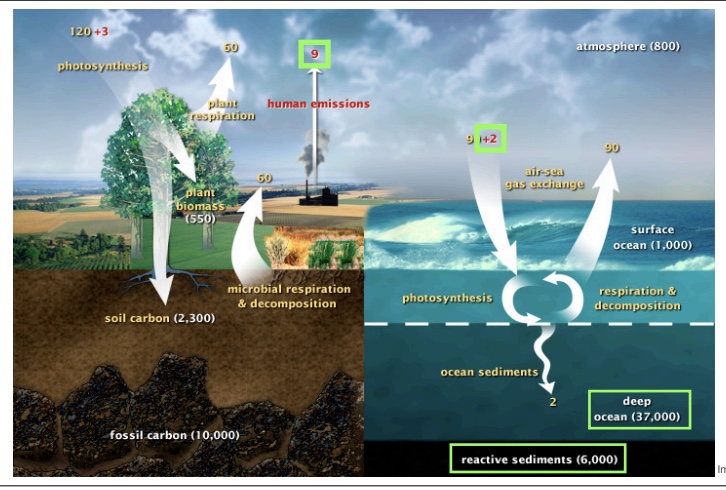
And the ocean is doing a lot of work to take up
some of that excess carbon → buffering to some extent the anthropogenic greenhouse gas emissions
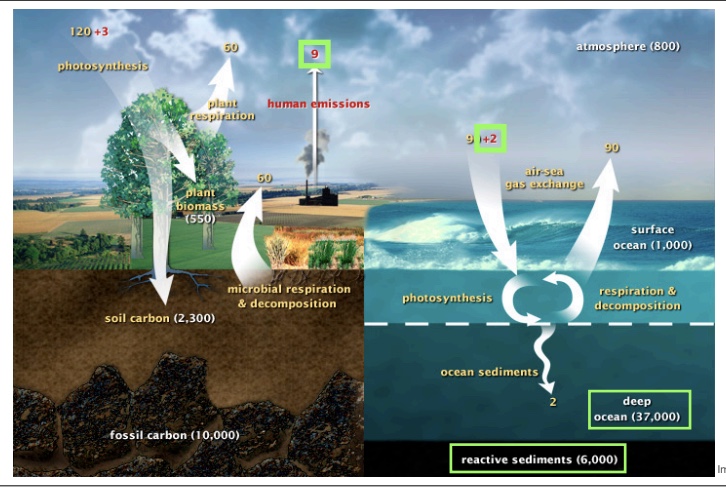
Both the deep ocean and buried ocean sediments are the massive
reservoir of carbon (huge amount of carbon)
Carbon dioxide diffuses into the ocean carbon cycle through the
air-sea surface exchange
More carbon is moving into the ocean in
warmer parts of the ocean
Once carbon dissolves into the seawater, that carbon dioxide can enter the ocean carbon cycle through what three different mechanisms?
The physical C pump (physical)
The biological C pump (biological)
The carbonate pump (chemical)
Where does the initial diffusion of CO2 take place in the physical pump?
At the air-surface interface (where the atmosphere meets the water).
What two types of physical ocean movements drive the carbon pump?
Surface currents and deep ocean currents.
What are the two vertical processes that drive the movement of carbon in the water column? (physical carbon pump)
Downwelling (moving carbon down) and upwelling (moving carbon up).
How does the physical pump move carbon throughout the ocean?
throughout the ocean?Through the diffusion of CO2 at the surface and the physical circulation of water masses (currents).
Deep water formation
In the Atlantic where surface water sinks and becomes deep water
What is the common name for the large-scale system of ocean currents that moves carbon globally?
Global Ocean Conveyor Belt (simplified)
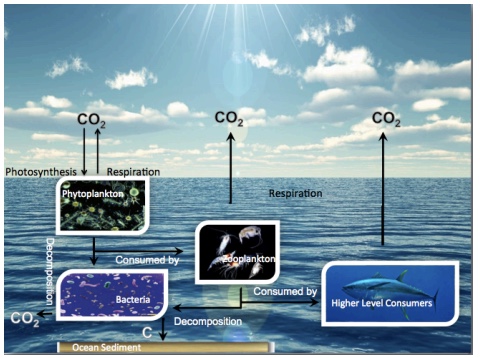
Biological Carbon Pump
Phytoplankton doing photosynthesis in the surface water, taking that inorganic carbon → converting it into organic carbon → once consumed by other organisms, that is part of the biological carbon pump. Relates to Dial vertical migration and sinking of marine snow (organisms moving carbon from surface water to deep water)
What system is very important to marine organisms such as coral, oysters, calms, and lobsters building their shells (organisms that build a calcium carbonate shell)
The ocean carbonate system
The ocean carbonate system connection to Biological pump
Sinking shells bring carbon down to the deep ocean (deep sea sediments)
The chemical processes that happen that can sort of overall be described as ocean acidification
When carbon dioxide diffuses into water it becomes carbonic acid → more CO2 the more carbonic acid that dissociates into hydrogen ions and bicarbonate ions
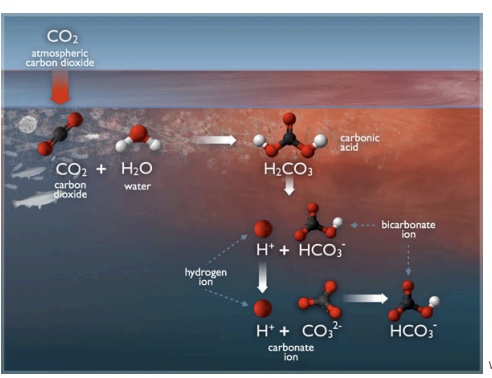
More carbon dioxide in the ocean leads to
increasing acidity (ocean acidification)
Any organisms that builds a calcium carbonate shell has a harder time doing that
in more acidic conditions (calcium carbonate in a strong enough acid will dissolve)
What are the four primary deep-sea impacts caused by increased atmospheric GHGs (carbon dioxide, methane, etc)?
1. Increasing temperature
2. Decreasing oxygenation (the warmer a liquid is, the lower [ ] of dissolved gasses it can hold)
3. Increasing acidity (lower pH)
4. Decreasing food/nutrients (POC, Particulate Organic Carbon)
How does the food supply for deep-sea organisms change due to climate change?
There is decreasing food/nutrients (a reduction in the "marine snow" or POC falling from the surface).
What percentage of anthropogenic $CO_2$ emissions have been absorbed by the oceans?
~30% (carbon dioxide absorbed) → thermal buffering
How much of that absorbed CO2 is found below 400m?
1/2
How much of the total anthropogenic CO2 is found below 1000m?
1/5
What percentage of the heat trapped by GHGs has been absorbed by the oceans?
90%
How much of the trapped heat is stored below 700m?
~1/2 (specifically 42% of total heat).
What is the primary biological consequence of ocean warming mentioned?
Warming influences primary productivity
What percentage of Earth's total accumulated energy is stored in the Oceans?
93%
Sea Surface Temperature Anomaly
is basically comparing sea surface temperatures to baseline pre anthropogenic climate change → positive values, part of ocean surface is warmer than expected, blue values cooler. Not seeing red everywhere, but especially in the Artic there are very warmer areas there
What are the three main benefits of using Global Climate Models?
1. They work at a Global scale.
2. They become more precise with more/better data.
3. They allow comparisons.
What are the three main limits of using Global Climate Models?
Limited data → only as good as the data we have
Don’t include all surface-depth linkages (not a lot of models integrate benthic and pelagic habitats)
Scale (generally larger than many seafloor features) → breaking earth up into grids, usually units are larger than many seafloor features, cant factor a specific hydrothermal vent or something
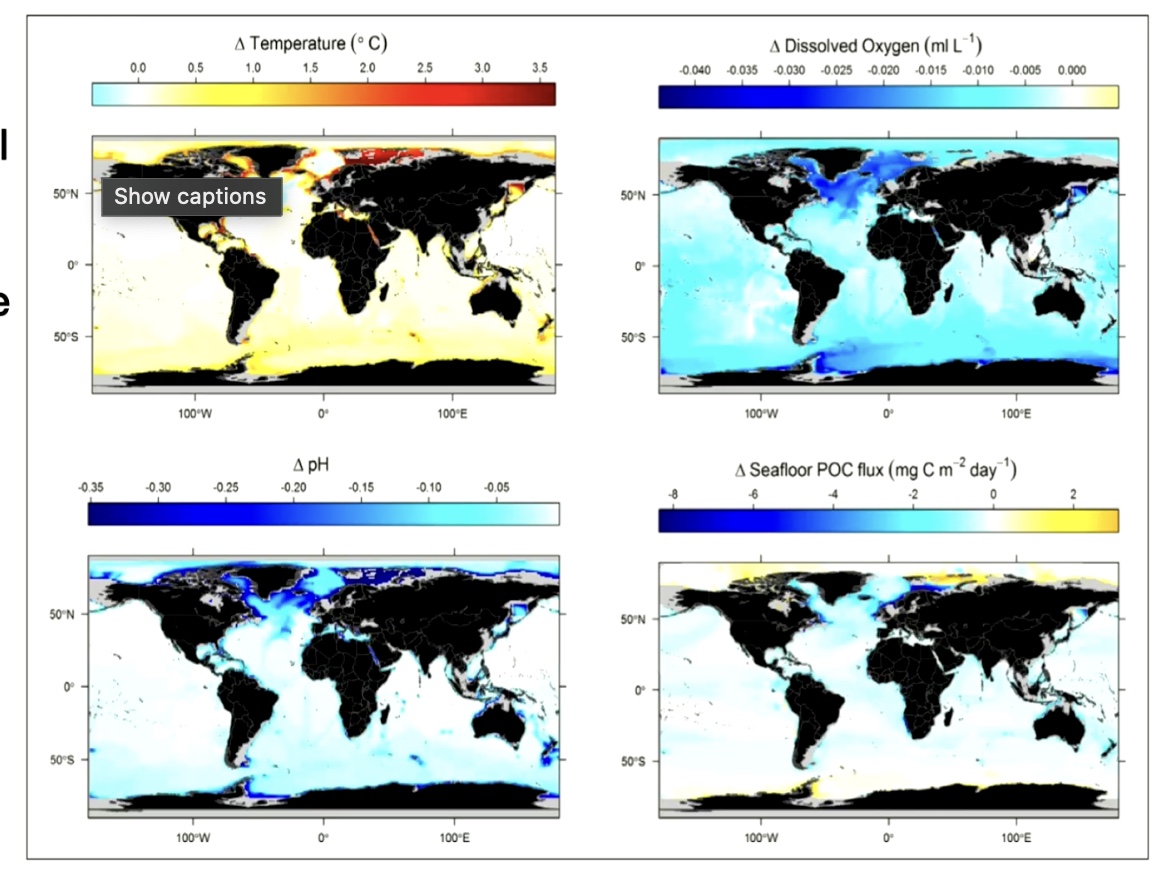
Modeled environmental changes at the deep seafloor in the year 2100
Arctic and some of the coastal areas predicted to have the greatest increases in temperature
Dissolved oxygen →
Seafloor POC flux → less carbon down to the seafloor
pH - blue areas predicted to be more acidic
Climate change will affect polar regions in terms of POC flux how?
An increase in polar regions for POC flux
Predicted effects of climate change on deep-sea benthic ecosystems in terms of metabolism
In general for most organisms when you increase temperature, metabolic rates will increase
When metabolic rates increase that means organisms are using up more
oxygen in benthic ecosystems in terms of climate change
As temperature increases, they predict that body size will
decrease (higher metabolic rates, limited food) in benthic ecosystems in terms of climate change
Predicted effects of climate change in benthic ecosystems in terms of oxygen concentration
Macro and megafauna, would decrease as oxygen concentrations decrease
Benthic biomass/sediment mixed layer depth will decrease
Habitat will be compressed
Shift from larger to smaller organisms
Predicted effects of climate change in benthic ecosystems in terms of pH
Abundance and diversity of calcifiers will decrease (increase of acidity)
Metabolism/energy demand/shell dissolution → more energy into making and maintaining shells
Predicted effects of climate change in benthic ecosystems in terms of POC flux
Biodiversity up and down
Sediment mixed layer depth will decrease, driven by oxygen and by amount of carbon
Microbial contribution to C-cycling increasing
Biological pump increase in the contributions of microbes as bigger organisms will decrease
What about climate change predictions for the pelagic? Very hard to model
Benthic predictions might be easier to model. 3D habitat (vertical and horizontal contributions) → huge biogeographic ecoregions that are hard to model
Very poorly characterized
Huge mesopelagic fish biomass
Mesopelagic food webs provision deep-sea species
Biogeochemical cycling
What are the two types of stress responses that need more study for deep-sea species?
Chronic (habitat increased over y years, hard to picture) vs accute stress (lab setting stress, what we mainly do)
Besides steady trends, what kind of events require more research to understand threats?
Intermittent events → frequency of these events
The Ocean Decade Action seven decade outcomes
Clean Ocean
Healthy and resilient ocean
a predicted ocean
A safe ocean
A sustainable harvested and productive ocean
A transparent ocean
An inspiring and engaging ocean
UN report (2022), actions that can be taken to help climate change
National governments international cooperation → we can consider on who we decide to vote for and advocate
Subnational government → smaller scale changes
Businesses → who we support
Citizens → consume sustainability, use public transportation, etc.