02. AP Psychology, MEMORY
 Call Kai
 Learn
Learn Practice Test
 Spaced Repetition
 Match
Match Flashcards
 Knowt Play
1/73

There's no tags or description
Looks like no tags are added yet.
Name | Mastery | Learn | Test | Matching | Spaced | Call with Kai |
|---|
No analytics yet
Send a link to your students to track their progress
74 Terms
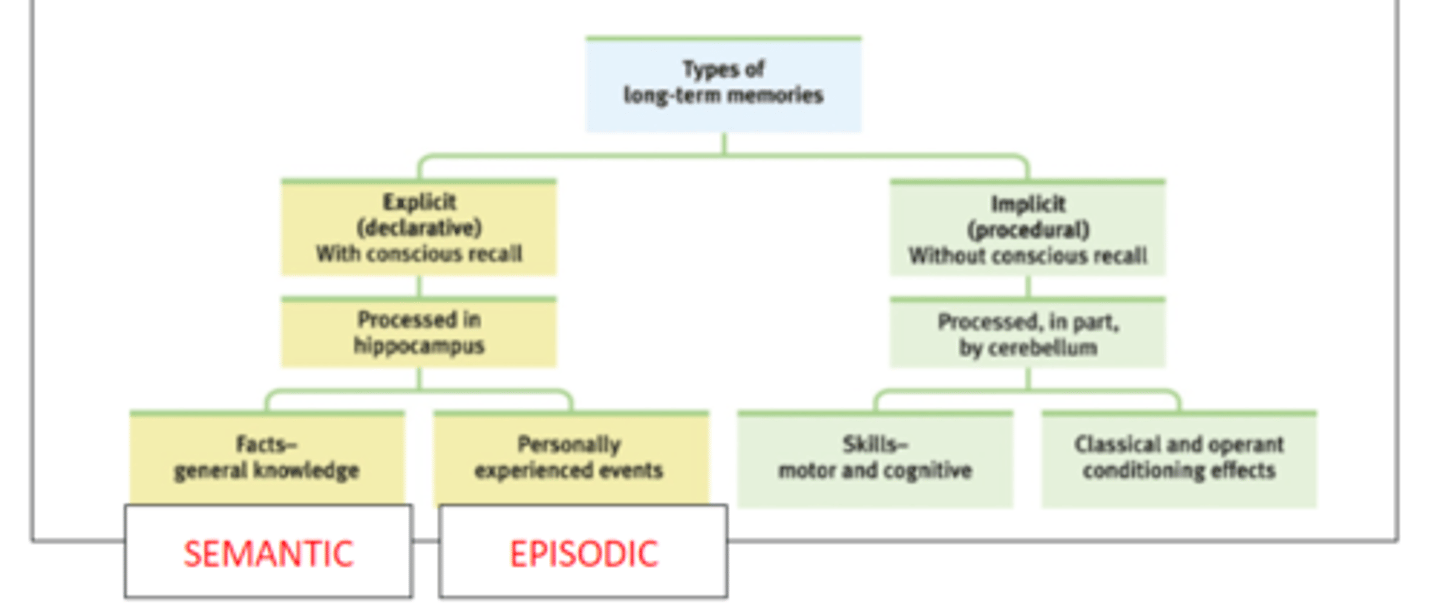
Explicit memory
memory of facts and experiences that one can consciously know and "declare" [this includes semantic and episodic memory)
Implicit memory
retention of learned skills (procedural memories) or classically conditioned associations independent of conscious recollection
Semantic memory
memory of facts and general knowledge
Episodic memory
memory for one's personal past experiences
Procedural memory
a type of implicit memory that involves motor skills and behavioral habits
Prospective memory
remembering to do something at some future time
Flashbulb memory
a clear memory of an emotionally significant moment or event
Hippocampus
A neural center located in the limbic system that helps process explicit memories for storage.
Cerebellum
the "little brain" at the rear of the brainstem; functions include processing sensory input and coordinating movement output and balance. Instrumental in storing procedural memories.
Caudate nucleus
one of the major nuclei that make up the basal ganglia; significant in this unit of because those with HSAM (Highly Superior Autobiographical Memory) had enlargement of this area. This area is involved in habit formation and is prominent in those with OCD.
Temporal Lobe
A region of the cerebral cortex responsible for hearing and language. In HSAM subjects, this region is enlarged.
E.P.
A case study featuring a degenerative hippocampus; strong displays of anterograde amnesia--unable to lay down new memories
Clive Wearing
A case study showing severe amnesia; evidence of implicit memory (piano playing) despite severe deficiencies in explicit memories
H.M.
A case study: patient of William Beecher Scoville who hippocampus was removed. Demonstrated anterograde amnesia; exhibited procedural learning without the recall of the task itself
Highly Superior Autobiographical Memory
cases who exhibit remarkably accurate memory for autobiographical events; scans show larger temporal lobes and larger caudate nuclei
Glucose and adrenaline
Chemicals released during emotionally charged moments. (The fuel of flashbulb memories.)
Decay/Transience
a challenge to retrieval in which memory traces fade over time
Encoding failure
An inability to recall information based on the information not having not entered into a memory system
Retrieval cues
Stimuli that are used to bring a memory to consciousness or into behavior [a place, a clue, a smell]
Tip-of-the-tongue phenomenon
the temporary inability to retrieve information (partial retrieval)
Proactive interference
the disruptive effect of prior learning on the recall of new information
Retroactive interference
the disruptive effect of new learning on the recall of old information
Repression
in psychoanalytic theory, a defense mechanism that pushes from consciousness anxiety-arousing thoughts, feelings, and memories
Constructive memory
a process by which recall of events is mixed in with details of other information, some of which may not be true
Consolidation
the process by which memories become stable in the brain
Re-consolidation
a process in which previously stored memories, when retrieved, are potentially altered before being stored again
Misinformation effect
incorporating misleading information into one's memory of an event [suggestibility through wording]
Source amnesia
faulty memory for how, when, or where information was learned or imagined; a type of misinformation
Suggestibility
the development of biased memories stemming from misleading or specifically selected word choices [e.g. leading questions]
Imagination inflation
a memory phenomenon in which vividly imagining an event markedly increases confidence that the event actually occurred
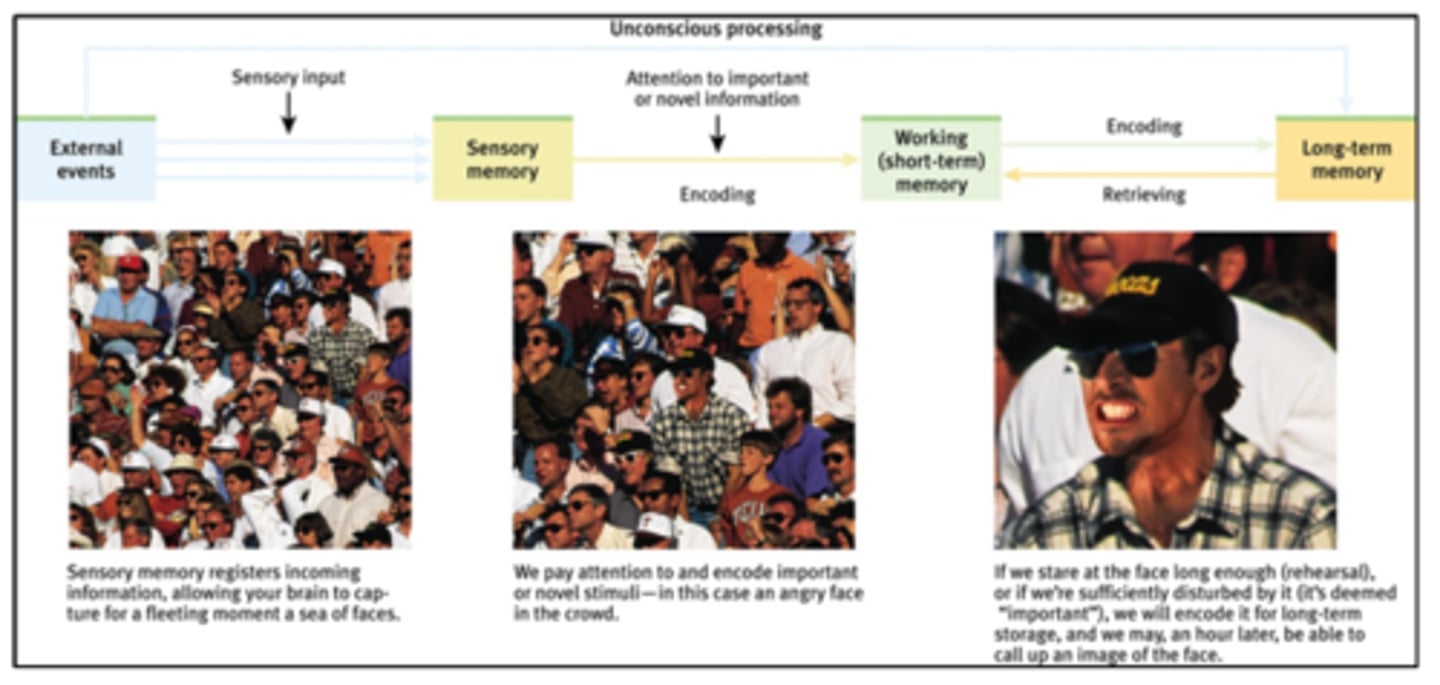
Multi-Store Model
Atkinson and Shiffrin (1968) Memory Model
Working memory model
Baddeley and Hitch (1974)
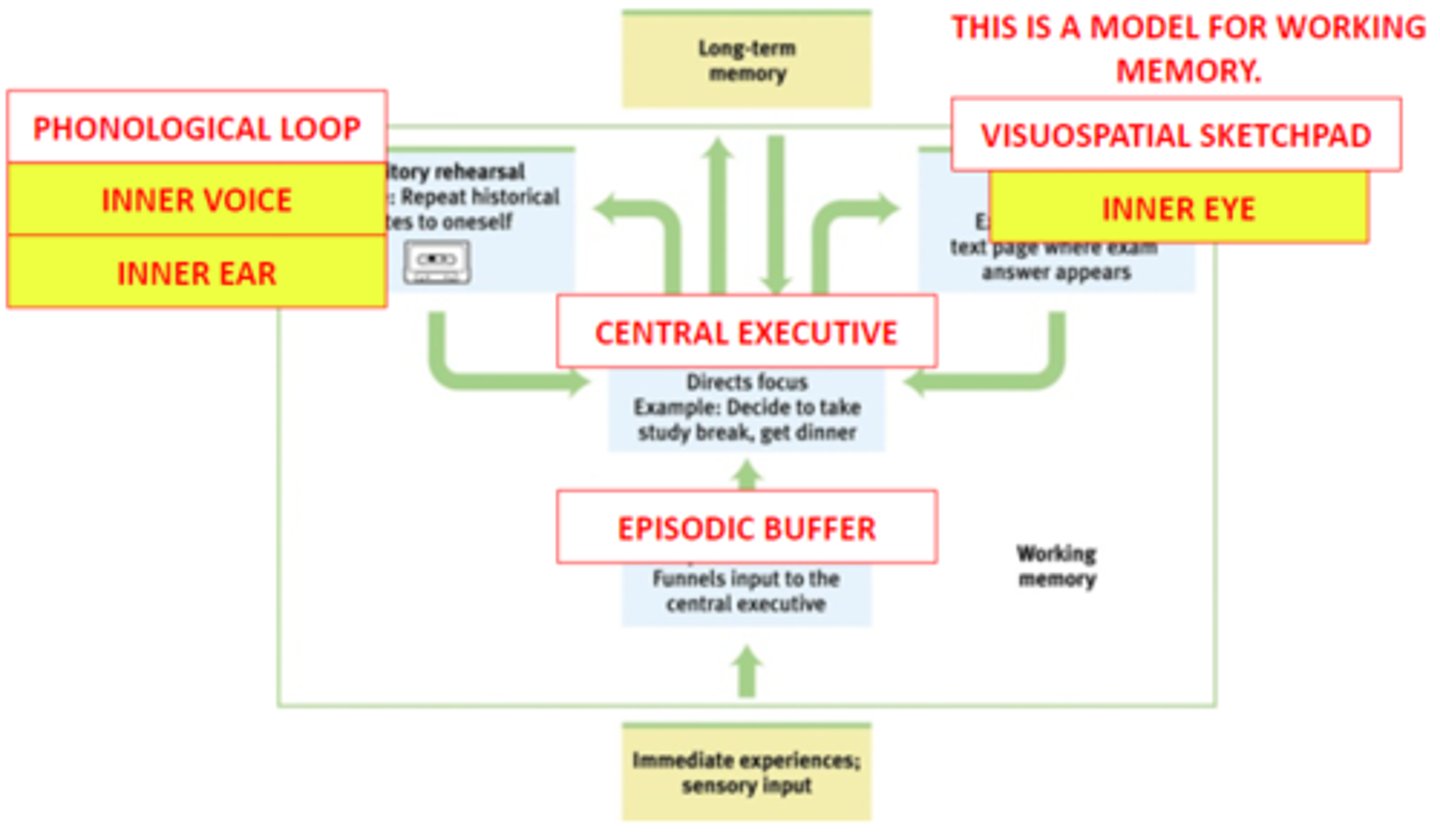
Central executive
a component of Baddeley and Hitch's working memory model that directs attention and processing, overseeing the phonological loop and the visuospatial sketchpad
Phonological loop
a system in Baddeley and Hitch's working memory model that holds and processes verbal (inner voice) and auditory information (inner ear)
Visuospatial sketchpad
A system of Baddeley and Hitch's working memory that mental images to remember visual information (inner eye)
Episodic buffer
A component of Baddeley and Hitch's working memory model in which new information interacts with information in long term memory (eg. relating information you are processing to a previous memory)
Unconscious processing
the processing of information into long-term memory with little to no effort (e.g. recalling what you had for dinner last night)
Sensory memory
the immediate, very brief recording of sensory information in the memory system (consists of iconic and echoic memory)
Iconic memory
a momentary sensory memory of visual stimuli; a photographic or picture-image memory lasting no more than a few tenths of a second
Echoic memory
a momentary sensory memory of auditory stimuli; if attention is elsewhere, sounds and words can still be recalled within 3 or 4 seconds
Working memory
a newer understanding of short-term memory that focuses on conscious, active processing of incoming auditory and visual-spatial information, and of information retrieved from long-term memory
Primary memory system
another term for short-term memory--a system that stores a small amount of information that is currently bring consciously processed.
Long-term memory
the relatively permanent and limitless storehouse of the memory system. This includes knowledge, skills, and experiences.
Effortful processing
encoding that requires attention and conscious effort
Maintenance rehearsal
repeating stimuli in their original form to retain them in short-term memory
Elaborative rehearsal
a method of transferring information from STM into LTM by making that information meaningful in some way (any mnemonic technique that allows for better storage and retrieval)
Shallow processing
encoding on a basic level (e.g. structural encoding)
Deep processing
encoding in a way that shows better understanding of content (e.g. semantic encoding)
Structural encoding (Structural processing)
a shallow processing of information that focuses on the appearance of learned information (Does the word start with a capital letter?)
Phonemic encoding (Phonemic or Acoustic processing)
processing of information that focuses on a quality of its sound or pronunciation (Does the word rhyme with cat?)
Semantic encoding (Semantic processing)
A deep processing of information that focuses on the meaning of words (Does the word make sense in the following sentence: The _____________________ attended the game last night.)
Context effects
memory that is aided by being in the physical location where encoding took place
Mood-congruent memory
A memory process that selectively retrieves memories that match one's mood.
Metacognition
"Thinking about thinking" or the ability to evaluate a cognitive task to determine how best to accomplish it
Priming
the activation, often unconsciously, of particular associations in memory
Chunking
organizing items into familiar, manageable units; often occurs automatically
Hierarchies
a graphic organizer that shows relationships among its parts
Method of Loci (memory palace)
a mnemonic that relies on associations with familiar physical locations allowing for easier retrieval (a type of elaborative encoding)
Testing effect
enhanced memory after retrieving, rather than simply rereading, information
Distributed practice
spacing the study of material to be remembered by including breaks between study periods
Massed practice
cramming information to be learned
Serial position effect
our tendency to recall the first (primary effect) and last (recency effect) items on a list while having more difficulty remembering things in the middle
Primacy effect
the tendency to remember items at the beginning of a list
Recency effect
tendency to remember words at the end of a list especially well
Anterograde amnesia
an inability to form new memories
Retrograde amnesia
an inability to retrieve information from one's past
Infantile amnesia
the inability to retrieve memories from much before age 3
Recall
retrieving information from long-term memory without any choices (fill-in-the-blank, for instance)
Recognition
retrieving information from long-term memory from a list of choices (matching, multiple-choice, a police line-up)
Types of Memories (Diagram)
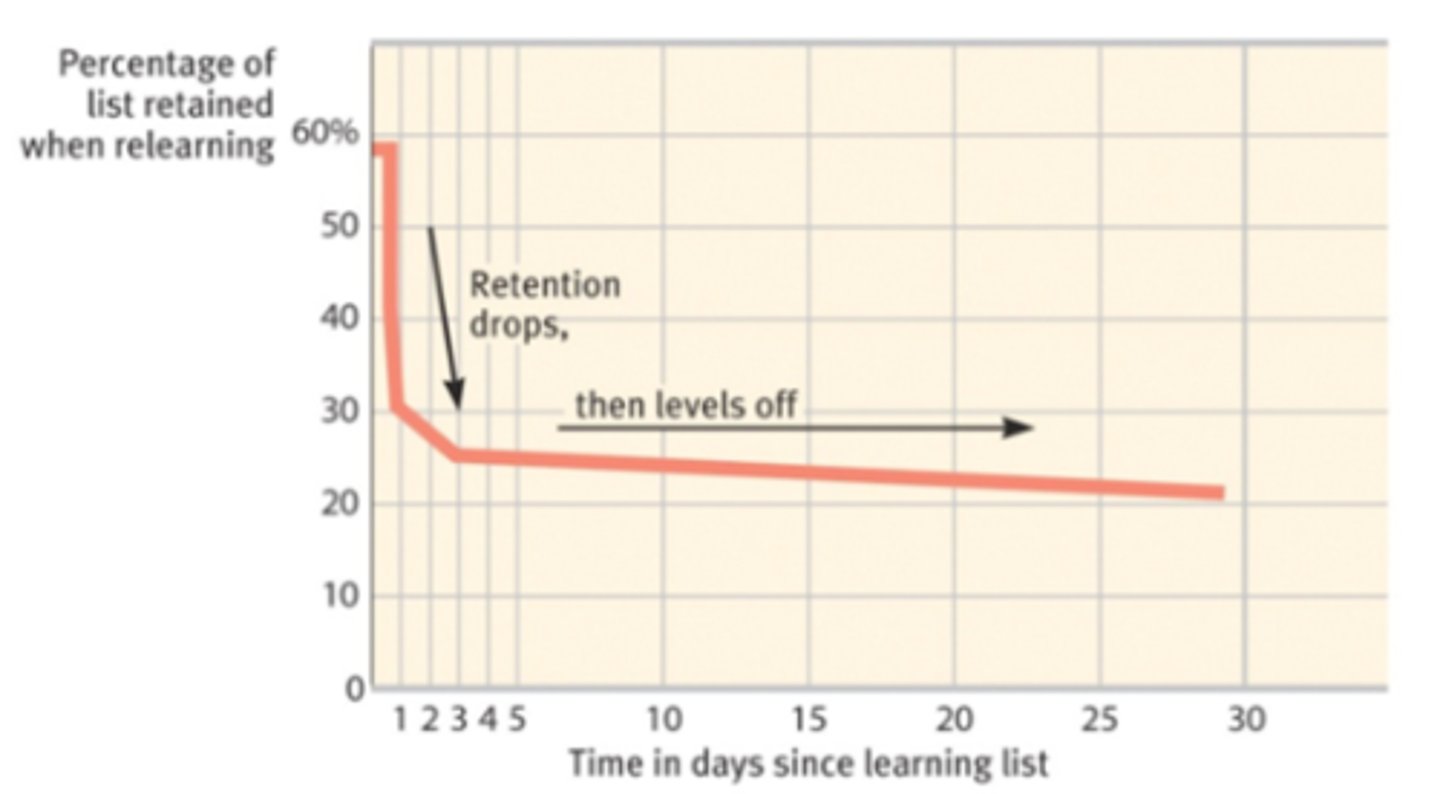
Ebbinghaus' Retention Curve (Diagram)
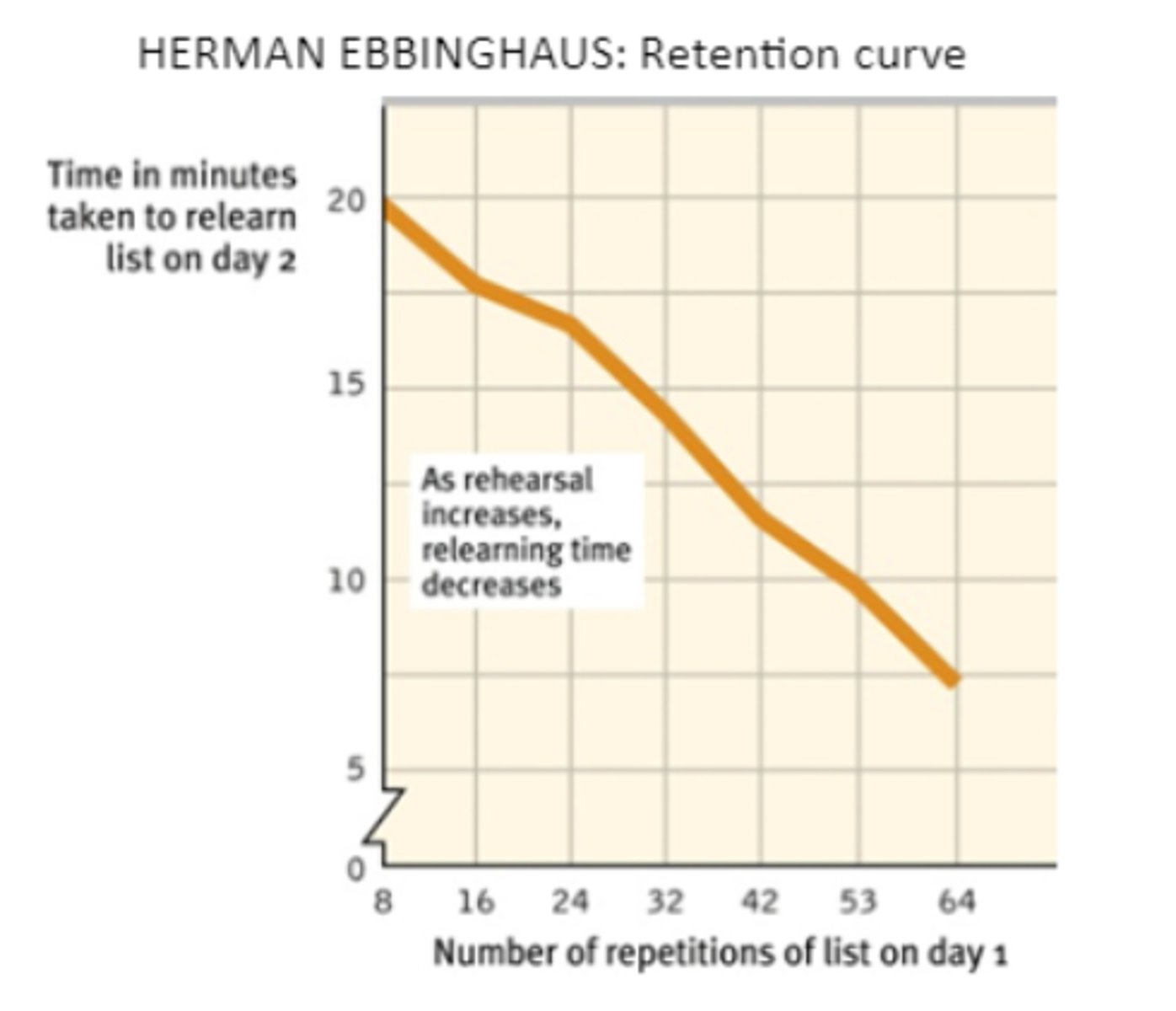
Ebbinghaus' forgetting curve
the course of forgetting is initially rapid, then levels off with time
State-dependent memory
the phenomenon through which memory retrieval is most efficient when an individual is in the SAME STATE OF CONSCIOUSNESS as they were when the memory was formed
Primary Memory System
a limited capacity store [another term for short-term or working memory]