final chem
 Call Kai
 Learn
Learn Practice Test
 Spaced Repetition
 Match
Match Flashcards
 Knowt Play
1/72

There's no tags or description
Looks like no tags are added yet.
Name | Mastery | Learn | Test | Matching | Spaced | Call with Kai |
|---|
No analytics yet
Send a link to your students to track their progress
73 Terms
BrINClHOF is only diatomic when it is by….
itself
For things to dissolve in a liquid they must be in this state
aq
What makes a strong base?
-A high pH
-Doesn’t dissolve in water well
-OH usually bonded to a metal
What makes a strong acid?
-A low pH
-Usualy H bonded to a nonmetal of ployatomic
true or false: H2O can be both a base and acid
true
When writing net ionic equations and there is a single replacement, the element that ends up by itself will always be a ___ and have a charge of ___
solid, zero
To write a net ionic equation what do you do?
-Write a complete ionic equation
-Get rid of spectator ions (ions that are same on both sides)
NOTE: they are not the same if they have different states
For complete ionic equations, do liquids, gasses, or solids get a charge?
No
How to find out if pairs of substances will react with each other?
-Look at reactivity series
-If the element alone is above the element paired, it WILL react
For activity series, if the element alone is above the element paired, it will/will not react?
WILL react
For activity series, if the element alone is below the element paired, it will/will not react?
WILL NOT react
What are 3 ways to increase pressure of a contained gas?
-Decrease size of container
-Increase temperature of gas
-Add more particles to container
Percent composition formula
% element = mass of element/ molar mass of compound x 100
When there is a constant temperature, what gas law equation can you use?
P1V1=P2V2
(boyle’s law)
When there is constant pressure, what gas law equation do you use?
V1 /T1 = V2 / T2
(Charles Law)
When there is constant volume, what equation do you use?
P1 / T1=P2 / T2
(gay-lussac’s law)
What is the combined gas law
P1V1 / T1 = P2V2 / T2
What is the ideal gas law
PV = nRT
What is the equation for specific heat?
q= mcΔT
What is the half-life formula to find out remaining amount of time?
Remaining = Intial (0.5)half-lifes
What is the equation for molarity
M= n/v
M= mol/ L
What is the equation for Molality
m = Moles of solute / kg of solvent
what is the equation for pH
pH= -log[ H+ ]
What is the equation for pOH
pOH = 14 - pH
or
pOH= -log[OH-]
What is the number for KW
1.0 × 10⁻¹⁴
What is the equation for equilibrium constant
Keq= [C]c[D]d/ [A]a[B]b
How do you write an equation for alpha decay
4/2 α
- subtract from the atomic number and mass to find the new alpha decay
How do you find beta decay
0/ -1 β
-add to atomic number and mass to find new beta decay
When ΔH is -, it is endo/exothermic?
exothermic
-Heat is released
When ΔH is +, it is endo/exothermic?
endothermic?
-Heat is absorbed
When it is exothermic the products have ___ energy than the reactants
less
(Heat is on products side)
When it is endothermic, the products have ___ energy than the reactants
More
(Heat is on reactantss side)
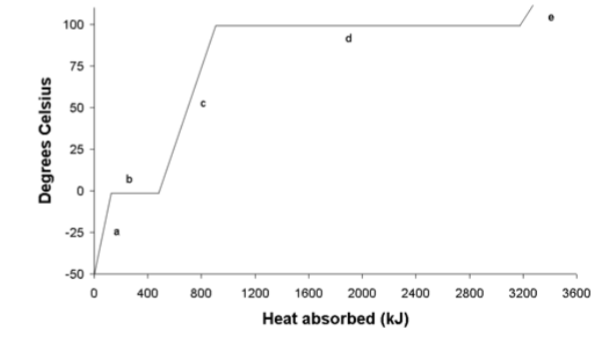
What state of matter is at leg a
Solid
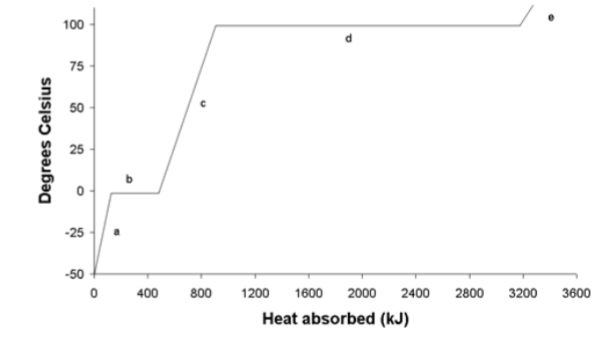
What state of matter is at leg b
melting
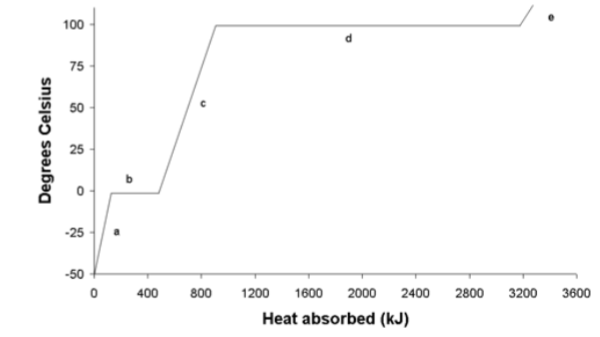
What state of matter is at leg c
liquid
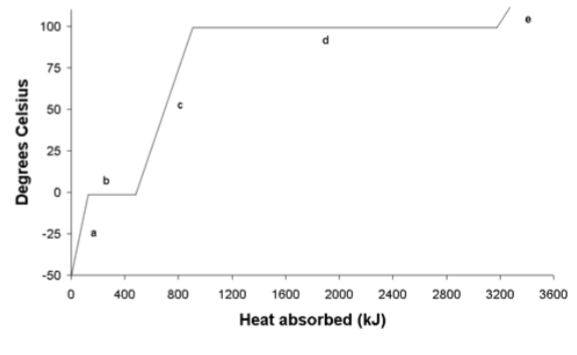
What state of matter is at leg d
boiling
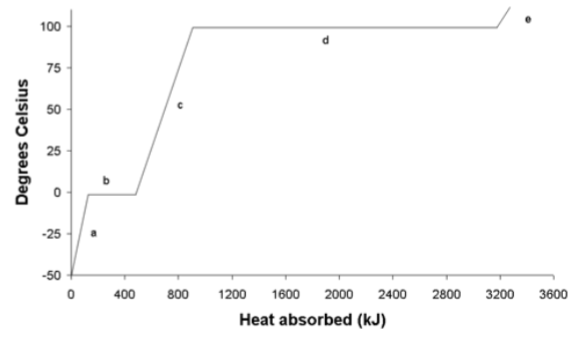
What state of matter is at leg e
gas
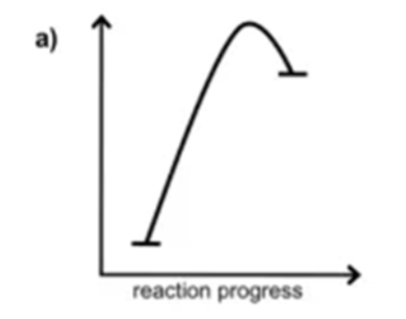
This reaction is endo/exothermic
endothermic. Reactants>productsW
When reactants>products, the reaction is
endothermic
When reactans<products, the reaction is
exothermic
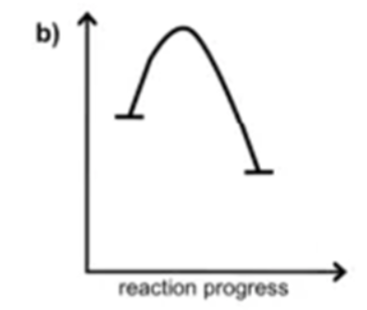
This reaction is endo/exothermic?
Exothermic
Reactants<products
What is ΔH on a energy diagram
The difference between the reactants and products
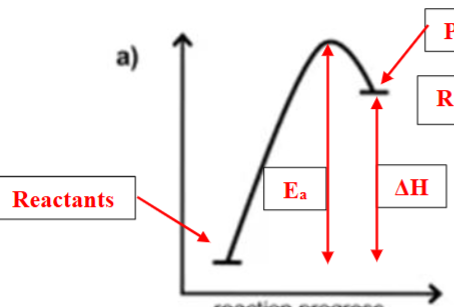
Activation energy matches the reactants/products height?
reactants
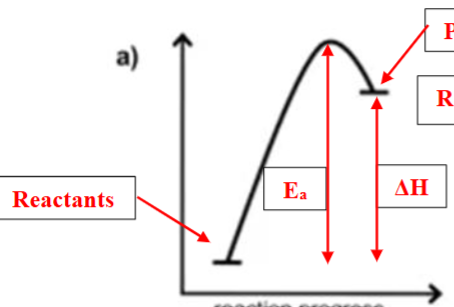
How would a catalyst affect an energy diagram?
A catalyst would decrease the activation energy, which would bring the products and the reactants closer together
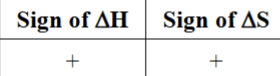
When is the reaction spontaneous?
At high temperatures
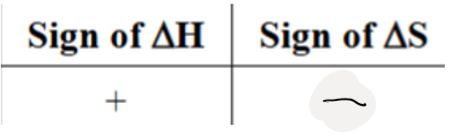
When is the reaction spontaneous?
Never spontaneous
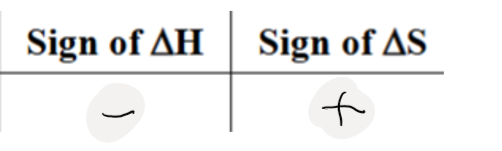
When is the reaction spontaneous
Always spontaneous
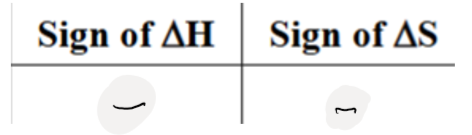
When is the reaction spontaneous
At low temperatures
What do collegiative properties depend on. what does it not?
-Depends on the amount of dissolved substance
-doesn’t depend on the identity of dissolved substance
What do collegiative properties do
-Lower vapor pressure
-Depress freezing point
-Increase osmotic pressure
-Increase boiling point
What is a solvent?
Substance doing the dissolving
What is a solute
substance gettung dissolved
How do you rank compounds based on their effect of collegiative properties?
Based on the number of particles each produces when dissolved
-Nonmetal ones are 1 particle
-Polyatomic ions count as 1 particle each
When a point is on the line on a solubility curve, is it saturated, undersaturated, or supersaturated?
Saturated
When a point is above the line on a solubility curve, is it saturated, undersaturated, or supersaturated?
supersaturated
When a point is below the line on a solubility curve, is it saturated, undersaturated, or supersaturated?
undersaturated
Acids taste…
sour
bases taste…
bitter
Acids are reactive/unreactive with metal?
reactive
Bases are reactive/unreactive with metal
unreactive
What is an acids pH level?
below 7
What is a bases pH level
above 7
What did arrhenius define acids as
They release H+ in water
What did Arrhenius define bases as
They release OH- in water
What did Bronsted Lowry define acids as
Proton (H+) donor
What did Bronsted Lowry define bases as
Proton (H+) acceptor
What is the formula for acetic acid
HC2H3O2
Bases turn into conjugate ___ usually
acids
Acids turn into conjugate ___ usually
bases
Usually, the thing in the products side that becomes positive is the conjugate ___
acid
To write conjugate bases, what happens to them?
-They lose an H and their charge goes down by 1
HI turns into I-
To write conjugate acids, what happens to them?
They gain an H and their charge increases by 1
CN- to HCN
iGNORE
IGNORE