P5 - Forces
 Call Kai
 Learn
Learn Practice Test
 Spaced Repetition
 Match
Match Flashcards
 Knowt Play
1/49

There's no tags or description
Looks like no tags are added yet.
Name | Mastery | Learn | Test | Matching | Spaced | Call with Kai |
|---|
No analytics yet
Send a link to your students to track their progress
50 Terms
Contact force
Physical forces that occur only when two objects are directly touching
Non-contact force
Physical forces that act between objects without direct physical contact
Scalar
Only has magnitude
Vector
Has magnitude and direction
How can a resultant vestor be found?
Adding them (this value can be negative), if forces at right angle Pythagoras can be used
No resultant force =
No acceleration
Examples of scalar quantities
Distance, speed, mass, energy, temp
Examples of vector quantities
Displacement, velocity, acceleration, force, momentum
Weight
The force that gravity pulls an object down with
Weight =
Weight = mass x gravitational field strength
Gravitational Field Strength of the Earth
9.8 N/kg
Gravitational Field Strength of the moon
1.6 N/kg
Every 1kg has a weight of?
10N
If you hold an object or lift at a constant speed, you must be pushing up with how much force?
A force that is the same size as its weight
Work done
Energy transferred by a force
Work done =
Work done = force x distance
Any object that deforms elastically (returns to its original shape), obeys what?
Hooke’s law - force and extension are directly proportional
Force =
Force = spring constant x extension
Spring Practical
Add masses onto a spring to change force (100g = 1N)
Measure extension with ruler at each weight, plot F against e
Gradient of graph = spring constant
Avoid systematic error by lining 0cm with bottom of spring
Avoid parallax error by getting on eye level and measuring
Straight line through origin on graph = directly proportional relationship (obeys Hooke’s law)
Speed or velocity =
Speed or velocity = distance or displacement / time
The gradient of a distance/displacement time graph gives you the what?
Speed or velocity
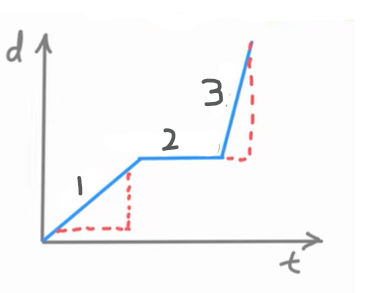
1?, 2?, 3?
1 - slow
2 - stationary
3 - fast
Acceleration =
Acceleration = change in velocity / time
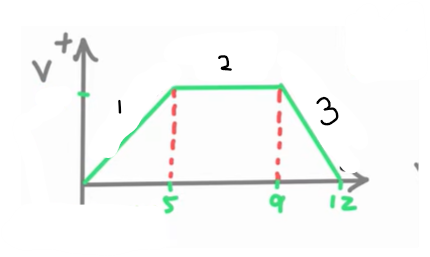
1?, 2?, 3?
1 - accelerating
2 - constant speed
3 - decelerating
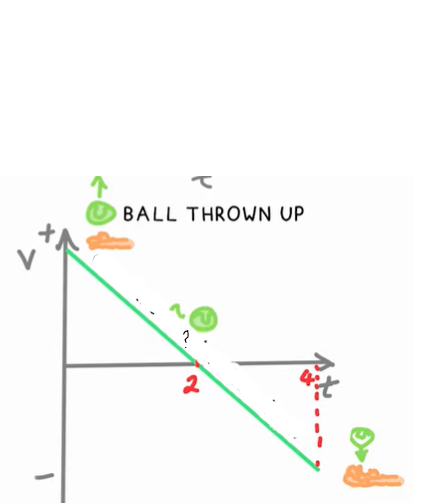
Constant acceleration down
The area beneath a speed distance graph gives what?
The displacement
S U V A T
S - displacement (m)
U - initial velocity (m/s)
V - final velocity (m/s)
A - acceleration (m/s2 )
T - time (s)
v =
v = u + at (similar to acceleration equation)
s =
s = ((u+v) /2) x t (essentially means v = d/t)
s = (also)
s = ut + ½ at2 (usually u=0)
v2 - u2 =
v2 - u2 = 2as (this is the most common)
If starting at rest, u=what?
0 m/s e.g something dropped
If stopping, v=what?
0 m/s e.g car stopping
If only force involved is gravity, a=what?
9.8 m/s
Newtons 1st Law
If no resultant force acts on an object, its motion will be constant (velocity will not change)
Terminal Velocity
True when due to the drag force balancing the other force
Inertia
The tendency for an objects motion to stay constant if no force
Newtons 2nd law
F = ma, Force = mass x acceleration
F=ma practical
Accelerate trolley on track with slotted mass on string over pulley
Use light/photogates to measure acceleration
Change force by removing masses and placing on trolley (to keep the total mass the same)
Plot F against a, gradient = total mass
Newtons 3rd Law
For every action (force), there is an equal and opposite reaction (force) (this is not balanced forces)
Stopping distance =
Stopping distance = thinking distance + braking distance
What is thinking distance affected by?
Speed
Distractions
Alcohol
Drugs
Tiredness
What is braking distance affected by?
Speed
Conditions of brakes, tyres, road
Weather conditions
Momentum =
Momentum = mass x velocity
Momentum, scalar or vector?
Vector, it’s negative if v is in the negative direction
In any collision, total momentum is always what?
Conserved, but total kinetic energy is unlikely to be conserved
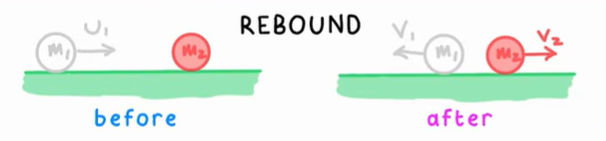
m1 u1 = m1 v1 + m2 v2
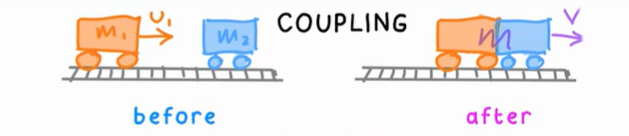
m1 u1 =mv
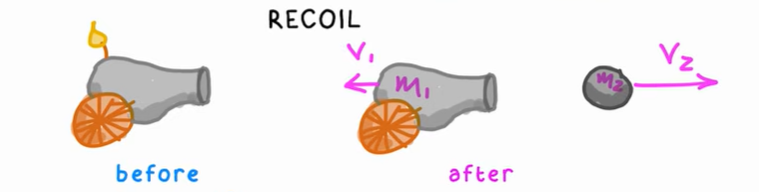
0 = m1 v1 + m2 v2
Recoil shortcut
The momentum of the two objects are equal and opposite so: m1v1 = (-) m2v2