ESPM Final Study Guide
 Call Kai
 Learn
Learn Practice Test
 Spaced Repetition
 Match
Match Flashcards
 Knowt Play
1/115

Earn XP
Description and Tags
Vocabulary-style flashcards covering the key concepts and definitions of environmental health policy, risk categories, and risk transition frameworks.
Name | Mastery | Learn | Test | Matching | Spaced | Call with Kai |
|---|
No analytics yet
Send a link to your students to track their progress
116 Terms
Value Triad
A framework where political struggles are shaped by the interactions between three key values: economic, equity, and the environment.
Trans-science issues
Issues that lie at the interface of science and politics which transcend the proficiency of science to answer, often involving political, economic, or moral dimensions.
Type 1 Diseases
Traditional diseases including communicable and infectious diseases, maternal mortality, and nutritional diseases.
Type 2 Diseases
Modern diseases including non-communicable diseases, cancer, heart and lung diseases, neuropsychiatric conditions, and congenital defects.
Type 3 Diseases
Non-transitional diseases consisting of injuries, subdivided into unintentional (e.g., agriculture, motor vehicle, falls) and intentional (e.g., suicide, violence, war).
Local Traditional Risks
Risks occurring at the household level, such as traditional diseases, sanitation, water, and food safety.
Community Transitional Risks
Risks at the community level, including urban air quality and occupational hazards.
Global Modern Risks
Modern risks on a global scale, such as cancer and heart disease.
Risk Overlap
The phenomenon where traditional risks are declining while new risks are simultaneously increasing.
Risk Genesis
The creation of entirely new types of risks.
Risk Transfer
Occurs when efforts to reduce one type of risk result in making another type of risk worse.
Risk Synergism
A situation where the combined risk associated with two or more factors is greater than the sum of their solitary effects.
Factors affecting (re) emergence of infectious diseases
ecological changes, human behavior and demographics, international travel, technology, microbial adaptation, breakdown in PH infrastructure
Environmental burden of disease
Disease burden attributable to environmental factors impacting susceptibility to and recovery from disease/injury
Attributable risk
amount of disease that would not exist today if exposure to a specified risk factor that causes that disease had not occurred
DALY
YLL + YLD
What is DALY?
Metric of mortality and morbidity that outputs a present value of future years of disability free life that are lost as result of the premature deaths or cases of disability occurring in a particular year
Critiques of DALY
Deaths of individuals who are old, sick or disabled contribute less to estimated burden of disease, doesn’t account for resource allocation, and lack of consistent and quality data
Global Burden of Disease Study
Measures burden of disease globally which helps set health research priorities, identify vulnerable groups, target health interventions and guide programs
Health Equity
Everyone has a fair and just opportunity to be as healthy as possible. Reducing disparities in health and its determinants.
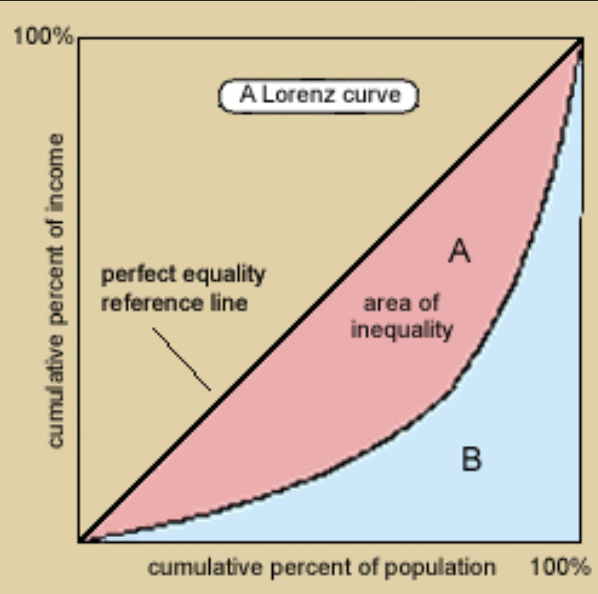
GINI Coefficient
A/A+B with values ranging from 0-1
What is Gini a measure of?
Measure of income or wealth inequality
What does a low gini score mean?
More equitable distribution but 0 meaning perfect income equality
What does a high gini score mean?
Less equitable distribution with gini of 1 meaning perfect income inequality
Lorenz Curve
Graphical representation of income inequality
Absolute Income Hypothesis
Consumption will rise as income rises but not at the same rate
Relative Income Hypothesis
Saving and spending behavior is affected by a person’s relative position in the income distribution with lower savings rates in more unequal societies
Materialist Approach
Health effects are driven exclusively by access to tangible resources such as food, clothing, shelter and ability to control life
Psychosocial Approach
Health effects are mediated through symbolic resources such as status, prestige and control
Racial segregation and environmental quality in US cities
Air quality is worse for POC and it’s worse in more segregated cities
Wealth/income distribution and health outcomes
Linkages b/w equity and environmental quality
More unequal societies have more polluted and degraded environments.
Inequality/Sustainability Hypothesis
Social inequality is linked to poor environmental quality in the literature through asymmetries in political power, environmental intensity of consumption and level of social cohesion and cooperation
Contextual effect
Inequality has spillover effect on pop health above and beyond direct impacts of impoverishment on health of poor
Social gradients of health
Linking of inequality and health with how individually oriented preventative action can push health hazards
Examples of social gradients of health
Occupational status, unemployment, poor housing
The Whitehall Studies
British civil servants at every occupational grade lived longer than their inferiors in the british civil service hierarchy
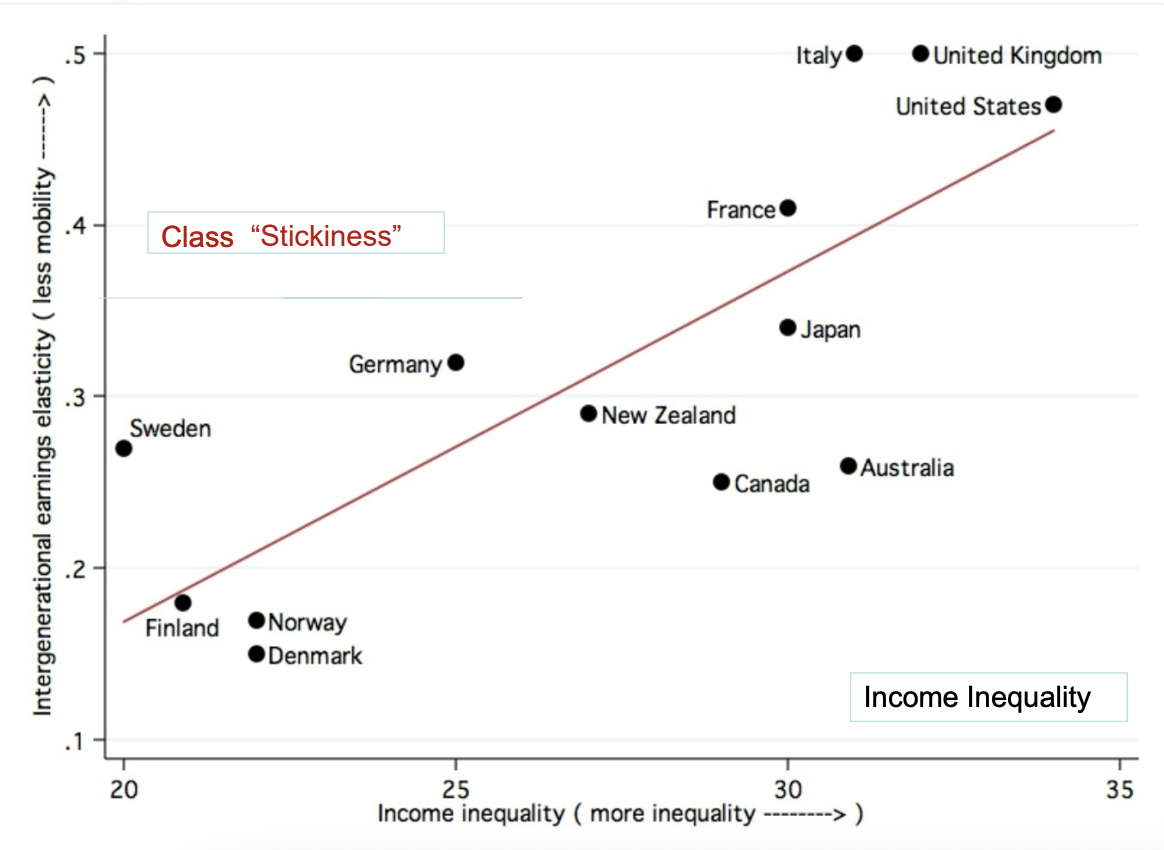
The Great Gatsy Curve
Documents empirical relationship b/w income inequality and intergenerational earning elasticity
Inequality, trust and cooperation
Inequality leads to more rivalry and fear of others
Achieving equity through policy
Improving access to the conditions and resources that strongly influence health for those who lack access and have worse health with policies oriented toward equity
What is equity oriented policy?
Soften impact of inequality by improving conditions of daily life, narrow the gap by addressing inequitable distributions and track progress
Significance of chemicals in 1st industrial revolution
Mass production of energy materials and machinery driving up productivity and volume of production
Significance of chemicals in 2nd industrial revolution
Chemical manufacturing, use of petrochemicals and electricity marking expansion yields and use of chemicals
Significance of chemicals in post-war American: the age of mass consumption
American military and economic hegemony with high rates of consumers, increased government spending for public programs, suburbanization and rise in petrochemical industry
Chemical Ignorance
Chemicals entering marketplace without comprehensive and standardized information on their reproductive or other chronic toxicities
Toxic Substances Control Act 1976
Federal regulatory framework for chemical regulation
Weaknesses of TOSCA
Ineffective, grandfathered in legacy chemicals, put burden of proof on EPA, cost benefit analysis over risk analysis, industry influenced and limited resources for risk assessment
Frank Lautenberg Chemical Safety Act 2016
Amendment of TOSCA with review and regulation of chemicals to be focused on health risk and costs
Strengths of Frank Lautenberg Chemical Safety Act 2016
Removed requirement that EPA choose least burdensome regulatory option, established science standards and risk evaluation process, review of chemicals already in use, EPA must evaluate entire lifecycle of new and existing chemicals
Environmental Public Health Continuum
Sources, emissions, concentration, exposure/dose and health effect
Sources
Where environmental chemicals come from
Examples of sources
Smokestacks, car emissions, dry cleaner, household products
Emissions
Release of chemicals into the environment
Characteristics of emissions
Toxicity, mass, volume, solubility, and attributes the give idea of potential health effects of a pollutant
Concentration
Measures and concentration of pollutant in various medias
Measuring concentrations of env chemicals in:
Air, water, soil and fod
Concentration of pollutants and their transport
Through environmental pathways and chemical transformation due to sunlight exposure
Exposure
Indicates degree to which chemical reaches the barriers b/w individual humans and their environment
Exposure in population
Function not only of concentration but of how many people are in contact for how long
Pathways of exposure
Inhalation, ingestion, absorption
Dose
Measure of amount of material that has penetrated into the body or into critical organs of the body
Health effects
Adverse health outcomes from exposure
Fate and transport of environmental contaminants
Route of emissions spreading health effects of pollutants
Endocrine Disrupting Chemicals (EDCs)
Increase/decrease hormone production, mimic and change hormones, interfere with cell signaling, cause premature cell death and prevent proper gene functioning
BPA
Used to form polycarbonate plastic and epoxy and used in can linings
Exposure Routes for BPA
Dietary ingestion, workplace exposure, water pipe epoxy, fetal and early childhood, hydrolysis, bioaccumulation and chronic low level exposure
Health Effects of BPA
EDC, infertility, reduced sperm count, brain development, prostate and breast cancer, early onset female puberty, diabetes and obesity
Bisphenol S (BPS)
Chemical found in many BPA free consumer products which is just as potent in altering brain development and causing hyperactive behavior
Phthalates are found
Everywhere, in medical devices, personal care products, toys, food wrap and more
Health effects linked to phthalates
Endocrine disruption, male reproductive health effects, reduced fertility, learning and behavior effects, obesity, diabetes and rise in chronic diseases
Triclosan
Antibacterial pesticide used in countertops, soaps, toothpaste and cleaning products that can alter thyroid hormonse critical to proper brain development and cvd health
Is triclosan banned?
Yes it’s banned from anti-bacterial soaps but not from toothpaste
PBDE and LEAD
Period of susceptibility
Fertilized egg, embryo fetus, infant, child and teenager
Exposure timing
More potency in early exposures having greater effect on developing organ systems
Dutch Famine
200% increase in coronary heart disease and more obesity in early gestation exposure with decreases later in gestation and later in life
Ubiquity of chemical exposures
Chemical body burden