*Umich Environ 201- Benedict Midterm Lectures 4-6
 Call Kai
 Learn
Learn Practice Test
 Spaced Repetition
 Match
Match Flashcards
 Knowt Play
1/52

There's no tags or description
Looks like no tags are added yet.
Name | Mastery | Learn | Test | Matching | Spaced | Call with Kai |
|---|
No analytics yet
Send a link to your students to track their progress
53 Terms
ecology
the study of the relationships between organisms and their environment, both living and non-living
trophic levels
links in a food chain through which energy from food passes down from one organism to another
keystone species
A species that has strong or wide-reaching impact far out of proportion to its abundance. It is vital to an ecological community and a removal of a keystone species could have major consequences
carrying capacity
the largest population that an environment can support at any given time
limiting factor
An environmental factor that prevents a population from increasing
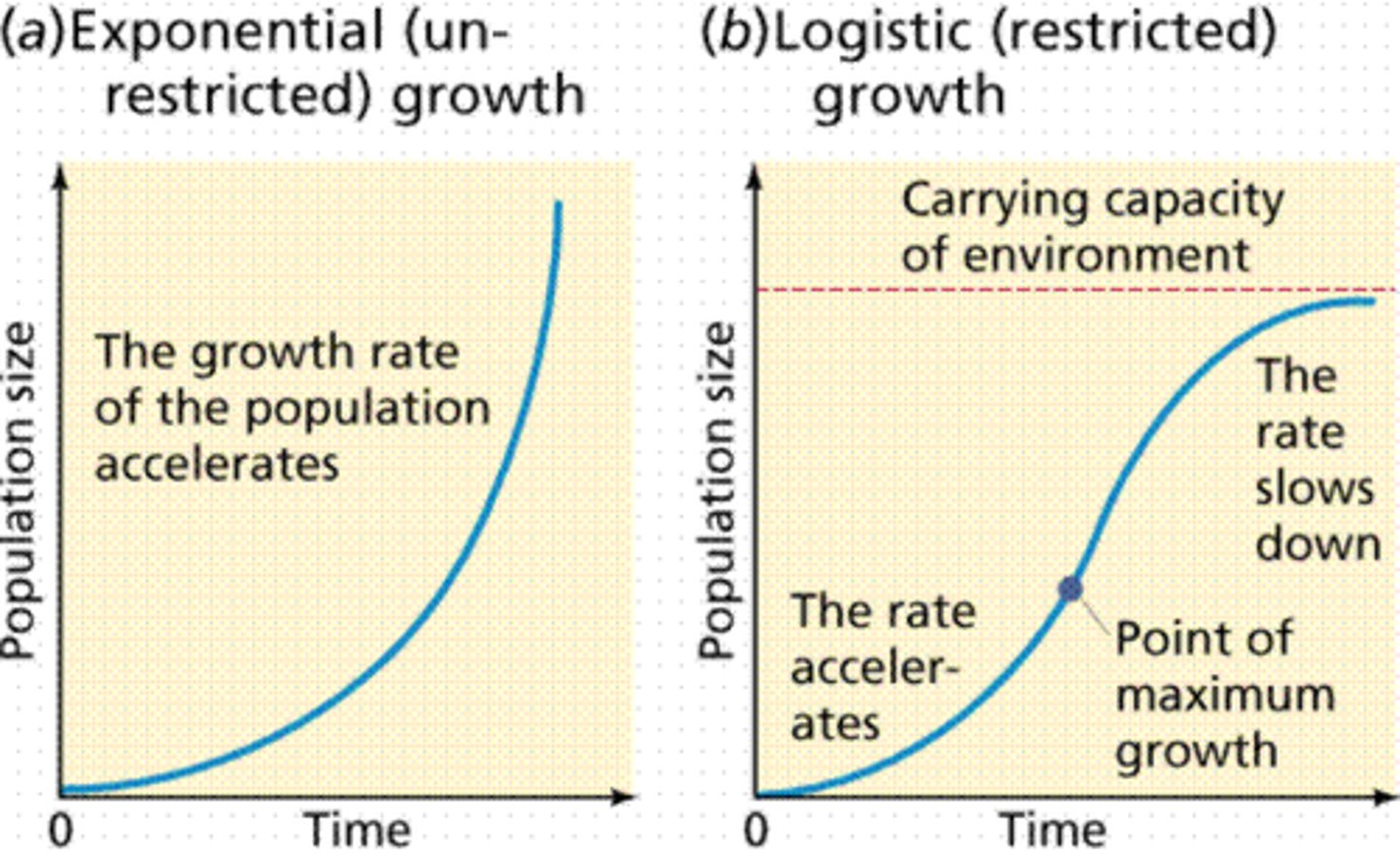
logistic growth curve vs exponential growth curve
-logistic growth curve: S-shaped curve, population expansion decreases as resources become scarce. increase gradually at first, more rapidly in the middle growth period, and slowly at the end, leveling off at a maximum value after some period of time. (at K= carrying capacity)
-exponential growth curve: When resources are unlimited, populations exhibit exponential growth, resulting in a J-shaped curve.
dead zones
In a body of water, an area with extremely low oxygen concentration and very little life
Eutrophication
A process by which nutrients, particularly phosphorus and nitrogen, become highly concentrated in a body of water, leading to increased growth of organisms such as algae or cyanobacteria.
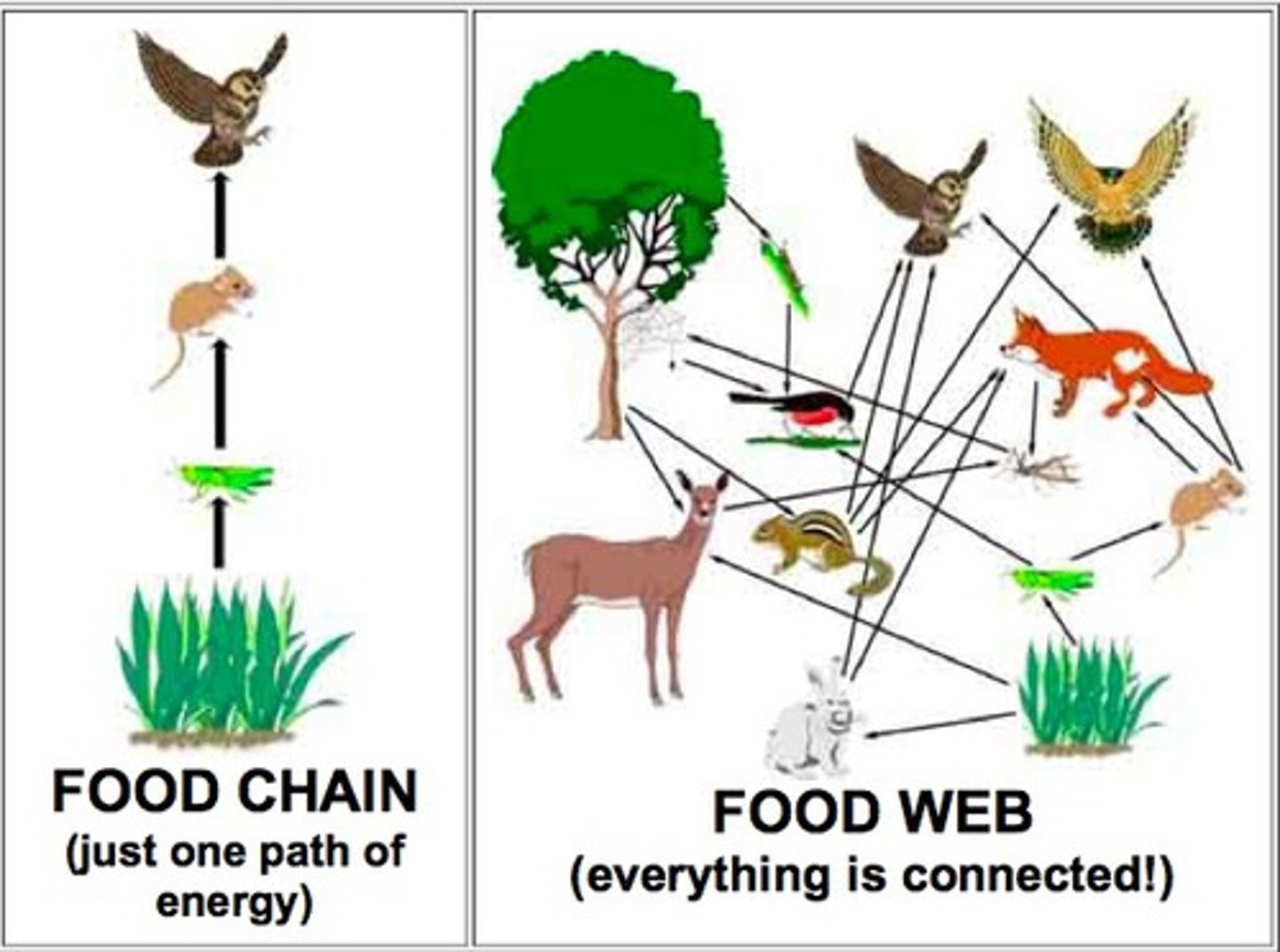
Compare and contrast food chains and food webs; which is a more accurate representation of the natural world?
more accurate = food webs
• food chains: energy from food passes from one organism to the other
• food webs: a visual map of energy flow that uses arrows to show the many paths along which energy passes as
organisms consume one another
Why are there only 3° or 4° consumers in a typical food chain?
there is limited energy available within the food chain; only 10% of energy gets transferred between tropic levels
How much energy is typically transferred between tropic levels? Where does the other energy go?
Only about 10% of the energy of the prey is passed between tropic levels
The rest of the energy is lost through the metabolic process as heat
What does the concept, "energy flows, matter cycles" mean?
• energy is released as heat in a one way flow
• matter is conserved and cycled within the ecosystem
What would happen to matter if detritivores and decomposers were absent in a community?
detritivores and decomposers use the chemical energy and nutrients from the producers and consumers to make detritus (non-living organic matter) to fuel the ecosystem.
How do humans create algal blooms, which lead to dead zones, or anoxic/eutrophic conditions?
Algal blooms are created when we add extra nutrients to a body of water (nitrogen, phosphorus, etc.)→ blooms of algae, increased production of organic matter that dies and sinks, decomposition and loss of dissolved oxygen→ dead zones
How common are harmful algal blooms (HAB) and what do they do? What makes them different than normal algeal blooms
-Reasonably common and they cause the water to be bad and wildlife die because there is not enough oxygen
-In rarer cases some phytoplankton produce HABs and toxins which is unsafe for humans
What is the Dead Zone in the Gulf of Mexico and what human activity causes this phenomenon?
• formed predominantly from agriculture runoff from the Mississippi River Basin
• excess nutrient runnnoff in bay, which stimulates algae blooms, when algae dies they sink to the bottom and decompose, the decomposition process uses up the O2 in the bay. No O2? Fish die.
- caused by: farming, sewage treatment, power plants
what are three ways Zebra and Quagga mussels have impacted industry and biodiversity in North America, especially the United States?
1. Clog pipes which leads to property damage
2. starve & suffocate native clams by adhering to their shells & sealing them shut
3. attach to recreational boats and are easily moved into new body of water, boaters must clean their boat each time.
Know the difference between positive and negative feedback loops. Which are more common in nature? Which are more commonly created by human activities?
more common —> negative feedback loop
Positive feedback loop: RARE IN NATURE → HUMANS: system output causes the system to change in the same way and drives it further towards one extreme or another (exponential population growth, spread of cancer, melting sea ice)
Negative feedback loop: IN NATURE: the system changes and moves in one direction, which causes the system to correct itself and balance out by moving in the other direction (homeostasis) (exp. Body temperature)
inbreeding depression
genetically similar parents mate and produce inferior offspring
species richness
Species richness is simply a count of species, and it does not take into account the abundances of the species or their relative abundance distributions.
species diversity
Species diversity takes into account both species richness and species evenness.
latitudinal diversity gradient
observation that current areas at low latitude have higher number of species than higher latitude areas; more species near equator
endangered species
species that are considered to be in imminent danger of extinction
threatened species
species that are likely to become endangered, at least locally, within the foreseeable future
vulnerable species
species that are naturally rare or have been locally depleted by human activities to a level that puts them at risk
umbrella species
species selected for making conservation-related decisions, typically because protecting these species indirectly protects the many other species that make up the ecological community of its habitat.; if you protect this species, many other species will also be protected.
conservation biology
the study of the factors behind the loss, protection, and restoration of biodiversity
biodiversity hotspots
Relatively small areas of land that contain an exceptional number of endemic species and are at high risk from human activities
Why would populations with high genetic diversity be more resilient to environmental change or disease? Why would populations with low genetic diversity be more vulnerable?
-With low genetic diversity, the two parents have more similar genes and produce inferior offspring, more vulnerable to environmental change or disease
-With high genetic diversity populations are more resilient
Why would more species in an area with more interspecies interactions create more ecosystem resilience? (Think about niches and ecosystem services)
-More genetic diversity→ if one species goes away there are other food sources;
• when the richness and evenness (relative abundance) are higher in an ecosystem allow adaptation to alternative resources when the ecosystem changes. For example, a species that relies entirely on one resource for food will suffer immensely when their food source is no longer accessible (polar bears and hunting seals off of diminishing sea ice)
What causes inbreeding depression?
• populations have low genetic diversity & genetically similar parents mate to produce inferior offspring
What is the major cause of extinction or loss of biodiversity?
habitat loss
Why are species more abundant at the equator?
• latitudinal gradient: species richness increases toward the equator (due to temperate climate throughout the year- stable climate, more coastal areas)
Again, know at least five ecosystem services.
- pollination
- photosynthesis
- nutrient cycling
- water regulation
- climate regulation
- erosion regulation
How does biodiversity impact tourism, in particular ecotourism? How could these activities boost conservation efforts? Could they also have a negative impact on a particular region?
Biodiversity boosts economies with ecotourism
People want to protect things that are linked to tourism, but over harvesting and other things that could be used for tourism can harm the environment
what are three causes of biodiversity endangerment/loss
1. habitat losses, destruction, and fragmentation
2. Invasive species & disease
3. overharvesting (hunting/poaching)
4. pollution
5. climate change
What is kudzu and why is it of particular concern in subtropical regions of the US?
Type of plant introduced from Japan, gained popularity in the 1930s/40s to stop soil erosion
Invasive species that spreads very quickly
What is the Emerald Ash Borer and why is it of particular concern in Michigan? Where else has this invasive species spread?
Type of insect that burrows through wood and kills trees
Was a problem in south eastern Michigan, the state told people not to bring wood from the lower peninsula into the upper peninsula
It is also in Europe and Asia
Compare and contrast umbrella species with keystone species and be able to provide an example of each (note these terms are not exclusionary, so choose examples that don't fit both definitions).
Umbrella species: when protected protects other species
-Panda bear
Keystone species: holds together the environmental balance
-Otter
How does overharvesting impact species and what type of species is most vulnerable?
Hunting and poaching when people think animals are valuable
Most affects K-Selected species: large, few in numbers, long-lived, and have few young (exp. Elephants, large ocean animals)
What caused the US to almost extirpate its most iconic bird? What was the problem, when did we start it, and when did we correct it?
bald eagles poisoned with DDT by eating contaminated fish, this made them not able to create strong eggshells for their babies; 1963 issue, then DDT banned and eagles were off the danger list in the 90's
Something to think about: At what point would you decide that human activities are more important than a species going extinct or extirpated (removed from a region)?
Compare and contrast "Right to live" arguments with value for human use arguments.
Right to Live argument: fundamental moral principle that we should care about every living thing
Value for Human use argument: provides ecosystem services, species have complex interactions with the environment, inherent value of organisms (drug, design principle)
What is the ESA and what are its two main goals?
Endangered Species Act (1973)
1. Stabilize declining populations
2. Enable populations to recover
What are the costs and benefits associated with the Endangered Species Act's "God squad?"
God Squad: federal review board that was established to grant exemption from the endangered species act if there is no other alternative, the project is of national/regional significance, the benefits clearly outweigh alternative options
Good because it can put the needs of the nation first
Bad because they can choose what to save and what not to save
Know at least three umbrella species and what they are protecting by being protected themselves.
Umbrella Species: species that when protected helps protect other species
Northern spotted owl→ protects forests
Siberian tiger→ protects its prey and habitat
Panda bear→ protects plants
Why is there a movement to protect ecosystems rather than individual species?
By protecting ecosystems, we protect the species within them
What is the current world population of people and what is the US population?
• world population: (7.88 billion people)
• US population: (330 million people)
What are some major reasons humans are living longer in some nations?
Better technology and drugs, better fertility rate, good sanitation, food, healthcare
Who is Thomas Malthus and what did his research focus on?
Says that humans cannot increase food production as rapidly as needed to match population growth
Population is limited by positive check (shorter life) and preventative check (reduced birth)
Who is Paul Ehrlich and what did his research focus on?
Talks about how populations are growing exponentially
What is IPAT and what does it help us understand?
• Impact = Population Affluence enviro effect of Tech * Sensitivity of area impacted
• environmental impacts depend on population, and the resource intensity of that population. IPAT helps calculate
which populations have the greatest impacts.
Why does empowerment to people (especially women) reduce fertility rates?
• fertility is affected by: access to family planning, rates of infant mortality, levels of women's rights, level of affluence, importance of child labor, gov support for retirees.
• where women are freer to decide whether and when to have children, fertility rates fall
What happens to resource use as countries become more developed?
-Use more resources at higher rates
-Use more electricity
-Pollute more and have generally more stuff