Chp 7- Infections Human Bio
 Call Kai
 Learn
Learn Practice Test
 Spaced Repetition
 Match
Match Flashcards
 Knowt Play
1/124

There's no tags or description
Looks like no tags are added yet.
Name | Mastery | Learn | Test | Matching | Spaced | Call with Kai |
|---|
No analytics yet
Send a link to your students to track their progress
125 Terms
Define Pathogens
A disease-causing organism;
often referred to as a pathogenic organism
What is Bacteria?
Unicellular, prokaryotic organisms
with a cell wall but lacking membrane-bound organelles and an organised nucleus;
singular: bacterium
What are the structures of a typical bacterial cell?
slime layer
Cell membranes
Flagella
Cytoplasm
Cell wall
DNA
Capsule
What is the purpose of the slime layer?
around outside of some bacteria
Protect?
What is the purpose of the cell membrane?
Provide structural support & stability to maintain cell shape
Regulate transport of nutrients in and waste out
Enabling cellular communication
What is the purpose of the Flagella
movement
One or many
Not found in all bacteria
What is the purpose of the Cell wall?
often made up of peptodoglycan
→ combination of carbohydrate-protein
What is the purpose of the Cytoplasm?
lots of ribosome
→ cytoplasm appears granular
Do not have membrane-bound organelles
E.g: mitochondria, Golgi apparatus
How is DNA stored in bacterial cells?
no nuclear membrane
→ DNA forms tangle inside cell
Some in form of loops called plasmids that can e exchanged during reproduction
What is the purpose of the Capsule?
formed of complex carbohydrates by some bacteria
For protection
Are all bacteria harmful?
Majority non-pathogenic
But can, infect host in order to exploit goof potential of host’s body tissue
→ exploitation cause disease, bacteria don’t care
What are cocci?
spherical cells
Occur singly (coccus)
pairs (diplococci)
Clusters (staphylococci)
Chains (steptococci)
What are bacilli
type of bacteria with flagella (for movement) & have rod-shaped cells
Singular (bacillus)
What are spirilla?
twisted cells
Singular (spirillum)
What are vibrio?
Curved rods, often shaped like comma
Define a virus
An infectious agent, viruses are totally dependent on living cells for reproduction
What are the structures of a virus?
a protein sheath surrounding a core of nucleic acid (DNA OR RNA)
some have external lipid envelope
Why are viruses dependent on living cells for reproduction?
viruses are not living things
→ cannot reproduce by themselves
Must infection living cell,
→ its DNA/RNA induces cell to manufacture more virus particles
New virus particles able to leave host cell to infect others
What happens to the cells during the infection of a virus?
become damaged, changed or die
What are viruses that multiply in bacterial cells, and cause the death of bacterium?
Bacteriophages
How can communicable disease be spread?
Transmission of pathogenic organisms from one person to another.
Some are said to be contagious: directly passed
Or passed through vectors: intermediate hosts
How can communicable diseases be spread through transmission by contact?
spread of pathogens by physical contact
→ direct (touching infected person)
→ indirect (touching object that infected individual touched)
E.g: skin infections, STI’s
How can communicable diseases be spread through Ingestion?
ingest good or drink contaminated w pathogens
How can communicable diseases/infections be spread through Transfer of body fluids?
when blood/body fluids from infected person comes into contact w mucous membranes of uninfected person
→ nose, mouth, throat, genitals, bloodstream
Pathogens may enter body of that person
How can communicable diseases/ infections be spread through droplets?
tiny droplets of moisture containing pathogenic organisms emitted when talking, sneezing, or coughing
→ droplets may be breathed by others, or settle on food, utensils, or later ingested w food
How can communicable diseases/infections be spread through Airborne transmission?
when moisture in exhaled droplets evaporates, many bacteria killed
→ but virsuses & some bacteria viable 7 can cause infection when inhaled
Particles lighter, remain viable for greater distance than those transmitted by droplets
How can communicable diseases be spread through Transmission by vectors?
vectors = transfer of pathogens by other animals
Some vectors transfer pathogen directly, some spread pathogen to food or water
Many vector-borne diseases spread by specific vector
What are non-specific vs specific defences?
Non-specific: work against all pathogens
→ body’s first line of defence
Specific: directed at particular pathogen
How does skin act as an external defence to pathogens?
covers whole outside of body
Stop entry of micro-organisms→ provided not broken by curs & abrasions
Skin have normal bacteria, so potential pathogen difficult to become established
Sebum, oily secretion produced by oil glands in skin, contains substances that kill some pathogenic bacteria
Sweat secreted onto skin contains salts & fatty acids that prevent growth of micro-organisms
How does Mucus act as an external defence to pathogens?
mucous membranes line body cavities that open to exterior
→ secrete mucus
Traps particles, therefore inhibits entry of micro-organisms to organs
→ digestive, urinary & reproductive tract
How do hairs act as an external defence to pathogens?
found in nasal cavity
Hairs & layer of mucus trap 90% of particles inhaled when breathing
How does cilia act as an external defence to pathogens?
Cilia: tiny hair-like projections from cells, capable of beating motion
mucous membranes lining nasal cavity, trachea & other air passages have cilia
→ beating of cilia moves mucus, containing trapped particles & micro-organisms
→ towards throat, where coughed or swallowed
How do ancids act as an external defence to pathogens?
stomach juice, strongly acidic : hydrochloric
→ kills many bacteria taken in w food or those contained in mucus swallowed from nose & windpipes
Vagina also has acid secretions, reduce growth of microorganisms-organisms
Urine & sweat slightly acidic
What is a reflex?
automatic, involuntary response to stimuli
Help protect body form injury
How does sneezing act as a protective reflex against pathogens?
stimulus: Irritation of walls of nasal cavity
→ may be caused by noxious fumes or dust particles, likely carrying micro-organisms
Forceful expulsion of air from lungs carries mucus, foreign particles & irritating gases out through nose & mouth
How does coughing act as a protective reflex against pathogens?
Stimulus: irritation in lower respiratory tract (bronchi & bronchioles)
air forced from lungs to remove irritant
Air drives mucus & foreign matter up trachea, towards throat & mouth
How does vomiting act as a protective reflex against pathogens?
psychological stimuli
Excessive stretching of stomach & bacterial toxins can induce vomiting
Contraction of muscles of abdomen & diaphragm, not contractions of stomach expels stomach contents
How does diarrhoea act as a protective reflex against pathogens?
irritation of small & large intestine by bacteria, viruses, or protozoans can cause
Irritation causes increased contractions of muscles of wall of intestines, so irritant removed asap
Material does not stay in large intestine long enough for water to be absorbed, so faeces watery
What happens to organisms that penetrate the external defences?
attacked by phagocytes
What are phagocytes?
specialised white blood cells, or leukocytes
→ engulf & digest micro-organisms & cell debris
Eliminates pathogens before infection has chance to take hold.
What are the different types of cells that are phagocytic?
monocytes & macrophages
Neutrophils
Dendritic cells
What do monocytes & macrophages do?
When tissue becomes infected or inflamed
→ monocytes leave bloodstream & enter tissue
→ differentiate to macrophages
Large phagocytic cells,
move through tissue looking for & destroying pathogens or fixed in one place & deal w pathogens that come to them
→ particularly important in removing microbes & dying cells through phagocytosis
What do neutrophils do?
granulated leucocyte
Characterised lobulated nucleus
Most abundant leucocyte
During infection, neutrophils first cells to move into tissue to destroy pathogen
→ by phagocytosis
Important in killing pathogen inside cells
Die after few days → makes up pus after infection
What do dendritic cells do?
characterised by projections from cytoplasm
Function beyond just phagocytosis
Cells have ability to detect, engulf, & process foreign particles
Use info abt ingested particles to assist w specific immunity
What is inflammation & its 4 signs?
response to any damage to the tissues
Signs: redness, swelling, heat & pain
What is the purpose of inflammation?
reduce spread of any pathogens
→ destroy & prevent entry of additional pathogens
Remove damaged tissue & cell debris
Begin repair of damaged tissue
How does the complement system work?
some steps in inflammatory response assisted by proteins in complement system
→ Produced by liver cells & macrophages
Series of more than 20 proteins
Normally inactive, when initiated one protein activates the next
What is the 1st step in the inflammatory response? (Stimulus)
Mechanical damage or local chemical changes cause specialised leucocyte, mast cells, to be activated by complement proteins
→ results in release of histamine, heparin & other chemicals into tissue fluid
What is the 2nd step in the inflammatory response? (Histamine)
histamine increases blood flow through area due to vasodilation, = redness & heat
→ making walls of blood capillaries more permeable, loss of fluid from blood = swelling
→ more fluid moves through capillary walls into tissue
What is the 3rd step in the inflammatory response? (Heparin
prevents clotting in immediate area of injury
→ release from mass cells
Clot of fluid forms around damaged area
→ slows spread of pathogen into healthy tissues
What is the 4th step in the inflammatory response? (Neutrophils)
Complement system proteins & some chemicals released by mast cells, attract phagocytes
→ particulary neutrophils
→ actively consume micro-organisms & debris by phagocytosis
What is the 5th step in the inflammatory response? (Pain)
Abnormal conditions in tissue, stimulate pain receptors, so person feels pain in inflamed area
What is the 6th step in the inflammatory response? (Dead phagocytes)
Phagocytes filled with bacteria, debris, & dead cells being to due
→ dead phagocytes & tissue fluid form pus
What is the 7th step in the inflammatory response? (Mitosis & repair)
New cells are produced by mitosis, & repair of damaged tissue takes place
Define a fever
An elevation of internal body temperature above the normal level of 37*C
What stimulates the hypothalamus to raise the body’s thermostat?
Chemicals called pyrogens
→ Released by white blood cells during inflammatory response
What is an example of a pyrogen?
Interleukin-1
→ produced by activated macrophages, also by dendritic & epithelial cells
What causes a fever?
Infection by pathogen or toxin
Phagocytic White blood cells ingests bacterium, destroying it, and releasing small proteins called pyrogens
thermostat reset
→ pyrogens act directly on hypothalamus & rest body’s thermostat to higher temp, producing fever
What are the benefits of a fever?
Inhibits growth of some bacteria & viruses
Speeds up metabolic reactions, which helps increase rate of tissue repair
Increases heart rate, so WBC delivered to sites of infection more rapidly
May inhibit viral replication by allowing interferons to operate more quickly
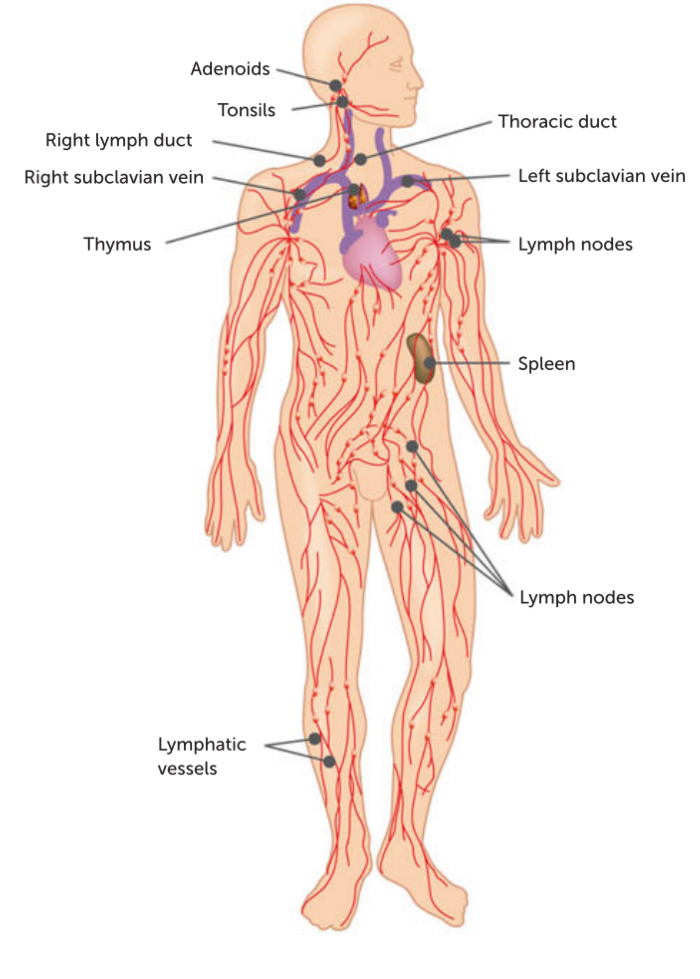
What does the lymphatic system consist of?
network of lymph capillaries joined to larger lymph vessels
Lymph nodes, located along length of some lymph vessels
What is the main function of he lymphatic system?
collect some of fluid tat escapes from blood capillaries & returns it to circulatory system
→ important part of body’s internal defect against pathogenic organisms
Where are lymph nodes situated in the body?
occur at intervals along lymphatic vessels
Each node contains masses of lymphoid tissue
→ cells of which are Criss-crossed by network of fibres
What does lymph contain when it enters lymph nodes?
cell debris, foreign particles, & micro-organisms that have penetrated body;S external defences
What could happen if some of the micro-organisms in the lymph are not destroyed?
If pathogenic
→ cause disease
How does the body destroy larger particles that enter the lymphatic system?
larger particles (bacteria) trapped in meshwork of fibres as lymph flows through spaces in noes.
Macrophages ingest & destroy particles by phagocytosis
What happens during an infection to the lymphatic system?
formation of lymphocytes increases
→ lymph nodes become swollen & swore
Lymphocytes important in specific immune response to particular pathogen
What is the immune system composed of?
cells & proteins that protect against foreign organisms, a range of alien chemicals, and well as cancerous and other abnormal cells
What are phagocytes and what do they do?
non-specific cell
Able to engulf & digest micro-organisms & cell debris
What is an immune response?
reaction and protection against a specific micro-organisms or disease-causing substance by B-cells & T-cells
Why os an immune response a homeostatic mechanism?
when micro-organisms or foreign substances enter body, immune response helps deal w invasion & restore interval environment to its normal conditions
What are the key cells involved in the immune response?
B-cells & T-cells
→ white blood cells called lymphocytes
Where are B-cells & T-cells produced & matured?
produced in bone marrow
T-cells matureL Thymus
B-cells mature: Bone marrow
→ both end up in lymphoid tissue
Where are lymphoid tissues located?
most in lymph node
→ also in spleen, thymus, tonsil
What are the two parts to the immune response?
Humoral response/ antibody-mediated immunity
Cell-mediated reponse
→ both triggered by antigens
What is humoral response/ antibody-mediated immunity?
production of special proteins called antibodies by B-cells
→ which circulate body & attack invading agents
What is cell-mediated response?
T-cells
Involved formation of special lymphocytes that destroy invading agents
What are antigens?
any substance capable of causing a specific immune response
Large molecules such as proteins, carbohydrates, lipids or nucleic acids
What are some examples of antigens?
virus particle
Whole micro-organisms (bacterial cell)
Part of bacterium (flagella, cell wall, capsule)
Toxins
Molecules on cells
Pollen grains
Egg whites
What are self-antigens and non-self antigens?
Self-antigens: large molecules produced in person’s own body
→ does not cause immune response
Non-self antigen: foreign compounds that do trigger immune response
How does your body distinguish between self, and non-self antigens?
immune system becomes programmed before birth to distinguish between self-antigens & non-self antigens
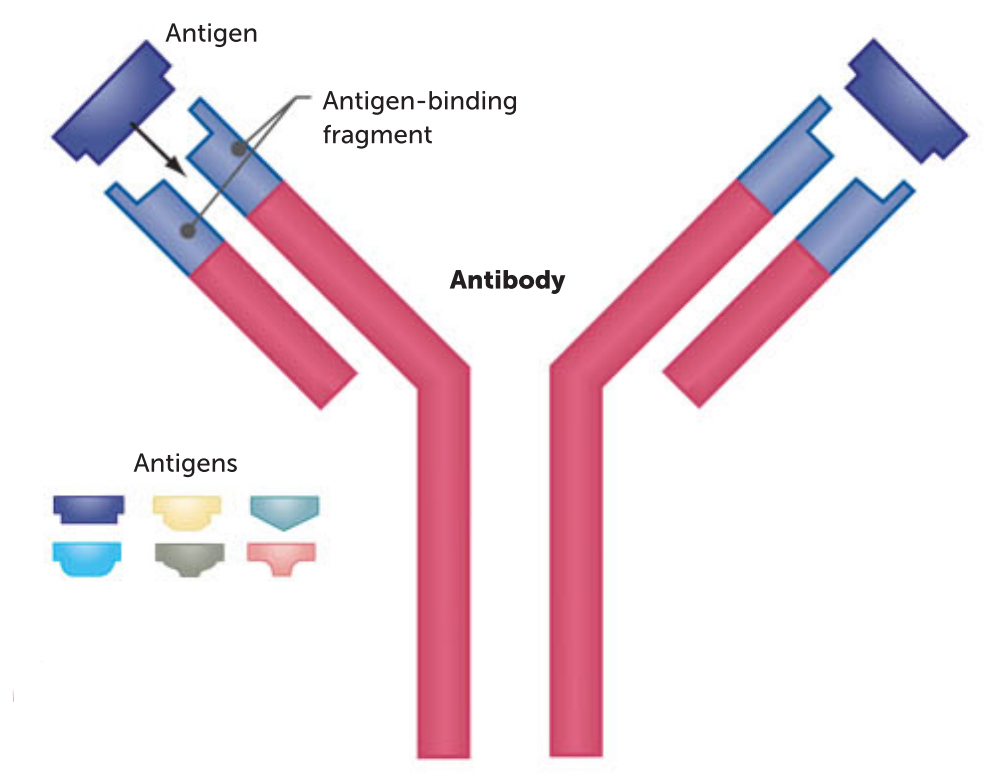
What is an antibody?
Y-shaped specialised protein produced by plasma cells in response to non-self antigen
Belong to grp of proteins: immunoglobulins
What is an antigen-antibody complex?
antibody produced in response to antigen can combine w that antigen to form: antigen-antibody complex
→ antigen molecules have specific active site w particular shape
→ antibody has complementary shape, Allowing 2 molecules to fit tgt
*each antibody can combine w only one particular antigen
What are antigen-presenting cells?
Specific cells that recognise & respond appropriately when non-self antigen enters body
What are some examples of antigen-presenting cells?
dendritic cells
Macrophages
Undifferentiated b-cells
What do antigen-presenting cells do?
Detect presence of non-self antigen
Engulf pathogen
Digest pathogen, producing small fragments that move to surface of cell (wear it)
Present antigen to lymphocytes
What are the 6 steps of the humoral response/ anti-body edited immunity?
Antigen presenting cells present the antigen, activating a particular b-cell
B-cell enlarges & divides into a group of cells called a clone
Most clones become plasma cells
Plasma cells secrete the specific antibody capable of attaching to active site of antigen
Some B-cells differentiate into long lived memory cells
Memory cells spread to all body tissues & will rapidly produce antibodies if same pathogen enters body again
What is the primary immune response?
first exposure to particular antigen
→Slow bcs takes time:
For B-cells to multiply & differentiate into plasma cells
For plasma cells to secrete antibodies
To. Build up large amounts of antibodies
What is the secondary immune response?
second or subsequent exposure to same antigen
→ fast because:
Memory cells recognise antigen
Produce antibodies at much faster rate in higher concentrations
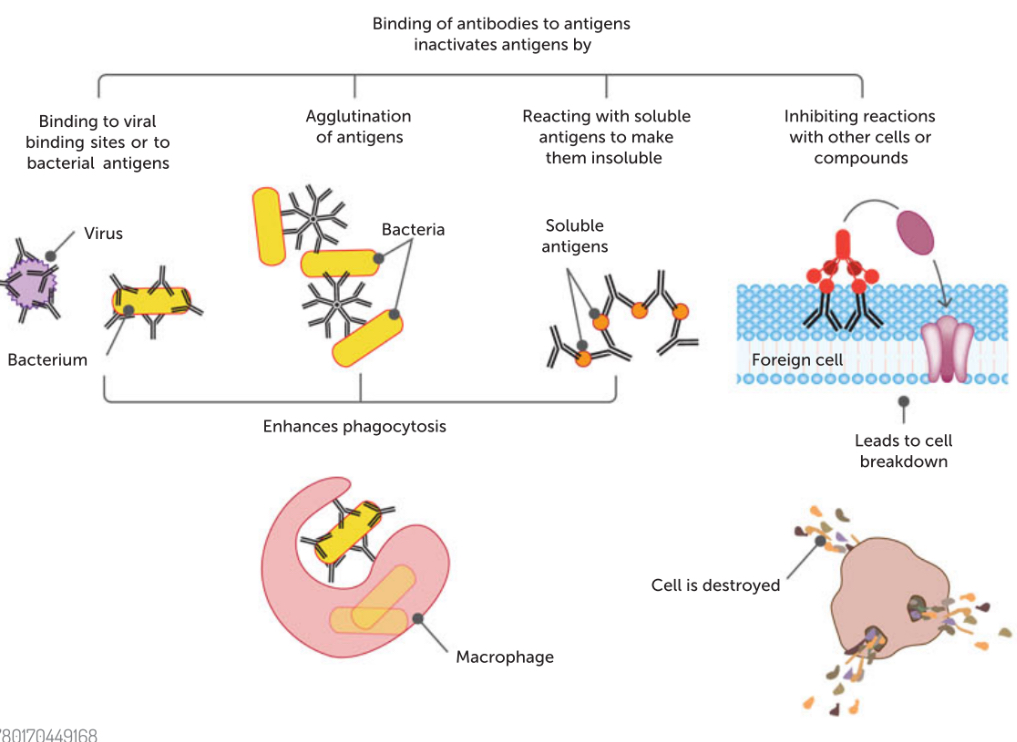
How may antibodies work?
Inactivate foreign enzymes or toxins by combining w them or inhibiting their reaction w other cells/ compounds
Bond to surface of viruses & prevent them entering cells
Coat bacteria so more easily consumed by phagocytes
Cause particles (bacteria, viruses, foreign blood cells) to clump tgt
→ agglutination
Dissolve organisms
React w soluble substances to make insoluble & thus more easily consumed by phagocytes
How would antibodies interact with antigen sot inactivate the antigens? (Diagram)
What does cell-mediated immunity provide resistance to?
intracellular phase of bacterial & viral infections
Fungi & parasites (round worm)
Transplants of foreign tissue
Cancer cells
What are the 6 steps to cell-m educated immunity?
Antigen-presenting cells presents foreign antigen to T-cells in nearest lymph node
Specific T-cell gets activated or sensitised
T-cell enlarges & divides into group of cells called clone
Most clones become plasma cells produce different type of T-cell cells
Some T-cells differentiate into one-lived memory cells
Memory cells spread to all body tissues & will initiate much faster response
If T-cells don’t become memory cells, what do the develop further into?
Killer T-cells (aka cytotoxic T-cells)
Helper T-cells
Suppressor T-cells
What are killer/Cytotoxic T-cells?
migrate to site of infection & deal w invading antigen
Attach to invading cells & secrete chemical that destroy antigen
→ then go in search of more antigens
What are Helper T-cells?
play important role in humoral & cellular immunity
Bind to antigen on antigen-presenting cells,
→ stimulating secretion of cytokines
What do cytokines do?
Attract lymphocytes to infection site
→ which become sensitised & activated, thus intensifying response
Attract macrophages to place of infection so macrophages can destroy antigen by phagocytosis
Intensify phagocytic activity of macrophages
Promote action of killer T-cells
What do Suppressor T-cells do?
act when immune activity becomes excessive or infection has been dealt with successfully
Release substances that inhibit T- & B-cell activity, slowing down immune response
Define immunity
Resistance to infection by inaving microorganisms
Natural vs Artificial immunity
Natural: occurs without human interventions
Artificial: results from administering
to people an antibody or antigen
Passive vs Active immunity
Passive: acquired when antibodies are transferred from one person to another
Active: develops after exposure to microorganisms or foreign substances