Evolution Bio Test
 Call Kai
 Learn
Learn Practice Test
 Spaced Repetition
 Match
Match Flashcards
 Knowt Play
1/40

There's no tags or description
Looks like no tags are added yet.
Name | Mastery | Learn | Test | Matching | Spaced | Call with Kai |
|---|
No analytics yet
Send a link to your students to track their progress
41 Terms
genetic drift
A change in the allele frequency of a population as a result of chance events rather than natural selection, mechanism of evolution
nonrandom mating
Mating among individuals on the basis of their phenotypic similarities or differences, rather than mating on a random basis
gene flow
Movement of alleles into or out of a population due to the migration of individuals to or from the population
conditions of natural selection
variation, overpopulation, inheritance, competition, differential survival, reproduction
Variation
differences in physical and biological traits of an individual from the group to which it belongs, condition of natural selection
Overpopulation
The number of people in an area exceeds the capacity of the environment to support life at a decent standard of living, condition of natural selection
Inheritance
The process by which physical and biological characteristics are transmitted from the parent (or parents) to the offspring, condition of natural selection
competition
the struggle between organisms to survive in a habitat with limited resources, condition of natural selection
Differential survival
individuals with favorable characteristics tend to survive more, condition of natural selection
Reproduction
the production of offspring, condition of natural selection
types of gene flow
immigration and emigration
types of genetic drift
founder effect and bottleneck effect
founder effect
a few individuals become isolated from a larger population and form a new population whose gene pool composition is not reflective of that of the original population, type of genetic drift
bottleneck effect
a reduction in the genetic diversity of a population caused by a reduction in its size (ie a natural disaster), type of genetic drift
r-selective species
those that reproduce rapidly/often and produce in large amounts, don't need to care for their offspring once born
K-selective species
those that reproduce very slowly and are slow to mature as well as that they produce one or two offspring at a time, need to nurture and care for offspring once born
allopatric speciation
The formation of a new species as a result of an ancestral population's becoming isolated by a geographic barrier.
sympatric speciation
The formation of new species in populations that live in the same geographic area
reproductive isolation
Separation of species or populations so that they cannot interbreed and produce fertile offspring, could be because it causes the production of infertile or weak offspring, or because of differences in geography, reproductive organs, or food
postzygotic isolation
reproductive isolation that occurs after members of two different species have mated and produced a hybrid offspring. Such hybrids are usually unable to reproduce
behavioral isolation
Form of reproductive isolation in which two populations have differences in courtship rituals or other types of behavior that prevent them from interbreeding
Speciation
the formation of new and distinct species in the course of evolution.
definition of evolution
change in allele frequencies in a population over multiple generations
definition of species
A group of organisms that can intrabreed and produce fertile offspring.
types of natural selection
directional, disruptive, and stabilizing selection: shape populations by favoring specific phenotypic traits over others
directional selection
Form of natural selection in which the entire curve moves; favors one extreme trait, shifting the population mean, occurs when individuals at one end of a distribution curve have higher fitness than individuals in the middle or at the other end of the curve
disruptive selection
form of natural selection in which a single curve splits into two; favors extreme traits, potentially causing divergence, occurs when individuals at the upper and lower ends of a distribution curve have higher fitness than individuals near the middle
stabilizing selection
Natural selection that favors intermediate variants by acting against extreme phenotypes, favors intermediate traits, reducing variation, individuals in the middle of the distribution curve have higher fitness than individuals near the ends
HardyWeinberg equation/equilibrium
p+q = 1, p^2 + 2pq + q^2 = 1, (P=dom q=rec), represents the distribution of alleles in a population that is large, mating is random, all genotypes are equally likely to reproduce (no natural selection), no emigration or immigration, and no mutations occur, if distribution of genotypes matches the equilibrium no evolution is occurring
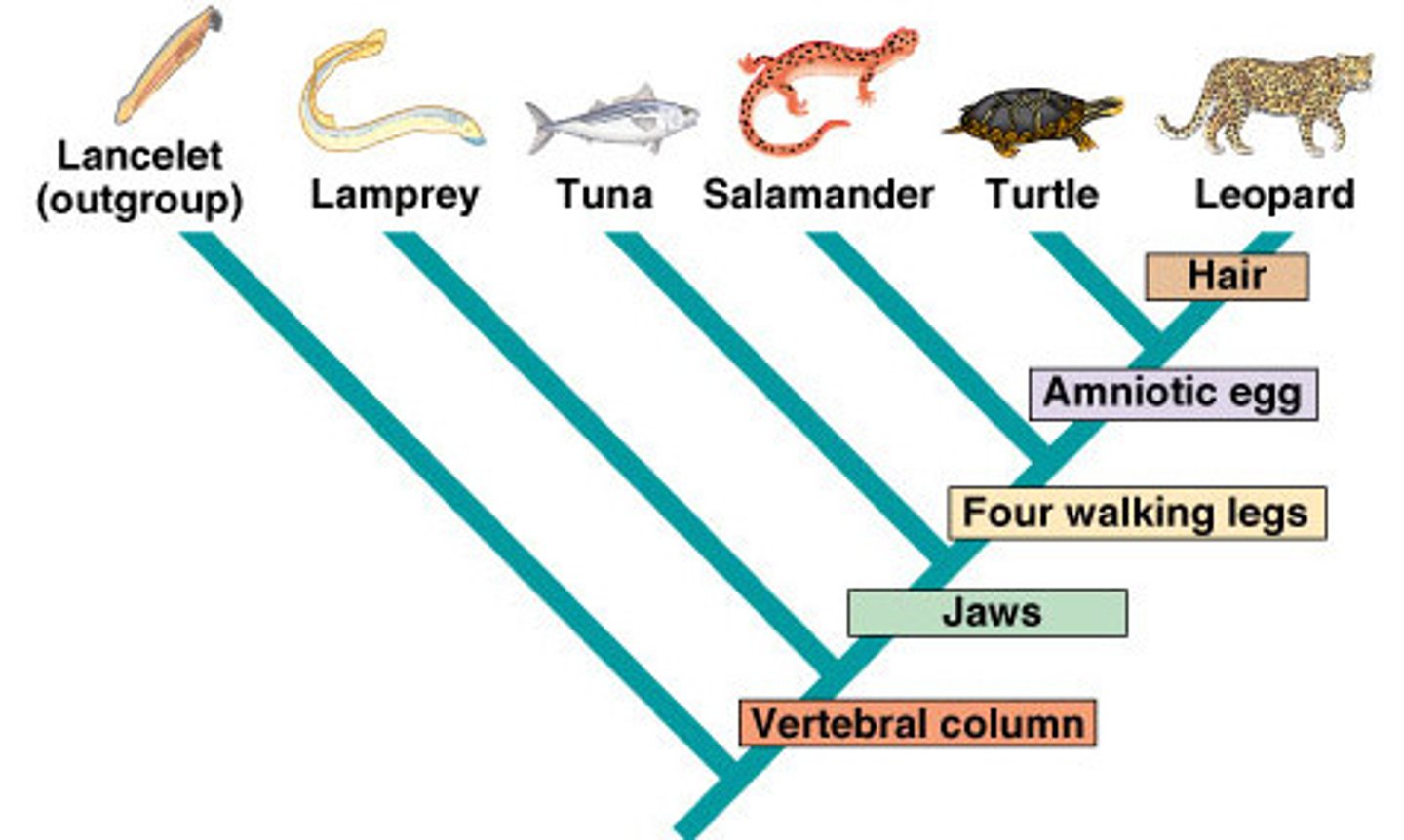
phylogenetic tree
A tree that shows the evolutionary relationships thought to exist among groups of organisms, traces emergence of new traits leading to new species
Microevolution
evolutionary change within a species or small group of organisms, especially over a short period.
Macroevolution
large-scale evolutionary changes that take place over long periods of time
Microevolution vs. Macroevolution
change in the gene pool of a population over several generations / large scale changes in a population that leads to the evolution of a new species
homologous structures
similar structures that related species have inherited from a common ancestor
analogous structures
Body parts that share a common function, but not structure
vestigial structures
remnant of a structure that may have had an important function in a species' ancestors, but has no clear function in the modern species, nonfunctional remnants of ancestral traits
5 mechanisms of evolution
natural selection, mutation, genetic drift, non-random mating, gene flow
Natural Selection
A process in which individuals that have certain inherited traits tend to survive and reproduce at higher rates than other individuals because of those traits, mechanism of evolution
Mutation
change in a DNA sequence that affects genetic information, mechanism of evolution
prezygotic isolation
a barrier to successful breeding that occurs before fertilization, such as differences in mating time or behavior
Still learning (36)
You've started learning these terms. Keep it up!