Extensions of Mendelian Genetics: Complementation, Multiple Alleles, and Organellar Inheritance
 Call Kai
 Learn
Learn Practice Test
 Spaced Repetition
 Match
Match Flashcards
 Knowt Play
1/59

There's no tags or description
Looks like no tags are added yet.
Name | Mastery | Learn | Test | Matching | Spaced | Call with Kai |
|---|
No analytics yet
Send a link to your students to track their progress
60 Terms
What is the purpose of a complementation test?
To determine if mutations with the same phenotype are in the same gene or different genes.
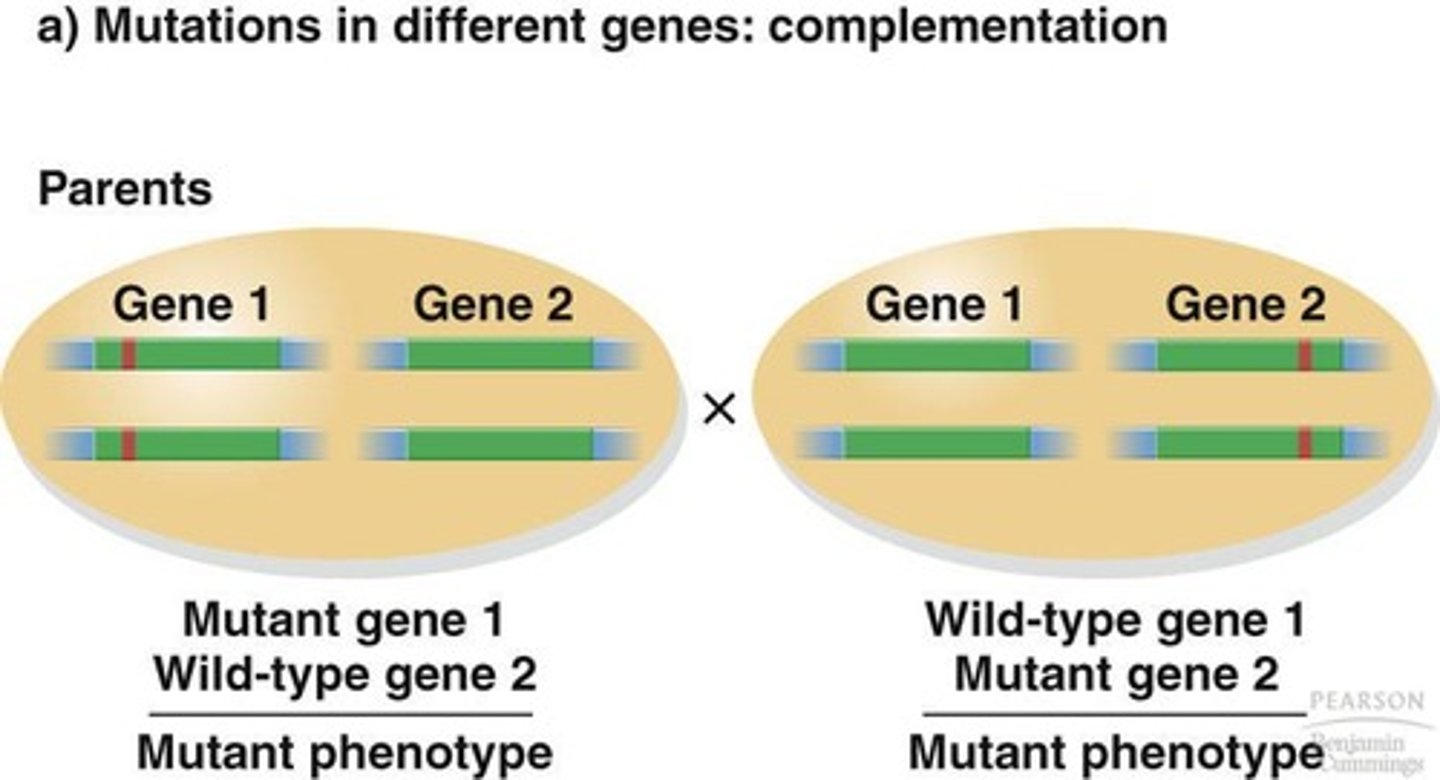
What is the assumption made during a complementation test?
The mutant alleles are assumed to be recessive.
What will be the F1 phenotype if mutations are on different genes?
The F1 phenotype will be wild type.
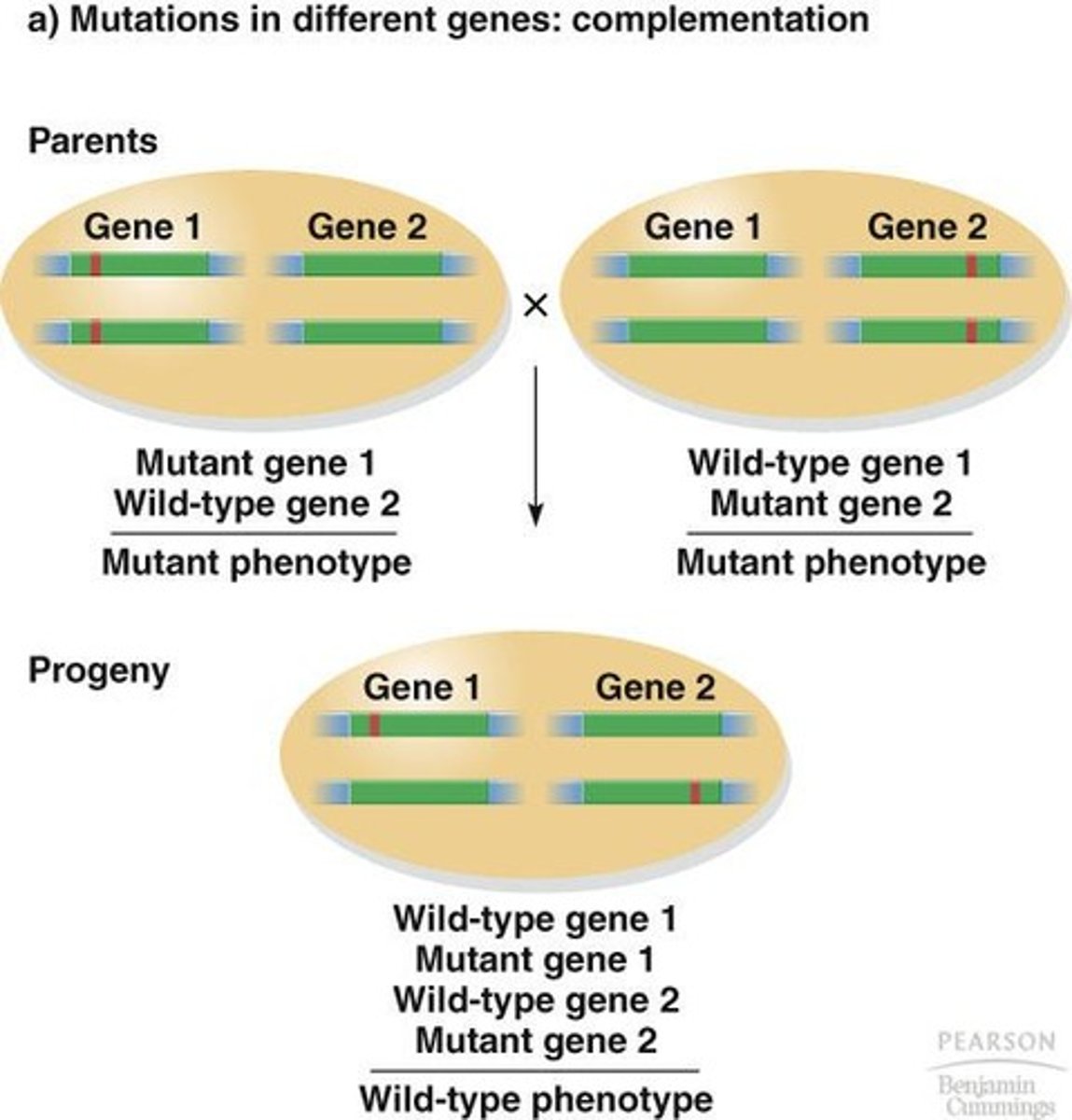
What will be the F1 phenotype if mutations are on the same gene?
The F1 phenotype will be mutant.
What are multiple alleles?
Many alleles are possible for a gene, but individuals can only have 2 alleles.
What is the significance of the ABO blood groups?
The ABO gene encodes a cell surface protein with alleles A, B, and O, where A and B are codominant and O is recessive.
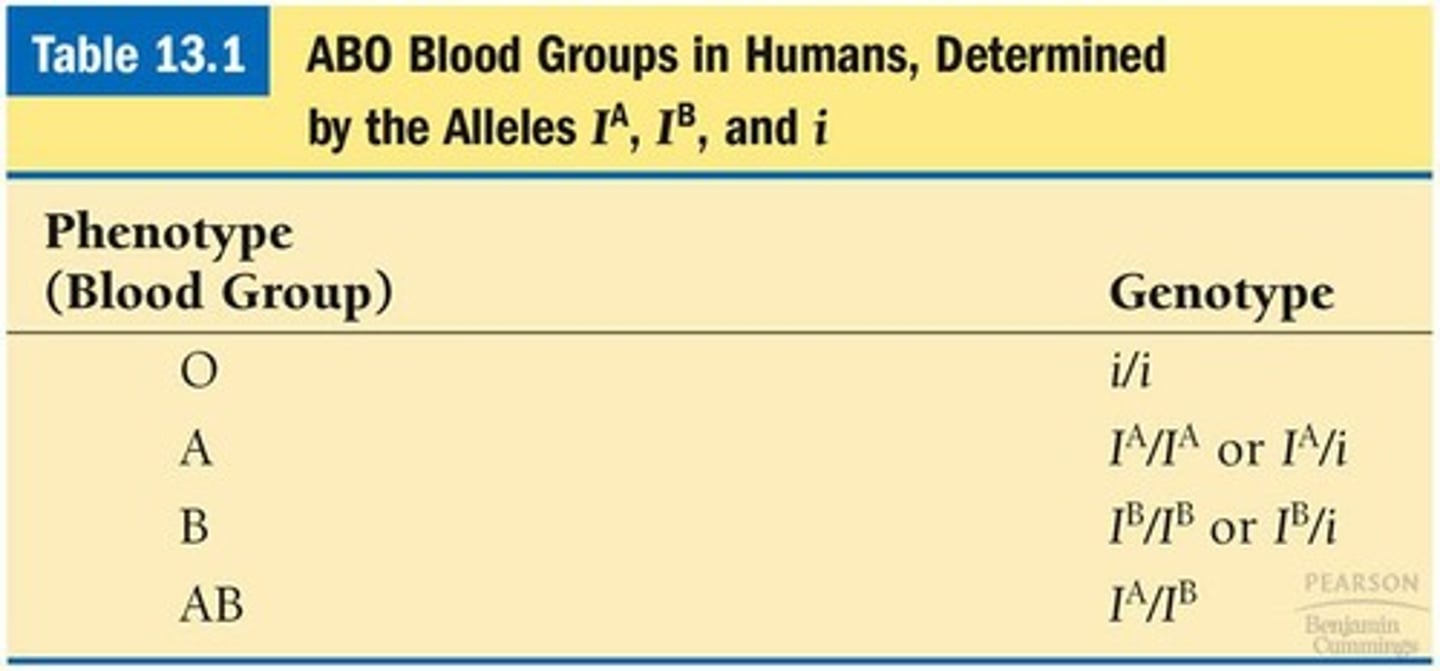
What does allele A (IA) produce?
Allele A produces A protein.
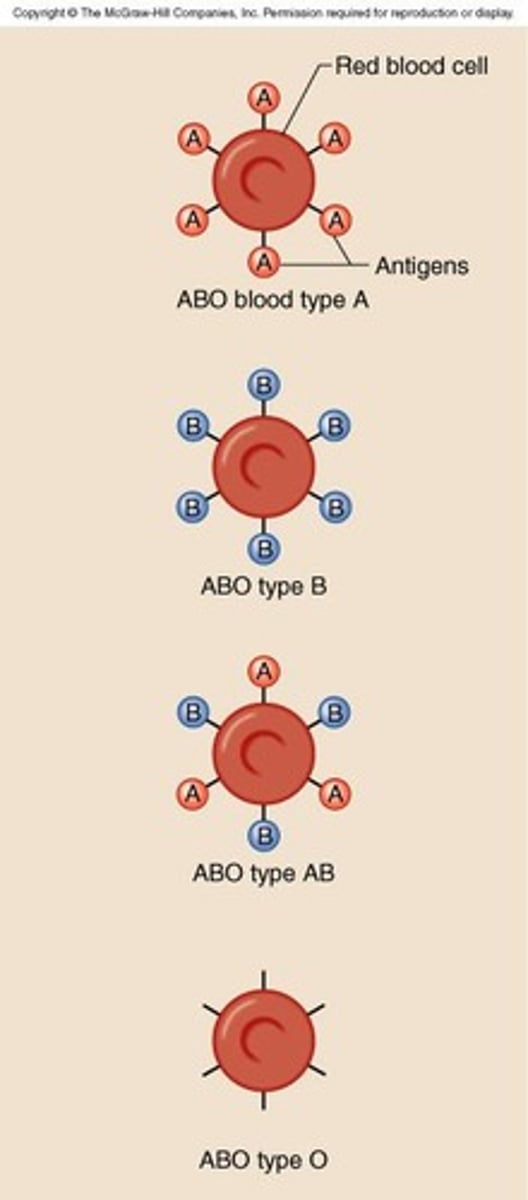
What does allele B (IB) produce?
Allele B produces B protein.
What does allele O (i) produce?
Allele O produces no protein.
What is an antigen?
A molecule recognized as foreign by the immune system.
What is an antibody?
A protein that recognizes and binds to foreign molecules, causing red blood cells to clump.
What is complete dominance?
If a dominant allele is present, the dominant phenotype is expressed.
What is complete recessiveness?
A phenotype that is only exhibited when an individual is homozygous for the recessive allele.
What is incomplete dominance?
A situation where heterozygotes exhibit an intermediate phenotype, resulting in a 1:2:1 ratio.
What is codominance?
A genetic scenario where heterozygotes express both phenotypes simultaneously.
How are codominance and incomplete dominance related?
Both involve the expression of alleles, but codominance shows both traits distinctly while incomplete dominance shows a blend.
What are essential genes?
Genes that are crucial for survival; mutations in these genes can lead to lethality.
What are lethal alleles?
Alleles that can cause the death of an organism when present in a certain genotype.
What is the modified Mendelian ratio?
Ratios that deviate from the classic 3:1 or 9:3:3:1 due to factors like incomplete dominance or codominance.
What is extranuclear inheritance?
Inheritance patterns that occur outside the nucleus, often involving mitochondrial or plastid DNA.
What is the significance of mutant analysis?
It helps in understanding the genetic basis of phenotypic variations and identifying novel mutations.
What is a dominant lethal allele?
An allele that causes death in both homozygous and heterozygous individuals.
What is a recessive lethal allele?
An allele that causes death only in homozygous individuals.
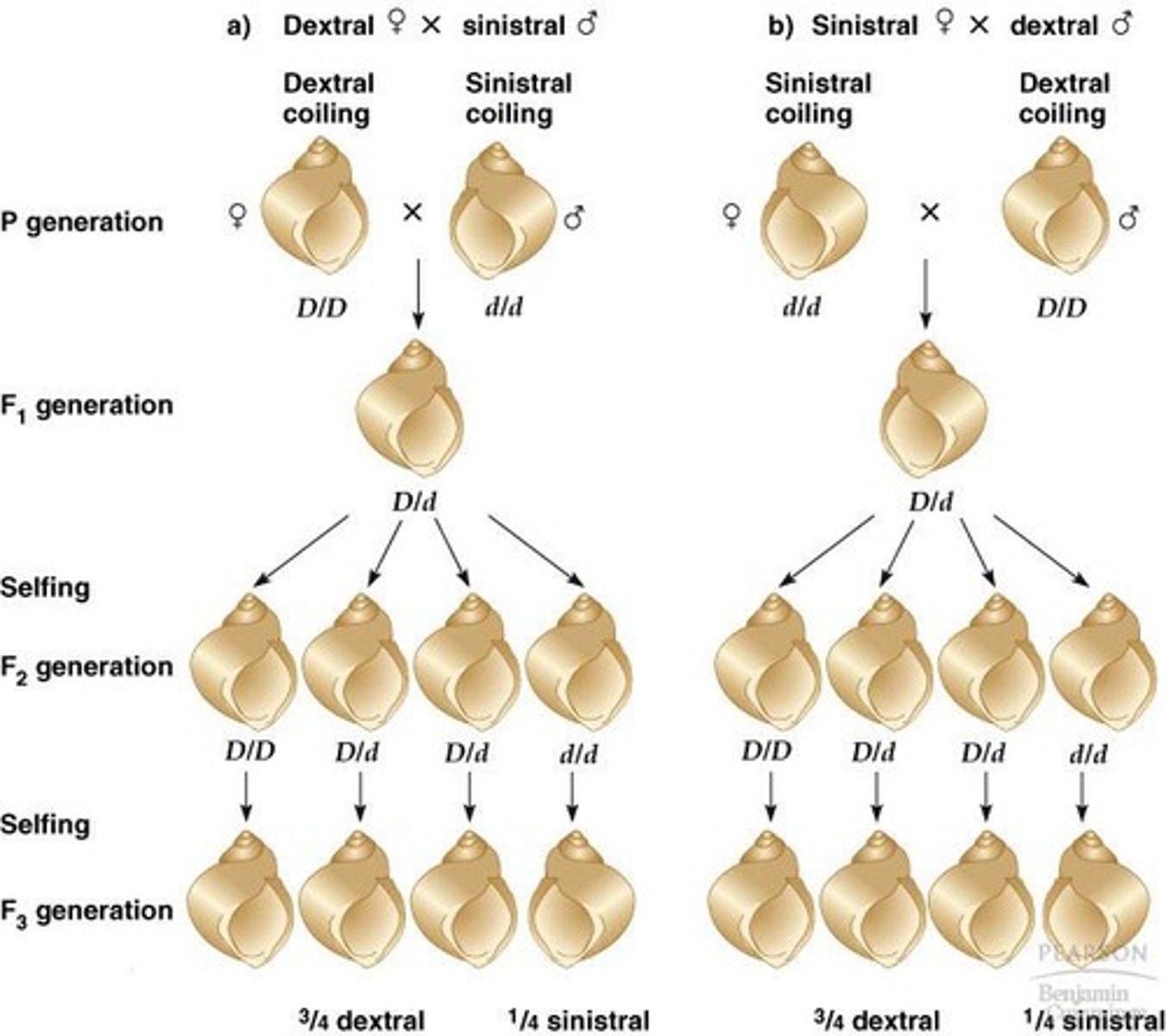
What is maternal effect?
A trait encoded in the nucleus where the phenotype is determined by the mother's genotype, not by the alleles.
How does the maternal effect differ from extranuclear inheritance?
Maternal effect traits are encoded in the nucleus, while extranuclear inheritance involves genes outside the nucleus.
What determines the shell coiling direction in snails?
The genotype of the mother, leading to right (dextral) or left (sinistral) coiling.
What is gene interaction?
When different genes affect the same trait, leading to various phenotypes.
What is epistasis?
The interaction of two or more genes that control a single phenotype, where one gene masks the expression of another.
What is recessive epistasis?
A situation where two homozygous recessive genotypes produce the same phenotype, often resulting in a 9:3:4 ratio.
What is dominant epistasis?
A condition where one dominant allele masks the expression of another gene, typically resulting in a 12:3:1 ratio.
What is the Endosymbiont Theory?
The theory that mitochondria and chloroplasts originated from free-living prokaryotes that formed a symbiotic relationship with ancestral eukaryotic cells.
What is the structure of mitochondrial DNA?
Mitochondrial DNA is circular, double-stranded, often GC-rich, and supercoiled with no histones.
How is mitochondrial DNA replicated?
Mitochondrial DNA is not synthesized de novo; it grows and divides from preexisting mitochondria.
What types of genes are found in the mitochondrial genome?
Mitochondrial genes include tRNAs, rRNAs, and several genes involved in respiration.
What is the chloroplast genome responsible for?
The chloroplast genome is involved in photosynthesis and contains genes for chloroplast transcription and translation.
What are the rules of non-Mendelian inheritance?
Non-Mendelian inheritance includes patterns that do not follow Mendelian ratios, such as codominance, incomplete dominance, and epistasis.
What is the significance of nuclear migration in chloroplasts?
Some components of chloroplasts are encoded by nuclear genes, indicating a migration of genetic material.
What is the expected phenotypic ratio for a dihybrid cross with epistasis?
The expected phenotypic ratio can vary, such as 9:3:4 for recessive epistasis or 12:3:1 for dominant epistasis.
What is Mendelian dominance?
The principle that one allele can mask the expression of another.
What is maternal effect in genetics?
A phenomenon where the phenotype is determined by the genotype of the mother, not by the alleles of the offspring.
What is mitochondrial DNA (mtDNA)?
The circular, double-stranded genome found in mitochondria, often GC-rich and supercoiled.
What is the chloroplast genome?
The double-stranded DNA found in chloroplasts, larger than animal mtDNA, involved in photosynthesis.
What is the significance of gene interactions?
Different genes can affect the same trait, leading to complex phenotypic expressions.
What is the role of nuclear mitochondrial genes?
They encode proteins necessary for mitochondrial function, including mt DNA polymerase and translation factors.
What is the difference between codominance and incomplete dominance?
In codominance, both alleles are fully expressed, while in incomplete dominance, the phenotype is intermediate.
What is the phenotypic ratio for a dihybrid cross?
The typical phenotypic ratio is 9:3:3:1.
What is a multiple allele system?
A genetic scenario where more than two alleles exist for a given gene, affecting the phenotype.
What is a modified Mendelian ratio?
Ratios that deviate from the classic Mendelian ratios due to gene interactions or other factors.
What is the role of mRNA in mitochondria?
Mitochondrial mRNAs are produced as one large molecule and later processed for translation within the organelle.
What determines shell coiling in snails?
The genotype of the mother, resulting in right (dextral) or left (sinistral) coiling.
What is duplicate recessive epistasis?
A genetic interaction where two recessive alleles at different loci result in the same phenotype, leading to a 9:7 ratio.
What is the role of chloroplasts?
Chloroplasts are involved in photosynthesis and contain thylakoids and photosystems.
What is maternal inheritance?
Progeny phenotype is determined by the mother's phenotype due to increased cytoplasm in maternal gametes.
What is cytoplasmic male sterility (CMS)?
A mitochondrial mutation that leads to sterile pollen, often used in hybrid crops.
What are yeast petite mutants?
Mutants that can only grow anaerobically and have mutations in nuclear encoded genes affecting respiration.
What is the significance of the AY allele in mice?
It is a dominant color allele that is also associated with a recessive lethal phenotype.
What is the genetic basis for the coat color of Labrador Retrievers?
The B gene determines black or brown color, while the E gene allows or prevents the expression of the B gene.
What is the phenotype ratio for a dihybrid cross?
The expected phenotypic ratio is typically 9:3:3:1.
What is the significance of chloroplast genomes?
They contain genes necessary for chloroplast function, including those for transcription and translation.
What is the inheritance pattern of Four O'Clock plants?
They exhibit variegated leaves due to the maternal inheritance of chloroplasts.