IGCSE Chemistry - Hydrocarbon tests
 Call Kai
 Learn
Learn Practice Test
 Spaced Repetition
 Match
Match Flashcards
 Knowt Play
1/16

There's no tags or description
Looks like no tags are added yet.
Name | Mastery | Learn | Test | Matching | Spaced | Call with Kai |
|---|
No analytics yet
Send a link to your students to track their progress
17 Terms
cracking - alkanes
600-700 degrees temp.
alumina/silica
substitution - alkanes
uv light
addition - alkenes
none
alkanes general formula
cnh2n+2
alkenes general formula
cnh2n
alcohol general formula
cnh2n+1oh
alcohol 3 types - oxidation
Combustion (burning in air)
Aerobic oxidation
Treatment with an oxidising agent
complete combustion of alcohol
characteristic - almost invisible blue flame
why schools use ethanol in spirit burners - burns cleanly without a strong odour

microbial oxidation of alcohol
Bacteria in the air use oxygen to oxidise the ethanol in the wine:
ethanol + oxygen → ethanoic acid + water
wine (left open) - microbial oxidation of ethanol will produce a weak solution of the carboxylic acid, ethanoic acid, the same acid used in vinegar
oxidisation agent - alcohol
potassium dichromate(VI) solution
(orange to green)
sulfuric acid
equation:
CH3CH2OH + [O] → CH3COOH + H2O
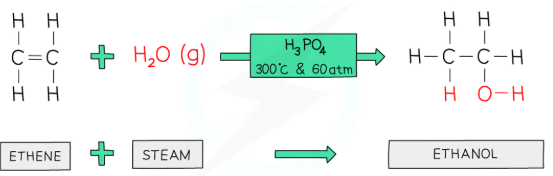
hydration of ethene - ethanol
300 degrees
60-70atm
concentrated phosphoric acid (catalyst)
ethanol steps (hydration of ethene)
ethene produced by cracking
hydrated
condensed (ethanol has lower b.p than ethene)
fractional distillation (separate ethanol from water)
fermentation - ethanol
glucose
30degrees
enzymes in yeast
absence of oxygen
C6H12O6 → 2CO2 + 2C2H5OH
carboxylic acid general formula
cnh2n+1cooh
esters functional group
o—c-o
esters features
sweet smelling
catalyst of esterification
concentrated sulfuric acid