Protein stability
 Call Kai
 Learn
Learn Practice Test
 Spaced Repetition
 Match
Match Flashcards
 Knowt Play
1/7

There's no tags or description
Looks like no tags are added yet.
Name | Mastery | Learn | Test | Matching | Spaced | Call with Kai |
|---|
No analytics yet
Send a link to your students to track their progress
8 Terms
Define protein stability
It is the net thermodynamic balance that determine whether a protein remains in its functional folded 3D structure (native state) or unfolds (denatured state)
Denoted by ΔG, which represents the balance between enthalpy (ΔH) and entropy (ΔS)
Negative ΔG → Native state favoured
Positive ΔG → Unfolded state favoured
What factors affect protein stability?
Hydrophobic effect: nonpolar side chains bury themselves inside the protein core to avoid water
Temperature:
Excess heat breaks weak non-covalent bonds by providing kinetic energy, shifting the equilibrium toward unfolding
Extreme cold can trigger cold denaturation when water solvation of hydrophobic residues becomes energetically favorable
pH: alters the ionisation states of amino acid side chains; extreme pH levels disrupt crucial ionic bonds and electrostatic interactions
Methods to study protein stability
Circular Dichroism (CD) Spectroscopy
Tryptophan/Intrinsic Fluorescence Spectroscopy
Differential Scanning Calorimetry (DSC)
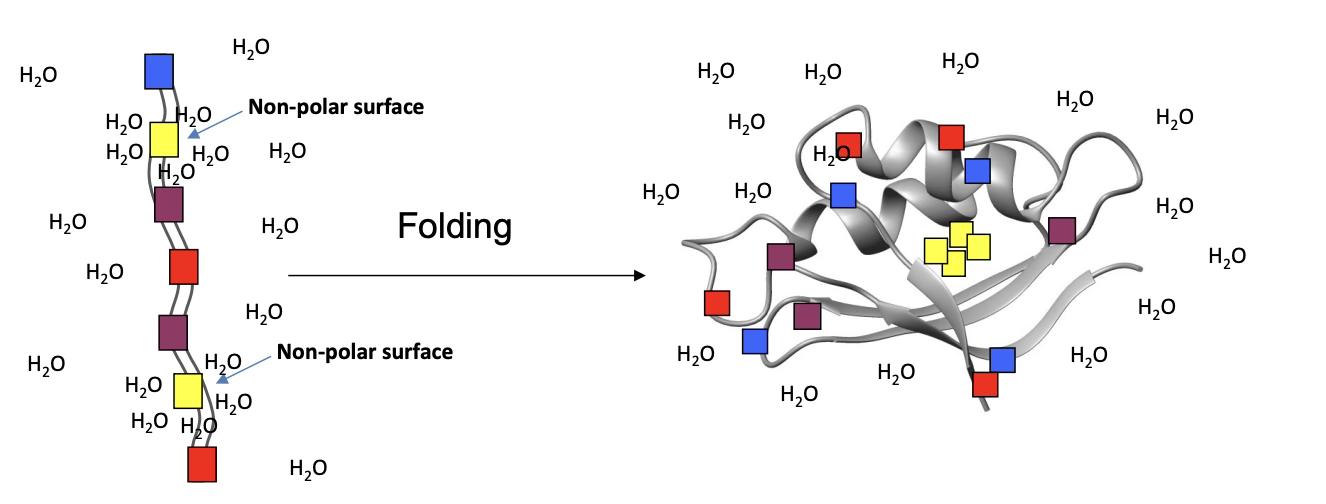
What drives protein unfolding?
THE HYDROPHOBIC EFFECT, WHICH IS DRIVEN BY THE ENTHALPY (ΔG), THIS IS WHY WE HAVE COLD DENATURATION
Hydrophobic effect: nonpolar side chains bury themselves inside the protein core to avoid water
If entropy (ΔS) drove folding, higher temperature would mean more stable protein, but the opposite is true because heat denatures proteins
At maximum stability, ΔS = 0, which rules out entropy as the driver
At low temps, water forms more ordered structures, making it enthalpically favourable to surround non-polar residues → protein unfolds → this is cold denaturation
Steps for calculating protein stability (ΔG) and Keq
Find biophysical parameter (y) that differs between the states (folded vs unfolded).
This can be tryptophan fluorescence for example
Protein will be put in different concentrations of perturbant (denaturant), like Urea or GluHCl, or pH/temp
Parameter y is measured at each pertubant concentration or temperature
Fraction of unfolded protein can be calculated for each y-value, using the equation
Plot y versus perturbant
From plot, unfolded and folded states can be noted at the plateaus
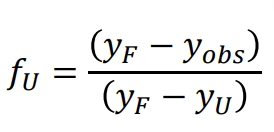
Steps for calculating Protein stability parameters (ΔGH2O, m-value, Cm)
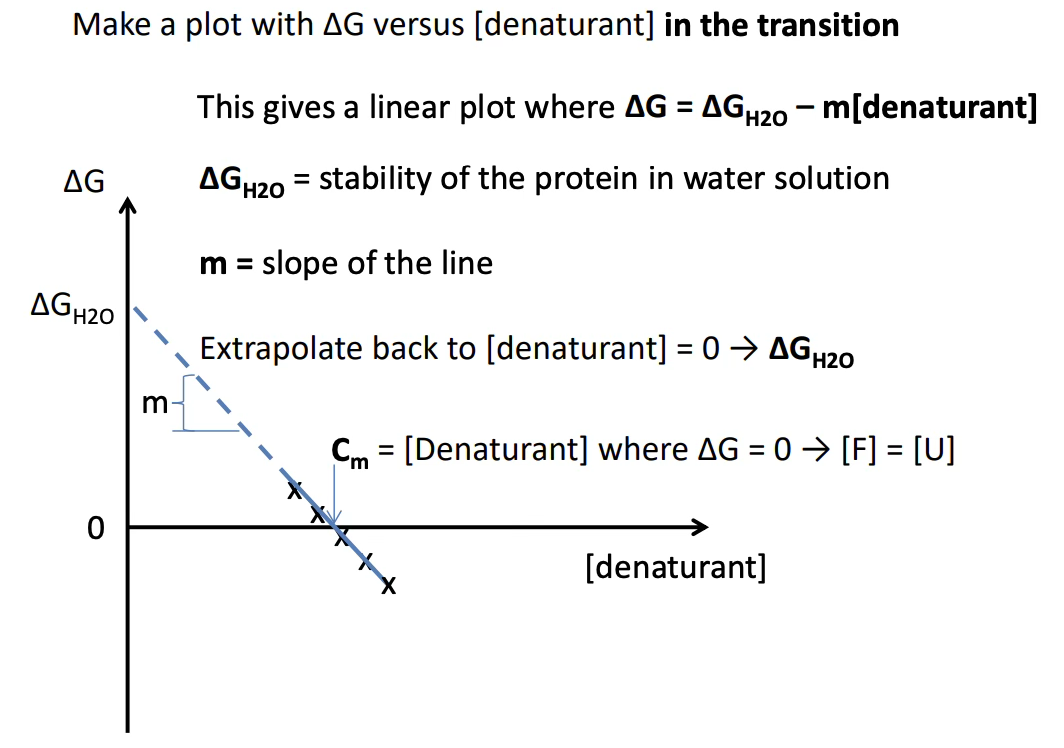
Accuracy evaluation of protein stability parameters.
CM: Highly accurate; directly read from the center of the experimental transition zone
m-value: Moderately accurate; relies heavily on having clean, well-defined pre- and post-transition baselines to calculate the slope
ΔGH2O: Least accurate; it is an extrapolated value calculated far outside the experimental transition window back to 0 M denaturant, any minor error in the m-value slope becomes amplified
What does the steepness of the graph represent?
Steepness of slope in graphs indicates cooperativity.
The steeper the slope (the higher the m-value), the higher the cooperativity