HD 101 Exam 2
 Call Kai
 Learn
Learn Practice Test
 Spaced Repetition
 Match
Match Flashcards
 Knowt Play
1/76

There's no tags or description
Looks like no tags are added yet.
Name | Mastery | Learn | Test | Matching | Spaced | Call with Kai |
|---|
No analytics yet
Send a link to your students to track their progress
77 Terms
Attachment
Positive emotional bond between a child and a particular, special individual
Most important aspect of infant socioemotional development
Provides pleasure, comfort, and safety
= Offspring Survival
Harry Harlow
Researched that monkeys preferred a soft terry-cloth “mother” over a wire mother that provided food
Secure Base
Child seeks comfort during times of fear (activator) and uses it to regulate emotions (terminator)
John Bowlby
Applied Harlow’s findings to human infants
Looked at effects of maternal deprivation on mental illness in children: Children need continuous relationship with permanent caretaker
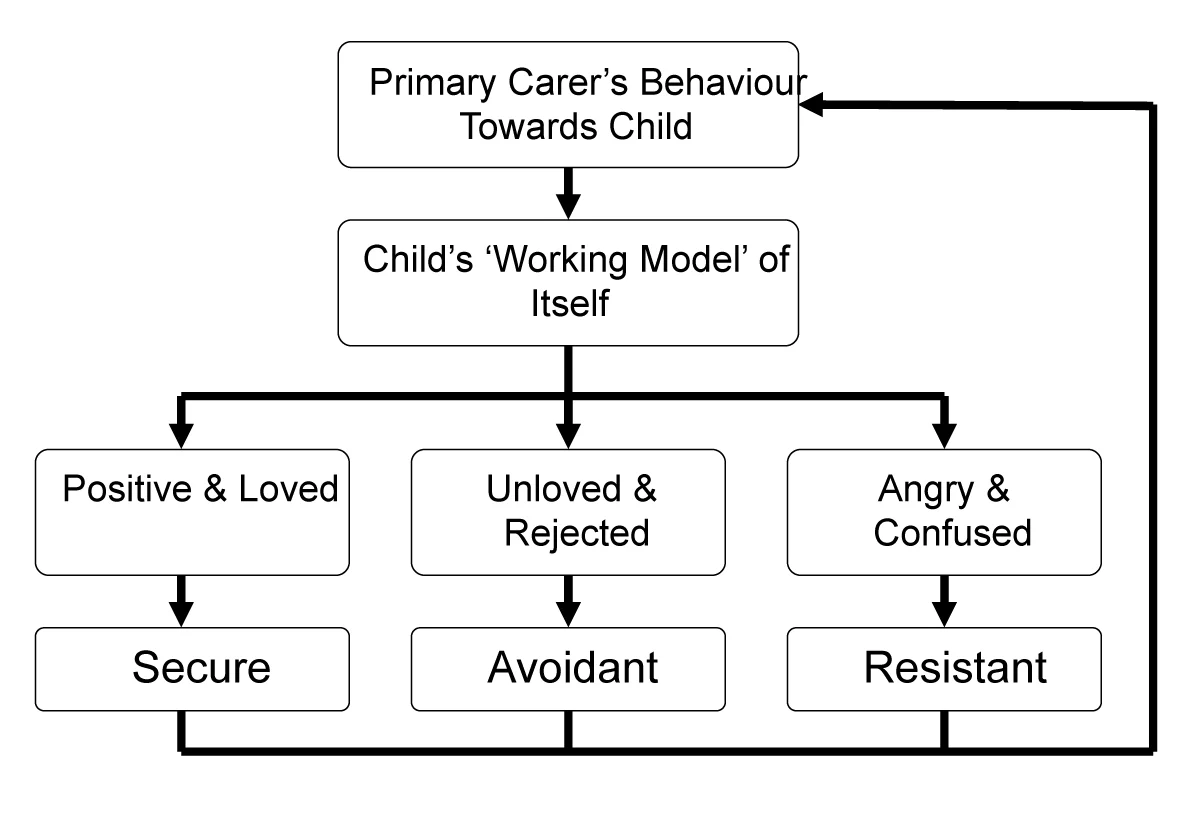
Attachment Behavior System
A pattern of mutual regulation between infant and caregiver
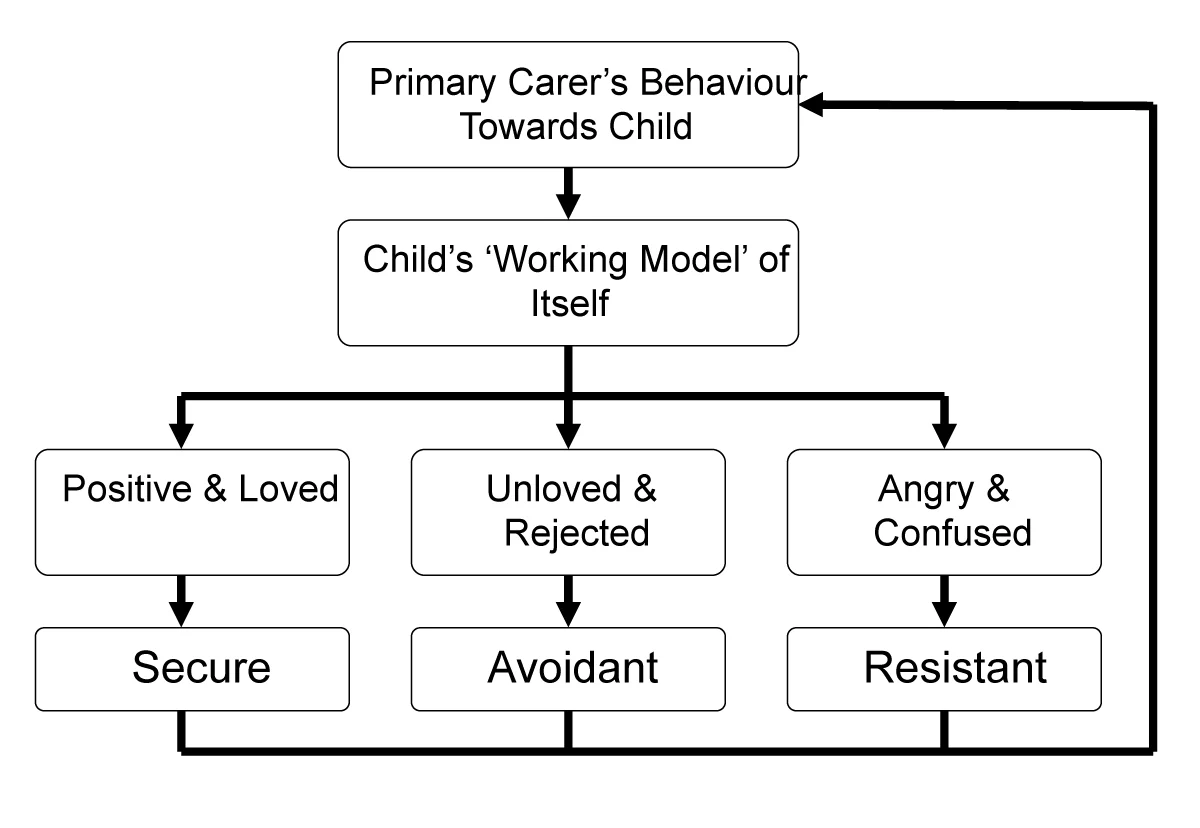
Internal Working Model
Over time, the infant forms a mental relationship to anticipate the nature of relationships
Bowlby’s Attachment Stages
Pre-Attachment
Attachment in the Making
Clear-cut attachment
Reciprocal Relationship
Pre-Attachment Stage
0-6 Weeks
Signals bring infant close to others
Attachment in the Making Stage
6 weeks - 6 months
Responds differently to caregiver
Clear-cut Attachment Stage
6 months - 2 years
Develops stranger/separation anxiety
Reciprocal Relationship Stage
2+ years
Responds to caregiver's feelings/needs
Strange Situation
By Mary Ainsworth to observe exploration, separation anxiety, and reunion behavior with caregiver
Attachment Patterns
Secure
Insecure Avoidant
Insecure Resistant
Insecure: Disorganized
Secure Attachment Style
Secure base for exploring, recovers quickly at reunion
Caregiver is sensitive and consistent
66%
Associated with positive outcomes in infancy, childhood, and adolescence
Avoidant Attachment Style
Explores without concern, slight distress at separation, ignores at reunion
Caregiver is unavailable, rejecting
15%
Resistant Attachment Style
Little Exploration, extreme distress at separation, seeks caregiver but agitated at reunion
Caregiver is inconsistent with responses
10%
Disorganized Attachment Style
Inconsistent behavior, frightened, confused, no attachment at reunion
Caregiver neglects or physically abuses
<10%
Quality of Parenting
Sensitive responsiveness = secure attachment
Consistent across both parents
Temperament
Consistent patterns of arousal and emotion
Forms the basis for personality development
Fairly Stable across the lifespan
9 Dimensions of Temperament
Quality of Mood
Activity Level
Rhythmicity
Distractibility
Attention Span & Persistence
Approach or Withdrawal
Adaptability
Threshold of Responsiveness
Intensity of Reaction
Quality of Mood
How friendly is infant’s response?
Activity Level
How active is infant?
Rhythmicity
How predictable is infant?
Distractibility
How distracted is the infant?
Attention Span & Persistence
How long does infant try? Does infant overcome obstacles?
Approach or Withdrawal
Response to new experiences?
Adaptability
How well does infant adapt to change?
Threshold of Responsiveness
How intense does a situation need to be to elicit a response?
Intensity of Reaction
How strong is the response? Talking? Laughing? Crying?
Main Patterns of Temperament
Easy
Difficult
Slow to warm up
Easy Temperament
Positive mood
Regular schedule
Moderate reactions
Adaptable
Comfortable with unfamiliar situations
Difficult Temperament
Negative mood
Irregular routine
Intense reactions
Slow to adapt
Resist unfamiliar situations
Slow to warm up Temperament
Low activity
Low intensity
Slow to adapt
Shy in new situations
What shapes temperament?
Heredity
Environment
Innate tendencies
How does heredity shape temperament?
Genetic, inborn tendencies
How does environment shape temperament?
Support or discouragement from parents and culture
How do innate tendencies shape temperament?
Can be reinforced, channeled, frustrated
Goodness of Fit
Match between child’s innate tendencies and the environment leads to better developmental outcomes
Nonverbal Encoding
Nonverbal expression of emotions
Nonverbal encoding characteristics
Born with the capacity to display basic emotions
At birth: interest, stress, disgust
At 1 month: joy, anger, surprise, fear, sadness
Culturally Universal (Similar across most diverse cultures)
Social Referencing
First appears around 8 - 9 months
Intentional search for cues
Aids in understanding other's’ behavior in context
Emotional Development in Early Childhood
Emotional capacity involving self-awareness increases with brain maturation
Move beyond egocentric view (false belief task)
Slowly gain insight into what others may be thinking
Increase in ability to understand the motives and reasons behind behavior of others
Emotional Development in Middle Childhood
Better understanding of emotions helps with emotional highs and lows (Control of emotions grows)
Empathy expands as children become more adept at genuinely experiencing the emotions of others
Ability to hide emotions increases (Emotional Dissemblance)
Emotional Development in Adolescence
Emotions tend to be among the most volatile during early adolescence
Emotions are more negative and more extreme than they were in middle school
Emotional response more transient and apt to be more quickly replaced
Self Concept in Adolescence
Describe self in multiple ways that are often contradictory
Ideal Self
Self one aspires to be
Real Self
One’s actual self
Mismatch between Ideal and Real Self
Linked with poorer adjustment (depression, self-esteem, poor grades)
Adolescent Self-Esteem
Increasingly accurate in understanding self
Factors that Influence Adolescent Self-Esteem
Gender
Race
Socioeconomic Status (SES)
Gender Differences in Adolescent Self-Esteem
Girls lower than guys
Racial Differences in Adolescent Self-Esteem
African and Latin American have lower but having Ethnic identity helps increase it
Reference Groups
Peers and peer groups provide opportunity to compare and evaluate opinions, abilities, and physical changes
Status
The evaluation of a person by other relevant members of a group
High Status
Have more friends
Engage more frequently in activities with peers
Disclose more of themselves to others
Involved more in extracurricular activities
Well aware of their popularity
Less lonely than rejected and neglected peers
Low Status
Have fewer friends
Engage in social activities less frequently
Have less contact with opposite gender
See themselves as less popular
Are more likely to feel alone
Popular social status
Mostly liked - High Status
Controversial social status
Liked by some disliked by others - high status
Rejected social status
Uniformly disliked - low status
Neglected social status
neither liked nor disliked - low status
Health Concerns for Adolescents
Depression
Depression in Adolescents Statistics
Over 25% report feeling it for two weeks or more
About 3% of adolescents experience MDD
Only 35% of teens received treatment
Depression Risk Factors
Genetics
Environment
Group Differences
Environmental Risk Factors for Depression
Parenting behaviors
learned helplessness
Peer Rejection
Lack of engagement
School, athletics, etc.
Group Risk Factors for Depression
More girls than boys
Possibly more Native American and African American
Emotional Development in Early Adulthood
Happiest memories
Unhappiest memories
Feelings of autonomy, competence, connectedness, self esteem
Happiest Memories
Psychological needs rather than material needs satisfied
Unhappiest memories
Basic psychological needs left unfulfilled
Basic Psychological Needs
Autonomy
Competence
Connectedness
Self-Esteem
Autonomy
Feeling a sense of independence and freedom to control your own life
Competence
Feeling confident in your knowledge and abilities
Connectedness
Feelings of connection with other humans
Self-Esteem
A generally positive or negative feeling of oneself
Health Concern in Daily Adulthood
Stress
Factors of Stress
Daily Hassles
Middle-aged adults experience more daily stresses
Hardiness
Chronic Stress
Small stresses that quickly accumulate to influence adults’ mood and ability to cope
Hardiness
Ability to adapt (Self-efficacy, autonomy, view challenges as growth)