Alcohols
 Call Kai
 Learn
Learn Practice Test
 Spaced Repetition
 Match
Match Flashcards
 Knowt Play
1/70

Earn XP
Description and Tags
Name | Mastery | Learn | Test | Matching | Spaced | Call with Kai |
|---|
No analytics yet
Send a link to your students to track their progress
71 Terms
What is the functional group of alcohols?
-OH (hydroxyl group).
Draw the displayed formula of a primary alcohol.
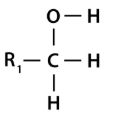
Draw the displayed formula of a secondary alcohol.
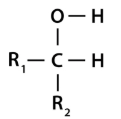
Draw the displayed formula of a tertiary alcohol.
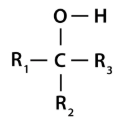
How can you make alkenes from alcohols?
By dehydrating the alcohols.
Give the general word equation for the dehydration of an alcohol.
Alcohol → alkene + water
What is a dehydration reaction?
A reaction in which water is eliminated from a molecule.
Why is dehydrating alcohols (made via the fermentation of glucose) a more sustainable way to obtain alkenes?
It means that alkenes do not have to obtained from non-renewable crude oil.
True or false? An acid catalyst is used in the dehydration of alcohols.
True.
Name and give the formulae of two acid catalysts that could be used in the dehydration of alcohols.
Sulfuric acid (H2SO4)
Phosphoric acid (H3PO4)
Name the reaction mechanism that the dehydration of alcohols takes.
Elimination.
Draw the mechanism for the dehydration of ethanol.
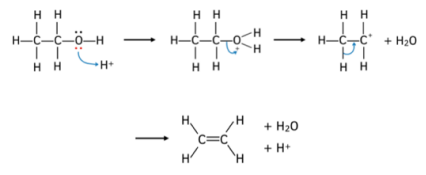
True or false? The dehydration of primary alcohols can lead to the production of two different alkenes.
False. THE DEHYDRATION OF NON-PRIMARY ALCOHOLS ONLY CAN LEAD TO THE PRODUCTION OF TWO DIFFERENT ALKENES.
Why can the dehydration of non-primary alcohols lead to the production of two different alkenes?
The double bond can form either side of the carbon that lost the hydroxyl group (the positive carbon in the carbocation).
Through what method is the dehydration of alcohols conducted? Why?
Distillation. It allows us to isolate the alkene when an impure product is produced.
True or false? When an alcohol is dehydrated, an impure product containing alkene, alcohol, water, and acid catalyst is produced.
True.
Through which property does distillation separate substances?
Boiling point.
Draw and label the apparatus for distilling the product of dehydration of an alcohol. What is the purpose of the cold water?
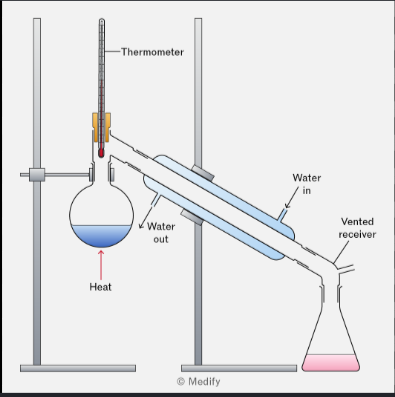
The cold water suddenly decreases the temperature from the boiling flask to the condenser, allowing the boiled product to condense and collect as a liquid in the receiver.
Why might you need to further separate an alkene produced from alcohol dehydration after distillation?
The alkene may still contain impurities.
What two things can you do to further separate an alkene produced by alcohol dehydration after distillation?
Put the alkene through a separating funnel.
Add a drying agent to the alkene.
How does a drying agent further purify an alkene produced by alcohol dehydration after distillation?
The drying agents reacts with any water impurities in the alkene.
Talk me through how a separating funnel works accompanied by a diagram.
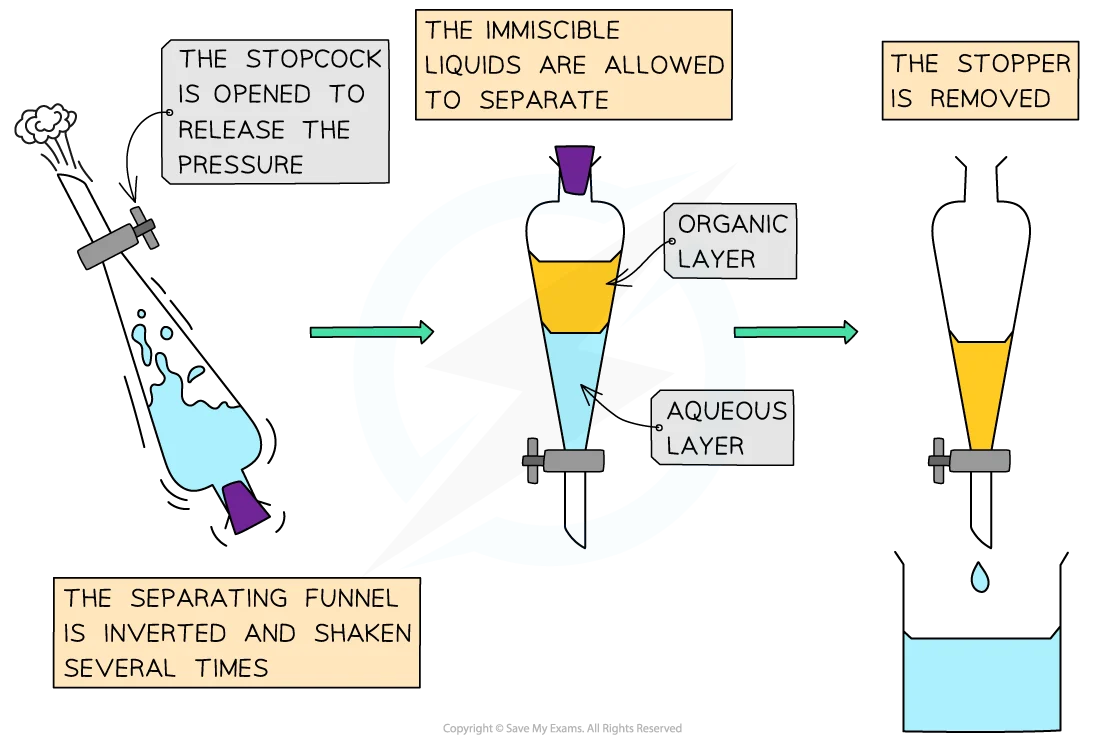
What does immiscible mean?
Liquids that cannot mix to form a homogenous solution.
What alcohol would you dehydrate to make cyclohexene?
Cyclohexanol.
Talk me through and explain the process of dehydrating and distilling cyclohexanol to produce cyclohexene.
1) Add concentrated acid catalyst and cyclohexanol into a round-bottomed flask.
2) Add anti-bumping granules to the round-bottomed flask (for a smooth boiling process).
3) Use a heating mantle (electrical heating element) to warm the reactants in the round-bottomed flask to 83 degrees celsius (cyclohexanol boiling point) (chemicals with boiling point less than 83 degrees celsius with enter the condenser and condense into a distilled liquid).
Why do you not use a bunsen burner when heating cyclohexanol while dehydrating and distilling it?
Cyclohexanol is flammable.
Talk me through and explain the process of separating and purifying the cyclohexene produced by dehydration of cyclohexanol after distillation.
Separation
1) Add the distilled product into a separating funnel.
2) Add water to the separating funnel (to dissolve soluble impurities and make an aqueous solution).
3) Invert the separating funnel several times (to mix all it’s contents).
4) Leave the separating funnel (to allow the two layers to settle).
5) Drain off the (lower) aqueous layer by opening the tap on the separating funnel.
Purification
1) Add impure cyclohexene to a round-bottomed flask.
2) Add anhydrous calcium chloride (CaCl2) to the round-bottomed flask (this is a dehydrating agent that will remove any remaining aqueous impurities in the cyclohexene).
3) Invert the round-bottomed flask several times.
4) Leave the round-bottomed flask for 20-30 minutes.
What does the top layer in the separating funnel of the distilled product of cyclohexanol dehydration consist of?
Impure cyclohexene.
What does the bottom layer in the separating funnel of the distilled product of cyclohexanol dehydration consist of?
Aqueous mix containing soluble impurities.
How can you produce alcohols from alkenes?
By hydrating the alkenes.
What conditions are needed to produce an alcohol from an alkene?
Steam.
Acid catalyst.
300 degrees celsius temperature.
60 atm pressure.
Draw the mechanism for the hydration of ethene in the presence of steam and an acid catalyst.
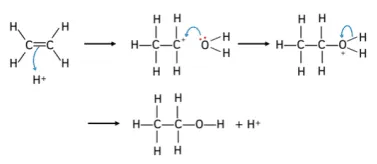
Name the reaction mechanism that the hydration of alkenes takes.
Electrophilic addition.
What is an alternative way to making ethanol from ethene and steam?
Fermentation of glucose.
True or false? Fermentation of glucose is an endothermic process.
False. FERMENTATION OF GLUCOSE IN AN EXOTHERMIC PROCESS.
Give the conditions needed for the fermentation of glucose.
Yeast.
Anaerobic conditions.
30-40 degrees celsius temperature.
Give the overall word equation for the fermentation of glucose.
Glucose → ethanol + carbon dioxide
What is the role of yeast in the fermentation of glucose?
Yeast acts as an enzyme.
Why must the temperature not be any higher than 40 degrees celsius when fermenting glucose with yeast?
Yeast is an enzyme and will denature past 40 degrees celsius.
How is pure ethanol obtained from the ethanol produced in the fermentation of glucose?
Fractional distillation.
Give one advantage and one disadvantage of producing ethanol from the fermentation of glucose.
Advantage
Little equipment so cheap.
Uses renewable resources.
Low temperatures needed for the majority of the process.
Disadvantage
Time consuming.
Not very large yield of ethanol.
What are biofuels made from?
Dead biological matter.
In which countries is bioethanol used most? Why?
In countries where there is a high supply of sugarcane. Sugar canes are a good source of glucose that can be fermented to make bioethanol.
Give two advantages of using biofuels.
Biofuels are renewable.
Biofuels are carbon neutral.
Why are biofuels considered to be carbon neutral?
Net 0 carbon dioxide is released into the atmosphere as while carbon dioxide is released when biofuels are burnt, carbon dioxide is absorbed when the plants used to make biofuel photosynthesise.
Give two disadvantages to biofuels.
Expensive to convert existing petrol engines into engines that can withstand higher concentrations of ethanol.
Land that could have been used to grow food is being used to grow biomass used for fuel.
Write out balanced symbol equations showing how bioethanol is carbon neutral.
(carbon dioxide used up)
1) 6CO2 + 6H2O → C6H12O6 + 6O2 (photosynthesis)
(carbon dioxide released)
2) C6H12O6 → 2CO2 + 2C2H5OH (fermentation)
3) 2C2H5OH + 6O2 → 4CO2 + 6H2O (combustion)
6 MOLES USED UP, 6 MOLES RELEASED.
Give three reasons why biofuel may not be completely carbon neutral.
Fuels burnt to transport biofuel across areas.
Fuels used to make fertilisers for crops.
Fuels burnt for machinery to harvest crops.
Give three species that alcohols could be oxidised to make.
Aldehydes.
Ketones.
Carboxylic acids.
Give the general formula of alcohols.
CnH2n+1OH
Name and give the formula of the oxidising agent used to oxidise alcohols.
Acidified potassium dichromate. K2Cr2O7
What colour change occurs (and give the species that cause these colours) when acidified potassium dichromate is oxidised?
Orange (Cr2O72-) to green (Cr3+ (chromium ion)).
What are primary alcohols first oxidised to and then secondly oxidised to?
1) Aldehyde.
2) Carboxylic acid.
What are secondary alcohols oxidised to?
Ketones.
True or false? Tertiary alcohols cannot be oxidised using dichromate as it is a mild oxidising agent.
True.
How could you oxidise tertiary alcohols? Why would you not do this?
Burn the tertiary alcohol. No useful product would be produced.
How can you generally represent an oxidising agent?
[O]
True or false? Aldehydes have higher boiling points than alcohols.
False. ALDEHYDES HAVE LOWER BOILING POINTS THAN ALCOHOLS.
What techniques are used when oxidising primary alcohols to obtain an aldehyde?
Distillation and reflux.
Why is distillation used when oxidising a primary alcohol?
To remove the aldehyde from the mixture being oxidised before the aldehydes get oxidised into carboxylic acids.
How would you make carboxylic acid from a primary alcohol?
Reflux and excess oxidising agent with primary alcohol.
What is beneficial about reflux?
It allows strong heating without losing more volatile reactants and products, allowing the reaction to continue and be completed.
Under what conditions are secondary alcohols oxidised?
Under reflux.
Give two reagents you can use to distinguish between aldehydes and ketones.
Fehling’s solution.
Tollen’s reagent.
How do Fehling’s solution and Tollen’s reagent work in distinguishing between aldehydes and ketones?
They are oxidising agents so will oxidise aldehydes into carboxylic acids but not do anything to ketones.
What colour is Fehling’s solution and why?
Blue as it contains Cu2+ ions.
What will you observe if you add Fehling’s solution to:
a) an aldehyde?
b) a ketone?
a) Colour change from blue solution to brick red precipitate.
b) Solution remains blue.
What is the brick red precipitate formed when Fehling’s solution is added to an aldehyde?
Cu2O (copper (I) oxide).
What is Tollen’s reagent?
[Ag(NH3)2]+ solution.
What will you observe when Tollen’s reagent is added to:
a) an aldehyde?
b) a ketone?
a) Silver coating (silver mirror) on reaction vessel forms.
b) No change.
What rough temperature must Tollen’s reagent be when testing for aldehydes and ketones?
Warm.