BIOL 0510 - Protists & Helminths
 Call Kai
 Learn
Learn Practice Test
 Spaced Repetition
 Match
Match Flashcards
 Knowt Play
1/118

There's no tags or description
Looks like no tags are added yet.
Name | Mastery | Learn | Test | Matching | Spaced | Call with Kai | Chat |
|---|
No analytics yet
Send a link to your students to track their progress
119 Terms
What does the term ‘protist’ refer to?
any microbial eukaryote that isn’t an animal, plant or fungus
What does parasitology focus on?
helminths and protozoa
What are secondary endosymbioses?
multiple times, a eukaryote containing a chloroplast has been engulfed by another eukaryotic cell
What is Archaeplastida?
a plant and pigmented algae kingdom that resulted from primary endosymbiosis
What skill do Archaeplastida have?
photosynthesis
Provide an example of a member of the Archaeplastida kingdom?
Linchen Thallus
What is Lichen Thallus?
a mutualistic combination of an alga that produces and secretes carbohydrates and a fungus that provides structure
Provide an example of a member of the SAR clade
Phytophthora infestans
What is Phytophthora infestans?
a water mold that infects potato, tomato and pepper crops
What did Phytophthora infestans cause?
the potato blight that caused the Great Irish Famine
How do hyphae aid Phytophthora infestans’ mechanism of disease?
used to penetrate host cell walls
How does Phytophthora infestans absorb nutrients from the crops it infects?
using Haustoria structures that invaginate the host plasma membrane
What are zoospores?
motile spores with two different types of flagella (whiplash and tinsel)
How does Phytophthora infestans use zoospores?
to swim through films of water on leaves or in the soil to find a host
What diseases can apicomplexans cause?
malaria and toxoplasmosis
What is an apical complex?
a specialised structural organisation essential for host cell invasion
What are the names of the secretory organelles within the apical complex?
micronemes and rhoptries
What do the micronemes and rhoptries do?
secrete enzymes that facilitate host penetration
Within the apical complex, there is a polar ring. What does it do?
reorganise the host cell microtubules
What is an apicoplast?
a non-photosynthetic plastid that was derived from secondary endosymbiosis
Although it doesn’t allow for photosynthesis, why is an apicoplast essential for apicomplexans?
it has unique metabolic functions
What’s a characteristic of members of the Excavates group?
an asymmetrical appearance with a feeding groove and usually flagella
Give examples of members of the Excavates group?
Giardia, kinetoplastids and Trichonomas
What does Giardia intestinalis do?
cause giardiasis which is a common waterborne intestinal disease
What’s a key feature of Giardia intestinalis?
2 nuclei of equal size
What is Trichomoniasis?
the most common STI caused by Trichomonas vaginalis
Is trichomonas more common in women or men?
women
What are distinct features of Trichomonas?
no mitochondria but they have hydrogenosomes for anerobic metabolism
What feature do kinetoplastids share?
a mass of DNA known as a kinetoplast which is present in their single large mitochondrion
Provide examples of kinetoplastids
Leishmania and Trypanosoma cruzi and brucei
What is the cause of African Sleeping Sickness?
Trypanosoma brucei
What is the cause of Chagas disease?
Trypanosoma cruzi
What does Leishmania cause?
leishmaniasis
How does the cutaneous form of leishmaniasis appear?
as lesions that eventually ulcerate
How does the mucocutaneous form of leishmaniasis appear?
as ulcers on the nasal or oral mucosa
How does the visceral form of leishmaniasis appear?
throughout the body
What is the most severe form of leishmaniasis?
visceral
How does a person acquire leishmaniasis?
via a female sandfly which releases some of the microorganism
What happens when Leishmania enters the body?
macrophages engulf it and Leishmania replicates within them.
What makes Leishmaniasis difficult to eradicate?
it has multiple hosts and is caused by multiple different species within the Leishmania genus
What is a characteristic feature of Amobeozoa?
Terrestrial and aquatic. Use pseudopodia for movement and feeding.
What are gymnamoebas?
free living amoeba that inhabit soil and aquatic environments
What are entamoebas?
parasites of vertebrates and invertebrates
When do independent unicellular amoeba form a slime mold?
when food is scarce
What is a defining feature of an environment with little nutrients?
high cAMP
What is the purpose of amoeba forming a fruiting body?
some cells sacrifice themselves to form a stiff stalk from which other cells (which become spores) can be carried away from by the wind
Provide examples of important marine and aquatic protists
water molds, red tides, sea weeds and diatoms
What are parasites?
organisms that obtain food and shelter by living on or within another organism and causes damage to that organism
In medical terms, what is a parasite?
a eukaryotic pathogenic organism that’s either a helminth or protozoa
How are parasites dependent on their host?
metabolically or physiologically
What is a host?
the organism that harbors the parasites and suffers a loss
What is a definitive host?
the organism that the parasite lives in during its adult and sexual life
What is an intermediate host?
the organism that the parasite lives in during its larval and asexual stage
What are reservoir hosts?
non-human hosts that harbor the parastite and ensure the continuity of its lifecycle but are asymptomatic
What is a paratenic host?
a host that serves as a holding place for a parasite but isn’t necessary for its lifecycle to continue
What is a vector?
an arthropod (insect) that serves as an intermediate host and is responsible for transmitting the parastic infection
Direct transmission involves…
1 host
What does indirect transmission require?
2 or more hosts
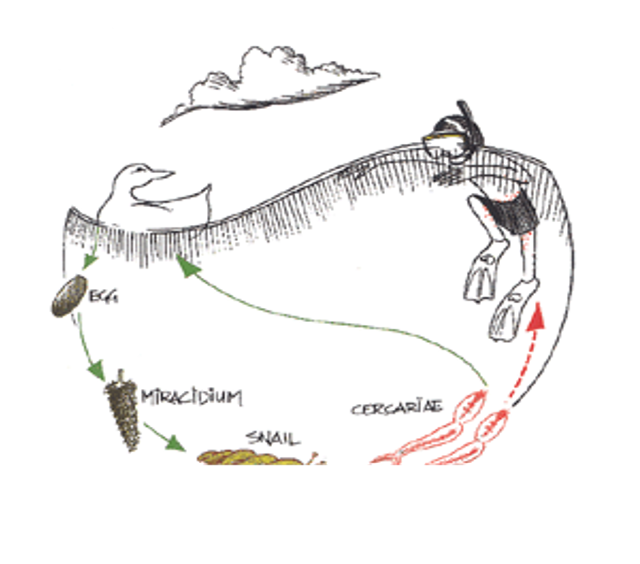
What can the duck involved in swimmer’s itch be described as?
definitve host because an adult releases its eggs within the duck
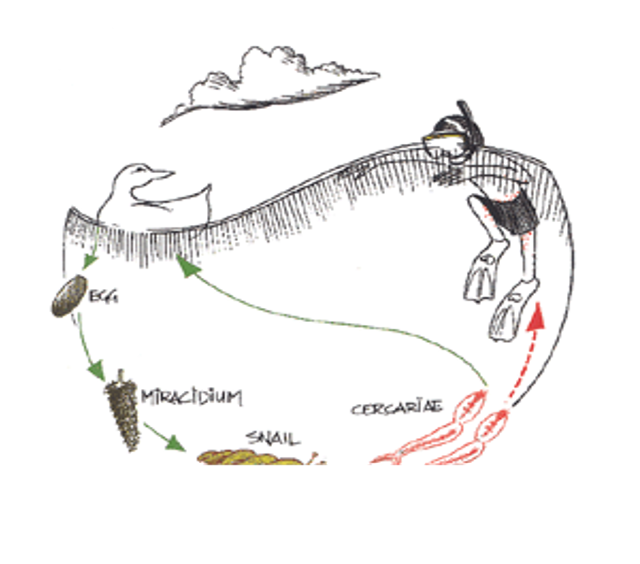
What can the snail involved in swimmer’s itch be described as?
an intermediate host because its required for larval stage
What is an obligate parasite?
a parasite that can’t survive without a host
What is a facultative parasite?
a parasite that can live in a host or in its free form
What is an endoparasite?
parasite that live inside the body
Provide an example of an endoparasite
helminth
What is an ectoparasite?
parasites that live on the host
What’s an example of an ectoparasite?
a tick
What are epiparasites?
parasite that lives in/on another parasite
What is horizontal transmission?
from infected host to neighbour
What is vertical transmission?
mother to offspring but this is rare for parasites
What is spillover?
an infectious disease moving from an animal to a human
What is spill back?
an infectious disease moving from a human to an animal
Provide examples of maternal-fetal infections?
Zika virus, chlamydia and gonorrhoea
When can maternal-fetal infections occur?
during pregnancy, during delivery or shortly after birth
What is Zika virus?
a virus spread by mosquitoes that causes pregnant women to give birth to babies with microcephaly
What causes toxoplasmosis?
Toxoplasma gondii
What are the effects of toxoplasmosis?
cyst formation in muscles and sometimes other tissues but it’s mostly asymptomatic
How does toxoplasmosis spread?
fecal oral transmission
What are some of the rare complications associated with toxoplasmosis for pregnant women?
miscarriages, fetal brain damage and still birth
What are some of the rare complications associated with toxoplasmosis for immunocompromised individuals?
Myocarditis, encephalitis and pnuemonitis
What’s a possible way for a human to contract toxoplasmosis?
through a domestic cat as approximately 1% of domestic cats in the US shed toxoplasma through their feces
What happens when humans come into contact with toxoplasma?
The oocyst of the toxoplasma organism hatches in the gut and then moves into the muscles. The immune system causes a cyst to encase the organism so it doesn’t spread elsewhere
How did mice behave when infected with toxoplasma gondii?
increased dopamine levels and affinity to cat urine
What are helminths?
macroscopic multicellular worms
What portion of the world is affected by helminths?
1/3
If a helminth has a head, it is classified as a…
cephalopod
What can be found at the anterior (head) region of a helminth?
suckers, teeth, hooks, or plates for attaching to host
What is the body of a helminth covered with?
a tough cuticle that may have ridges, spines, and tubercles
What is the significance of the tough cuticle?
protection from enzymes
How do parasites acquire nutrients?
absorption or ingestion of host body fluids
What is the result of most helminths being oviparous (egg excreting)?
in their adult form, they can’t replicate in humans
Where do helminths hide?
in immunologically protected areas
How do helminths defend themselves from the host?
large size, elaborate attachment to the host, multiple hosts, suppression of the immune system, shedding of surface antigen
What are key features of flatworms?
eye spot, ganglia, incomplete digestive system
How do flatworms move?
in an undulating motion
What are the two main groups within flatworms?
flukes (trematodes) and cestodes (tapeworms)
Provide examples of flukes
liver fluke, lung fluke and blood fluke
What’s a major disease caused by a trematode?
Schistosomiasis (snail fever)
Describe cestodes (tapeworms)
flattened ribbon shaped bodies with a scolex which has suckers or hooklets. They have no digestive system so they likely absorb nutrients
Which tapeworm are humans susceptible to?
Taenia
What are tapeworms associated with?
undercooked pork, beef and fish