iop: recruitment and selection
 Call Kai
 Learn
Learn Practice Test
 Spaced Repetition
 Match
Match Flashcards
 Knowt Play
1/71

There's no tags or description
Looks like no tags are added yet.
Name | Mastery | Learn | Test | Matching | Spaced | Call with Kai |
|---|
No analytics yet
Send a link to your students to track their progress
72 Terms
Resolving Internal Complaints
Before a complaint can be fired with the EEOC, an employee must utilize whatever internal resolution process available within the organization
Outsourcing
having outside vendors supply services previously done by a company’s employees
Offshoring
having outside vendors abroad supply services
blind box
organization doesn’t want its name in public
company might fear that people wouldn’t apply if they knew the name of the company
a company needs to terminate an employee but wants first to find a replacement
Realistic Job Previews
involves giving an applicant an honest assessment of a job
Example: instead of telling the applicant how much fun she will have working on the assembly line, the recruiter honestly tells her that although
the pay is well above average, the work is often boring and there is little chance for advancement
Because they know what to expect, informed applicants will tend to stay on the job longer than applicants who did not understand the nature of the job
Labor Code of the Philippines
Protects workers from discrimination based on gender, age, religion, political beliefs, etc.
Promotes just working conditions, fair wages, and security of tenure.
Magna Carta of Women (RA 9710)
Protects women's rights in the workplace
Ensures equal opportunities, protection from sexual harassment, and fair treatment (e.g., maternity benefits, no discrimination in hiring or promotion).
Data Privacy (RA 10173 – Data Privacy Act of 2012)
Protects personal and sensitive information (e.g., resumes, test scores, employee records)
Organizations must get consent, store data securely, and only use it for legitimate purposes.
HR departments and I-O psychologists must handle data responsibly
Equal Employment Opportunity (EEO) Principles
All applicants and employees must be treated fairly and equally.
Hiring, promotion, training, and termination should be based on merit, not race, gender, disability, or other personal characteristics.
Supports a diverse and inclusive workplace
PWD Rights (RA 7277 – Magna Carta for Persons with Disabilities)
Promotes equal opportunity and accessibility in employment for PWDs.
Employers are encouraged to provide reasonable accommodations (e.g., ramps, flexible work schedules)
Grievance System
employee take their complaints to an internal committee that makes a decision regarding the complaints
If the employees does not like the decision, they can take the complaints to EEOC (DOLE or CSC)
Mediation
employees and the organization meet with a neutral third party who tries to help the two sides reach mutually agreed upon solution
Arbitration
two sides present their case to a neutral third party who then makes a decision to which side is right
Binding Arbitration
neither side can appeal the decision
final, legally enforceable, and must be followed by both parties.
A union and company disagree on wages. They go to arbitration. The arbitrator decides a 5% salary increase. Both sides must follow the decision
Nonbinding Arbitration
the parties can either accept the decision or take the case to the court
The arbitrator gives a recommendation or opinion, but both parties are not required to follow it.
The decision is advice—you can accept or reject it.
A workplace dispute goes to arbitration. The arbitrator recommends reinstating an employee. The company can choose whether to follow it or not
Civil Rights Act and Equal Pay Act of 1963
prohibits discrimination based on sex
Age Discrimination in Employment Act (ADEA)
forbids an employer or union from discriminating against an individual over the age of 40
Vocational Rehabilitation Act of 1973
prohibits discrimination against people with disabilities
Pregnancy Discrimination Act
states that women affected by pregnancy, childbirth, or related medical conditions shall be treated the same for all employment related purposes, including receipt of benefit programs, as other persons not so affected but similar in their ability or inability to work
Bona Fide Occupational Qualification (BFOQ)
if a job can only be performed by a person in a particular class
Four-Fifths Rule
the percentage of applicants hired from one group is compared to the percentage of applicants hired in most favored group
Quid Pro Quo
granting of sexual favors is tied to such employment decisions such as promotions and salary increases
FAMILY MEDICAL LEAVE ACT
Provides eligible employees a minimum of 12 weeks of unpaid leave each year to deal with family matter
Employers can decide if they want to define the eligibility period as calendar year or as rolling 12-month period as calendar year
Workforce Planning
process of deciding which positions are to be filled and how to fill them
Goal is to identify and eliminate gaps between employer’s workforce needs and the current employees who might be suitable for filling those needs
The first step before recruiting and hiring employees
Succession Planning
process of identifying and developing internal talent to fill critical roles
Personnel Replacement Charts
used in to identify and prepare potential candidates for key positions within an organization (broad)
shows MANY positions in the organization
“Who can replace people across THESE positions?”
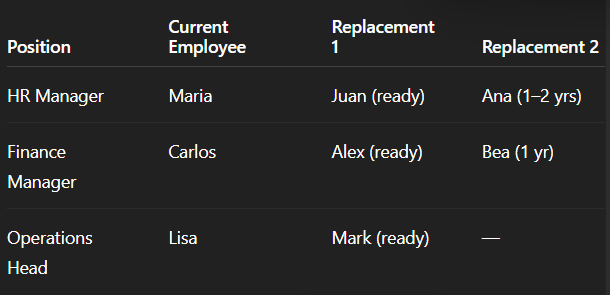
Position Replacement Card
used to identify and track potential replacements for key positions, including their qualifications, performance, and promotion potential (specific)
focuses on ONE job position
“Who can replace THIS person?”
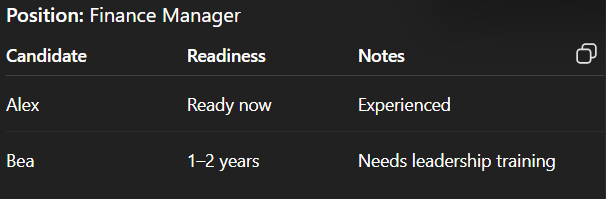
Markov Analysis
forecasts availability of internal job candidates
predict future events (like an employee’s career path) based on current probabilities of how they move between states (e.g., staying in their current role, moving up, or leaving the company)
ex: how likely is it that an entry-level employee will become a manager, or how likely is it that someone will leave the company after a certain period?
Recruitment
attracting people with the right qualifications to apply for the job
Internal Recruitment
promote someone from within the organization
To enhance employee morale and motivation, it is often good to give current employees an advantage in obtaining new internal positions
External Recruitment
hire someone from outside the organization
Newspaper Ads
Respond by calling
Apply-in-person ads
Send-resume ads
Send resume to a blind box
Electronic Media
television and radio
Situation-Wanted Ads
placed by the applicants rather than by organizations
List extensive qualifications, some give applicant’s names, and some are generally more creative than others
Point-of-Purchase Methods
based on the same point-of-purchase advertising principles used to market products to consumers
Job vacancy notice is placed where customers are likely to see them
Outside Recruiters
outside recruiting sources as private employment agencies, public employment agencies, and executive search firms
Employment Agencies
Either charge the company or the applicant
Especially useful if an HR department is overloaded with work or if an organization
Company loses control over its recruitment process and may end up with undesirable applicants
Executive Search Firms
Jobs they represent tend to be higher-paying, non-entry level positions
Fees charged are usually 30% of the applicant’s first-year salary
They find top leaders (ceo, director) for companies who are hard to recruit through normal job ads.
They are also commonly called “headhunters.”
Public Employment Agencies
Designed primarily to help the unemployed find work, but they often offer services such as career advisement and resume preparation
Often, government programs are also available that will help pay training costs
State and local employment agencies
Employee Referrals
Current employees recommend family members or friends for specific job openings
Most effective recruitment method
Care must be taken when developing referral program to ensure that the referral pool is representative of the ethnic and racial makeup of the qualified workforce
At risk of possible discrimination
Internet
Fast growing source of recruitment
Employer-Based Websites
An organization lists available job openings and provides information about itself and the minimum requirements needed to apply to a particular job
Applicants can download their resumes, answer questions designed to screen unqualified applicants, and take employment tests
Use of job domains have been rampant
Internet Recruiters
A private company whose website lists job opening for hundreds of organizations and resumes for thousands of applicants
It’s less costly than newspaper advertisement and reaches more people over a larger geographic area
Blogging
allows recruiters to discuss an organization’s career opportunities and corporate culture informally with potential applicants
Direct Mail
An employer typically obtains a mailing list and sends help-wanted letters or brochures to people through the mail
Especially useful for positions involving specialized skills
Job Fairs
Designed to provide information in a personal fashion to as many applicants as possible
Many types of organizations have booths at the same location
Also held when an event or disaster occurs that affects local employment
Many organizations in the same field in one location
Organization holds it own
Expectation-Lowering Procedure
lowers an applicant’s expectations about work and expectations in general
Valid
Reduce the chance of a legal challenge
Cost-effective
Effective employee selection systems share 3 characteristics
Valid selection test
based on a job analysis, predicts work-related behavior, and measures the construct it purports to measure
Structured Interview
Source of questions is from the conducted job analysis
All applicants are asked with the same questions
Has standardized scoring key
More reliable and valid
Interviews high in structure are more valid
Viewed more favorably in courts
Unstructured Interview
Follows no set format
Question vary depending on the applicant
There are generally no right or wrong answers
Problems with Unstructured Interviews
Poor Intuitive Ability
Lack of Job Relatedness
Interviewee Appearance
Nonverbal Cues
Primacy Effects
first impressions
Contrast Effects:
the interview performance of one applicant may affect the interview score given to the next applicant
Negative-Information Bias
negative information apparently weighs more heavily than positive information
Interviewer-Interviewee Similarity
interviewee will receive a higher score if she is similar to the interviewer in terms of personality, attitude, gender, or race
Future-Focused Questions or Situational Questions
ask what they would do in particular situation
Situations are typically hypothetical
Future-oriented
Ex. What would you do if a co-worker takes all the credit for your work?
Past-focused Questions or Patterned Behavior Description Interviews
focused on previous behavior
Asks candidates what they did in a certain situation
Makes use of actual situations
Ex. What did you do to manage your time well?
Style
determined by the number of interviews and number of interviewers
One-on-One Interviews
involve one interviewer interviewing an applicant
Serial Interviews
involves a series of single interviews
a candidate goes through multiple rounds of interviews with different people or departments, usually in a sequential manner.
ex: hr —> hiring manager —> team interview —> executive interview
Return Interviews
similar to serial interviews with difference being a passing of time between the first and subsequent interview
Panel Interviews
multiple interviewers asking questions and evaluating answers of the same applicant at the same time
Group Interviews
have multiple applicants answering questions during the same interview
Serial-Panel-Group Interview
a candidate faces multiple rounds of interviews (serial), with multiple interviewers (panel), and potentially interacts with other candidates (group) during the process.
Cover Letters
tells an employee that you are enclosing your resume and would like to apply for a job
Salutation
name of the person to whom you want to direct the letter
Cover Letters
Avoid sounding so desperate
Avoid grammar and spelling errors
Avoid officious words or phrases
Don’t discuss personal circumstances
Tailor your letter to each company
Don’t write your cover letter on the stationery of your current employer
Resume
summary of an applicant’s professional and educational background
Viewed as a history of your life or an advertisement of your skills
Must be attractive and easier to read
Cannot contain typing, spelling, grammatical, or factual mistakes
Chronological Resume
list previous jobs in order from the most to least recent
most traditional and widely used format
Functional Resume
organizes jobs based on skills required to perform them rather than the order of the specific timeline of your work experience.
Psychological Resume
contains the strengths of both the chronological and functional styles and is based on psychological theory and research
often used in highly personal professions or for roles where emotional intelligence, teamwork, and personal development are critical