Acute cardiovascular and the pulmonary responses to exercise stress
 Call Kai
 Learn
Learn Practice Test
 Spaced Repetition
 Match
Match Flashcards
 Knowt Play
1/23

There's no tags or description
Looks like no tags are added yet.
Name | Mastery | Learn | Test | Matching | Spaced | Call with Kai |
|---|
No analytics yet
Send a link to your students to track their progress
24 Terms
Exercise/stress response pathway type
Fight or flight (sympathetic nervous response)
What is the hypothalamus’ response to stressor of exercise?
Hypothalamus stimulates pituitary gland
What does APG stimulation do? (2)
Activates two systems:
Stimulates APG to activate sympathetic nerve pathway to cause adrenaline secretion via adrenal medulla (Sympathetic Adrenal Medullary (SAM) System)
ACTHrf → stimulates APG to secrete ACTH → to stimulate adrenal cortex to secrete cortisol + other corticosteroids (Hypothalamic Pituitary Adrenal Cortical System)
Sympathetic Adrenal Medullary (SAM) System function (3)
Rapid mobilisation of metabolic resources.
Increased cardiac output.
Heightened energy alertness
Hypothalamic Pituitary Adrenal Cortical System function (3)
Provides a backup response for long-term stress coping
Regulates metabolism and immune response
Assists in returning the body to general homeostasis
Pulmonary system response to exercise (1)
Increased pulmonary ventilation
How pulmonary ventilation rate is increased (2) + description (2)
Respiration Rate: The frequency of breaths per minute.
Tidal Volume: The depth of each individual breath.
Resting vs vigorous exercise ventilation rate
State | Ventilation Rate (Approximate) |
|---|---|
Resting | 6 Litres per minute |
Vigorous Exercise | 150 Litres per minute |
How is blood composition/pH affected by exercise? (2)
Decreased O2 + increased CO2 → increased acidity/reduced pH
Which chemoreceptors are sensitive to blood conc./pH changes + what effect do they have?
Chemoreceptors in aorta, brain + muscles detect changes → stimulate increased ventilation to replenish O2 + remove CO2
What is the cardiovascular system’s primary role during exercise? What unit is this measured in?
To increase the rate of circulation (increased cardiac output)
What is cardiac output?
Stroke volume x heart rate
Relationship between heart rate and exercise intensity + systems it’s regulated by
HR increases fairly linearly w/ exercise intensity
Regulated by the sympathetic nervous system and the suppression of parasympathetic control
What is anticipatory response + what causes it?
When HR increases before exercise begins
Neurons in the medulla
Steady state description
Heart rate plateauing when exercise intensity stays the same
Does stroke volume increase during exercise?
Yes
What causes stroke volume to increase during exercise?
Catecholamines
Adrenaline and noradrenaline stimulate ventricles to contract with more force, reducing end-systolic volume (blood left in the heart after contraction)
Venous return
The "muscular pump" (contraction of skeletal muscles) and deeper respiration assist in pushing blood back to the heart, leading to more efficient cardiac filling (increased end-diastolic volume)
Max cardiac output table (maybe don’t need to know)
Individual Type | Resting CO | Max Exercise HR | Max Exercise SV | Max Exercise CO |
|---|---|---|---|---|
Untrained | ~5 L/min | 195 bpm | 113 ml | 22 L/min |
Trained | ~5 L/min | 195 bpm | 179 ml | 35 L/min |
Elite (XC-Skier) | ~5 L/min | 191 bpm | 210 ml | 40 L/min |
How does blood pressure change during aerobic exercise? (2)
Systolic blood pressure increases significantly due to forceful heart contractions
Diastolic blood pressure remains stable/drops slightly as blood vessels in muscles dilate to allow blood flow
How does blood pressure change during strength training? (1)
Blood pressure responses can be exaggerated, with readings as high as 300/180 mmHg observed
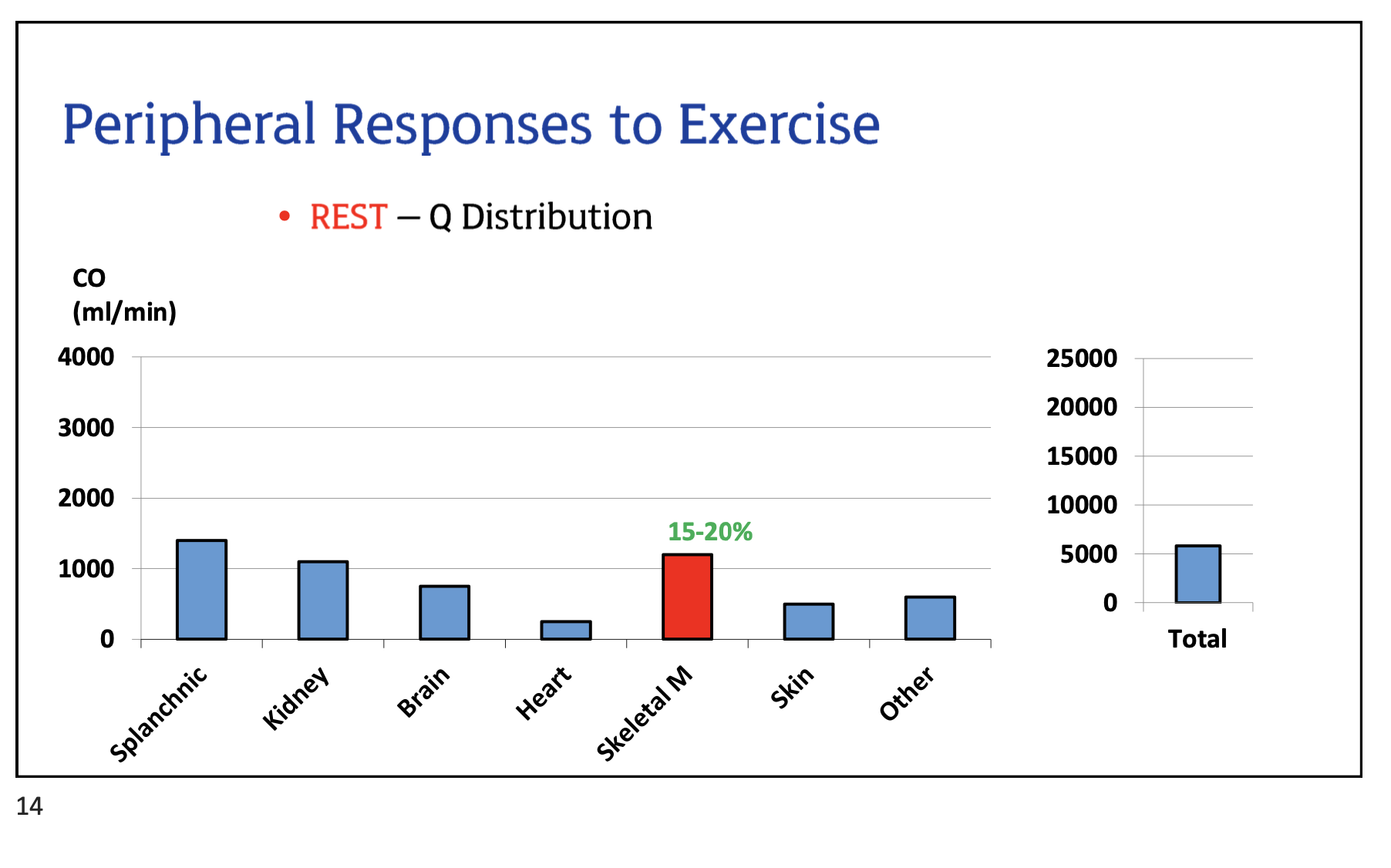
Distribution of blood supply at rest: viscera vs skeletal muscle vs heart vs skin
High (greatest supply)
15-20%
Constant
Low
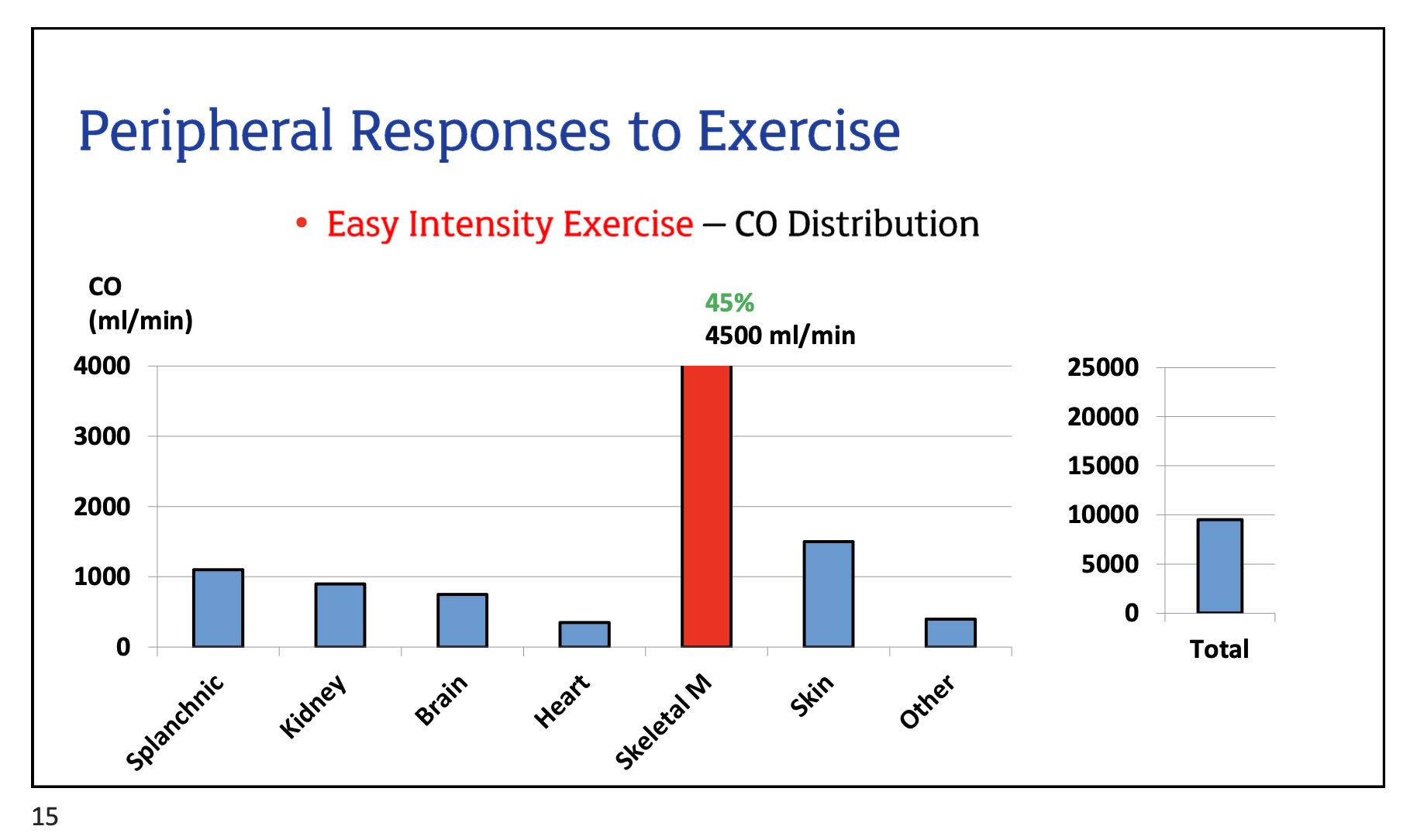
Distribution of blood supply during moderate exercise: viscera vs skeletal muscle vs heart vs skin
Decreasing
Increased
Increased
Increasing (for heat regulation)
Distribution of blood supply during max exercise: viscera vs skeletal muscle vs heart vs skin
Decreased
Increased
Increased
Decreased (due skeletal muscle ‘competing’ for blood supply)