Accounting Exam 1 & 2
 Call Kai
 Learn
Learn Practice Test
 Spaced Repetition
 Match
Match Flashcards
 Knowt Play
1/82

There's no tags or description
Looks like no tags are added yet.
Name | Mastery | Learn | Test | Matching | Spaced | Call with Kai |
|---|
No analytics yet
Send a link to your students to track their progress
83 Terms
Accounting
information system to measure business activities
The Accounting Equation
Assets = Liabilities + Shockholders’ Equity
The Entity Assumption
any organization (or person) that stands apart as a separate economic unit.
Historical Cost Principle
Assets should be recorded at their historical (original) cost on the date of purchase
The Stable-Monetary-Unit Assumption
Accountants assume that the dollar’s purchasing power is stable over time. (We ignore inflation)
examples of Assets
prepaid expenses, accounting receivable, cash, inventory, etc.
Assets
Things the company owns (economic resources)
examples Liabilities
note payable, long-term debt, accounts payable, ANYTHING PAYABLE (money you need to pay)
Liabilities
money you own (debt)
examples of Equity
common stock, revenue, expenses, dividends, etc
Equity
remaining assets available to stockholders
current assets
resources used for less than a year
long-term liabilities
debt to pay off for more than a year (bonds payable, notes payable)
Current liability example
Accounts payable, accrued liabilities, and unearned revenue
The Income Statement
shows a year’s worth of financial actives
The Income Statement equation
Revenue - Expense = Nest income (or Net loss -)
The statement of retained earnings
shows what the company did with the earns
The statement of retained earnings formula
beginning retained earnings
( + net income or - net loss)
-dividends declared
The balance sheet
reports assets, liabilities, and equity
statement of cash flow
shows cash receipts and cash payments
transaction
any event that has financial impact
T- account
tracking of accounting balances
debit is on the
left side
credit is on the
right side
DEALER Acronym means
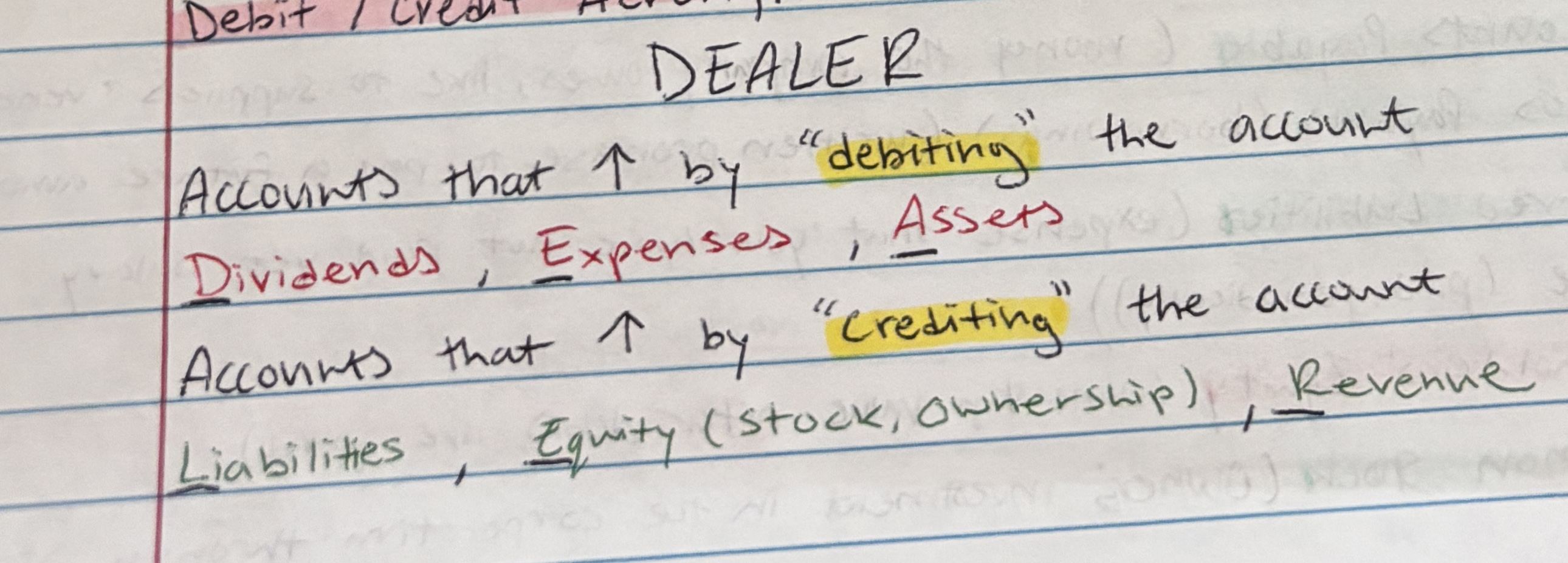
Proprietorship
single
Liable for business debt
General partner ship
2 or more
Make agreements that legally bind all parties (a disadvantage)
Corporation
stockholders
No personal obligation for the businesses debt
Double taxation (a disadvantage)
debit =
credit
End Bal =
Beg Bal - Cash receipts + cash payments
if the account is high, then there is an
overstated
if the account is low, then there is an
understated
Cash-basis accounting
records only cash transaction
Accrual accounting
Impact of a business transaction
Revenue Principles
Revenue is recorded when it has been earned (when service has been performed)
Expense Recognition Principle
Expenses are recorded when incurred and recognized
Accrued expense
An expense that has not yet been paid
Accrued revenue
Revenue that has been earned but not collected
Closing the books
preparing the accounts for the next period’s transactions
Temporary Accounts (limited period)
Revenue
Expense
Dividends
Permanent Accounts
Assets
Liabilities
Stockholders Equity
Current Ratio - reflects operating liquidity
Total current A / Total current L
Debt Ratio – Measures debt-paying ability
Total L / Total A
Net working capital - how fast an asset can be converted to cash
Total current A - Total current L
Retained earnings have 3 things
Revenue, expense, and dividends
Stockholders equity what 2 accounts increase when debited
Dividend and expense
Net Working Capital – Calculated dollar amount that represents operating liquidity
Total current A - Total current L
Bank statement balance - cash book balance =
The difference (error)
Adjusted bank balance =
Adjusted book balance
Adjusted bank balance has:
beginning balance
Deposit in transit
(-) Outstanding checks
(+-) Bank error
Adjusted book balance
beginning balance
Bank collection
Entrance revenue
EFT receipt (electronic movement of money from one one bank to another)
(-) bank service charge
(-) NSF Check (check bounced)
(-) EFT Payment
(±) bank error
Misappropriation of assets
Steal money from the company then cover it up
Fraudulent financial reporting
Makes FALSE entries in the book to make it look better
The fraud triangle (motive)
Why they did it?
The fraud triangle (opportunity)
Had too much power given
The fraud triangle (rationalization)
“Everyone else is doing it”
For the adjusted book side only
Requires journal entry
Internal control
A way to stop fraud
Separation of duties
Separate handling and signing of checks and etc.
Revenue principle
Revenue is recorded when earned
FOB Shipping
Recognizing when goods LEAVE the shipping dock
FOB (free on board) Destination
Recognize when good is DELIVERED to customer
2/10 means
2% off discount and within 10 days
n/30 means
If the payment is not due at a certain time, they have until 30 days for full payment
Discount =
Price • %
Amount to pay =
Price - discount
Write off does not
affect net receivable
What decreases accounts receivable
Collections of cash and write offs
Specific identification method
Tracks each inventory item
Average cost method
Calculates cost of goods
Average cost method =
Cost goods available / # of units available
First in, first out method (FIFO)
First to come in it’s the first to come out
Last in first out method (LIFO)
Recent purchase items are sold first
COGS (cost of good sold) (Credit)
Number of units sold • average cost per unit
For FIFO, cost of ending inventory
Unit cost (purchase) • number of ending inventory
Allowance for Bad debit
The amount of accounts receivables the company does not expect to collect
Allowance for Bad debit (Creditable) formula

Interest income formula

Inventory (what we sell to customers) formula

Net realizable value
Amount of accounts receivables the company expects to COLLECT
Net realizable value formula
Accounts receivable - allowance of bad debt (estimated uncollectible x sales revenue)
Bad debt expense formula
Net credit sales x estimated uncollectible (%)
Percent of sale method
Estimates a business bad debt expense as a percent