BSCI222 Final Cumulative Topics
 Call Kai
 Learn
Learn Practice Test
 Spaced Repetition
 Match
Match Flashcards
 Knowt Play
1/70

Earn XP
Description and Tags
Topics that were missed from study guide
Name | Mastery | Learn | Test | Matching | Spaced | Call with Kai | Chat |
|---|
No analytics yet
Send a link to your students to track their progress
71 Terms
Histone
Histones: Organize DNA into nucleosomes
Nucleosomes
Nucleosomes: 8 histone ball proteins and DNA
Chromatin
Chromatin: All DNA and histone proteins in the nucleus
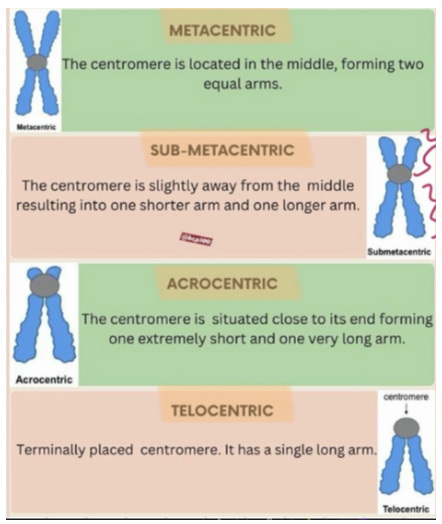
Draw the metacentric, submetacentric, acrocentric, and telocentric positions.
What Enzymes are involved in Prokaryotic DNA replication?
Prokaryotes
Helicase: Unzips the DNA
Gyrase: Relieves torsional strain
Primase: Makes RNA using DNA template
DNA pol III: Adds DNA to the 3’ end of the primer
DNA pol I: Replaces the RNA primer with DNA
Ligase: Joins the nicks
What Enzymes are involved in Eukaryotic DNA replication?
Helicase: Unzips DNA
Topoisomerase: Relieves torsional strain
DNA pol alpha: Puts down some RNA primer and synthesizes a small part of the DNA
DNA pol delta: Synthesises of the lagging strand
DNA pol epsilon: Synthesises of the leading strand
FEN1: Replaces the RNA primer portion with DNA
DNA ligase: Joins the nicks
snRNA
snRNA: snRNA helps cut out introns from pre-mRNA (helps form the spliceosome).
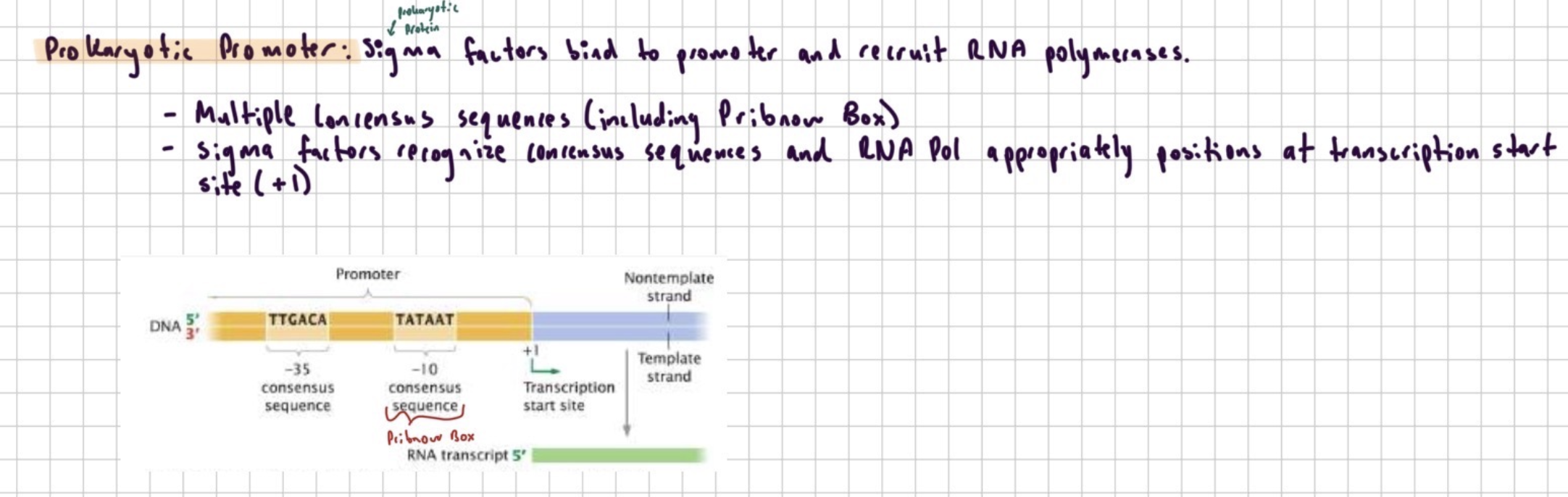
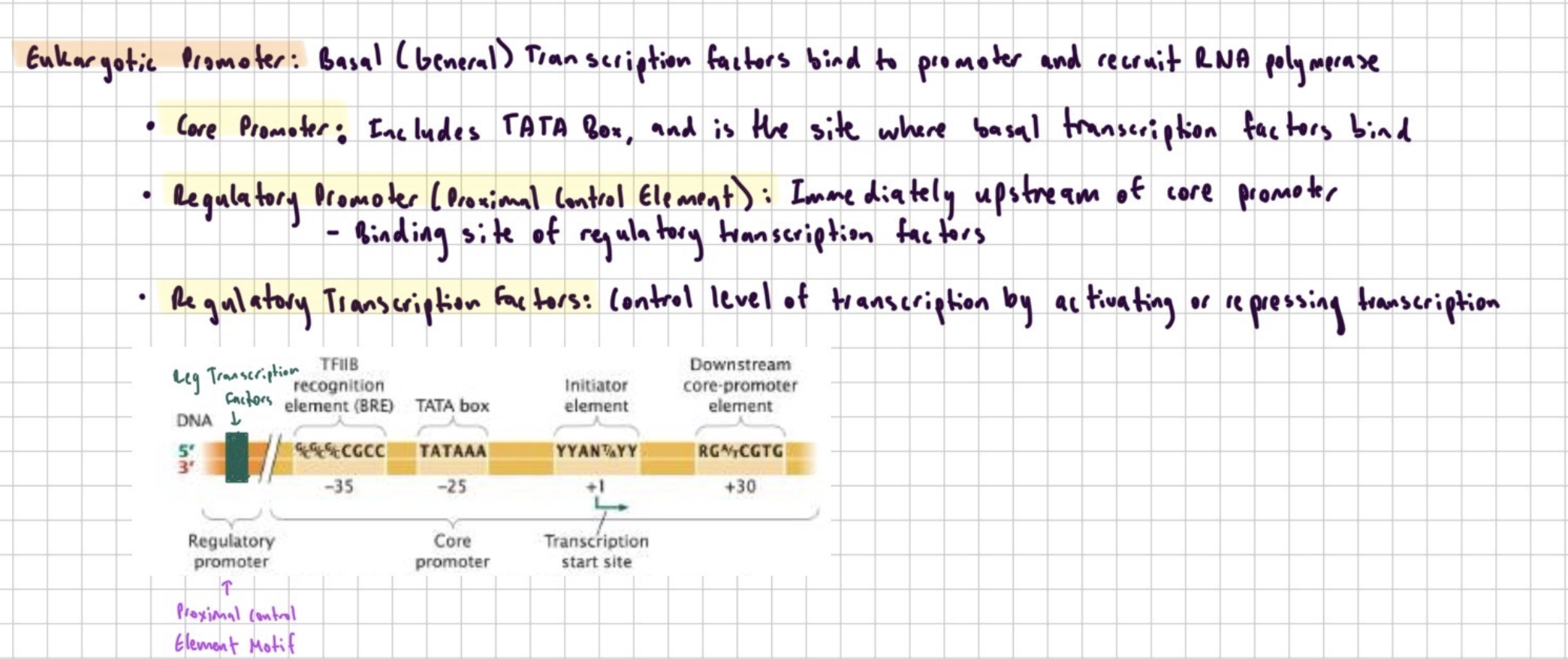
Promoter
DNA sequence that signals the start of transcription, location where RNA polymerase binds
Explain elements of the Prokaryotic promoter.
Explain elements of the Eukaryotic promoter.
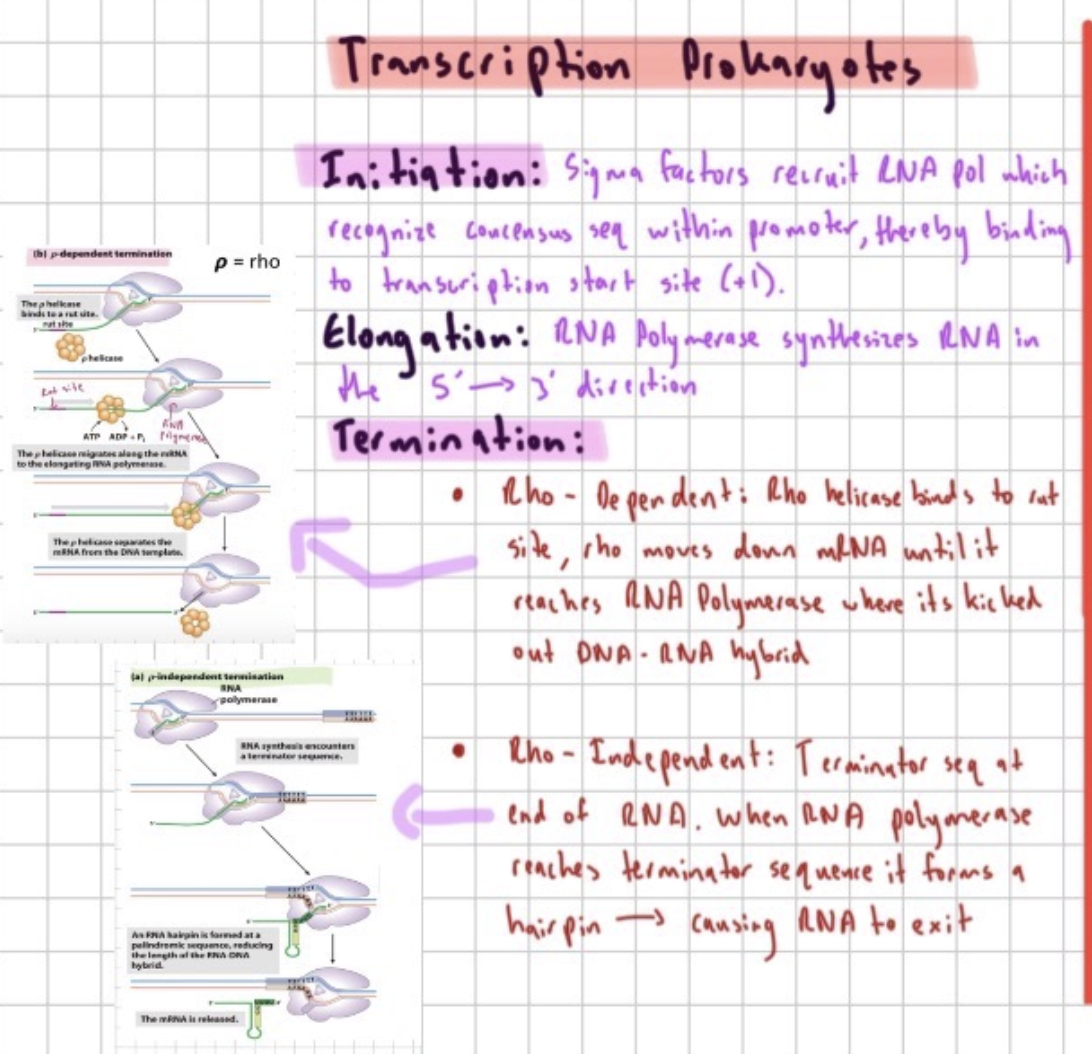
Briefly, describe transcription in Prokaryotes.
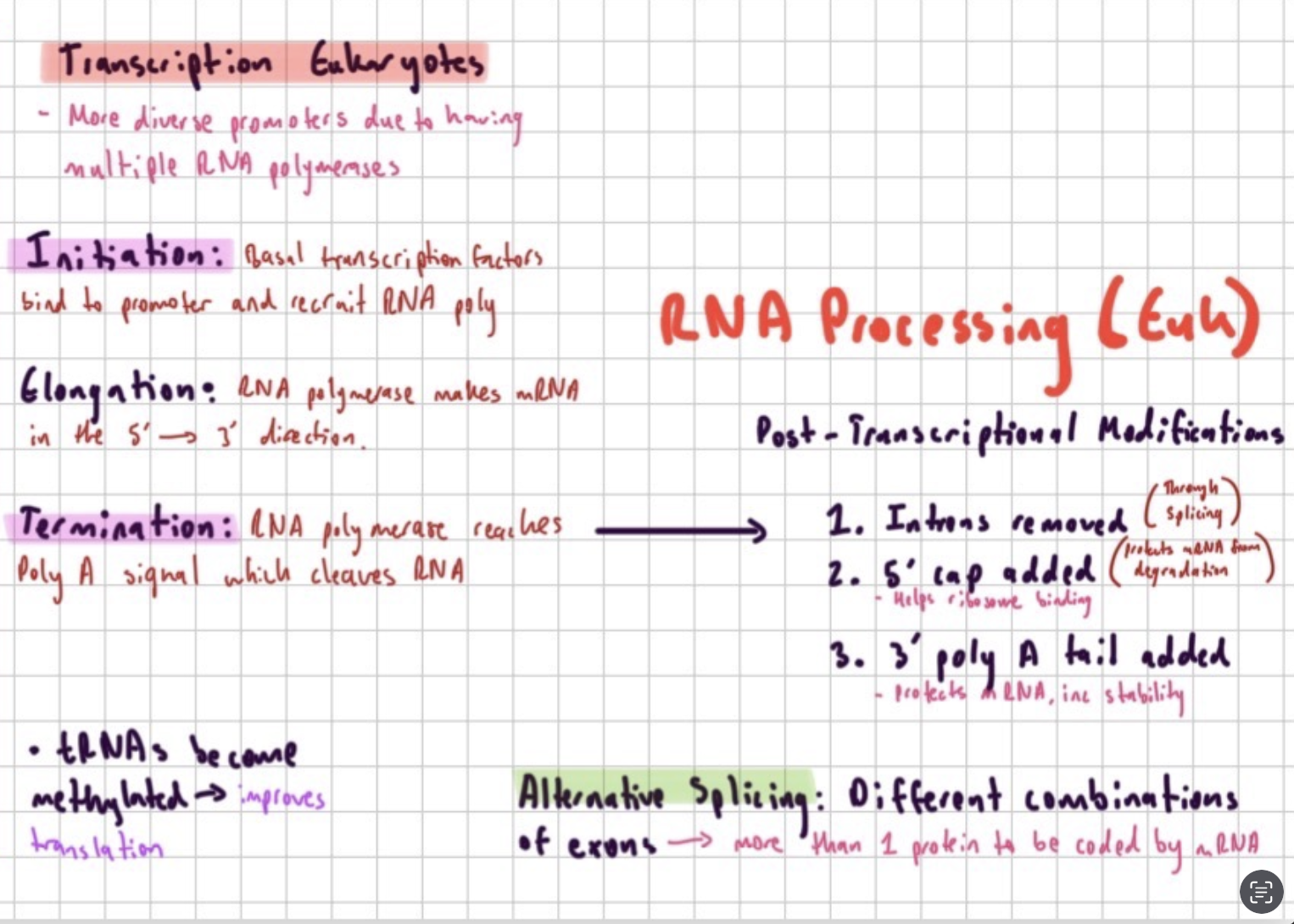
Briefly, describe transcription in Eukaryotes.
What post-transcriptional modifications occur in Eukaryotes?
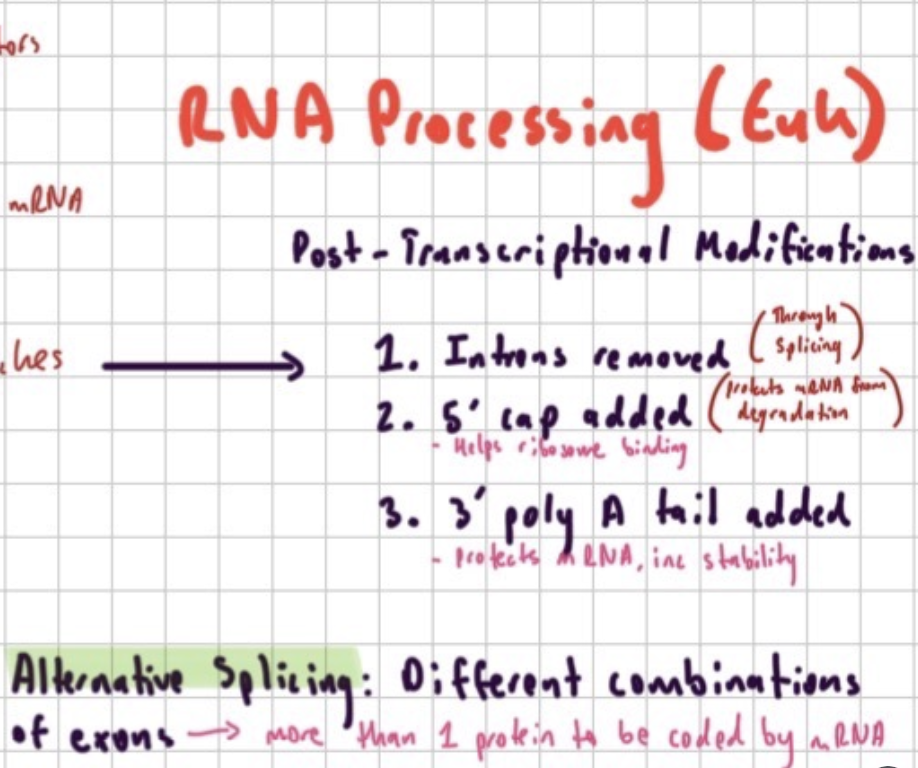
Alternative Splicing
Makes different combinations of exons —> more than 1 protein to be coded by mRNA
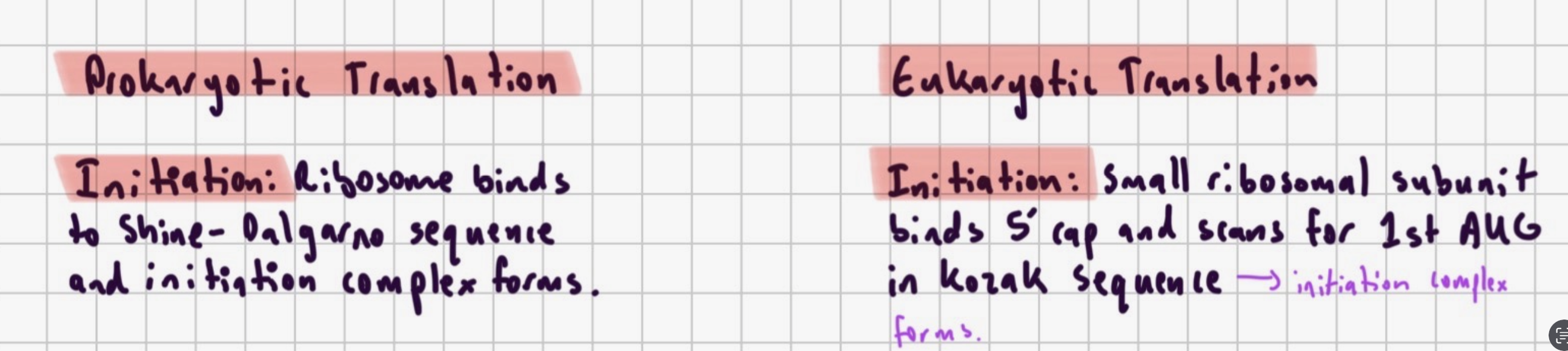
Prokaryotic Translation Initiation vs Eukaryotic Translation Initiation
Helix-turn-Helix
Bind to major groove of DNA
Operons are found only in ______. They have 4 elements _________.
Prokaryotes
P: Promoter (RNA Polymerase recruited and binds here)
R: Repressor (Can supress transcription if bound to operator)
O: Operator (where repressor binds, determines if transcription will occur
G: Gene
Inducible Operon. What is the function of the inducer?
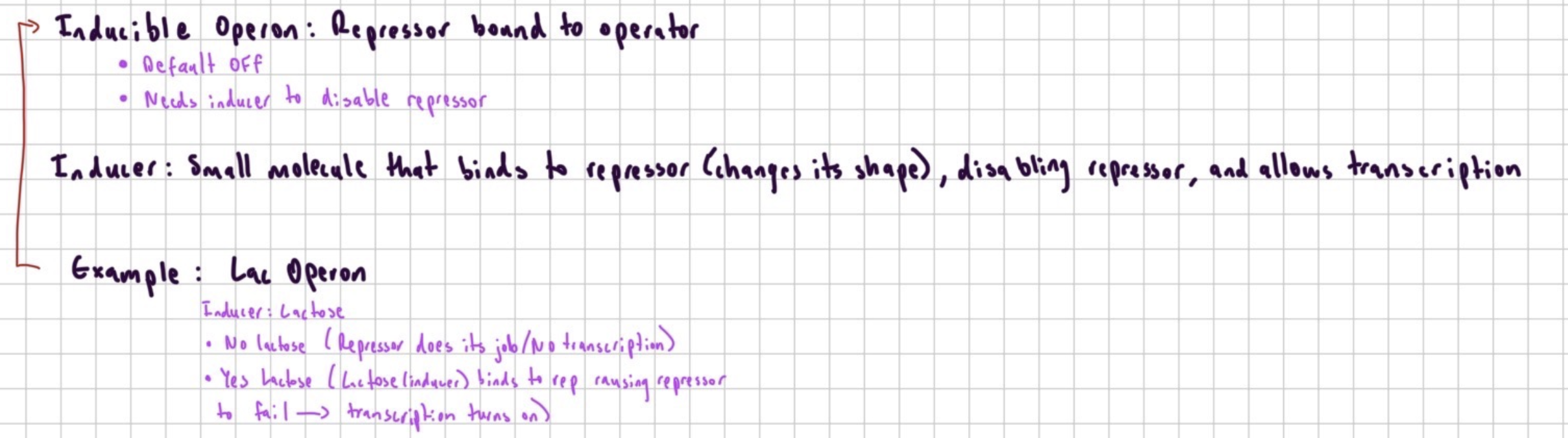
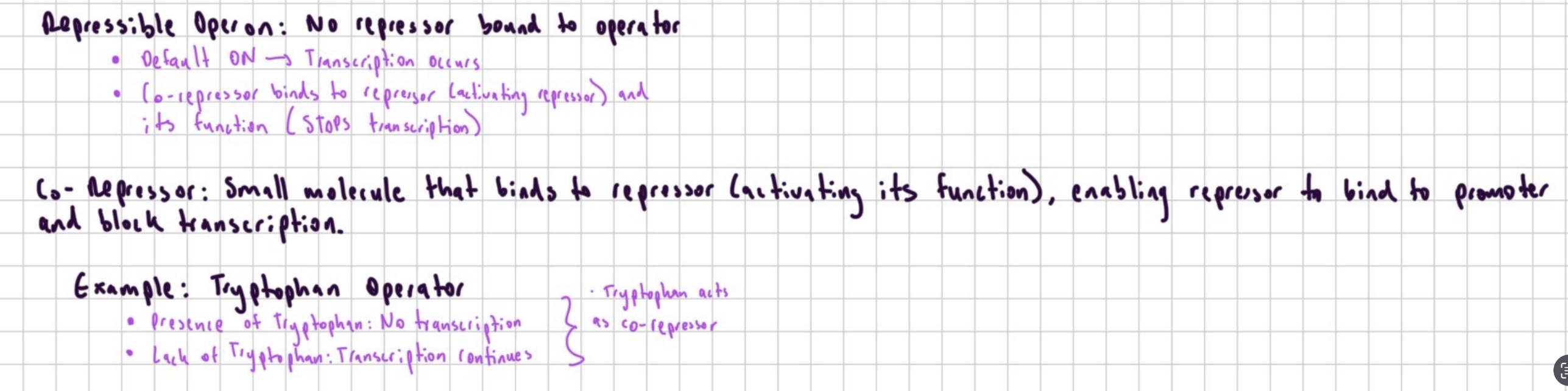
Repressible Operon
Attenuation
Early termination of transcription
siRNA
Part of RISC complex that targets RNA
Dicer
Enzyme that cuts double stranded RNA
Linked Genes
Genes located together on the same chromosome tend to be inherited together
Not 9:3:3:1 ratio
Recombinant Frequency
# of Recombinant/Total Offsprings
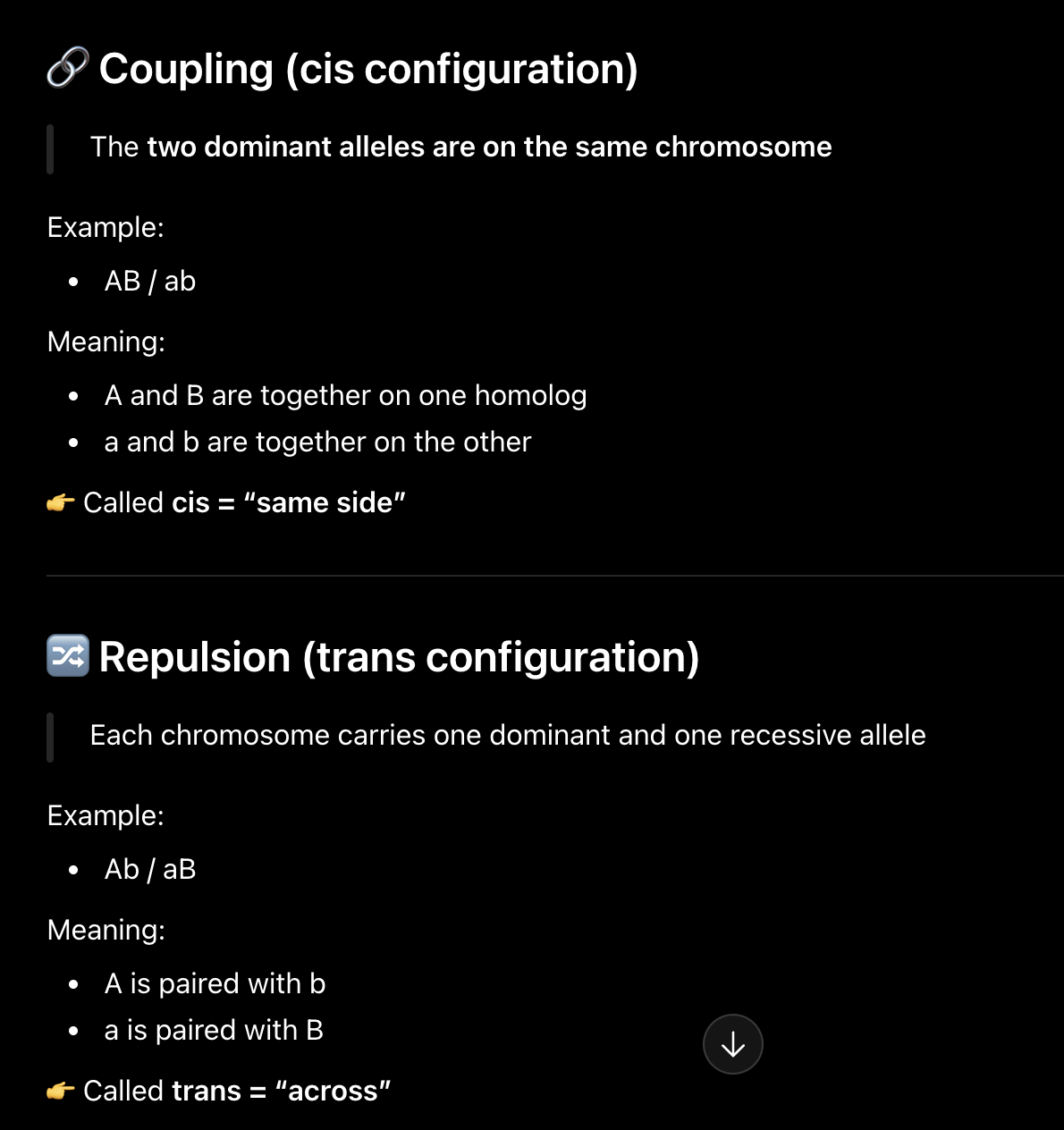
Cis vs Trans Configuration
Cis: Same alleles linked (DOM/DOM) or (REC/REC)
Trans: 2 different alleles linked (DOM/REC)
Coupling vs Repulsion
Double Crossover is the _______.
Parental or non-recombinant type _______.
Double Crossover is the least frequent.
Parental or non-recombinant type is the greatest.
Mitosis
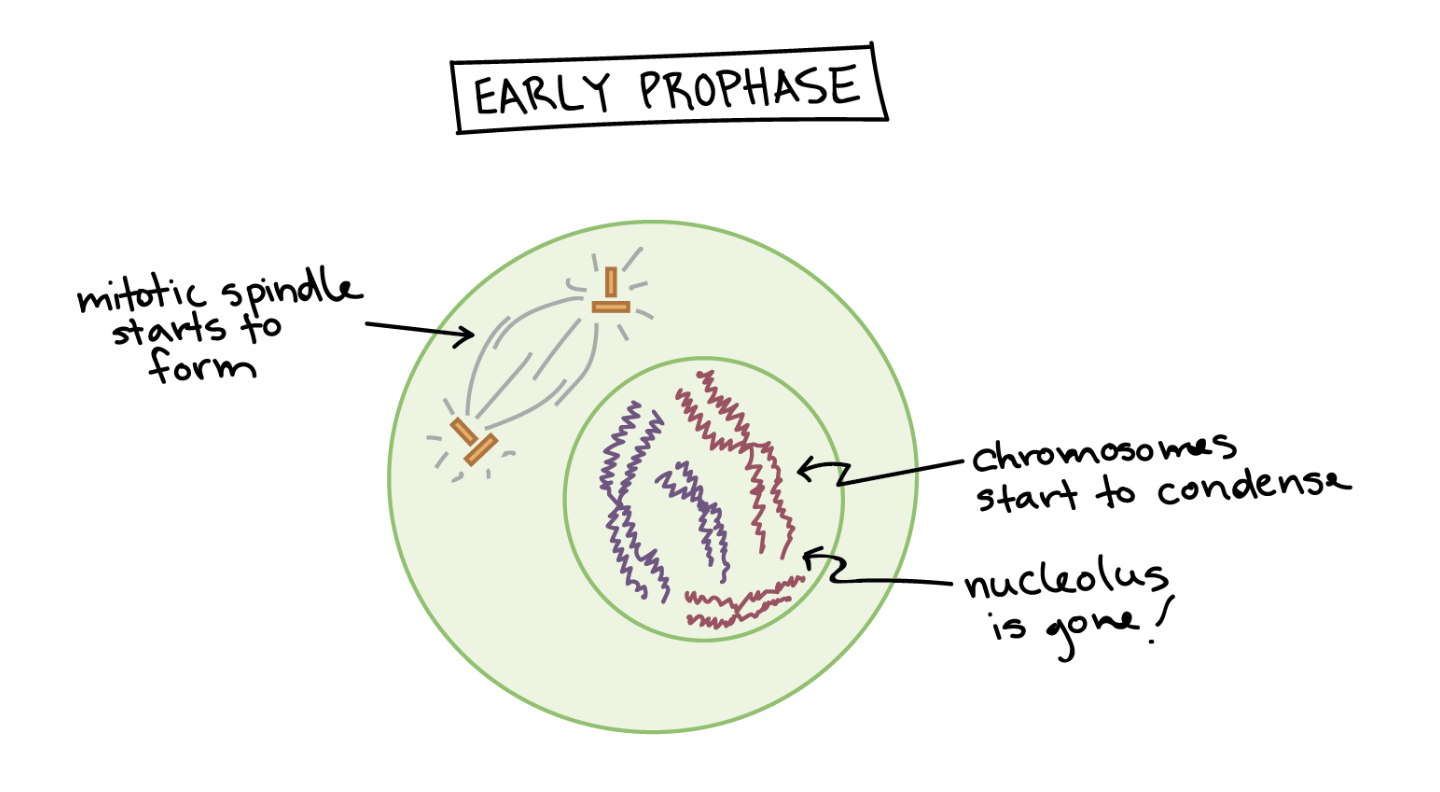
Prophase
Chromosomes condense
Spindle fibers form
Mitosis
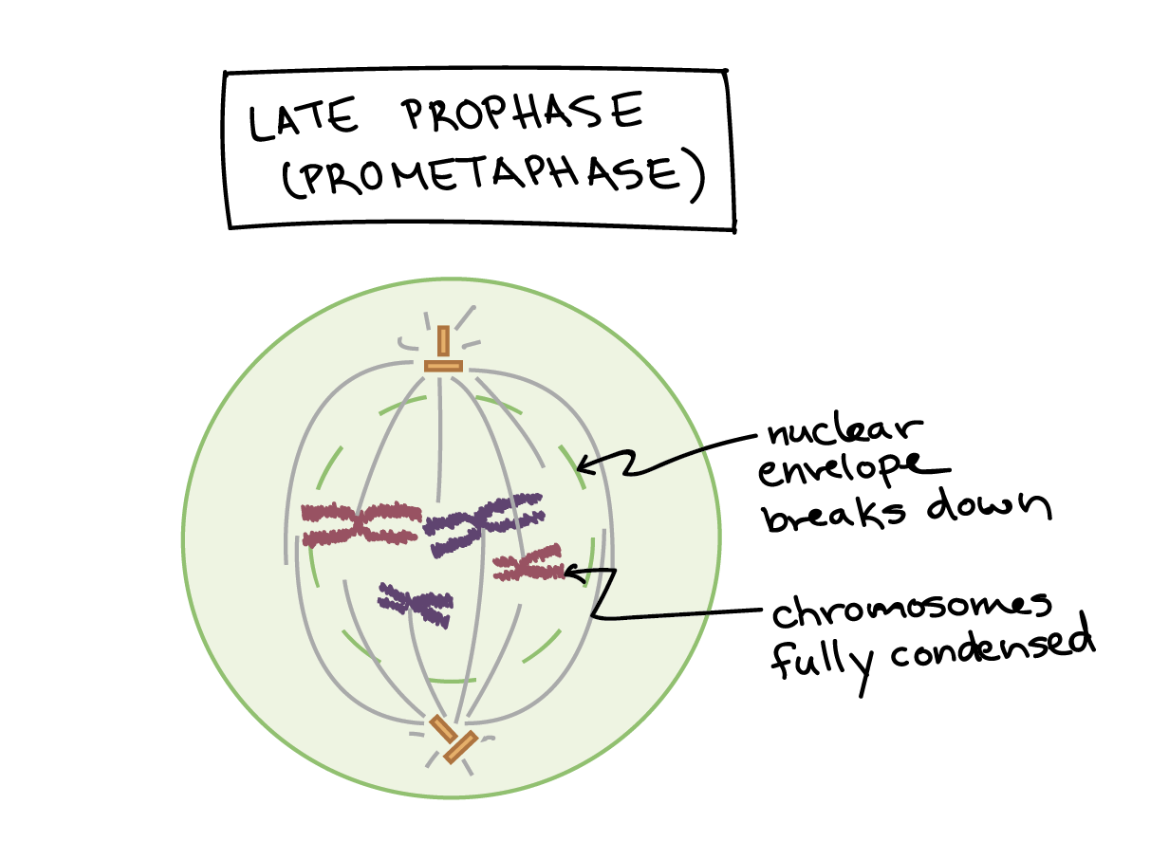
Prometaphase
Nuclear envelope disintegrates, and spindle microtubules attach to kinetochores.
Mitosis
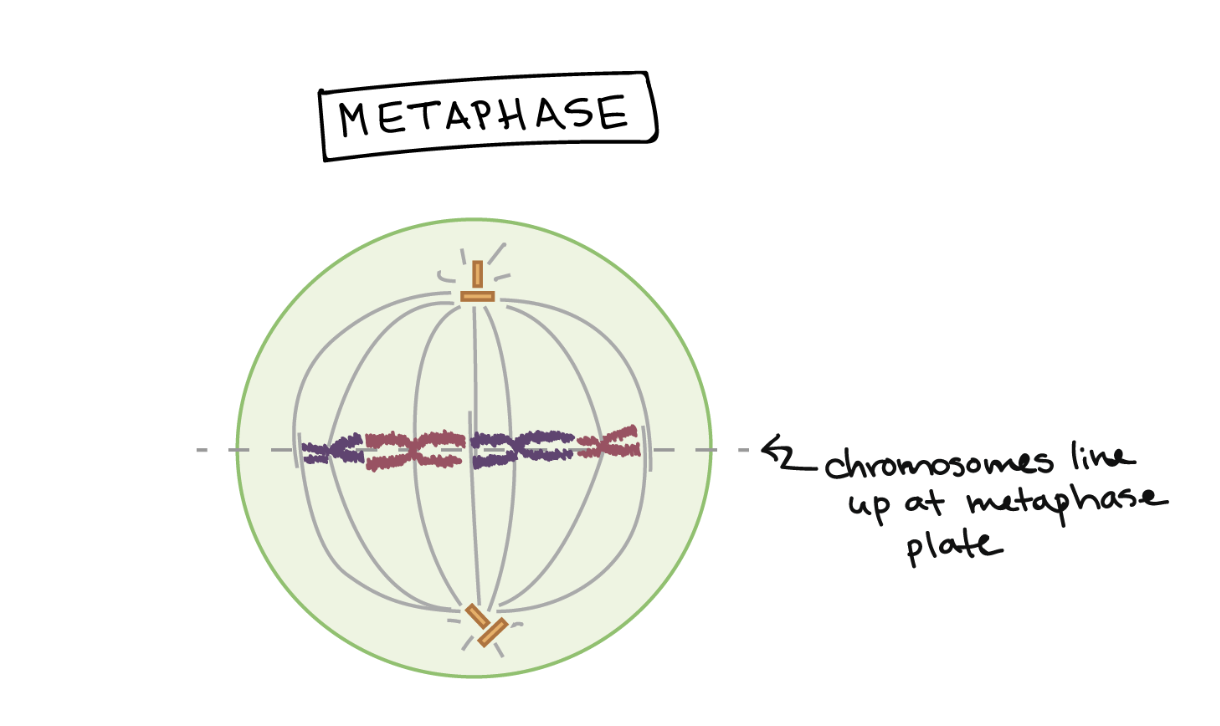
Metaphase
Spindle captures all chromosomes and lines them up at the middle (metaphase plate)
Mitosis
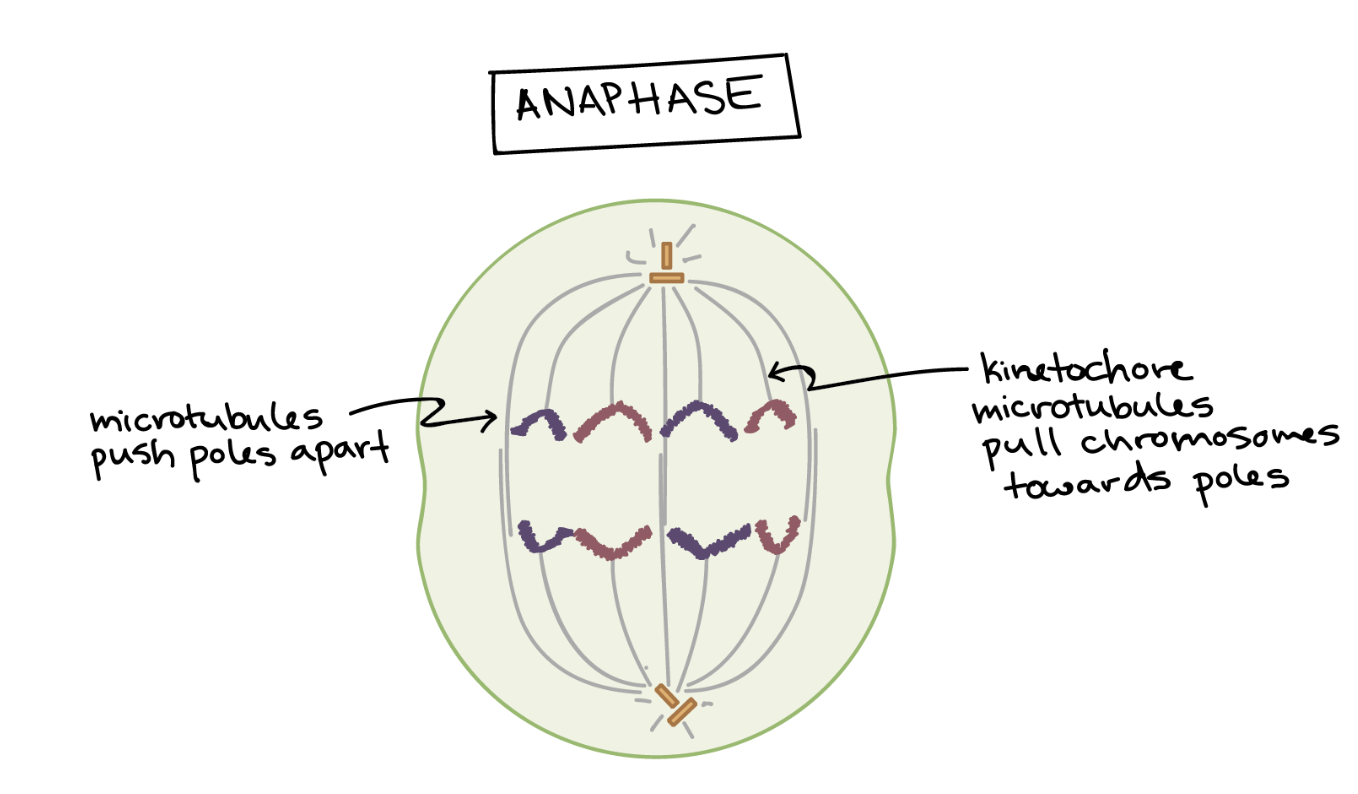
Anaphase
Sister chromatids pulled to opposite ends
Mitosis
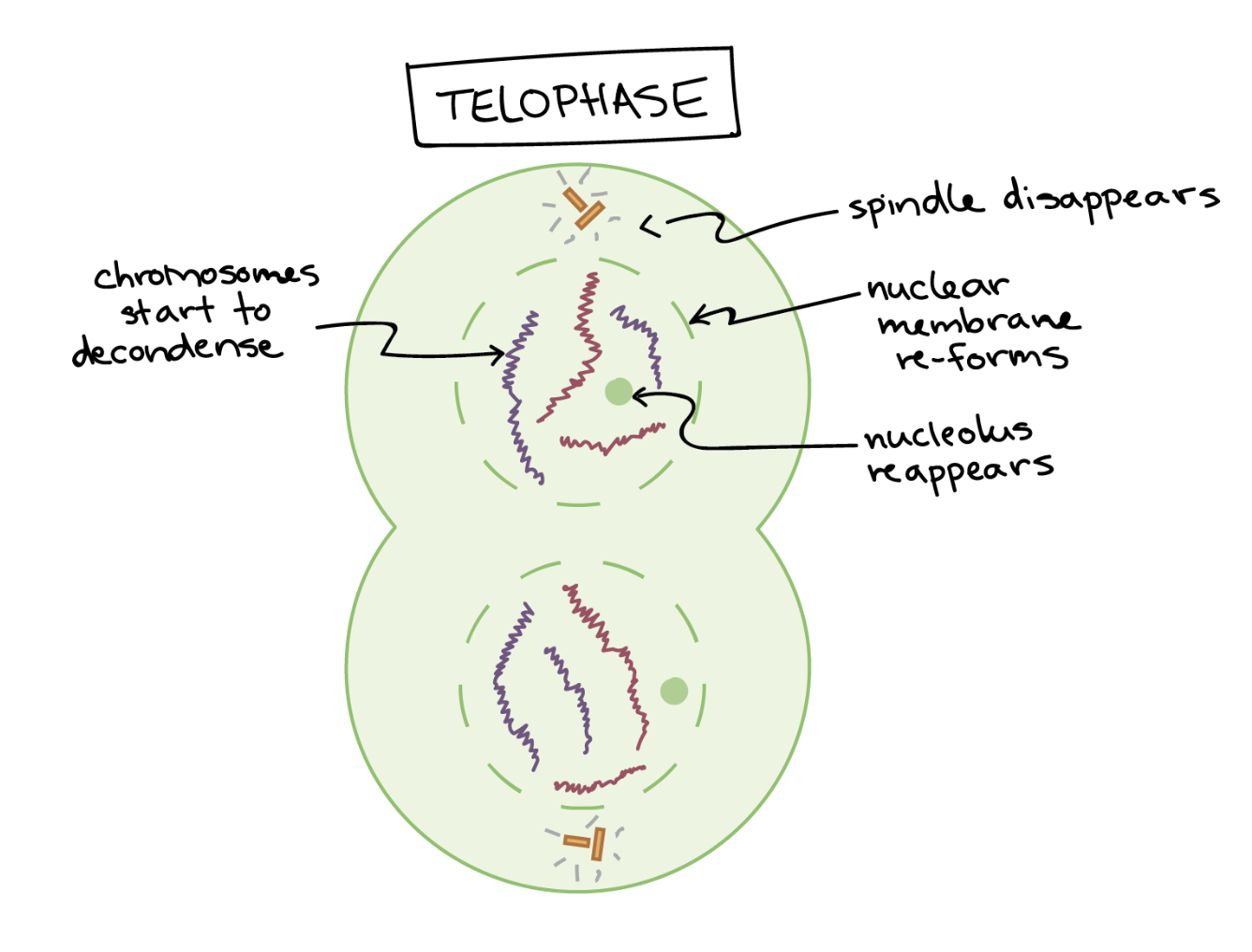
Telophase
Spindle disassembles, 2 new nuclei form, nuclear membrane reappears. Chromosomes decondense (stringy form)
Cytokenesis
Pinch crease disappears and 2 identical daughter cells are made.
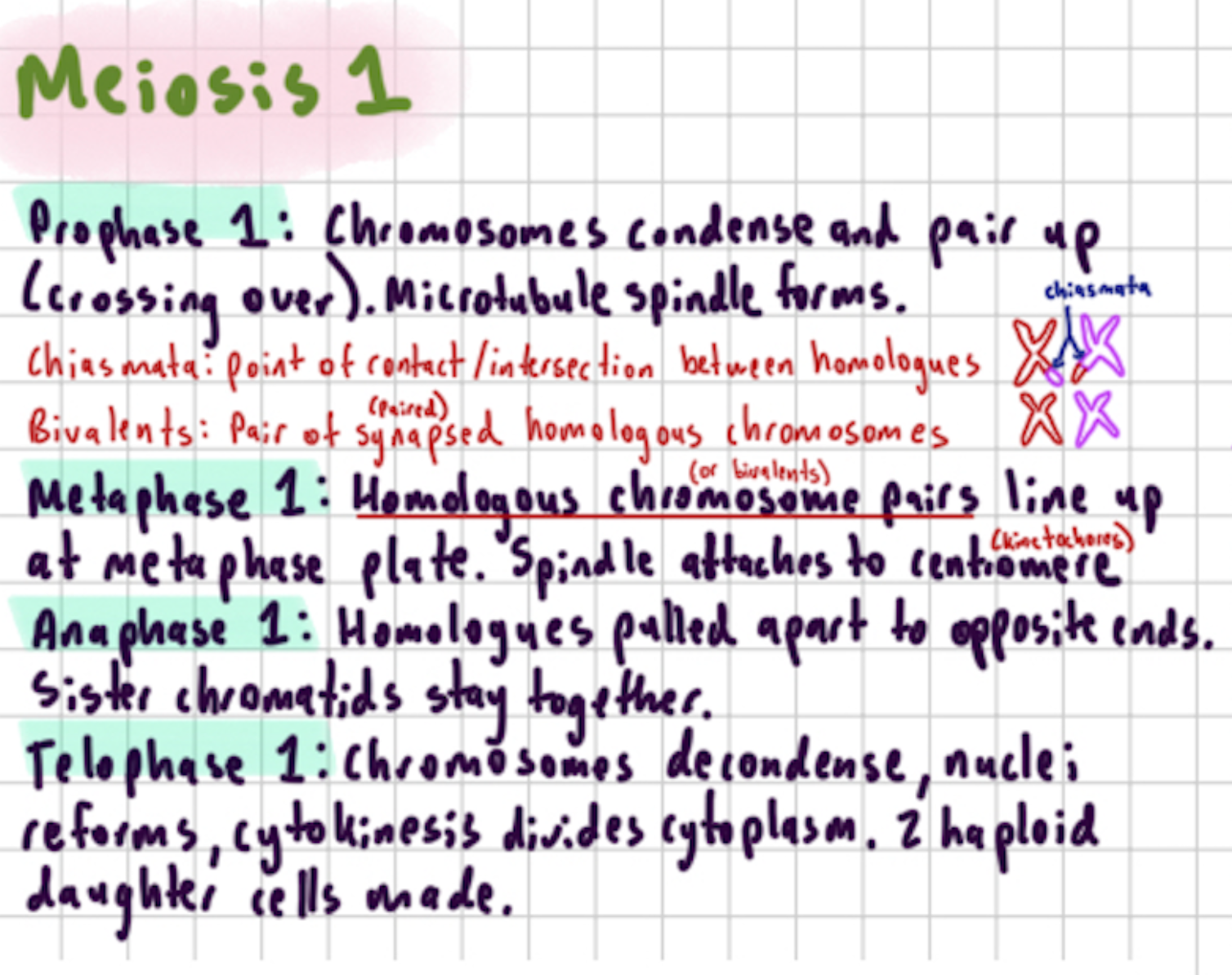
Meiosis 1
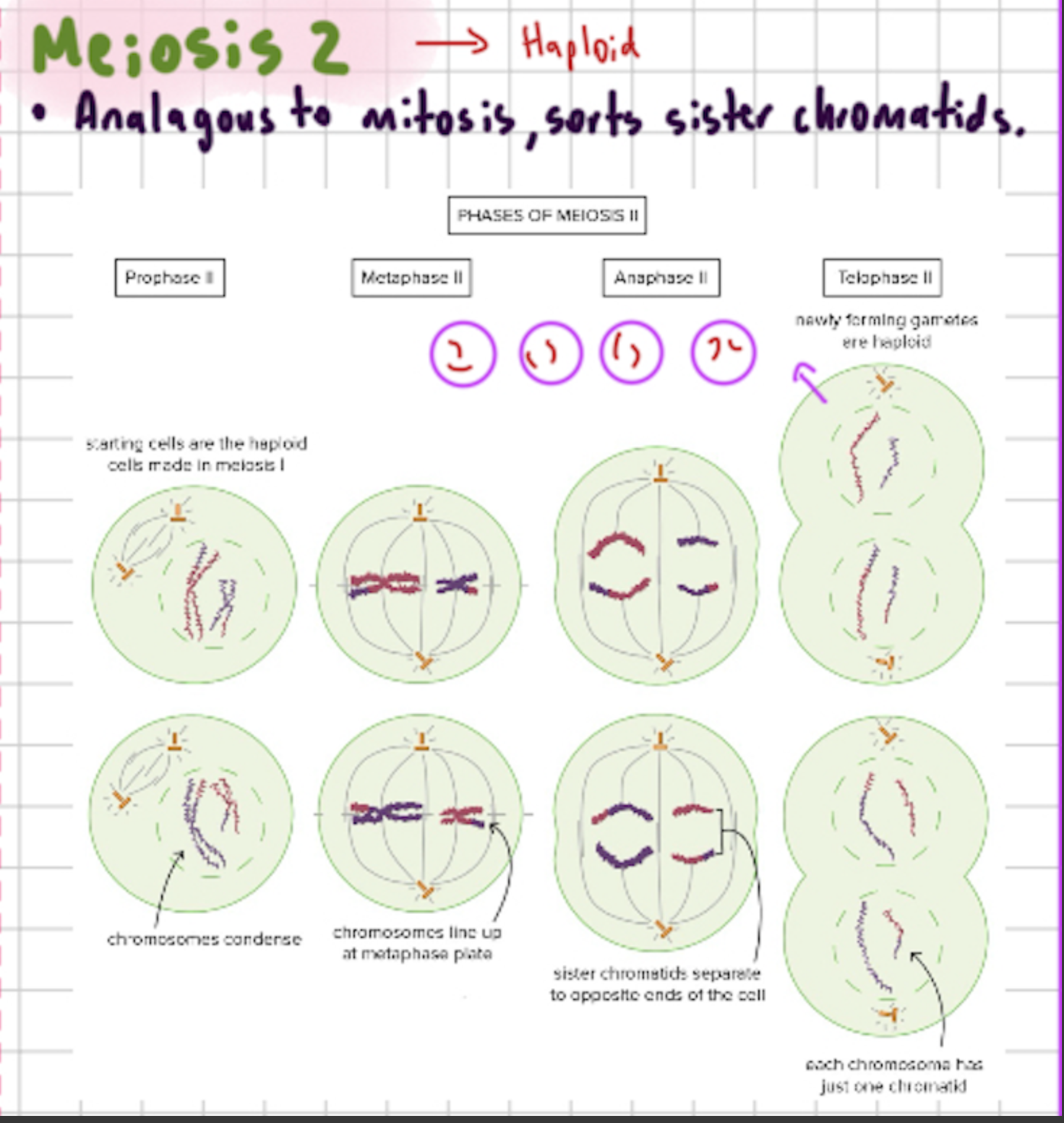
Meiosis 2
Prophase 2: Haploid chromosomes condense
Metaphase 2: Chromosomes line up at the metaphase plate
Anaphase 2: Separation of sister chromatids
Telophase 2: 4 Haploid cells form
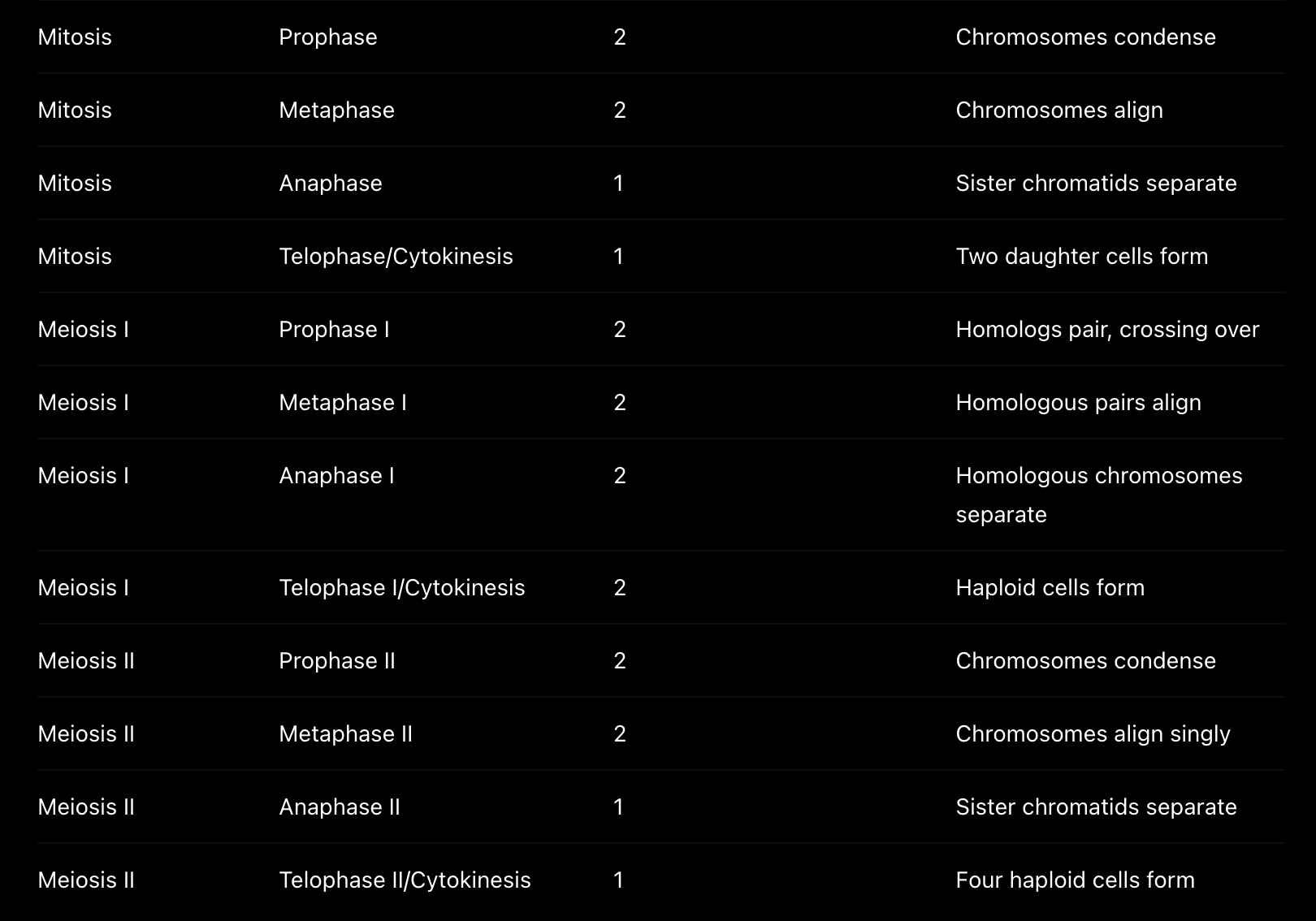
How many chromatids per chromosome will you find at each phase of Mitosis, Meiosis 1, and Meiosis 2?
What is reduction division in meiosis 1?
Diploid (2n) —> Haploid (1n)
Pure Breeding
Homozygous for either (Dominant AA) or (Recessive aa)
Mendel’s First Law: Principle of Segregation
Alleles for a gene will be separated into different gametes of equal proportion
Mendels Second Law: Principle of Independent Assortment
Alleles of one gene sort into the gametes independently of the alleles of another gene
Backcross
F1 Hybrid crossed back with parent
Testcross
Used to determine the unknown genotype of a dominant phenotype (AA vs Aa)
Crossing the individual with a homozygous recessive organism
If offspring have recessive, then unknown genotype is heterozygous dominant
Monohybrid Cross
A cross between two organisms that are heterozygous (hybrid) for a single gene (Aa x Aa)
Yields 3:1 ratio
Dihybrid Cross
A cross following two different genes simultaneously, where both parents are hybrids (heterozygous) for both traits.
Expected Ratio: 9:3:3:1
(AaBb X AaBb)
What is the SRY gene? How does the SRY gene contribute to XX-XY sex determination?
SRY gene is a Y-linked gene and determines whether an individual will develop as a male.
In mammals, all embroyos start with both male and female reproductive ducts with undifferentiated gonads. The SRY protein induces testes development and testosterone --> promoting male characteristics.
If SRY gene is absent (meaning no Y), an individual will undergo female development and male ducts will degenerate.
Chromosomal Sex Determination
ZZ-ZW
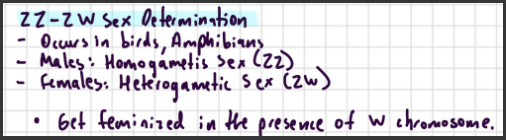
Chromosomal Sex Determination
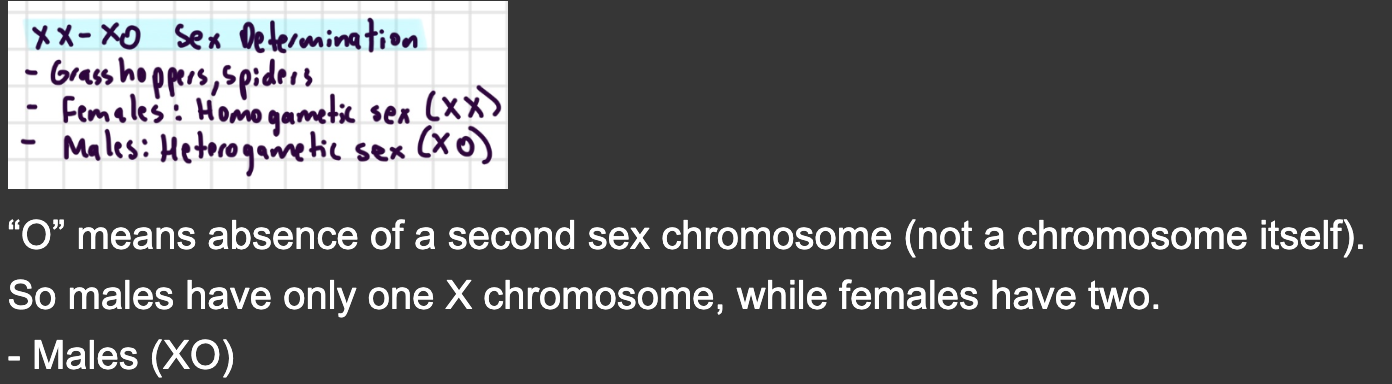
XX-XO
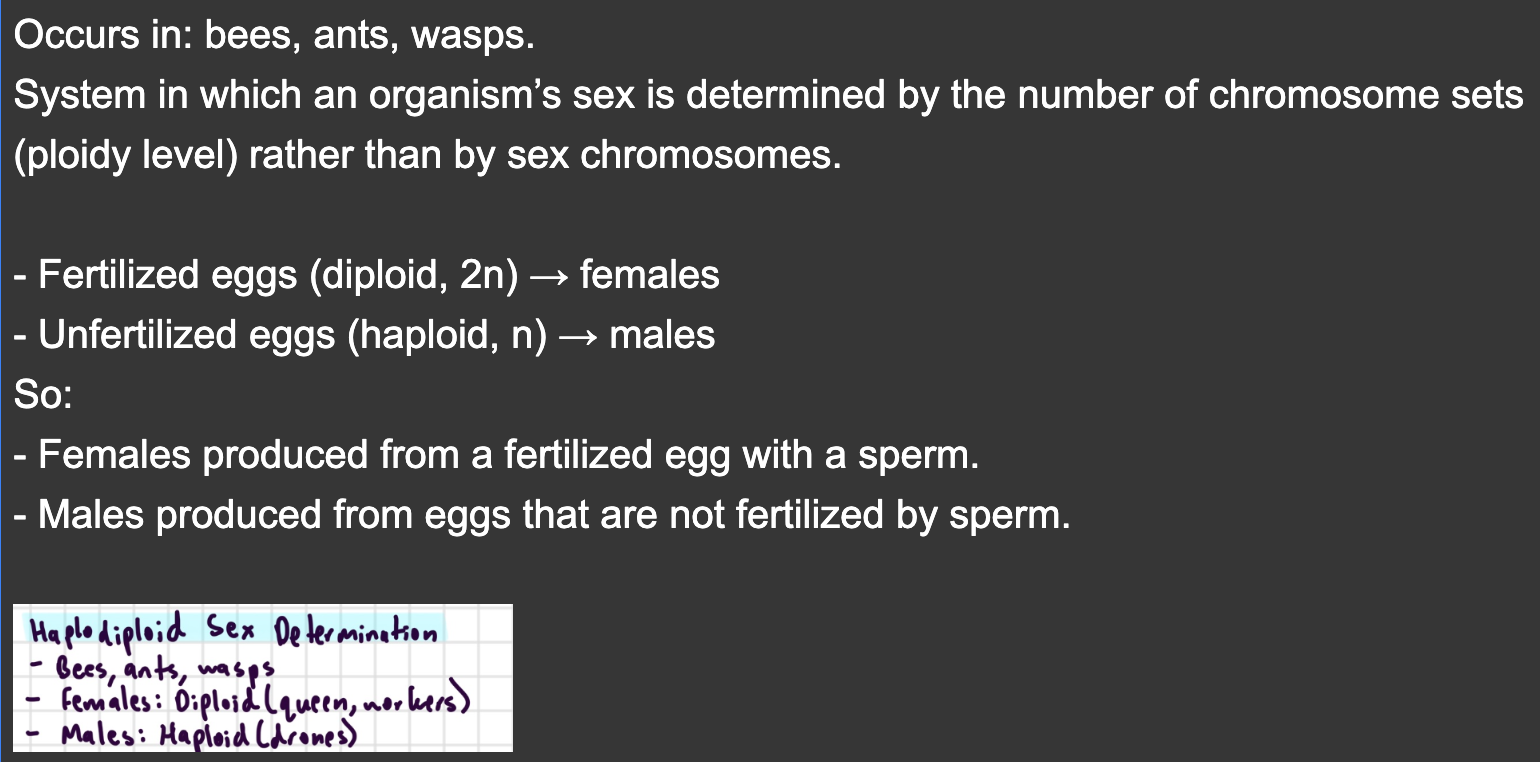
Haplodiploid Sex Determination
Genic Sex Determination
Sex is determined by specific genes that regulate sexual development rather than by chromosome ratios or environmental conditions.
Environmental Sex Determination
A system in which an organism’s sex is determined by environmental conditions during development, rather than by sex chromosomes.
Environmental Sex Determination
Temperature Dependent Sex Determination
Organism’s sex is determined by the temperature experienced during embryonic development, rather than by sex chromosomes.
Environmental Sex Determination
Sequential Hermaphrodism
Individuals can change sex in their lifetime due to hormonal, social, or environmental signals.
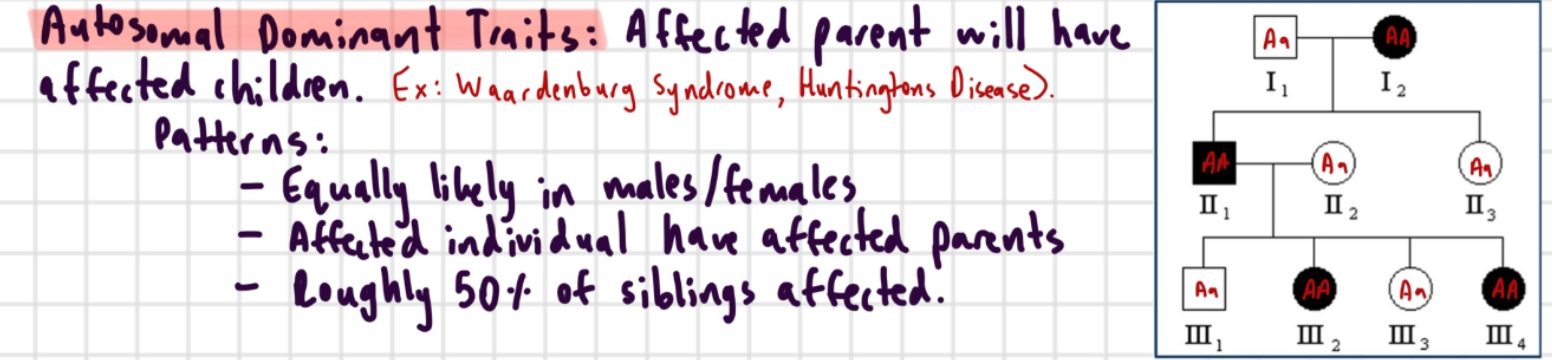
Autosomal Dominant
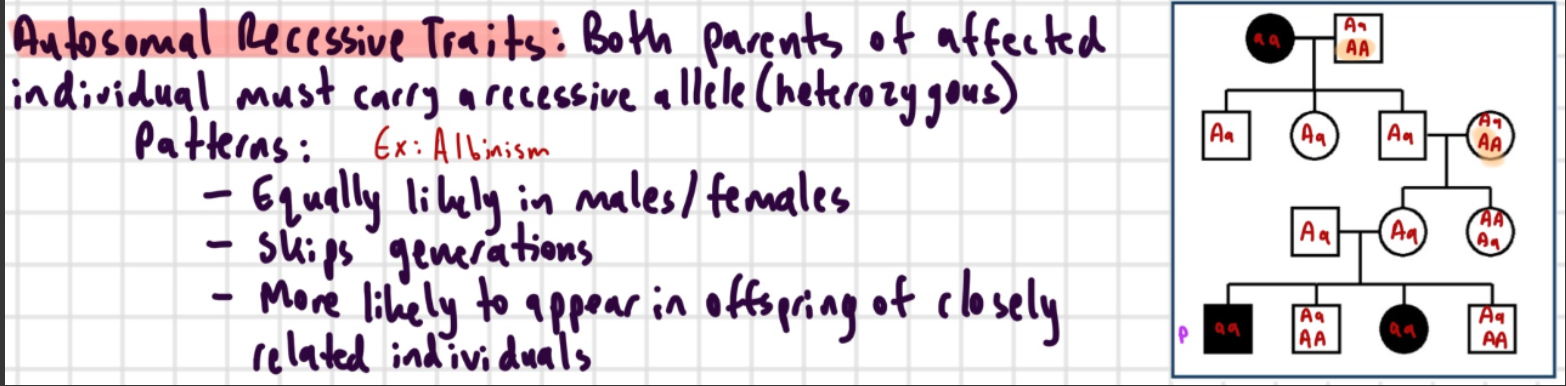
Autosomal Recessive
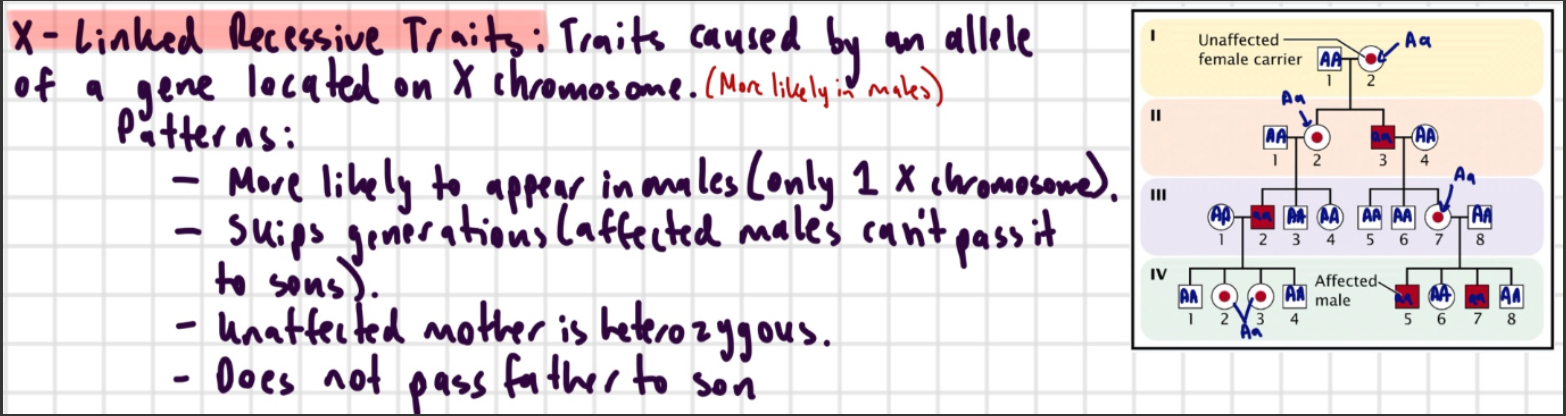
X-Linked Recessive
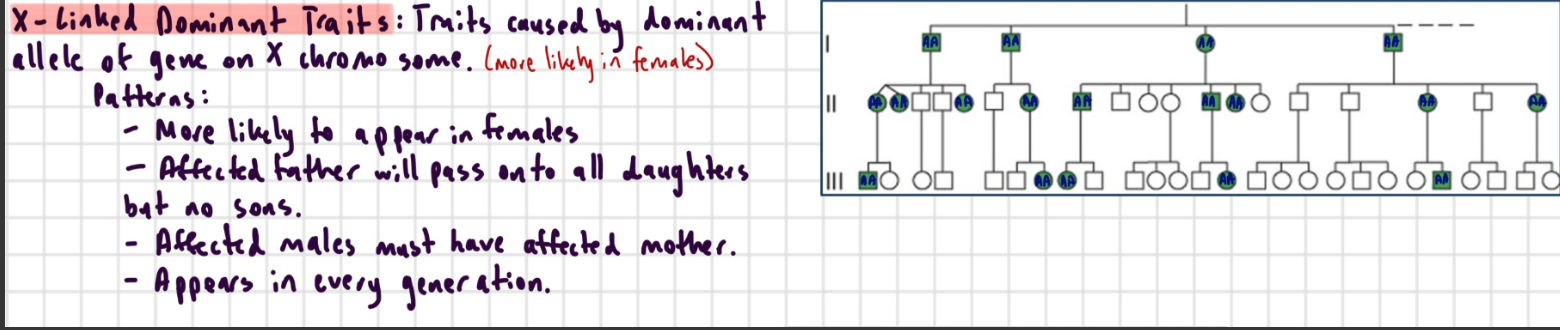
X-Linked Dominant
What is the role of cohesion at the centromere?
Keep chromatids attached after DNA replication and during metaphase. At anaphase, cohesin is cleaved, allowing sister chromatids to separate and move to opposite poles.
Dosage Compensation
Explain random X-inactivation. What are barr bodies?
X-Inactivation: One of the two X chromosomes in female mammals is randomly turned off (inactivated) in each cell early in embryonic development.
Barr Body: Inactivated X chromosome that appears as a condensed, darkly staining body in the nuclei of most cells of female placental mammals.
Without regulation, females would produce twice as much X-linked gene product, which would disrupt normal development.
👉 X-inactivation provides dosage compensation, ensuring males and females have similar levels of X-linked gene expression.
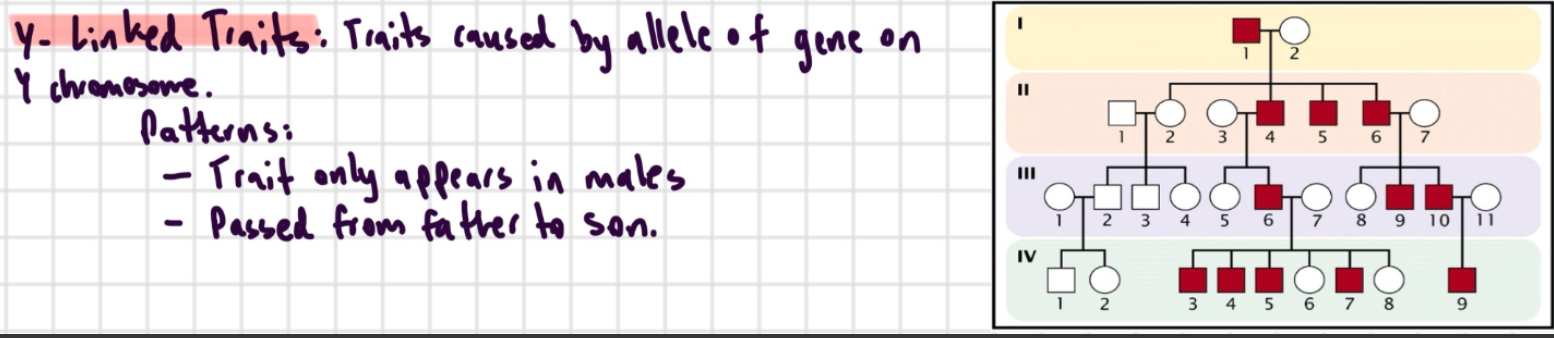
Y-Linked Traits
Define incomplete dominance and provide an example.

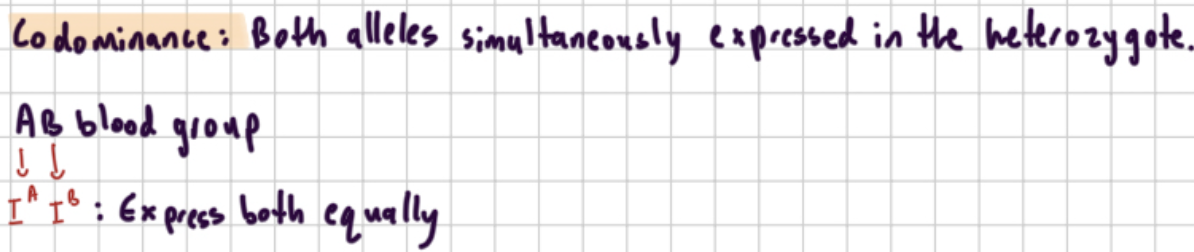
Define co-dominance and provide an example.
Define complete dominance and provide an example.

What is haploinsufficiency? Use this as an example to describe how dominance works.
Heterozygotes have the recessive phenotype
One copy does not have enough protein to express a trait. The heterozygote (Aa) looks more phenotypically like the recessive because the big A makes half the needed protein, and the little a makes no protein, which shows the recessive phenotype instead.
What is dominant negative? Use this as an example to describe how dominance works.
The mutant protein interferes with the function of the normal protein. Mutant disrupts everything, making the heterozygote express the mutant phenotype. So the mutant allele acts as the dominant.
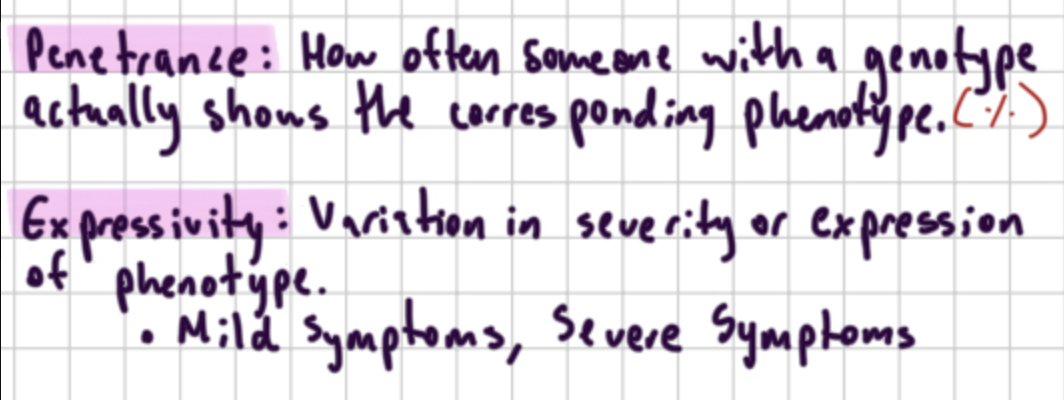
Explain the difference between penetrance vs expressivity.
Define pleiotropy. What actions does it have?
One gene affects many traits
What are multi-genic traits?

Epistasis. Describe an example.

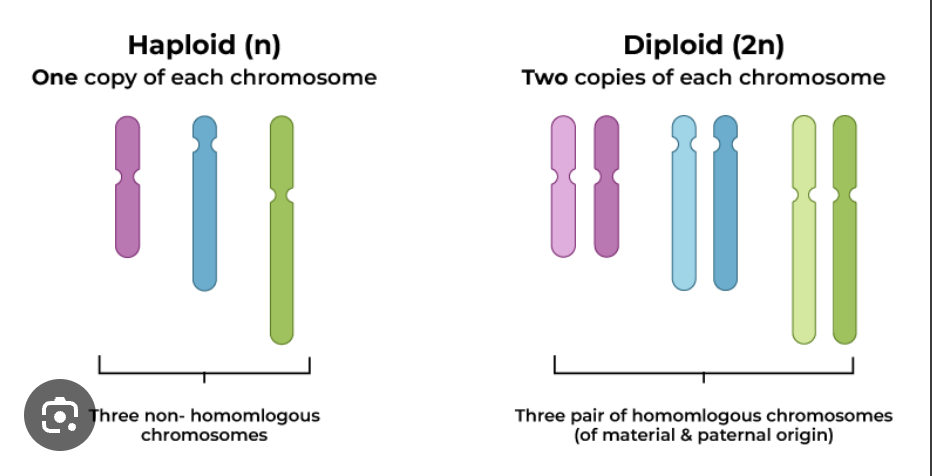
Diploid
Homologous pairs for every chromosome
2n
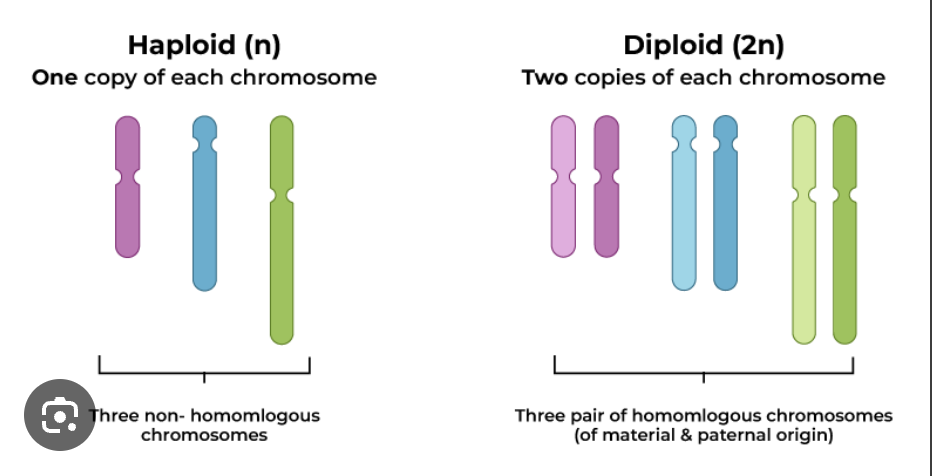
Haploid
One copy of each chromosome n=__
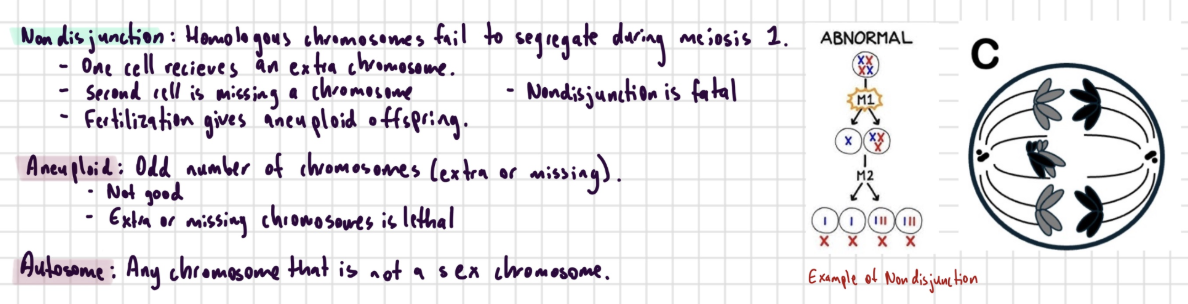
Explain nondisjunction. When does it happen? What is it? What type of cells are made?