Invasive Species Final
 Call Kai
 Learn
Learn Practice Test
 Spaced Repetition
 Match
Match Flashcards
 Knowt Play
1/41

There's no tags or description
Looks like no tags are added yet.
Name | Mastery | Learn | Test | Matching | Spaced | Call with Kai |
|---|
No analytics yet
Send a link to your students to track their progress
42 Terms
Definition of Invasion + How it differs from other processes
No clear definition (difficult to seperate from natural dispersal/colonization)
Human movement component
humans move species beyond natural limits
human mediated invasions occur faster and are more common than natural ones
Major Vectors
Shipping
ballast water
fouling communities
stowaways
anchor wells
Packing material
Wood products
raw wood
solid wood packing material (SWPM)
Living industries
horticulture
agriculture
pet/wildlife trade
Biological control introduction
Manufacturing chains
Changes in transportation and trade
Invasions driven by movement of people, goods, and communities
Rapid technological change → shifts pathways
Ex: shipping containers increased volume and speed of shipping, trade used to be predominatly with Europe but now is mostly Asia
Future drivers of invasive species
Climate change
trade agreements
economic developement
technological change
Conceptual Invasion model
Sequence:
Transport → introduction → establishment → spread → invasion
only 1% of introduced species become invasive
Problems with small populations
Extiction vortex
inbreeding
genetic drift
demographic stochasticity
allee effects
more vurnerable to random events
Environmental stochasticity
Random environmental variation affecting populations
density dependant
can be positive or negative
Demographic stochasticity
Random variation in
births
deaths
survival
reproduction
more important in small populations
Founder effect
Founder populations
small subset of original genetic density
random genotype representation
inbreeding (increased deleterious alleles)
Genetic paradox of invasion
Invasive species often succeed despite low genetic diversity and inbreeding
Explanations
genetic purging
multiple introductions
phenotypic plasticity
Component Allee effect
individual fitness increases with population size (Ex: poppy in Chile. More plants = more pollinators = more seed production)
Demographic Allee effect
increasing per capita population growth rate with increasing population size. Strong component allee effects can lead to demographic allee effects
Propagule pressure
number of individuals introduced, number of introduction events, interaction between both
Overcomes demographic stochasticity, Allee effects, genetic limitations
Spatial spread
Diffusion- spread within natural dispersal lmits
human-vectored spread- long distance jump beyond natural limits
Stratified diffusion- combination of population growth and coalescence
Lag times
period of low or no population growth after establishment
Caused by maladaptation, environmental change, Allee effects, detectability issues
Sleeper species
Established but not invasive
limited by abiotic or biotic factors
May become invasive due to climate change, disturbance, new genotypes, arrival of mutualists
Invasional meltdown
invasive species facilitate other invasives, creates positive feedback loop, leads to changes in ecology
Ex: Zebra and quagga mussels reengineering the lake bottom and filtering vast amounts of water
Biotic resistance
Native species limit invasion via competition, predation, parasitism, and pathogens
Stronger in diverse communities on a small scale
Enemy release hypothesis
invaders experience decreased regulation by natural enemies leading to increased abundance and distribution
EICA (Evolution of Increased competitive ability)
Reduced investment in defense to allocate resources to growth and reproduction
Introgression
hybrid offspring backcrosses with parent populations leading to genetic swamping and hybrid vigor (increased fitness of hybrids)
Issues caused by invasives
Replaces native species
insert into new niches
54% of extinctions involve invasives 20% of which are solely from invasives
Biotic changes
Alter trophic structure, simplify food webs, remove species interactions
Abiotic invasions
Alter nutrient or water availability, disturbance regimes, and physical environment
Autogenic ecosystem engineers
alter environment through their structure
Ex: phragmites
allogenic ecosystem engineers
alter environment via activity
Ex: beavers
invasion curve
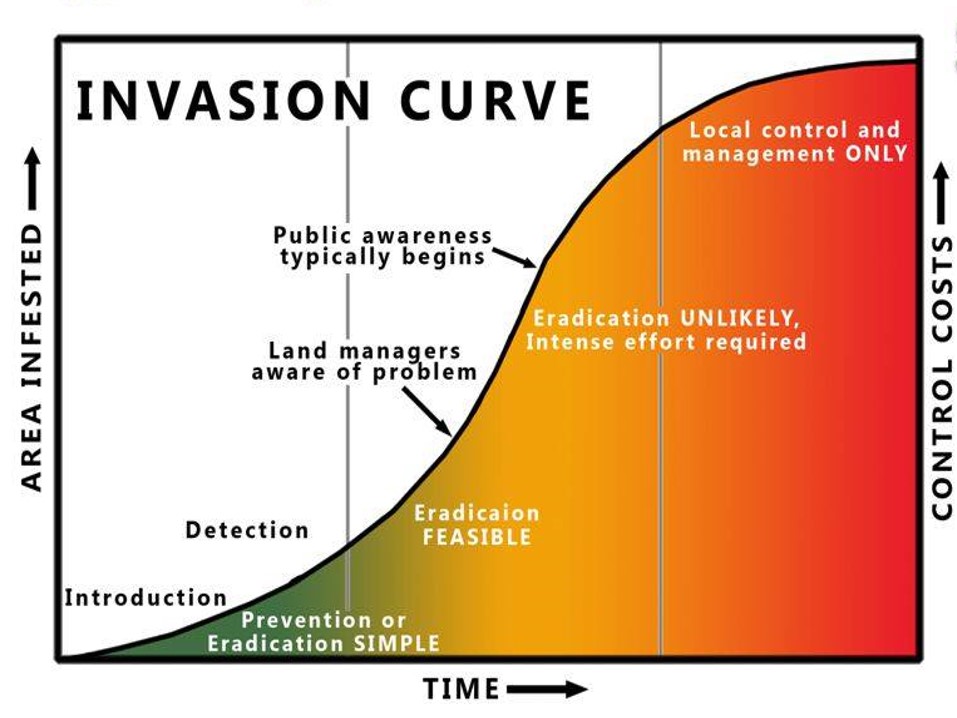
Eradication
complete removal of propagules, requires early detection and rapid response
Why eradication fails
Late detection
insufficient resources
species already established/spread
reinvasion
Unintended consequences of removal attempts
non-target impacts
predator removal can lead to prey release, mesopredator release
hyperpredation
Mesopredator release
When the apex predator is removed mesopredators can have greater impact on prey species
Hyperpredation
removal of invasive prey species leads to increased predator populations having a greater impact on native prey species
3 too’s
Too much (invasion too extensive)
Too little (lack of resources or effort)
Too late (detected after establishment)
Control methods
Mechanical/physical
chemical
Biological
genetic
integrated pest management
Genetic control options
breeding natives to become more resistant
gene drives (genetic engineering tech that forces specific traits to move rapidly through environment)
high upfront costs
Integrated pest management
combines multiple control strategies
developed after reliance on insecticides
uses chemical, biological, and physical methods together
goal more sustainable and effective control
Chemical control
hebricides, pesticides
cost effective
can have minimal non-target impacts
public resistance exists
physical/mechanical control
picking, cutting, burning, flooding
limited by scale
requires repeated effort
Biological control
use natural enemies
long term control if successful
risk to non-target species
often fails, but high payoff if not
Steps of classical biological control
suitability
evaluate
select
test
small release
large release
post-release
Slow-the-spread
Used when eradication not possible to delay spread, prepare communities, and buy time
Centrifugal phylogenetic method
test more closely related species first then move on to distant relatives