Power series
 Call Kai
 Learn
Learn Practice Test
 Spaced Repetition
 Match
Match Flashcards
 Knowt Play
1/9

There's no tags or description
Looks like no tags are added yet.
Name | Mastery | Learn | Test | Matching | Spaced | Call with Kai |
|---|
No analytics yet
Send a link to your students to track their progress
10 Terms
What is a power series?
A power series is C(x)=∑n=0∞cnxn where x is a variable and c0,c1,c2,… are constants called coefficients of the power series.
What does absolute convergence for smaller modulus mean with relation to a power series?
Suppose for a given x0∈R the power series C(x0) is convergent. Then for all y with |y|<|x_0|
C(y) is absolutely convergent
For any fixed p≥0 we have \sum_{n=1}^{\infty}\left|n^{p}c_{n}y^{n}\right|<+\infty
Whats the interval of convergence of the power series?
The set of points where the power series is convergent.
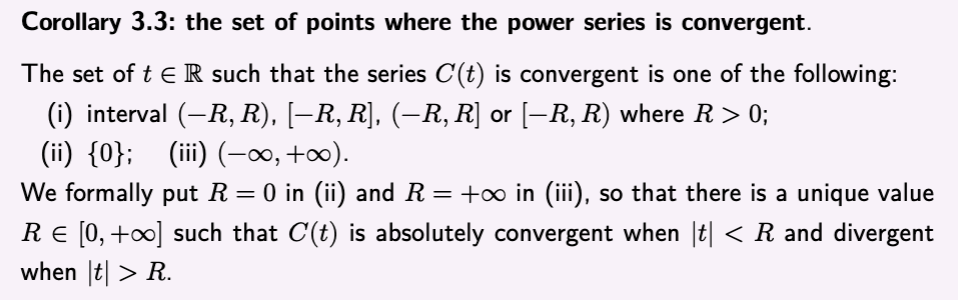
What’s the radius of convergence of the power series?
R∈[0,+∞] is the radius of convergence. If R=+∞ then the seres is convergent for all x∈R.
If 0<R<+\infty at x=R and x=−R the series may be
absolutely convergent
conditionally convergent
divergent
How do you find the interval of convergence?
Apply ratio test to the non-negative series ∑n=0∞∣an∣∣x∣n
Based on the test, determine R such that ∑n=0∞∣an∣∣x∣n is absolutely convergent when |x|<R and is not absolutely convergent when |x|>R. This is the radius of convergence.
Use further tests to check convergence of∑n=0∞anxn at x=−R and x=R
What is Lipschitz Continuous?
Let L be a non-negative constant. A function f:[a,b]→R is called L-Lipschitz continuous iff ∣f(y)−f(x)∣≤L∣y−x∣ for all x,y∈[a,b].
Proof that a function defined by a power series is continuous
Let C(x) denote the sum of a power series with radius of convergence R. Then C(x) is a continuous function on the interval (−R,R).
Proof: ∀ closed interval [−S,S] inside (−R,R), we show that C(x) is continuous on [−S,S] for a suitable S (namely if |x|<S<R) this will prove continuity of C(x) at all points of (−R,R).
If x,y∈[−S,S] then by the Infinite Triangle Inequality,
∣C(y)−C(x)∣=n=1∑∞cn(yn−xn)≤n=1∑∞∣cn∥yn−xn∣
Since xn is Lipschits continuous on a bounded interval (∀x,y∈[−S,S] ∣yn−xn∣≤nSn−1∣y−x∣ ).
∣C(y)−C(x)∣≤S1(n=1∑∞n∣cn∣Sn)∣y−x∣
Since ∑n=1∞n∣cn∣Sn is a convergent series, so the factor L=S1∑n∣cn∣Sn is finite. Hence the function C(x) is L-lipschiotz continuous and so continuous, on [−S,S].
What is the exponetnial in terms of a power series?
exp(x)=1+1!x+2!x2+⋯=n=0∑∞n!xn
e=exp(1)
Proof that exp(x) is continuous.
If x=0 the series is 1+0+0+… which is convergent with sum 1. If x=0, apply the ratio test to the series ∑n=0∞n!∣x∣n to find l=limn→∞n!∣x∣n(n+1)!xn+1=limn→∞(n+1)∣x∣=0,∀∣x∣
Since 0<1 the power series exp(x) is absolutely convergent.
Thus, exp(x) is well defined for all x so it follows that exp(x) is a continuous function on all of R.
Proof that exp(x+y)=exp(x)exp(y)
Recall that exp(x)=∑n=0∞n!xn. By the binomial formula, n!1(x+y)n=n!xn+(n−1)!xn−11!y+(n−2)!xn−22!y2+⋯+1!x(n−1)!yn−1+n!yn.
For n=0,1,2,… write the terms of these expansions in the nth column of a double series, filling the rest of the column with zeros.
Then the nth column sum is ColSumn=n!1(x+y)n, so ∑n=0∞ColSumn=∑n=0∞n!(x+y)n=exp(x+y).
On the other hand, the mth row has common factor m!ym, so RowSumm=(1+1!x+2!x2+⋯)m!ym=exp(x)m!ym.
Hence ∑m=0∞RowSumm=exp(x)∑m=0∞m!ym=exp(x)exp(y).
Since the double series is absolutely convergent, we may change the order of summation. Therefore exp(x+y)=exp(x)exp(y)."