Mometrix Flashcards: Domain III Critical Incident Management
 Call Kai
 Learn
Learn Practice Test
 Spaced Repetition
 Match
Match Flashcards
 Knowt Play
1/42

Earn XP
Description and Tags
Putting these into terms I understand and WILL memorize. These are 100% true and best practices
Name | Mastery | Learn | Test | Matching | Spaced | Call with Kai |
|---|
No analytics yet
Send a link to your students to track their progress
43 Terms
The Meissner’s corpuscle is part of the _ organ and it’s purpose is…
Integumentary (skin), sense light touch
The Pacinian corpuscle is part of the _ organ and it’s purpose is…
Integumentary (skin_, sense deep pressure
What are the 5 layers of the epidermis
Stratum corneum
Stratum lucidum
Stratum granulosum
Stratum spinosum
Stratum basale
Melanocyte
The spinal cord is protected by vertebrae. How many cervical, thoracic, lumbar and sacrum?
C7, T12, L5, S5 that are fused
HIPAA release form needs (6)
What medical information can be disclosed
Who may release the information
Who the information may be released to
Purpose for disclosing the information
Expired date of authorization
To be signed and dated by the patient
If a personal representative is signing the HIPAA release form, what is needed?
Representative’s authority to sign for patient must be identified
What is the purpose of HIPAA (3)
Governs how patient’s PMI is protected and what steps must be taken for PMI to be shared.
Ensures patients have access to their own PMI
Offers added control over how PMI is shared
Sets consequences if PMI is not kept private
Define duration of action and half life
length of time which blood level is adequate to provide minimum therapeutic results. this is based on the drug’s half life - time required to reduce blood level to the drug by half
Define frequency of administration
half life of the drug
steady state means what has been reached
when the amount of the drug ingested equals that which is metabolized
what are the differences between short half lives and longer half lives
short half lives - (2hrs) will reach steady state within 3 doses
longer half lives - (12hrs) will reach steady state within 2-3 days
what is SMART goal setting and how does it increase compliance in rehabilitation
specific, measurable, achievable, relevant, time bound
collaboration with patients on LT and ST goals will increase patient responsibility, increasing optimal results. this can be used to decrease stress of injury.
goal setting produces positive reinforcement and integrates time management
possible sociological responses to injuries (4) and role of the AT in providing social support (5)
decreased sense of belonging
decreased identity
isolation
question their self worth
You are to help them cope by:
actively listening
show authentic concern
build rapport
explain injury in human words
include patient in decision making
when patient is showing sociological responses with their injury, what technique should you use?
imagery & negative thought stopping as a stress decreasing technique
during an EAP, one person has a role. what are they? (4)
one person calls 911
one person meets EMP & directs them
one person keeps spectators away
one person goes with patient to hospital
PPE and supplies are needed to properly practice universal precautions when exposed to blood or bodily fluids. What does the ATR need to have (7)
PPEs
disposable containers for biohazardous materials
sharp disposals container
disinfectants that are EPA approved
chlorine bleed
antiseptics
contaminated laundry separated from others laundry in biohazardous bags
the name of the form needed to provide treatment to minors
Consent to Treat Minors - obtain at start of season; bring it when traveling along with parents contact information
what is the importance of triage when managing multiple patients suffering from various injuries
triage - who needs to receive medical care first
a responsible adult monitor the less injured one until the more injured is cared for or transported away
histmine’s role during anaphylaxis syndrome
causes initial erythema & edema by inducing vasodilation.
define anaphylaxis syndrome
an acute systemic inflammatory response with a sudden onset that affects the cardiopulmonary system and other systems. the response may be immunoglobulin E mediated or non-immunoglobulin E mediated
define immunoglobulin E mediated VS non immunoglobulin E mediated in anaphylaxis shock syndrome
IgE - mediated response against allergen. this is the most common type (anaphylactic shock)
non-IgE = non-mediated response. a systemic reaction to triggers e.g. infection, exercise, radio contrast material (anaphylactoid reaction)
Anaphylaxis syndrome includes symptoms of cardiopulmonary, dermatological, gastrointestinal response. What are the symptoms (8)
sudden onset of: weakness, dizziness, and confusion
severe generalized edema and angioedema (deep swelling)
urticaria (hives)
increased permeability of vascular system & loss of vascular tone
severe hypotension that leads to shock
laryngospasm/bronchospasm, airway obstruction, dyspnea, wheezing
nausea, vomiting, diarrhea
seizures, coma, death
Immediate treatment for anaphylaxis syndrome
establish airway
provide oxygen at 100% high flow
monitor vital signs
admin epinephrine (epi-pen or 1:1000 solution 0.1mg/kg) if available
transfer to ED for treatment (like IV fluids)
hyperventilation symptoms (7)
rapid, often deep breathing
tachynpea (>40bpm)
dyspnea (SOB or distressed breathing)
lightheadedness
dizziness
anxiety
agitation
If prolonged, calcium levels may drop and paresthesia with numbness, tingling, spasm may occur.
what is your role during a patient’s hyperventilation
reassurance and calmy coach to breath more slowly: in through nose, hold for short period, exhale slowly until breathing slows
DO NOT use the bag-breathing technique. This does little to alter blood gas and will stress cardiopulmonary system more
define seizures
sudden, involuntary abnormal electrical disturbances in brain that can manifest as alterations of consciousness, spastic tonic and clonic movements, convulsions and LOC.
define tonic-clonic seizures
tonic period - (10-30s) eyes rolls upward, LOC, arms flexed, body stiffens in symmetric contractions. may experience cyanosis and salivation
clonic period - (30s+) violent, rhythmic jerking with contractions, relaxation, sometimes, incontinence of urine and feces
You should refer patients for medical care for a patient who just experience a seizure under two circumstances
if it was their first seizure
if it lasted >5minutes
common post-symptoms of a patient who just experience a seizure episode (5)
confusion
disorient
impaired motor activity, speech, vision for several hours
headache
nausea, vomiting
skull fractures are an medical emergency, why? (3)
if seeing battle sign or raccoon ears = immediate referred for advance medical care and be seen by a neurosurgeon. It is the complication of intracranial bleeding, bone fragments on the brain, and possible infection
second-impact syndrome is a life threatening condition. what are some signs and the definition
suffering an injury to the head before fully recovering from a prior head injury. this 2nd impact will result in quick swelling and herniation of the brain and condition will rapidly deteriorate. (blow to chest creating sudden movement to head is a common mechanism)
prevention of second-impact syndrome is your primary defense; to prevent it from occurring.
subdural hematomas are life threatening medical conditions resulting from…what are the signs and symptoms (6)
resulting from acceleration and deceleration forces that cause injury to the brain causing bleeding & increased intracrainial pressure
headache that gets increasingly worse
dilation of one pupil
nausea
dizziness
lethargy
unconsciousness
those need immediate medical care for the best possible results
mandibular fracture define, sign and symptoms, and proper management
a blow to lower jaw MC in contact sports and is 2nd MC facial injury. Remember to inspect for possible head injury.
mandible deformity
malocclusion of teeth with possible bleeding
numbness of lower lip
pain with biting
trismus (reduced ability to open jaw)
Manage with immobilization with elastic wrap, refer out. A physician must reduce and fixate mandible.
Full return to play following a mandibular fracture may take how long
2-3mo
Maxillary fracture MC mechanism of injury
powerfull blow to upper jaw (hit by hockey puck or ball traveling at high speed) and is the 4th MC fracture to the face.
Le Fort fracture is a severe fracture of the maxilla, where its detached from the skull.
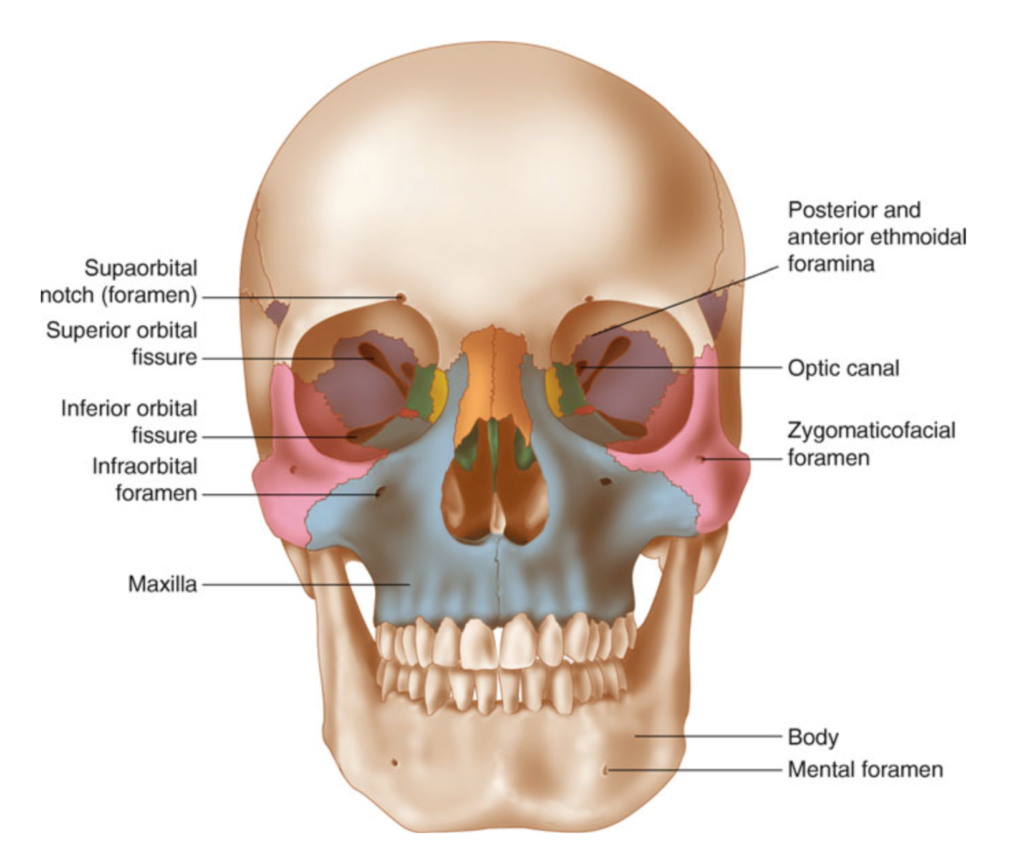
Maxillary fracture sign and symptoms, and management
swelling over maxilla
possible numbness if involvement of the infraorbital foramen and nerve
epistaxis (bleeding out of nose)
significant malocclusion of teeth and epistaxis with Le Fort fracture
How to manage if…
no malocclusion or epistaxis: RICE, ibuprofen, refer to physician within 24hrs
numbness present: referred for CT scan ASAP to determine proper care
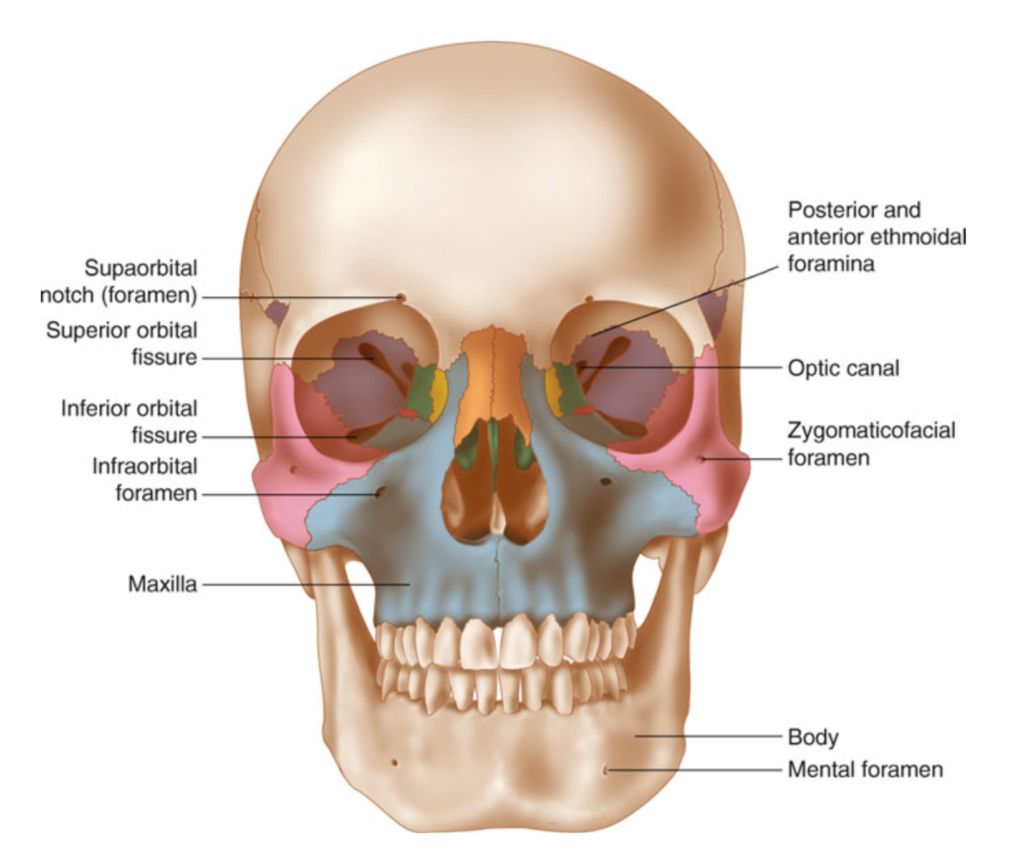
Zygomatic complex fracture mechanism of injury, sign and symptoms
usually forceful blow to area.
Pain and swelling
possible trismus (reduce opening of jaw)
possible numbness
there will not be an obvious deformity unless all three attachments to facial bones are fractured. if zygoma usually rotates downwards creating prominence of cheekbone if severe/obvious.
Zygomatic complex fracture management
Depends on the severity:
Obvious = immediate referral
fracture not displaced = RICE, ibuprofen, referral to physician within 24hrs is sufficient
Tooth subluxation (3), luxation, and avulsion: mechanism, sign and symptoms
Mechanism: blow to the mouth
subluxation -
slight looseness without misalignment
doesn’t “feel right”
sensitive to touch or biting
luxation - very loose and out place shifted forwards or backwards
avulsed - completely knocked out
Orbital fractures: mechanisms, sign and symptoms, management
blow to the eye creating eye to be pushed backwards into the socket. this creatss compressive force (possible fracture to surrounding structures)
limited eye mobility
diplopia
edema
affected eye appearing downwardly displaced
pain or numbness to area
management = immediate referral for advance medical care. most fractures require surgical repair and antibiotics
Tooth sublux/lux/avulsion management is dependent on the extent of injury. What are managements for each levels
Luxation = attempt to realign if easily moved & referred for immediate dental care
Avulsion = tooth rinsed clean but not scrubbed or scrapped, try to replant the tooth (sooner the better)
Regardless of if the tooth can be reimplanted or not, patient is referred for immediate dental care
Tooth avulsion injury: what solutions options to leave tooth in
Store tooth in patient’s saliva in a plastic bag, milk, saline, or inside patient’s mouth between cheek and gum
* The revised trauma scoring system is used for…what score requires treatment in trauma center?
to rapidly assess persons involved in trauma often done at scene of accident.
score of 11 and less requires treatment in trauma center. scores often used to predict patient outcomes.