BIOL 311 Topic 5 A
 Call Kai
 Learn
Learn Practice Test
 Spaced Repetition
 Match
Match Flashcards
 Knowt Play
1/60

There's no tags or description
Looks like no tags are added yet.
Name | Mastery | Learn | Test | Matching | Spaced | Call with Kai |
|---|
No analytics yet
Send a link to your students to track their progress
61 Terms
How does binary fission occur in prokaryotes?
The circular chromosome is replicated.
The two DNA copies attach to the cell membrane.
The cell elongates, moving the chromosomes apart.
A septum (new cell wall and membrane) forms between them.
The cell splits into two genetically identical daughter cells.
What is the difference between bacterial chromosomes and plasmids?
Chromosome = required for life.
Plasmid = bonus DNA that can provide useful traits.
Do all bacteria have plasmids?
No. All bacteria have a chromosome, but not all bacteria have plasmids.
What is a prototroph?
A prototroph is an organism that can synthesize all the compounds it needs for growth from a minimal medium.
What is an auxotroph?
An auxotroph is an organism that cannot synthesize a specific nutrient because of a mutation in a metabolic pathway.
What is minimal media?
Minimal medium is a growth medium that contains only the basic nutrients required for a prototroph to grow.
What is required for prototrophs vs autotrophs to grow?
Prototrophs grow on minimal medium.
Auxotrophs only grow if the nutrient they cannot make is added to the medium.
What is the major conceptual difference between a his⁻ mutant and a lac⁻ mutant?
his⁻ mutant: Cannot synthesize (make) an essential nutrient (histidine) → an auxotroph.
lac⁻ mutant: Cannot utilize (use) a nutrient (lactose) as a carbon source.
Is his- or lac- an auxotroph?
his- : only if the mutant can't make something it needs, it's an auxotroph.
How can growth for lac- be rescued?
Growth can be rescued by providing a different usable carbon source (e.g., glucose), not by adding more lactose.
How can you determine whether a bacterial strain is resistant or sensitive to streptomycin?
Minimal medium (control)
Minimal medium + streptomycin
Sensitive (Strˢ) bacteria: grow on minimal medium but do not grow on medium containing streptomycin.
Resistant (Strʳ) bacteria: grow on both minimal medium and medium containing streptomycin.
Does streptomycin resistant bacteria require it to be present for growth?
No. it is just able to grow with it present.
What is bacterial DNA exchange?
the process by which bacteria transfer genetic material to other cells rather than passing it down to their own offspring (within the same generation, movement/exchange of genetic information without sexual reproduction or cell division)
How does bacteria replicate? How is variation introduced to bacteria?
Bacteria reproduce asexually through binary fission, creating two genetically identical daughter cells. To introduce genetic diversity and evolve, bacteria share DNA through horizontal gene transfer
horizontal gene transfer vs vertical gene transfer
Vertical gene transfer is the passage of genetic material from parents to offspring through reproduction, while horizontal gene transfer is the movement of genetic material between independent, mature organisms
does bacteria undergo horizontal or vertical gene transfer
horizontal gene transfer
Describe bacteria exchange through conjugation
Conjugation is the direct transfer of DNA from a donor bacterium to a recipient bacterium through cell-to-cell contact via a pilus.
During bacterial conjugation, what is transferred?
either a small plasmid or a part of the bacterial genome (Hfr)
What is transformation in bacterial gene exchange?
Transformation is the uptake of free DNA from the environment or a dead bacterial cell and its incorporation into the cell.
How does a bacterium take up DNA during transformation?
A bacterium binds free environmental DNA with surface proteins and transports it through a DNA uptake channel.
How can bacteria be induced to take up DNA in the laboratory?
Bacteria can be forced to take up partial genomes using chemicals, heat shock, or electricity. These methods temporarily increase membrane permeability, allowing DNA to enter the cell.
Where does the free DNA used in bacterial transformation come from?
It usually comes from dead bacteria that have lysed and released their chromosomes and plasmids into the environment. Competent bacteria can then take up these DNA fragments before they are degraded.
Does transformation involve plasmids or chromosomal DNA?
Transformation can involve both. Plasmids are often taken up intact and replicate independently if they contain an origin of replication, while chromosomal DNA is usually taken up as fragments and must recombine with the bacterial chromosome to be maintained.
What is transduction in bacterial DNA exchange?
Transduction is the transfer of bacterial DNA from one bacterium to another by a bacteriophage (virus that infects bacteria).
What do viruses transfer during transduction?
During transduction, bacteriophages accidentally transfer chromosomal fragments or sometimes plasmid DNA.
What is the fertility (F) factor
a plasmid that gives the bacterial cell the ability to produce pili
Do both donor and recipient bacteria use pili during conjugation?
No. Only the donor cell (F⁺ or Hfr) produces and uses the sex pilus to initiate contact. The recipient cell does not use pili during transfer but may produce them after acquiring the plasmid.
How does the F factor differentiate between the donor and recipient?
F⁺ donor → has pilus genes → makes pilus
F⁻ recipient → no pilus genes → cannot make pilus
Can bacterial donor cells also act as recipients?
Yes. “Donor” and “recipient” describe roles in a specific gene transfer event, not permanent states. An F⁺ donor in conjugation can still receive DNA through transformation, transduction, or other conjugation events, making bacterial roles flexible.
Can an F⁺ bacterium act as a recipient and still have pili?
Yes. A bacterium can act as a recipient in DNA transfer (e.g., transformation, transduction, or Hfr recombination) and still retain its F plasmid. As long as it keeps the F plasmid, it remains F⁺ and can still produce sex pili and function as a donor in conjugation.
Are recipients always F-?
No. “Recipient” refers to any cell receiving DNA during a transfer event. While recipients in standard conjugation are usually F⁻ cells, F⁺ or Hfr cells can also act as recipients in transformation, transduction, or recombination events.
How are genes of interest transferred using the F plasmid?
A gene of interest is inserted into the F plasmid to create a recombinant plasmid. During conjugation, the plasmid is nicked at the origin of transfer and one strand is transferred to a recipient cell. Rolling circle replication in the donor replaces the missing strand while the recipient synthesizes the complementary strand, producing complete plasmids in both cells.
What is rolling circle replication (in bacterial conjugation)?
Rolling circle replication is a method of copying plasmid DNA during conjugation where one DNA strand is cut and a single strand is continuously peeled off and transferred to another cell. The original plasmid is simultaneously rebuilt in the donor, and the transferred strand is made double-stranded in the recipient, resulting in two complete plasmids
Which bacterial gene transfer processes require the F plasmid?
Only conjugation requires the F plasmid (either as a free plasmid in F⁺ cells or integrated in Hfr cells). Transformation and transduction do not require the F plasmid.
Which bacterial gene transfer process requires oriT?
Only conjugation requires oriT. It is the origin of transfer where plasmid DNA is nicked to initiate rolling circle replication and transfer between cells. Transformation and transduction do not use oriT.
Does an F⁻ cell always become F⁺ after conjugation?
No. An F⁻ cell becomes F⁺ only if it receives a complete F plasmid from an F⁺ donor. In Hfr conjugation, mainly chromosomal DNA is transferred, so the recipient usually remains F⁻.
What is an Hfr Strain?
a bacterial strain in which the F factor is integrated into the chromosome
Is Hfr formation natural, and is the entire F plasmid integrated?
Hfr cells form naturally when the entire F plasmid integrates into the bacterial chromosome via recombination between similar DNA sequences. This creates a chromosome containing the full F plasmid, allowing chromosomal gene transfer during conjugation starting from oriT. Scientists can also induce or select for Hfr strains, but they are fundamentally based on the same natural recombination event.
What is homologous recombination?
Homologous recombination is the exchange or integration of DNA between two DNA molecules with similar sequences. In bacteria, it allows incoming DNA from transformation, transduction, or conjugation to align with matching regions in the chromosome and replace or insert genetic material.
What happens in Hfr x F- cross?
None of the F- recipient strains are converted into F+ nor Hfr strains
The integrated F factor (in the Hfr strain) drives transfer of some of the bacterial chromosome, since the likelihood of transferring the whole chromosome is extremely low
The donor chromosomal fragment can recombine with the recipient chromosome
Where does DNA replication and transfer begin?
Where the F factor was integrated, at the origin of transfer
What is an exconjugant?
The cell that contains a fragment of donor DNA; has participated in conjugation
Explain step by step conjugation
transfer of single stranded DNA copy from donor to recipient
Transferred fragment converted into double helix forming an exconjugant
A double cross over inserts (switches) donor DNA and recipient DNA, excess DNA is lost
Why is linear DNA unstable in bacteria?
Linear DNA is unstable in bacteria because it has free ends that are easily degraded by exonucleases. As a result, linear DNA usually must recombine into the bacterial chromosome and degrade excess or be converted into a circular form to be maintained.
What is interrupted mating used for?
To determine the order of genes on a bacterial chromosome by stopping conjugation at different times, showing the ones that appear earlier to be closer to the F plasmid.
What does gene entry time tell you?
Genes that enter earlier are closer to the origin of transfer (oriT).
The earliest gene to appear = closest to the origin of transfer (oriT)
The later it appears = farther away
How do you determine gene order from interrupted mating data?
Rank genes by when they first appear in recipients: earliest = closest to origin.
Why do different Hfr strains give different gene transfer orders?
Because the F factor may be inserted at different locations and orientations
Why is a single Hfr strain insufficient to map the entire chromosome, why are multiple Hfr strains needed to map full chromosome?
A single Hfr strain only provides gene order relative to one transfer origin. Adding multiple will cause their overlapping transfer maps to be combined to reconstruct the entire circular chromosme.
Between what does recombination occur in bacteria
Recombination takes place between a complete genome and and incomplete genome
Exogenote vs endogenote
exogenote: partial genome
endogenote: complete genome
What must happen during recombination in order to keep the circular genome intact?
there must be an even number of recombination events as a single crossover cannot produce a viable recombinant as it creates a linear piece which cannot survive
Rule between closeness of genes and recombination
the closer two genes are together on the chromosome, the less likely a crossover event will occur between them
What is an early marker in Hfr mapping? What is a late marker in Hfr mapping?
A gene that enters the F⁻ cell first during conjugation because it is closest to the origin of transfer (oriT). A gene that enters the recipient later because it is farther from the origin of transfer.
Why are late markers less frequently found in recombinants?
Because conjugation often stops before the DNA segment carrying late genes is transferred.
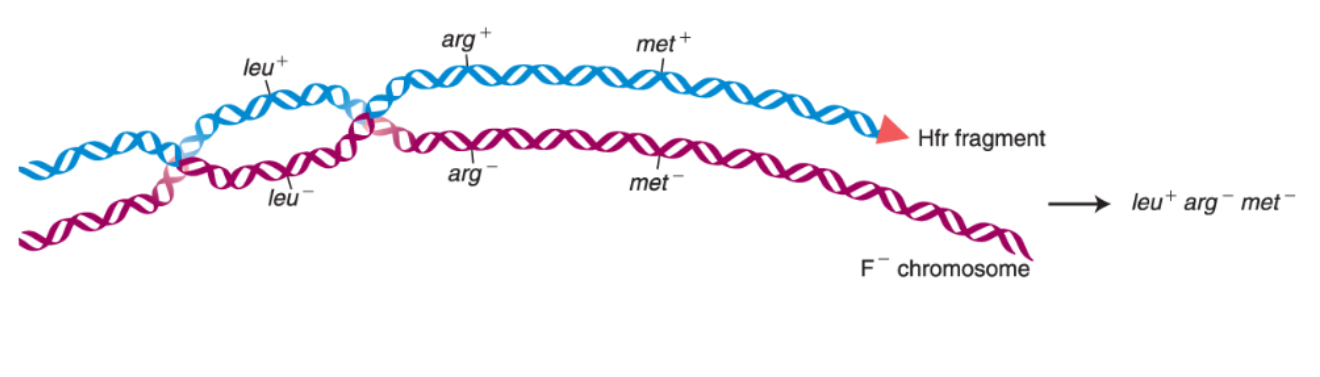
What is being inserted?
Insertion of late marker only
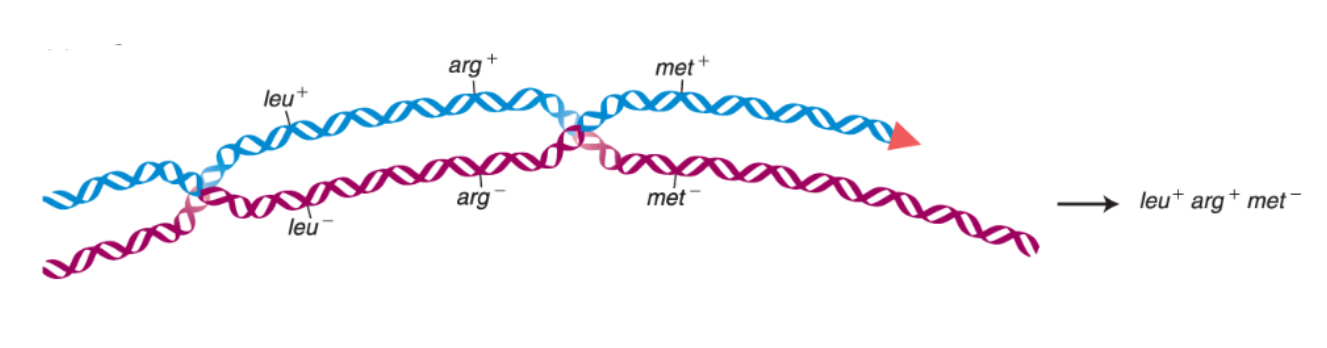
What is being inserted?
Insertion of late marker and one early marker
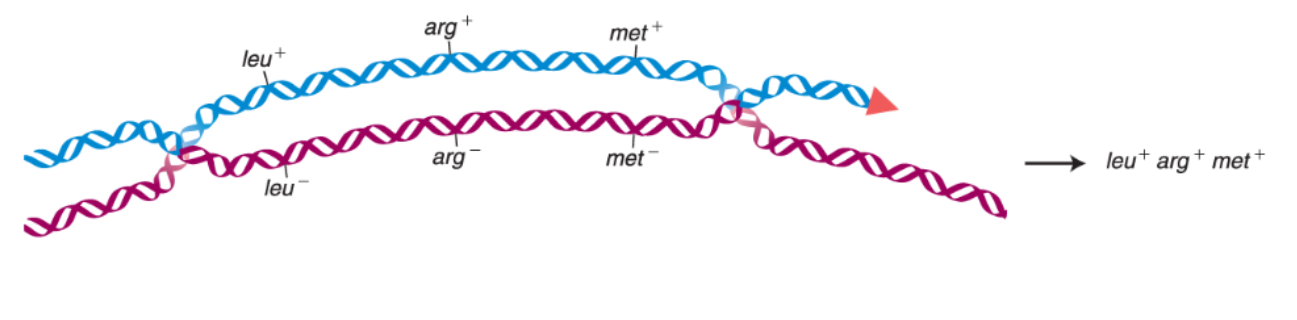
What is being inserted?
Insertion of all markers
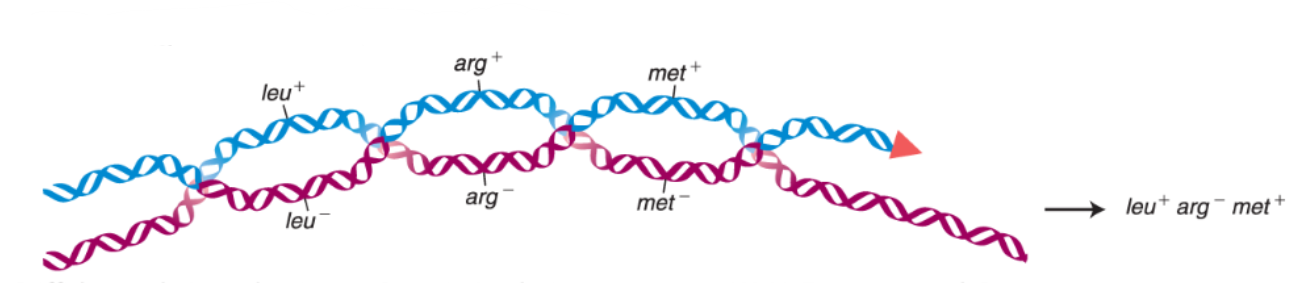
What is being inserted?
Insertion of late and early markers, but not of marker in between
What is the least common recombinant class and why?
insertion of an early and late marker, but not the marker in between, because DNA is transferred as a continuous segment. To retain the early and late markers while losing the middle marker requires multiple crossover events (or an unusual recombination pattern), making it much less likely than insertion of a single continuous DNA segment.
What is the most common recombinant class?
Insertion of all markers, because it can be produced by a simple double-crossover event that inserts one continuous donor DNA segment into the recipient chromosome. Recombinant classes that keep some markers but not others require additional or more specific crossover events and are therefore less frequent.