Eye witness testimony
 Call Kai
 Learn
Learn Practice Test
 Spaced Repetition
 Match
Match Flashcards
 Knowt Play
1/25

There's no tags or description
Looks like no tags are added yet.
Name | Mastery | Learn | Test | Matching | Spaced | Call with Kai | Chat |
|---|
No analytics yet
Send a link to your students to track their progress
26 Terms
what is eye witness testimony?
the evidence provided in court by a person who witnessed a crime, with a view to identifying the perpetrator of the crime
what is eye witness memory?
the ability of people to remember details of events, such as accidents and crimes, which they themselves have observed
what is misleading information?
incorrect information given to an eye witness usually after the event (post event info) which may lead to the altering of eye witness testimony
in what 2 ways can misleading information be shown?
leading questions
post event discussion
what is a leading question?
a question which, because of the way it is phrased, suggests a certain answer
what is post event discussion?
Occurs when there is more than one witness to an event and they discuss the event they have witnessed
This may influence the accuracy of the eyewitness memories - the discussion can contaminate or alter the original memory
what was the research into leading questions by Loftus and Palmer?
They did 2 experiments:
Experiment 1:
45 students
7 film of diff traffic accidents
Answered questionnaire and asked to describe incident, one critical q: how fast were the cars going when they 'hit' each other?
Given different verbs to describe the collision (e.g. collide, bump, smash etc.)
Findings (mean speed incident): smashed - 40.8 mph, contacted - 31.8 mph etc.
Experiment 2:
New set of Ps in 3 groups
Shown film of collision for 1 min
Again asked q's about speed
Ps returned one week later and asked another 10 q's
Crucial question: did you see any broken glass?
No broken glass in film but those who presumed car was travelling faster were more likely to say yes
Verb conditions | ||
| Smashed | Hit |
Yes | 16 | 7 |
No | 34 | 43 |
what were the 2 explanations to the results of Loftus and Palmer’s research into leading questions?
Response bias:
Memory remains unchanged
Ps just choose a different word - the leading question biases their word choice
Substitution explanation:
2nd part of Loftus and Palmer supports this
The info in the leading question changes the eye witnesses memory of the event
what was the research done by Gabbert et al. into post event discussion?
Ps in pairs where each member of pair watch a different video of same event so they viewed unique items
Pairs in one condition were encouraged to discuss the event before having to individually recall
Very high amount of witnesses (71%) who had discussed event went on to mistakenly recall items that weren't visible in their video during the discussion
No discussion before recall (control)- 0% compared to 71%
what are 2 explanations to the findings of Gabbert et al. research into post event discussion?
Memory contamination
Discussion between witnesses results in the original memories becoming altered or distorted
Ps combine info from their own and others accounts
Memory conformity
Witnesses go along with each other (NSI or ISI)
Desire to fit in/be right
In this case original memory is not altered
what is a real world application of leading questions that supports that it effects EWT?
P: practical uses in criminal justice system
E:
juries place high value on EWT
Important that they know the effect of leading questions and post event discussion on the accuracy
Police officers need to know their effect of phrasing questions
T: therefore it is clear that this research has important implications (socially sensitive research) for society and can be used to improve the legal system
what is some evidence that leading questions can make some parts of memory more accurate? (refutes idea that leading questions just produce misleading info)
P: eye witness testimony is more accurate for some aspect of an event than for others
E:
Researcher showed Ps a video clip
When Ps asked misleading questions their recall was more accurate for central details of the event than peripheral ones
Presumably Ps attention more focused on central features and those memories were relatively resistant to misleading info
T: Suggests the original memories for central details survived and were not distorted, so shows there is more to it than just leading questions
what is an evaluation point about methodological issues with research into misleading info?
P: Practical implications may be affected by methodological issues with research
E:
Lab vs real life - lack mundane realism and ecological validity
Film clips so no consequences so less motivation for accuracy
Lack of stress/anxiety
Know they are in experiment - demand characteristics
T: lab studies may overemphasize inaccuracy of eye witness testimony - may be more reliable in teal life situations
what is some evidence to refute the memory conformity explanation (AO3 point)?
P: Limitation of the memory conformity explanation is evidence that post event discussion actually alters eye witness testimony
E:
Researchers showed Ps video clips
2 versions e.g. muggers hair in one was dark brown and light brown in the other
Ps discussed the clips in pairs, having seen different versions
Often did not report what they had seen in the clips or what they had hear from their co witness but instead a blend of the 2 (e.g. common answer to hair q was medium brown rather than light or dark)
T: suggests the memory itself is distorted through contamination by misleading post event discussion, rather than a result of memory conformity
what is anxiety?
the unpleasant emotional state with increased physiological and emotional arousal
what is the name of the diagram that shows how arousal affects performance and what does the graph look like?
Yerkes - Dodson effect
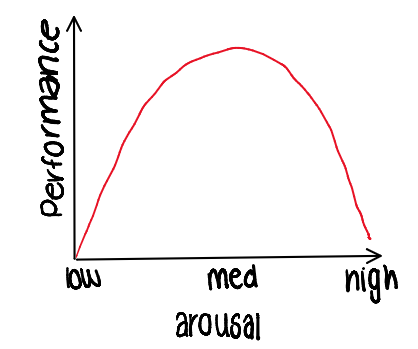
what tasks are more resistant to stress and what tasks are more likely to be affected by stress?
well practised tasks are more resistant to stress
new or challenging tasks are more negatively affected
what was the research into anxiety’s negative effect on EWT? (Johnson and Scott)
They theorised that EWT accuracy may be reduced due to something called weapon focus effect
Asked Ps to sit in waiting room
Ps could hear a heated argument in a room next to them
Then they saw a man run through the waiting room either carrying a pen covered in grease (low anxiety condition) or man carrying knife covered in blood (high anxiety, weapon focus condition)
Ps later asked to recognise man from a series of photos
Findings: 49% in pen condition could identify man, only 33% in knife condition
what is weapon focus effect?
view that a weapon in a criminal’s hand distracts attention (due to anxiety) from other features and therefore reduces the accuracy of identification
what did Loftus do to study eye movements in anxiety during EWT?
monitored eyewitnesses eye movements
found that the presence of a weapon caused attention to be physically drawn to the weapon itself and away from other things like the persons face
what is a counter study which refutes the weapon focus affect? (PET)
P: Research challenges the attention-shift explanation of the weapon focus effect.
E:
Researchers examined attention during a robbery scenario where Ps saw a man holding either a gun or a phone.
Eye-tracking recorded where Ps focused their attention.
Findings showed observers focused mainly on the people rather than the weapon or phone, and recall of the perpetrator’s appearance was not reduced in the gun condition.
T: This suggests the presence of a weapon may not automatically draw attention away from the perpetrator, so the attention-shift explanation of the weapon focus effect may lack validity.
what is a study that criticises the weapon focus affect and comes up with a new explanation for it? (PET)
P: researcher proposed reduced identification could be due to surprise not anxiety
E:
Ps watched thief enter hairdressing salon carrying scissors (high threat, low surprise), handgun (high threat, high surprise), wallet (low threat, low surprise) or a whole raw chicken (low threat, high surprise)
Identification was least accurate in high surprise conditions than high threat
T: Suggests reduced accuracy could be due to the unusualness of what is recalled, rather than higher arousal levels
what is the methodology of the key study to suggest anxiety increases accuracy of EWT?
Christianson and Hubinette
Questioned 58 real witnesses to bank robberies
Witnesses were either victims (bank tellers) or bystanders (customers) i.e. high and low anxiety retrospectively
Interviews conducted 4-15 months after event
what were the results of Christianson and Hubinette’s research into anxiety improving accuracy of EWT?
Researchers found all witnesses showed good memories of details of robbery itself (better than 75% accurate recall)
Witnesses who were most anxious (victims) had best recall of all
Study shows generally shows that anxiety doesn't reduce accuracy of recall
what is one good thing and one bad thing about Christianson and Hubinette’s research into anxiety increasing accuracy in EWT?
Good ecological validity as it was in a real life situation
However, interviews 4-15 months after - likely post event discussions had happened and everyone had the same type of story
what is an evaluation point for Christianson and Hubinette’s research into anxiety increasing accuracy of EWT?
P: Individual differences may affect the accuracy of eyewitness testimony (EWT).
E: Ps were classified as either ‘neurotic’ (more anxiety-sensitive) or ‘stable’ (less emotionally sensitive). Results showed stable Ps became more accurate as stress increased, whereas neurotic Ps became less accurate. Another researcher suggested small effect sizes in anxiety studies may occur because high and low accuracy scores are averaged together.
T: This suggests anxiety does not affect all witnesses in the same way, so individual differences are important when explaining the relationship between stress and EWT accuracy.