1. Dynamics of Food Quality
 Call Kai
 Learn
Learn Practice Test
 Spaced Repetition
 Match
Match Flashcards
 Knowt Play
1/26

There's no tags or description
Looks like no tags are added yet.
Name | Mastery | Learn | Test | Matching | Spaced | Call with Kai | Chat |
|---|
No analytics yet
Send a link to your students to track their progress
27 Terms
Perceiving food quality
Food products as such have no quality
Products have properties which are perceived by the consumer as quality
Made up of physical processes happening in the mouth and psychological processes in the brain.
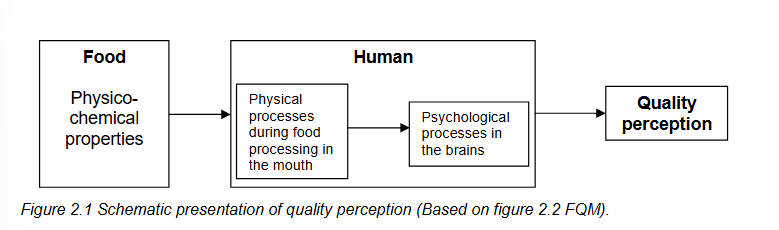
What is perceived quality made up of?
The physical processes occur when one puts food in the mouth
The psychological processes start when the physical stimuli, iniated by the food, change into neural responses.
Both physical and psychological processes are dynamic and differ form person to person.
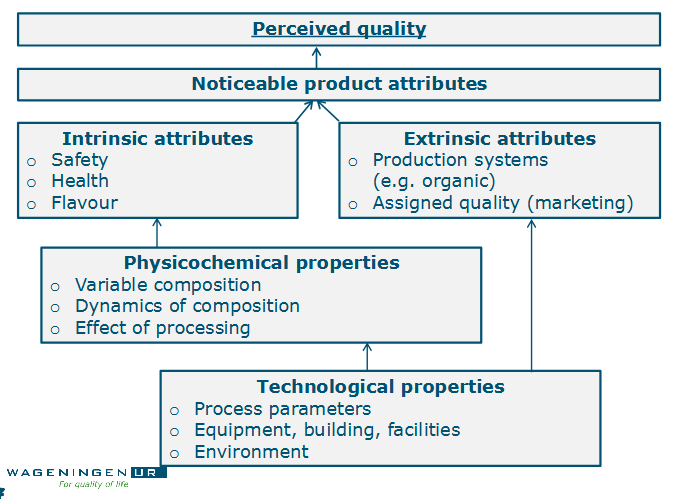
Intrinsic attributes
Are inherent to the physical product
These attributes can be noticeable (e.g. taste or texture) or otherwise objectively determined (e.g. safety or health)
They are the result of physicochemical and other properties of the product (e.g. pH, microbial load).
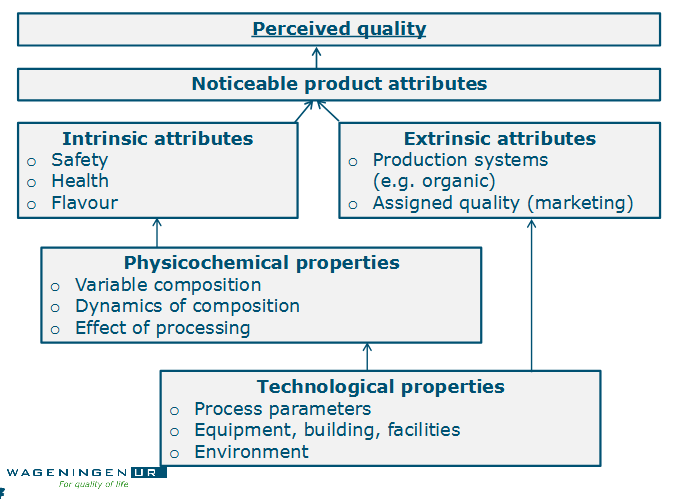
Extrinsic attributes
Do not necessarily have a direct relationship with the product properties, although they can still change the perception of the consumer of the quality of the product.
These extrinsic attributes relate to the production and marketing aspects of the product and can therefore influence the acceptability of the product (e.g. animal welfare, sustainability).
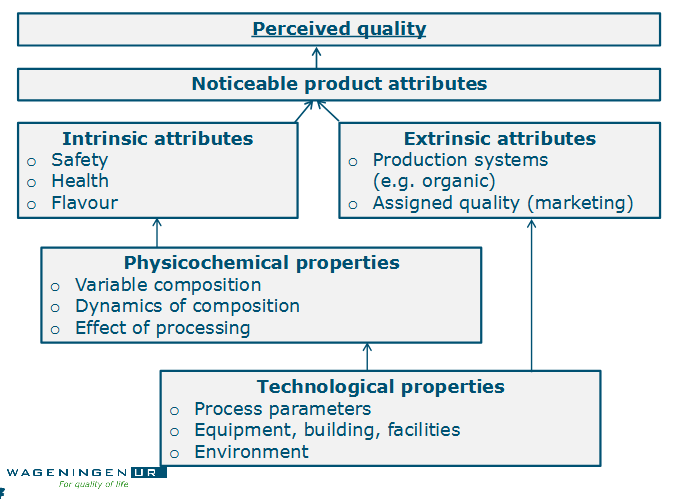
Physicochemical properties and technological properties
influences both intrinsic and extrinsic quality attributes
Moreover, the personnel involved in food product affect the technological properties by their behavior (e.g. hygienic behavior, quality control behavior)
Additionally the legislation affects quality attributes by putting restrictions and requirements on the product properties, technological properties, and managerial aspects.
Legislation can also directly influence the quality attributes, or example by the requirements for labelling of health claims.
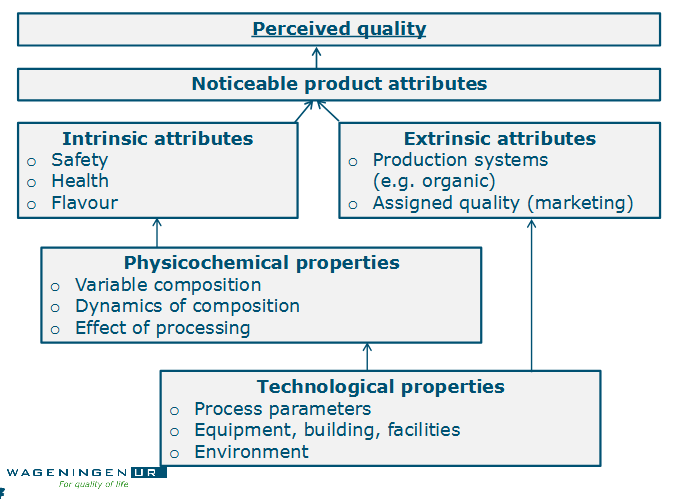
What is important to ensure quality of food?
Depending on their position in the food chain, different actors may have different concepts and requirements of quality
Consumers judge product quality based on the whole range of quality attributes: they usually do not judge quality based only on physicochemical properties of the product, like vitamin concentration: they judge produt in terms of “safe” or “healthy”
Mavlow’s hierachy of needs
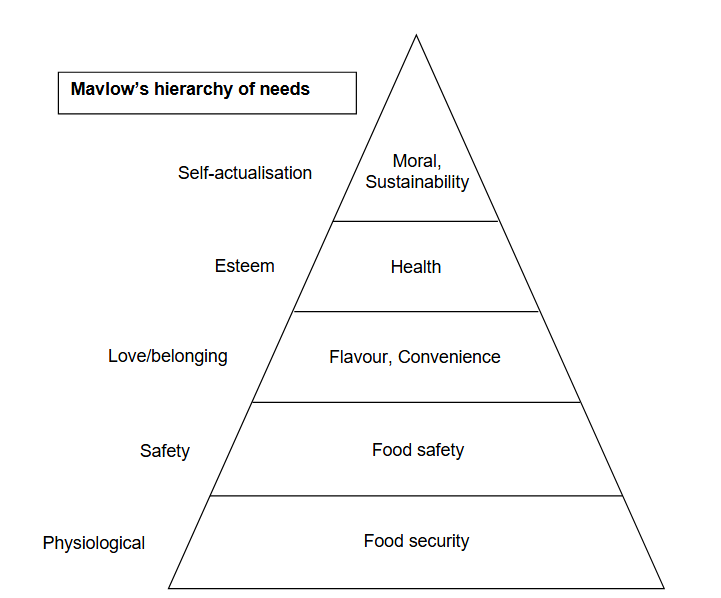
Food properties: Safety
Safety: absence of hazards
Risk: chance of presence of hazard & severity of harm
Acceptable risk?
Can be microbial, chemical or physical
Biological hazards
mainly involve microbes which grow or survive in foods
Two routes in which biological hazards may cause a risk to food safety
Pathogens themselves can cause illness upon ingestion: infection (e.g. Salmonella, E. coli and Listeria)
Pathogens can produce toxins while present in food: food intoxication. (e.g. Clostridium)
Chemical hazards
Chemicals in food product that provoke adverse reactions in consumers
Two groups:
Food sensitivities (to which specific individuals are vulnerable)
Consists of allergies and intolerances.
Allergy = immunological response to protein in food
Intolerance = All other non-immunological reactions to components in food
Food intoxicants (to which everyone who consumes the food is vulnerable)
Physical hazards
Can be defined as physical objects, normally not present in food products, which could harm the consumer
Can be distinguished between radioactive and non-radioactive hazards
Radioactive contaminants are very uncommon and are usually invisible to the consumer, very harmful, low chance
Non-radioactive contaminants is a group containing a wide range of hazards. It can refer to mineral physical hazards (e.g. soil, stones, jewellery), plant-derived (e.g. weeds, leaves and stems) and animal derived (e.g. insects, rodents, fish bones)
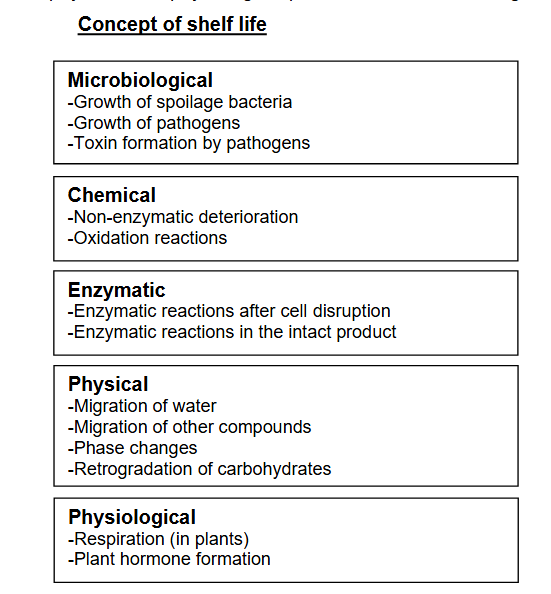
Food properties: Shelf life
Shelf life: time between production & point at which it is no longer fit for consumption
Shelf life is the time during which the product will:
Remain safe
Keep desired characterisitcs with respect to:
Sensory
Chemical
Physiological
Microbiological characteristics
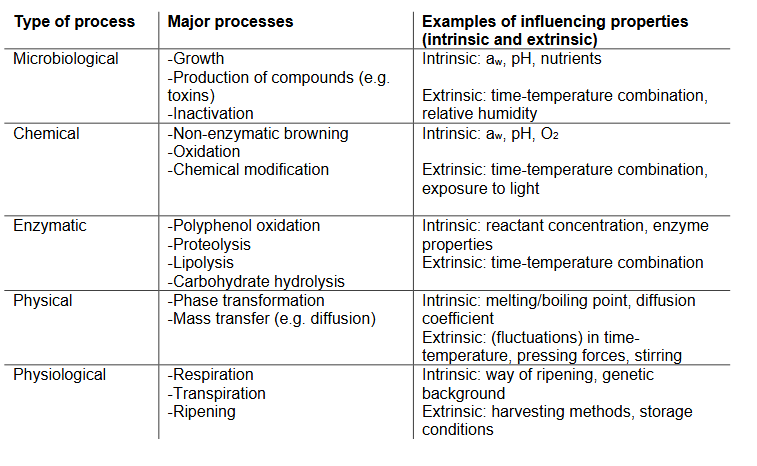
The different processes may occur at the same time and may interact.
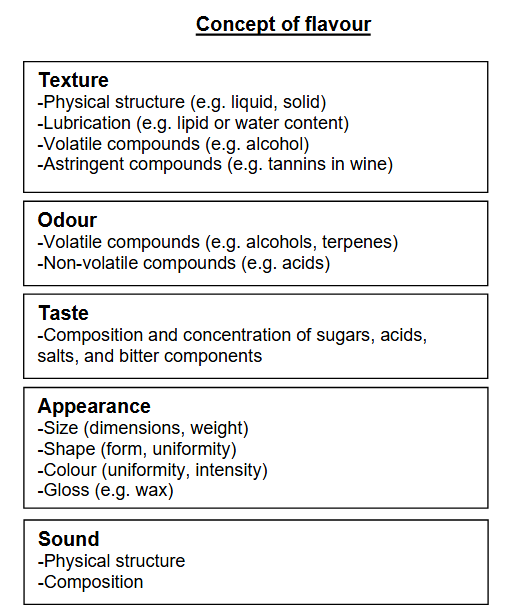
Food properties: flavor
Safety & shelf life are often taken for granted, whereas flavor is an essential element in satisfaction with a product
Flavor is defined here as the total sensory impression of a food
Flavor is observed with all five senses: sight, smell, touch, taste, hearing
Food properties: convenience
Convenience is related to ease-of-use
Convenience is a product attribute that can be determined upon buying, preparing or consuming the product.
Related to packaging, but also pre-processing so that preparation at home can be convenient.
Food properties: health
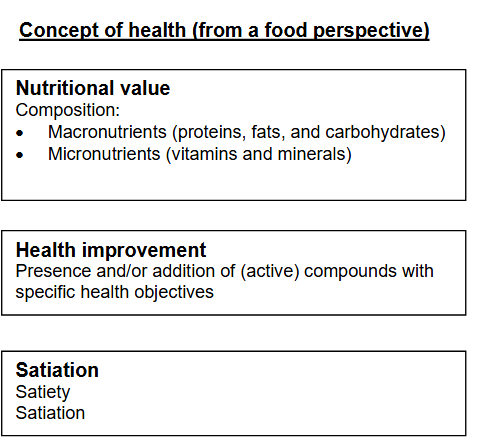
Starts from basic need of macro- and micronutrients
Also related to health-promoting/bio-active ingredients
As overeating is a major problem nowadays, also satiety/satiation is important for the consumers’ health
The consumer has to trust in the healthiness of the product, as this cannot be established before, during, or shortly after consumption like the other attributes.
Food properties - extrinsic attributes
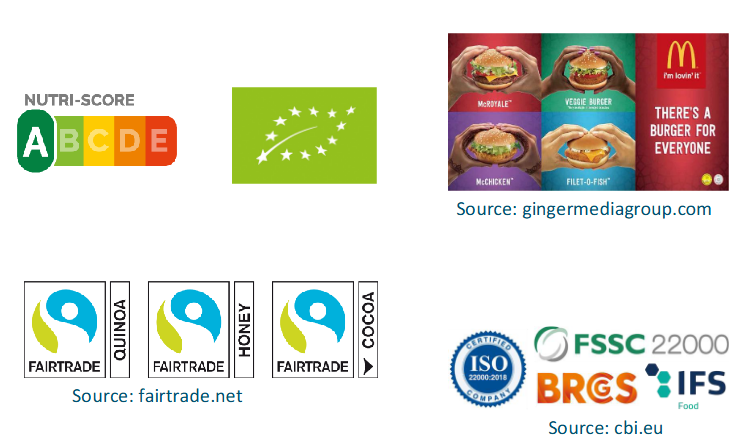
“Overall, there was no change in liking or quality perception based on the fair trade or organic information of the product. However, for the subgroup of participants which had a positive attitude towards fair trade and organic product, the information given about the pineapple pieces did have a stronger impact on the flavour of the product, whereas the opposite was true for participant with a negative attitude towards fair trade and organic products. This shows the complex relation between extrinsic quality
attributes and perceived food quality.”
What is assigned quality (or attributed quality)?
Quality that is ascribed to a product by communication (e.g. by labelling or advertisement).
The quality as perceived by the consumer can be affect by the assigned quality, although it is not necessarily related to the physicochemical properties of a food product.
What are the three aspects of food quality?
Linking properties of to food quality
Dynamics of food quality (food quality is not constant!)
Food quality throughout the production chain
What are the five types of dyanmic food processes?
Primary production - animal production (farming practices)
The three main quality influencing factors for animal production are farming practices, transport, and slaughtering.
"Farming practices" is a term covering a lot of different parameters describing the conditions on the farm. Factors like safety and flavor are strongly influenced by the farming practices.
Some of the conditions on the farm influencing final product quality are breed, keeping, feed and animal health.
“Breed” influences the quality attributes of the product (e.g. milk or meat). For example, different cow breeds all produce milk with a different composition.
“Keeping” situation of the animal can also influence quality in terms of hygiene. Problems with hygiene can lead to food safety/shelf life problems. (e.g. udder cleanliness)
“Feed” Influences the quality of the animal product through the amount as well as the quality of the feed given to the animal.
The amount and quality of milk/eggs/meat produced by an animal is directly related to the feeding regime on the farm.
“animal health” can influence the quality of animal products. E.g. mastitis (udder infection) in cows will signficantly reduce both the quantity and quality of the milk produced.
Primary production - animal production (Transport and slaughtering)
Transport of live animals is an important step, because stress of animals will significantly impact the quality of the meat.
Also stress during slaughtering can cause quality problems.
This stress can be reduced during transport by easy climbing into the truck, medium journeys (not too short, not too long) so that the animals have time to calm down.
Hygiene in the slaughterhouse is also important for food safety.
Primary production - vegetable production
Three important steps in vegetable production are the cultivation, harvesting practices and post-harvest practices.
“cultivation” The choice of seed to cultivate can depend on what can grow best in local area or on consumer demands.
The quality of cultivation depends on timing, supply of nutrients through fertilization, supply of water, use of herbicides and pesticides
“harvesting practices” Harvest time and mechanical injury are two important aspects of the harvesting process which should be well controlled to have an optimal product quality.
Harvesting should occur at right maturity, mechanical injury can occur during harvest.
“Post-harvest practices” refer to practices in both transportation and storage that take place after harvesting the fruits and vegetables
Food processing factors
Storage of raw materials
Processing
Preparation
Fermentation
Separation & combination
Heating
Evaporation and drying
Extrusion
Food processing - process
Preparation: Includes sorting, cleaning, cutting. Hygienic design of preparation process is imporant
Fermentation: When beneficial microbes grown in the food product. Increases shelf life, changes flavor and other quality attributes.
Separation & combination: When food is split in ingredients or ingreidients are added to foods.
Heating: Ensures the safety of the consumer and increases shelf life.
Evaporation & drying: stabilizes the food. Aims at reducing growth of bacteria, but may also be used to limit degradation reactions.
Extrusion: Used for e.g. pasta and is a combination of heating and drying.
Three aspects of packaging
Protection: food product should be protected against unwanted contamination from the environment.
Convenience
Labelling
Retial & consumer
Critical factors at the retailer which influence the product quality are time-temperature of storage, and hygienic conditions.
After buying the food product, the control over the treatment is in the hands of the ocnsumer.
List of intrinsic food quality attributes
Health
Convenience
Flavor
Shelf life
Food safety