Sustainable Agriculture 2
 Call Kai
 Learn
Learn Practice Test
 Spaced Repetition
 Match
Match Flashcards
 Knowt Play
1/243

There's no tags or description
Looks like no tags are added yet.
Name | Mastery | Learn | Test | Matching | Spaced | Call with Kai |
|---|
No analytics yet
Send a link to your students to track their progress
244 Terms
Definition of Land
Land has a broader meaning than soil
It includes all natural resources contributing to production:
Climate
Water resources
Landforms
Soil
Vegetation (forests + grasslands)
Conceptual Understanding
Land is a complex, integrated system rather than a single entity
Agricultural productivity depends on the interaction between its components
Example: rainfall influences nutrient leaching, vegetation cover affects erosion, and landform affects water drainage
Functional Perspective
Land can be divided into:
Biophysical components → soil, water, climate
Biological components → plants, animals
These components collectively determine:
Crop productivity
Ecosystem stability
Resource sustainability
Sustainable Land Management (SLM)
Definition
Sustainable Land Management refers to the use of land resources (soil, water, plants, animals) to:
Meet human needs
Maintain long-term productivity
Preserve environmental functions
Core Components
Productive use → agriculture, livestock, forestry
Sustainability → long-term maintenance of land potential
Environmental protection → conservation of soil, water, and biodiversity
Integrated Approach
SLM operates through a balance of three interconnected dimensions:
Environmental → preventing soil degradation, conserving biodiversity
Economic → ensuring land use remains profitable
Social → supporting livelihoods and long-term community needs
Mechanisms Involved
Maintains soil fertility through nutrient cycling
Reduces erosion and land degradation
Improves water management and retention
Enhances biodiversity and ecosystem resilience
Major Functions of Soil
1. Foundation of Life
Supports plant growth by:
Providing nutrients
Offering physical anchorage
Forms the basis of food, fiber, and fuel production
2. Water Regulator
Filters contaminants
Stores and releases water
Controls infiltration and runoff
3. Climate Stabilizer
Acts as a major carbon sink
Stores large amounts of organic carbon, helping regulate atmospheric CO₂
4. Biodiversity Hub
Hosts ~25% of global biodiversity
Includes microorganisms, fungi, insects, and soil fauna
Drives processes like decomposition and nutrient cycling
5. Cultural and Economic Importance
Supports livelihoods (farming, forestry)
Shapes landscapes and human settlements
Land Degradation
Definition
Land degradation is the temporary or permanent decline in the productive capacity of land
Scope
It includes:
Soil degradation
Damage to water resources
Deforestation
Decline in rangeland productivity
Types of Impacts
Physical → erosion, compaction
Chemical → nutrient loss, salinity
Biological → loss of organic matter and microbial life
Global Scale of Land Degradation
Definition (Extended)
A long-term decline in land’s ability to provide ecosystem services
Global Impact
~1.7 billion people live in areas where yields are reduced by ≥10% due to degradation
Regional Pattern
Asia is most affected
High population density
Accumulated environmental pressure
Scope of Land Degradation
1. Soil Degradation
Physical breakdown (erosion, compaction)
Loss of structure and porosity
Reduced water infiltration
2. Water Resource Degradation
Reduced water quality
Altered hydrological cycles
Increased runoff and flooding
3. Vegetation Loss (Deforestation)
Removal of protective plant cover
Exposure of soil to erosion
Disruption of nutrient cycling
4. Rangeland Degradation
Decline in grazing capacity
Loss of vegetation cover
Reduced livestock productivity
Types of Degradation Processes
Physical Degradation
Soil erosion (water/wind)
Compaction → reduced pore space
Crusting → prevents water infiltration
Chemical Degradation
Nutrient depletion
Salinization
Acidification
Biological Degradation
Loss of soil organic matter
Decline in microbial activity
Reduced nutrient cycling
Degradation Debt
Definition
Accumulated environmental damage that exceeds natural recovery capacity
Mechanism
Continuous exploitation without restoration leads to:
Soil nutrient exhaustion
Carbon loss
Reduced regeneration ability
Degradation Debt: System-Level Understanding
Land degradation is:
Cumulative → builds over time
Non-linear → sudden collapse after thresholds
Intergenerational → affects future productivity
Degradation debt locks ecosystems into reduced productivity states even if current practices improve.
Drivers of Land Degradation
Unsustainable Agriculture
Deforestation
Overgrazing
Poor Irrigation Practices
Drivers of Land Degradation: Unsustainable Agriculture
Practices
Intensive tillage
Monocropping
Excessive fertilizer and herbicide use
Removal of crop residues
Mechanisms
Tillage → breaks soil aggregates → increases erosion
Monocropping → reduces biodiversity → pest buildup
Chemical overuse → disrupts soil pH and microbiome
Organic matter loss → reduces water retention and fertility
Outcome
Decline in soil structure, fertility, and biological activity
Drivers of Land Degradation: Deforestation
Process
Removal of trees and vegetation
Effects
Loss of root systems → reduced soil binding
Increased runoff → higher erosion rates
Reduced evapotranspiration → altered local climate
Long-Term Impact
Loss of carbon storage
Reduced soil organic matter
Drivers of Land Degradation: Overgrazing
Mechanism
Excess livestock pressure removes vegetation cover
Effects
Soil compaction:
Reduced pore space
Poor aeration
Reduced infiltration
Exposure of soil → increased erosion
Advanced Outcome
Desertification in arid regions
Drivers of Land Degradation: Poor Irrigation Practices
Waterlogging
Excess water fills soil pores
Reduces oxygen availability → root suffocation
Salinization
Evaporation leaves salts behind
Salt accumulation disrupts plant water uptake
Mechanism
Improper drainage
Over-irrigation
Drivers of Land Degradation: Interactions Between Drivers
Example:
Deforestation + overgrazing:
→ rapid loss of vegetation
→ severe erosion
→ desertificationIntensive farming + poor irrigation:
→ nutrient loss + salinity
→ rapid decline in productivity
Effects of Land Degradation: Types of Effects
On-Site Effects (Local Impacts)
Off-Site Effects (External Impacts)
Land Degradation: On-Site Effects (Local Impacts)
Definition
Effects that occur directly on the degraded land itself
Key Outcomes
Reduced crop yields
Reduced livestock productivity
Decline in soil fertility
Increased need for inputs (fertilizers, irrigation)
Mechanism
Loss of topsoil → nutrient depletion
Soil structure breakdown → poor root growth
Reduced organic matter → lower microbial activity
Implication
Farmers compensate by:
Increasing fertilizer use
Expanding land use
This can further accelerate degradation (feedback loop)
Land Degradation: Off-Site Effects (External Impacts)
Definition
Effects that occur away from the original degraded site
Water Erosion Effects
Sedimentation of rivers and reservoirs
Decline in water quality
Alteration of water flow patterns
Wind Erosion Effects
Overblowing (transport of soil particles)
Deposition of sand in:
Agricultural land
Infrastructure
Settlements
Water Erosion
Water erosion is the removal of soil by water action, especially rainfall and runoff
Water Erosion: Sheet Erosion
Description
Uniform removal of a thin layer of topsoil over a large area
Characteristics
Often not easily visible
Occurs gradually
Mechanism
Rainfall impact loosens soil particles
Surface runoff carries them away
Impact
Loss of fertile topsoil
Reduction in soil nutrients
Water Erosion: Rill Erosion
Description
Formation of small channels (rills) due to concentrated runoff
Characteristics
Channels up to ~0.3 m deep
More visible than sheet erosion
Mechanism
Water concentrates into small streams
Gains energy → cuts into soil
Progression
If rills deepen (>0.3 m), they develop into gully erosion
Water Erosion: Consequences
Loss of nutrient-rich topsoil
Reduced water retention
Decline in agricultural productivity
Water Erosion (Gully Erosion)
Definition
Gully erosion occurs when runoff water becomes highly concentrated and powerful enough to remove large volumes of soil, forming deep channels (gullies)
Formation Mechanism (Gully Erosion)
Rainfall generates surface runoff
Runoff concentrates into channels
Increased velocity → higher erosive power
Soil particles are detached and transported
Channels deepen and widen into gullies
Characteristics
Typically deeper than 0.3 m (distinguishes from rill erosion)
Can reach depths of 10–15 m
Highly visible and destructive
Wind Erosion
Definition
Wind erosion is the removal and transport of soil particles by wind, primarily in dry and arid regions
Conditions Favoring Wind Erosion
Dry, loose, and light-textured soils (e.g., sandy soils)
Lack of vegetation cover
Strong winds
Drought conditions
Overgrazed land
Wind Erosion Mechanism
Wind erosion occurs in three stages:
Detachment → soil particles loosened
Transport:
Suspension (fine particles carried far)
Saltation (particles bounce along surface)
Surface creep (larger particles roll)
Deposition → particles settle elsewhere
Soil Fertility Decline
Definition
Soil fertility decline refers to the deterioration of soil’s physical, chemical, and biological properties, reducing its ability to support plant growth
Core Components of Soil Fertility Decline: Physical degradation
A. Physical Degradation
Loss of:
Soil structure (aggregation)
Porosity and aeration
Water holding capacity
Mechanism
Decline in organic matter → weaker aggregates → compaction
Leads to:
Reduced root penetration
Increased runoff and erosion
Add-on (impressive)
Bulk density ↑ → root growth ↓
Infiltration rate ↓ → surface crusting
Core Components of Soil Fertility Decline:
Core Components of Soil Fertility Decline: Chemical Degradation
Includes:
Macronutrient depletion (N, P, K)
Micronutrient deficiencies (Zn, Fe, etc.)
Nutrient imbalances
Toxicities
Acidification due to improper fertilizer use
Can lead to:
Aluminum toxicity (in acidic soils)
Reduced nutrient availability
Add-on (impressive)
“Nutrient mining” → continuous cropping without replenishment
Cation exchange capacity (CEC) declines with organic matter loss
Core Components of Soil Fertility Decline: Biological Degradation
Decline in:
Soil microbial biomass
Enzymatic activity
Soil fauna (earthworms, etc.)
Why this matters
Microbes drive:
Nutrient cycling (N mineralization)
Organic matter decomposition
Add-on (impressive)
Reduced microbial diversity → lower ecosystem resilience
Disrupts soil food web dynamics
Central Role of Soil Organic Matter (SOM)
Key Insight
SOM decline is the primary driver of fertility loss
Functions of SOM
Improves:
Soil structure (aggregation)
Water retention
Nutrient holding capacity
Supports:
Microbial activity
Causes of Soil Fertility Decline
Direct Causes
Continuous cropping (no fallow)
Overuse or misuse of fertilizers
Removal of crop residues
Lack of organic amendments
Indirect Causes
Erosion (removal of topsoil)
Monocropping systems
Poor land management practices
Waterlogging
Waterlogging = reduction in land productivity due to rise of groundwater close to or above the soil surface
Severe case:
Ponding → water accumulates on the surface
Soil shifts from aerobic → anaerobic system
This fundamentally alters:
Microbial processes
Nutrient availability
Waterlogging Core Mechanism
Stepwise Process
Excess irrigation / poor drainage
Groundwater table rises
Soil pores fill with water
Oxygen availability drops (anaerobic conditions)
Root respiration is inhibited → plant stress
Waterlogging Effects on Soil and Plants
A. Plant-Level Effects
Reduced root respiration (O₂ deficiency)
Root rot and poor root development
Nutrient uptake declines
B. Soil-Level Effects
Loss of soil structure
Reduced microbial activity (aerobic microbes die)
Build-up of toxic reduced compounds:
Fe²⁺, Mn²⁺, H₂S
C. Productivity Effects
Lower crop yields
Reduced land usability
Waterlogging Causes
Primary Causes
Poor irrigation management
Lack of drainage systems
Canal seepage
Over-irrigation
Secondary Causes (Impressive)
Clay-heavy soils (low permeability)
Flat topography (poor runoff)
Salinization
1. Definition
Salinization = accumulation of soluble salts in soil to levels that reduce productivity
Broadly includes:
Salinization (strict sense) → buildup of neutral salts
Sodification (alkalization) → dominance of sodium (Na⁺) on soil exchange sites
Salinization is essentially a water balance problem:
When evaporation > leaching, salts accumulate
Core Mechanism Salinization
Primary Process
Irrigation water contains dissolved salts
Water infiltrates soil
Evaporation removes water
Salts remain and accumulate in root zone
Lowering of the Water Table
Lowering of the water table = decline in groundwater level due to extraction exceeding natural recharge capacity
Typically occurs in areas with non-saline (“sweet”) groundwater
Core Mechanism (Stepwise) Lowering of the Water Table
Excessive groundwater extraction (e.g., tubewells)
Recharge (rainfall/infiltration) is insufficient
Groundwater levels progressively decline
Aquifer depletion occurs
This is a negative water balance system:
Extraction > recharge → depletion
Conservation Agriculture
1. Definition
Conservation agriculture (CA) = a sustainable farming system based on minimal soil disturbance, permanent soil cover, and crop diversification
Goal:
Improve resource-use efficiency
Maintain long-term productivity
The Toolbox for Sustainable Land Management]: Key principle
Sustainable land management (SLM) relies on a set of practical techniques to:
Prevent land degradation
Restore degraded land
Maintain long-term productivity
Key Objectives of the Toolbox
SLM practices aim to:
A. Enhance Soil Organic Carbon (SOC)
Improves:
Soil fertility
Structure and aggregation
Water retention
B. Reduce Soil Erosion
Protects:
Topsoil (nutrient-rich layer)
Prevents:
Loss of productivity
C. Improve Water Retention
Increases:
Soil moisture availability
Reduces:
Drought stress
D. Promote Biodiversity
Supports:
Soil microbes
Plant diversity
Enhances ecosystem resilience
The Three Core Principles of Conservation Agriculture
A. Minimum Soil Disturbance (No-till / Reduced tillage)
B. Permanent Soil Cover
C. Crop Diversification
Minimum Soil Disturbance (No-till / Reduced tillage)
A. Minimum Soil Disturbance (No-till / Reduced tillage)
Soil is not ploughed extensively
Seeds/fertilizers placed directly into soil
Why it matters
Preserves soil structure
Reduces erosion
Maintains soil microbial habitats
B. Permanent Soil Cover
Use of:
Crop residues
Cover crops (≥30% soil cover)
Functions
Protects against:
Rain impact (erosion)
Evaporation
Maintains:
Soil moisture
Organic matter
C. Crop Diversification
Crop rotation or intercropping
At least three different crops in sequence
Benefits
Breaks pest and disease cycles
Improves soil fertility
Enhances biodiversity
Poverty Trap in Land Use
The poverty trap refers to a self-reinforcing cycle where land degradation and low agricultural productivity prevent communities from escaping poverty
This is a positive feedback loop:
Degradation → lower yields → more pressure → more degradation
Poverty Trap in Land Use Mechanism
Population pressure increases
Farmers intensify land use (more cropping, less fallow)
Fallow periods become too short
Soil fertility declines
Crop yields decrease
Farmers compensate by:
Overusing land further
Expanding cultivation
→ Leads to further degradation and deeper poverty
Poverty Trap in Role of Fallow Periods
In traditional systems:
Long fallow → soil recovers (nutrients + organic matter)
In poverty trap:
Shortened fallow → incomplete recovery → fertility decline
This converts a:
Sustainable shifting cultivation system → unsustainable continuous cultivation system
Key Drivers of the Poverty Trap
A. Socio-economic Factors
Lack of access to:
Fertilizers
Technology
Credit systems
B. Environmental Factors
Poor soil quality
Climate variability
C. Institutional Factors (Impressive add-on)
Weak land tenure systems
Lack of agricultural policy support
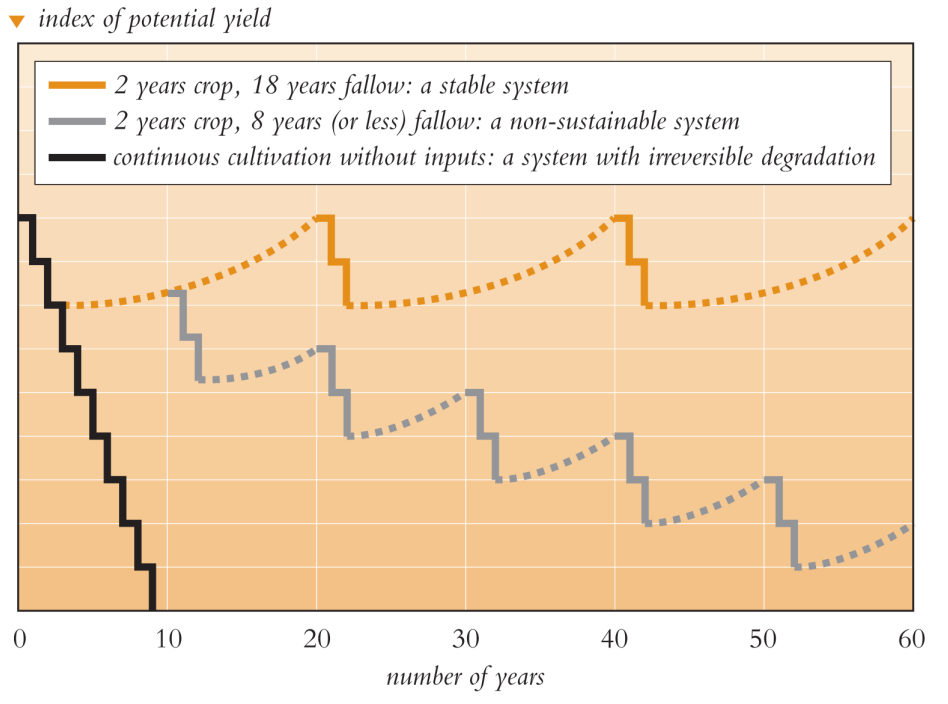
Agricultural Systems
The diagram compares soil productivity over time under three systems:
Stable shifting cultivation (sustainable)
Non-sustainable shifting cultivation (short fallow)
Continuous cultivation without inputs
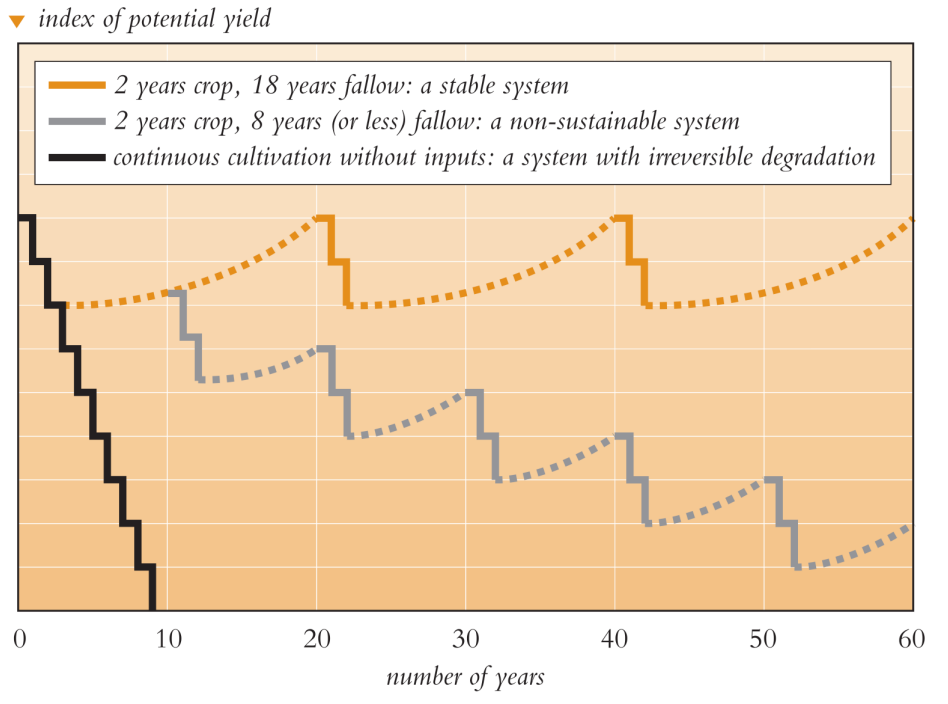
System 1: Stable Shifting Cultivation (Sustainable)
Description
Land is cultivated for a short period, then left fallow long enough to recover
Soil Productivity Trend
Productivity:
Declines during cultivation
Recovers fully during fallow
Key Mechanism
Fallow period allows:
Restoration of soil organic matter
Nutrient replenishment
Microbial recovery
Exam Insight
This system is ecologically balanced and can be sustainable under low population pressure
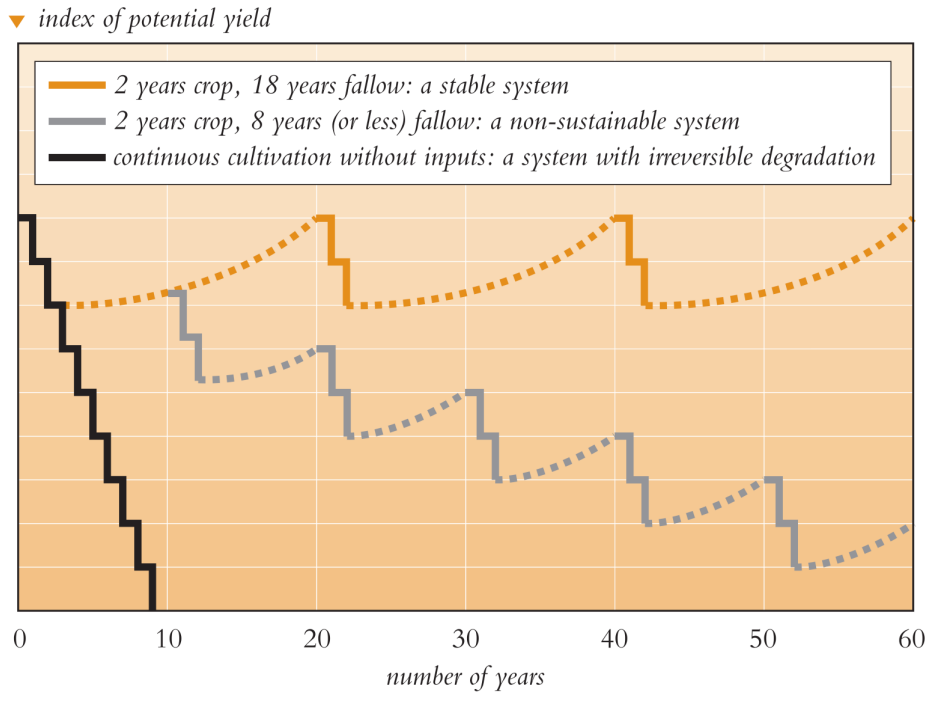
System 2: Non-Sustainable Shifting Cultivation
Description
Fallow period is too short due to population pressure
Soil Productivity Trend
Partial recovery only → gradual decline over cycles
Key Mechanism
Insufficient time for:
Nutrient restoration
Organic matter buildup
Link to Poverty Trap
This system directly leads to:
Soil degradation
Reduced yields
Increased pressure on land
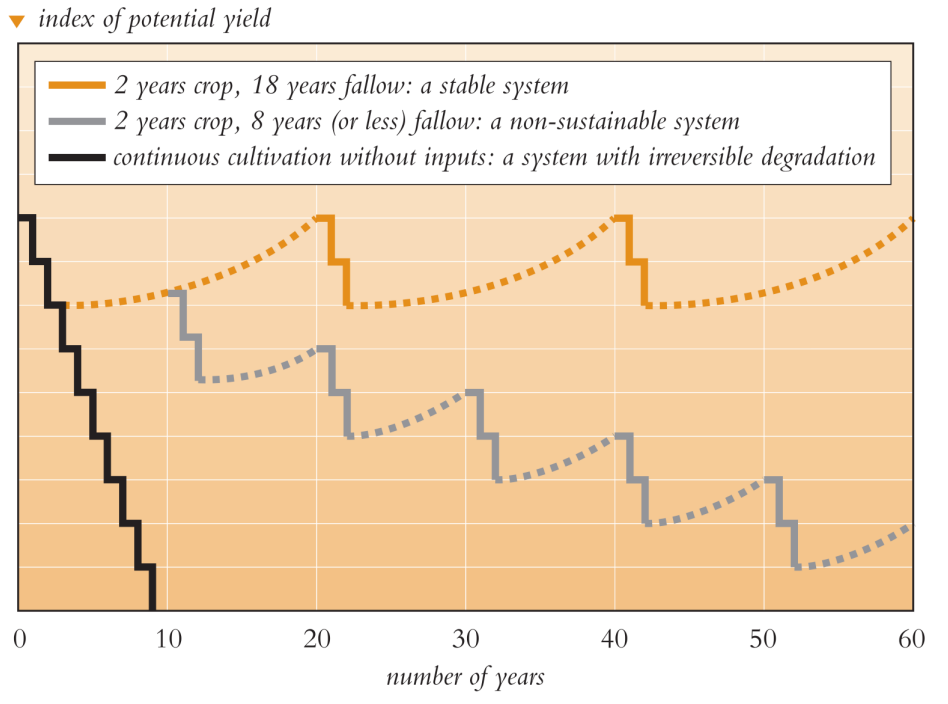
System 3: Continuous Cultivation (Without Inputs)
Description
Land is cultivated continuously with no fallow and no external inputs
Soil Productivity Trend
Sharp and continuous decline
Key Mechanism
Constant nutrient extraction
No replenishment → nutrient mining
Consequences
Severe fertility decline
Land becomes unproductive
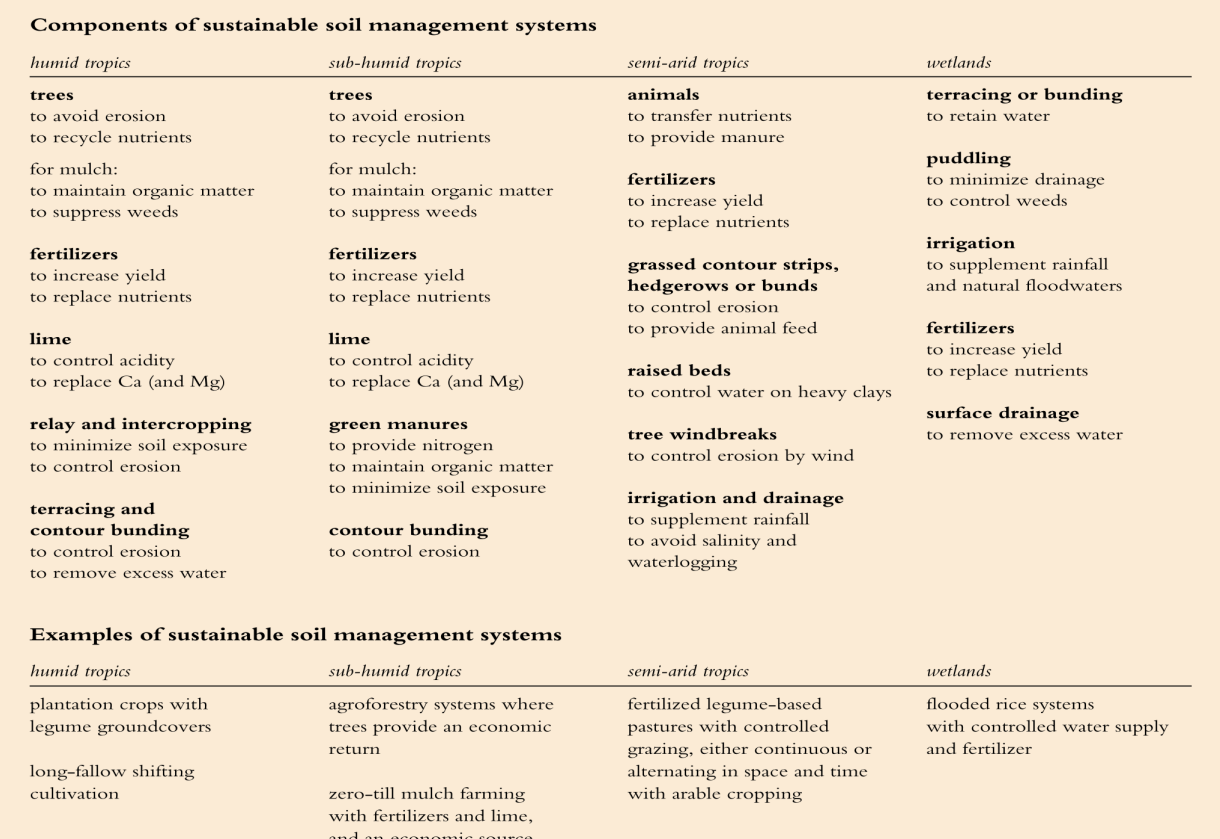
Components of sustainable soil management systems
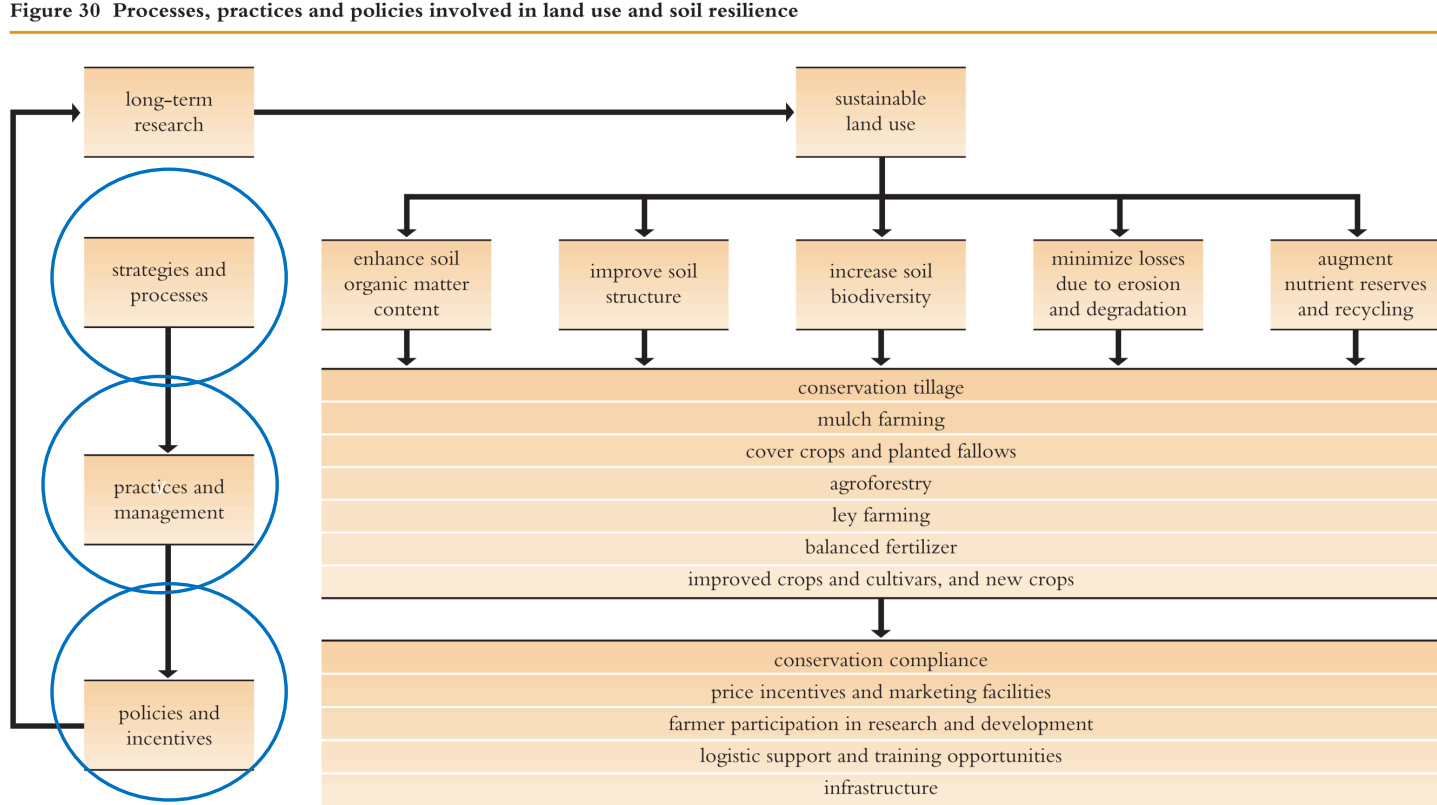
Processes, Practices, and Policies in Land Use & Soil Resilience: overview
Sustainable land use is achieved through integration of three levels:
Strategies & processes (conceptual level)
Practices & management (field level)
Policies & incentives (institutional level)
→ All three must work together to achieve soil resilience and sustainability
The 5 Core Objectives (Pillars of SLM)
1. Productivity
Maintain or increase land output
Ensure continuous production of food, fiber, fuel
2. Security
Reduce risks in production
Protect against:
Climate variability
Crop failure
3. Protection
Prevent degradation of:
Soil
Water resources
4. Viability
Must be economically feasible
Farmers should be able to sustain it financially
5. Acceptability
Must be:
Socially acceptable
Culturally appropriate
Integrated approach to sustainable land management
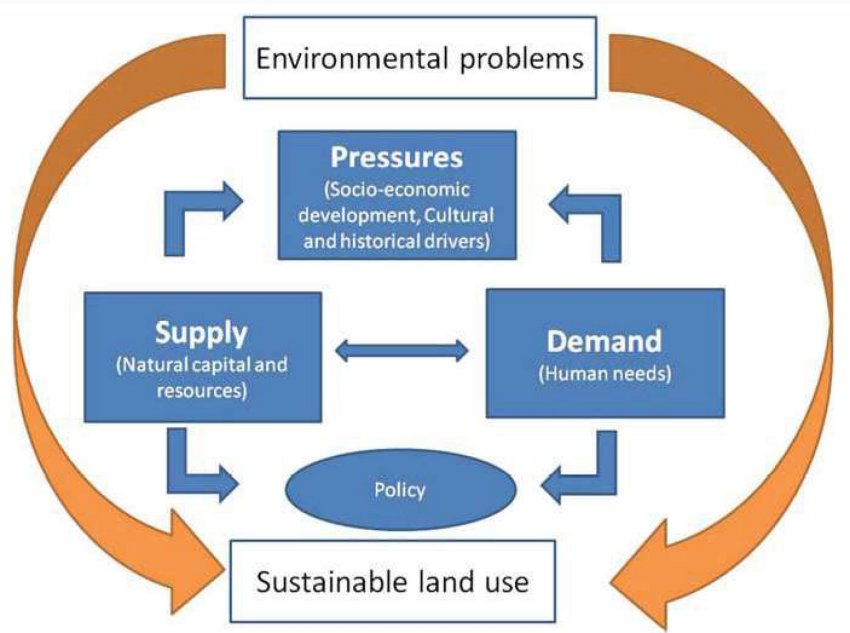
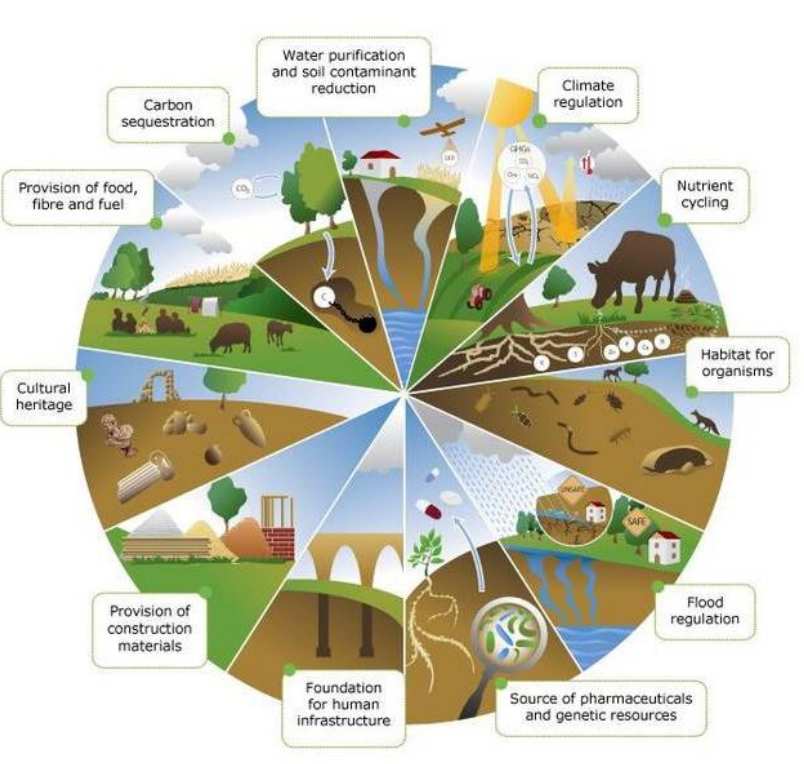
Integrated Approach to Sustainable Land Management (SLM)
Integrated Approach to Sustainable Land Management (SLM) examples
1. Provision of food, fiber, and fuel
Wheat/rice farming (food)
2. Carbon sequestration
Forest soils storing carbon
3. Water purification & soil contaminant reduction
Wetlands filtering agricultural runoff
4. Climate regulation
Forests moderating temperature and rainfall patterns
5. Nutrient cycling
Nitrogen fixation by legumes
6. Habitat for organisms
Soil supporting microbes, insects, earthworms
7. Flood regulation
Forest cover reducing surface runoff
8. Source of pharmaceuticals & genetic resources
Medicinal plants (e.g., plant-derived drugs)
9. Foundation for human infrastructure
Land used for roads, cities, agriculture
10. Provision of construction materials
Timber from forests
11. Cultural heritage
Traditional farming systems (e.g., terracing)
WOCAT Case Studies – SLM Technology Groups
1. Agroforestry
Integration of trees + crops/livestock
Example: Trees planted alongside crops to improve soil fertility
Function: Carbon sequestration + erosion control + biodiversity
2. Conservation Agriculture
Minimal tillage + soil cover + crop rotation
Example: No-till farming with residue cover
Function: Improves soil structure and moisture retention
3. Integrated Soil Fertility Management (ISFM)
Combined use of:
Organic inputs (manure)
Inorganic fertilizers
Function: Maintains balanced nutrient supply
4. Cross-slope Measures
Farming across slopes (contour farming, terracing)
Example: Contour bunding
Function: Reduces soil erosion and runoff
5. Water Harvesting
Collection and storage of rainwater
Example: Check dams, storage tanks
Function: Improves water availability in dry areas
6. Irrigation Management
Efficient use of irrigation water
Example: Drip irrigation
Function: Prevents waterlogging and salinization
7. Pastoralism & Grazing Management
Controlled livestock grazing
Example: Rotational grazing
Function: Prevents overgrazing and soil compaction
8. Integrated Crop-Livestock Management
Combining crops and livestock systems
Example: Using manure as fertilizer
Function: Nutrient recycling + system efficiency
9. Forest Management
Sustainable use and conservation of forests
Example: Reforestation, controlled logging
Function: Carbon storage + biodiversity protection
SLM in Central Asia
A. Dominance of Cropland & Grazing Systems
Majority of case studies focus on:
Crop production systems
Livestock/grazing systems
Indicates strong dependence on agriculture and livestock in the region
B. Importance of Mixed Systems
Many practices occur in integrated crop–livestock systems
Provides:
Food (crops)
Fodder (livestock)
Wood (fuel/materials)
Mixed systems improve:
Resource efficiency
Nutrient recycling
System resilience
C. Limited Forest Management
Few case studies related to forests
Forest areas are:
Limited in extent
Underutilized in SLM efforts
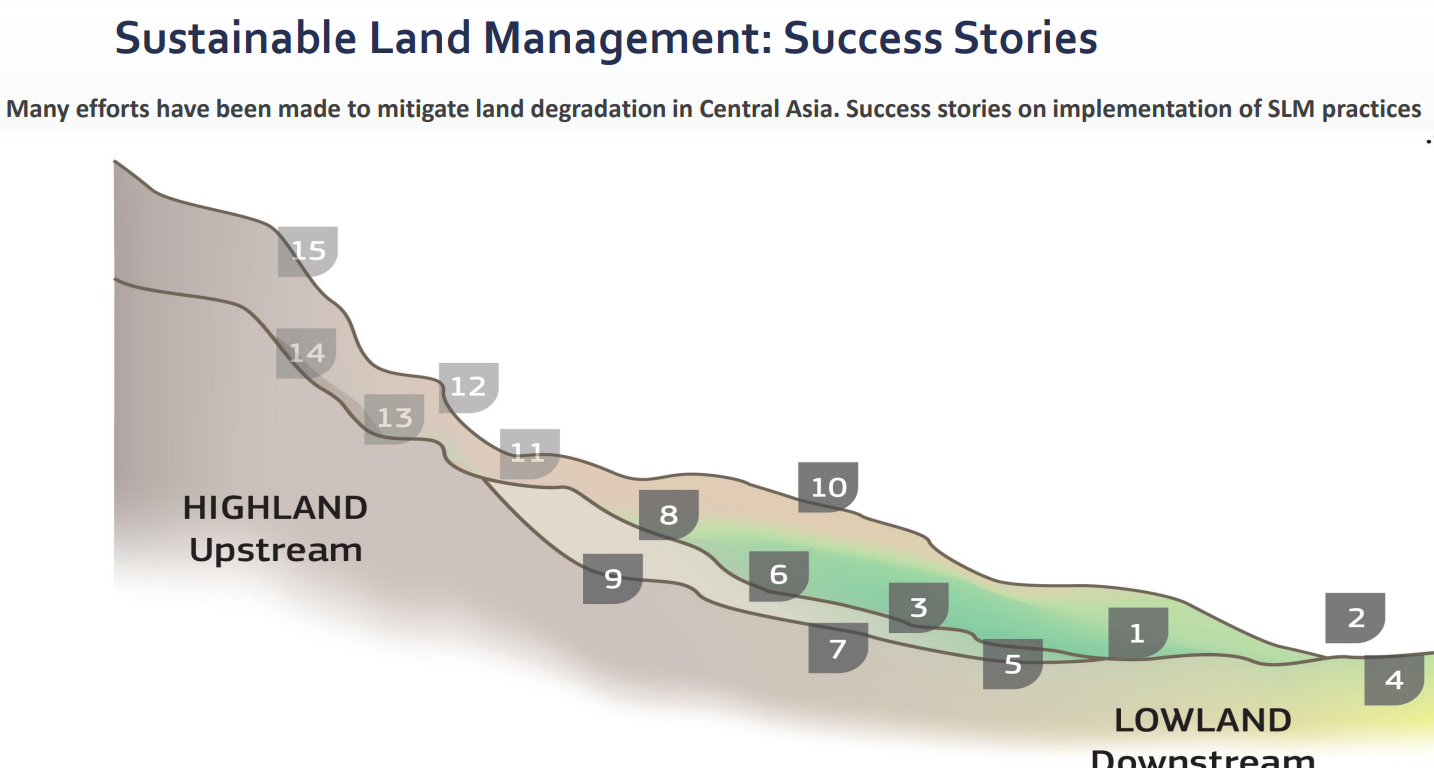
Diagram
Highland (Upstream)
Source of:
Water flow
Sediments
If poorly managed:
Causes erosion
Leads to downstream flooding and sedimentation
Lowland (Downstream)
Receives:
Water
Nutrients
Sediments
Highly dependent on upstream conditions
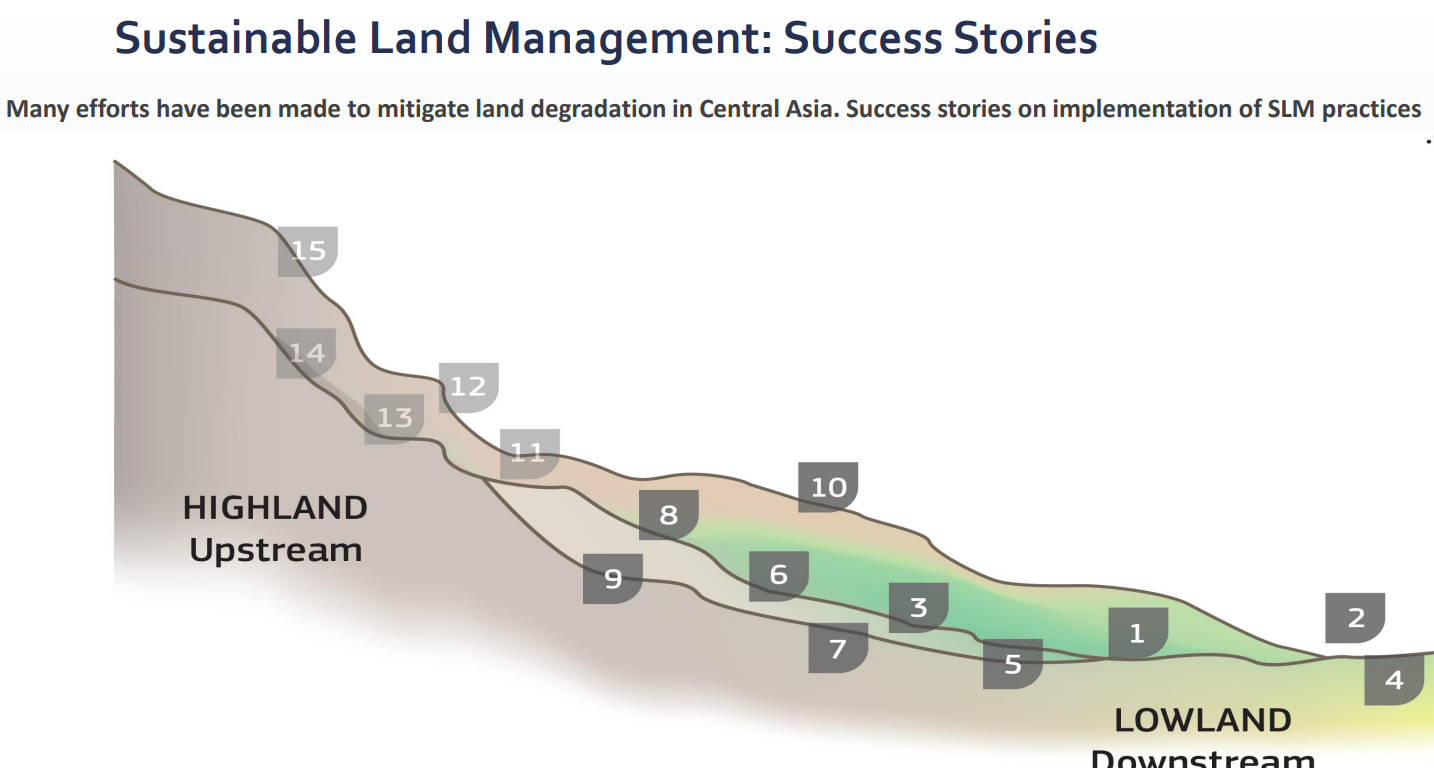
Functional Zonation of SLM
A. Highland Areas
Practices:
Terracing
Afforestation
Goal:
Reduce erosion
Stabilize soil
B. Mid-slope Areas
Practices:
Agroforestry
Cover cropping
Goal:
Improve infiltration
Reduce runoff
C. Lowland Areas
Practices:
Irrigation management
Flood control
Goal:
Efficient water use
Prevent waterlogging
Clifton Urban Forest (Karachi)
An urban reforestation project in Karachi using the Miyawaki method
Covers ~200 acres with 800,000+ native trees
An urban afforestation project using the Miyawaki method, which involves high-density planting of native species to accelerate ecological succession.
The approach enhances soil organic matter accumulation and microbial activity through rapid litter deposition.
It improves urban microclimate regulation by increasing evapotranspiration and reducing surface temperatures.
Dense root networks also contribute to soil stabilization and infiltration capacity in compacted urban soils.
Represents SLM in anthropogenically altered environments, focusing on ecological restoration within cities.
Environmental Benefits of miyawaki forest
A. Climate Regulation
Trees act as carbon sinks
Reduce urban heat island effect
B. Soil Improvement
Increased organic matter input
Improved soil structure and fertility
C. Biodiversity Enhancement
Habitat for:
Birds
Insects
Microorganisms
D. Air Quality Improvement
Trees absorb:
CO₂
Pollutants
Billion Tree Tsunami – SLM Success Story
1. Overview
A large-scale afforestation program launched in 2014 in Khyber Pakhtunkhwa, Pakistan
Restored ~350,000 hectares of forest and degraded land
Completed in 2017 (ahead of schedule)
Recognized by UNEP as a major environmental success
2. Core Objective
Restore degraded land and increase forest cover
Contribute to global climate and land restoration goals
Billion Tree Tsunami: Key components
A large-scale afforestation initiative restoring ~350,000 hectares through assisted natural regeneration and plantation forestry.
Enhances carbon sequestration capacity by increasing above- and below-ground biomass.
Improves soil structure and erosion resistance via root binding and organic matter inputs.
Contributes to hydrological regulation, increasing infiltration and reducing surface runoff.
Demonstrates how policy-driven SLM interventions can operate at landscape scale with measurable ecological outcomes.
Living Indus Initiative – SLM Success Story
A large-scale ecosystem restoration program in Pakistan
Led by:
Government of Pakistan
United Nations Environment Programme (UNEP)
Food and Agriculture Organization (FAO)
Targets:
~25 million acres of degraded land in the Indus Basin by 2030
Estimated cost:
~$17 billion
Living Indus Initiative – SLM Success Story: Key Components
A basin-wide restoration program integrating land, water, and biodiversity management across the Indus River system.
Focuses on hydrological connectivity, ensuring upstream land use supports downstream water quality and flow regimes.
Incorporates ecosystem-based adaptation (EbA) strategies to enhance resilience to climate variability.
Promotes wetland restoration, groundwater recharge, and sediment management.
Represents SLM as a multi-sectoral, systems-based approach operating at watershed scale.
SLM: Great Green Wall of China
A massive afforestation program in northern China
Designed to combat:
Desertification
Expansion of the Gobi Desert
Involves planting a long belt of trees → called the “Green Wall”
2. Core Objective
Prevent desert expansion toward populated regions (e.g., Beijing)
Stabilize land and restore degraded ecosystems
Limitations of Great Green Wall of China
A long-term afforestation program aimed at mitigating aeolian (wind-driven) soil erosion and desertification.
Vegetation acts as a windbreak, reducing wind velocity and preventing soil particle detachment.
Enhances soil aggregation and stability through root systems and organic inputs.
Alters local albedo and microclimate, influencing regional climate patterns.
Highlights SLM in arid and semi-arid ecosystems, where land–atmosphere interactions are critical.
SLM Success Story – Straw-Covered Field (Uganda)
A residue management practice where crop straw is retained as surface mulch post-harvest.
Reduces soil erosion by intercepting raindrop impact and decreasing runoff velocity.
Enhances soil moisture retention by limiting evaporative losses.
Promotes organic matter decomposition and nutrient mineralization, improving fertility.
Demonstrates a low-input, farmer-driven SLM strategy based on ecological processes rather than external inputs.
Spain Wind Farm Landscape
Integrates renewable energy production with land restoration, allowing dual land use.
Wind turbines reduce pressure on land for conventional energy extraction, enabling reforestation and vegetation recovery.
Land management includes fuel load control (grazing, pruning) to reduce wildfire risk.
Demonstrates multi-functional land systems, balancing ecological restoration with economic productivity.
Represents SLM beyond agriculture, incorporating energy-land nexus considerations.
SLM Success Story – India (Slide 44: Rajasthan Terracing System)
In Rajasthan, stone walls and forward-sloping terraces are constructed on slopes to reduce runoff velocity and enhance water retention in arid conditions .
These structures function by interrupting overland flow, thereby minimizing soil erosion and increasing infiltration time.
However, in hot drylands, this method alone is insufficient due to high evapotranspiration rates, which limit effective soil moisture retention.
Additional vegetative or agronomic measures (e.g., cover crops, mulching) are required to maintain long-term productivity.
This example highlights that structural SLM measures must be complemented by biological practices for full effectiveness.
SLM Success Story – Nepal
In Nepal, traditional terrace farming combined with manure application and residue retention is used to maintain soil fertility .
Terracing reduces slope length, thereby controlling soil erosion and surface runoff in mountainous regions.
Application of manure enhances soil organic matter, nutrient availability, and microbial activity.
Crop residues provide soil cover, improving moisture retention and reducing degradation.
This system represents a closed-loop nutrient cycling model, demonstrating long-term sustainability through integration of physical and biological SLM practices.
Lvels of biodiversity
Genetic Diversity: Variation within species (e.g., different wheat varieties resistant to rust).
• Species Diversity: Variety of species (e.g., birds, insects, microbes in a rice field).
• Ecosystem Diversity: Variety of habitats (e.g., forests, wetlands, deserts, irrigated plains).
Why Biodiversity Matters for Agriculture (Agrobiodiversity)
2. Planned Biodiversity (Managed Component)
Includes:
Crops
Livestock
Trees (agroforestry systems)
Technical Role
Determines:
Primary productivity (yield)
System design (monocrop vs mixed systems)
3. Associated Biodiversity (Functional Component)
Includes:
Soil microbes
Insects (pollinators, pests, predators)
Soil fauna (earthworms)
Biodiversity Improves Production: Input: Agroecological Practices
2. Input: Agroecological Practices (Left side)
Organic fertilizers / amendments
Conservation tillage
Cover crops
Crop diversification
Integrated pest management
👉 These practices increase biodiversity in soil (not just crops)
Biodiversity Improves Production: Soil Biodiversity
Includes:
Bacteria
Fungi
Nematodes
Earthworms
Microfauna
These organisms are called “ecosystem engineers” because they physically and chemically modify soil
Biodiversity Improves Production: Mechanisms
A. Nutrient Cycling
Microbes decompose organic matter → release:
N, P, K, Ca, Mg
Converts nutrients into plant-available forms
B. Soil Structure Maintenance
Earthworms + microbes create:
Aggregates
Pores
→ Improves:
Aeration
Root penetration
Water infiltration
C. Water Regulation
Better structure → better:
Water retention
Drainage
D. Biological Pest Regulation
Predators + microbes:
Suppress pests and pathogens
Reduces need for pesticides
E. Contaminant Mitigation
Soil organisms can:
Immobilize or transform heavy metals (Cd, Pb, Zn)
Improves food safety
Biodiversity improves soil: Output: Sustainable Crop Production
Higher biomass
Better nutrient content
Stable yields
Safer food
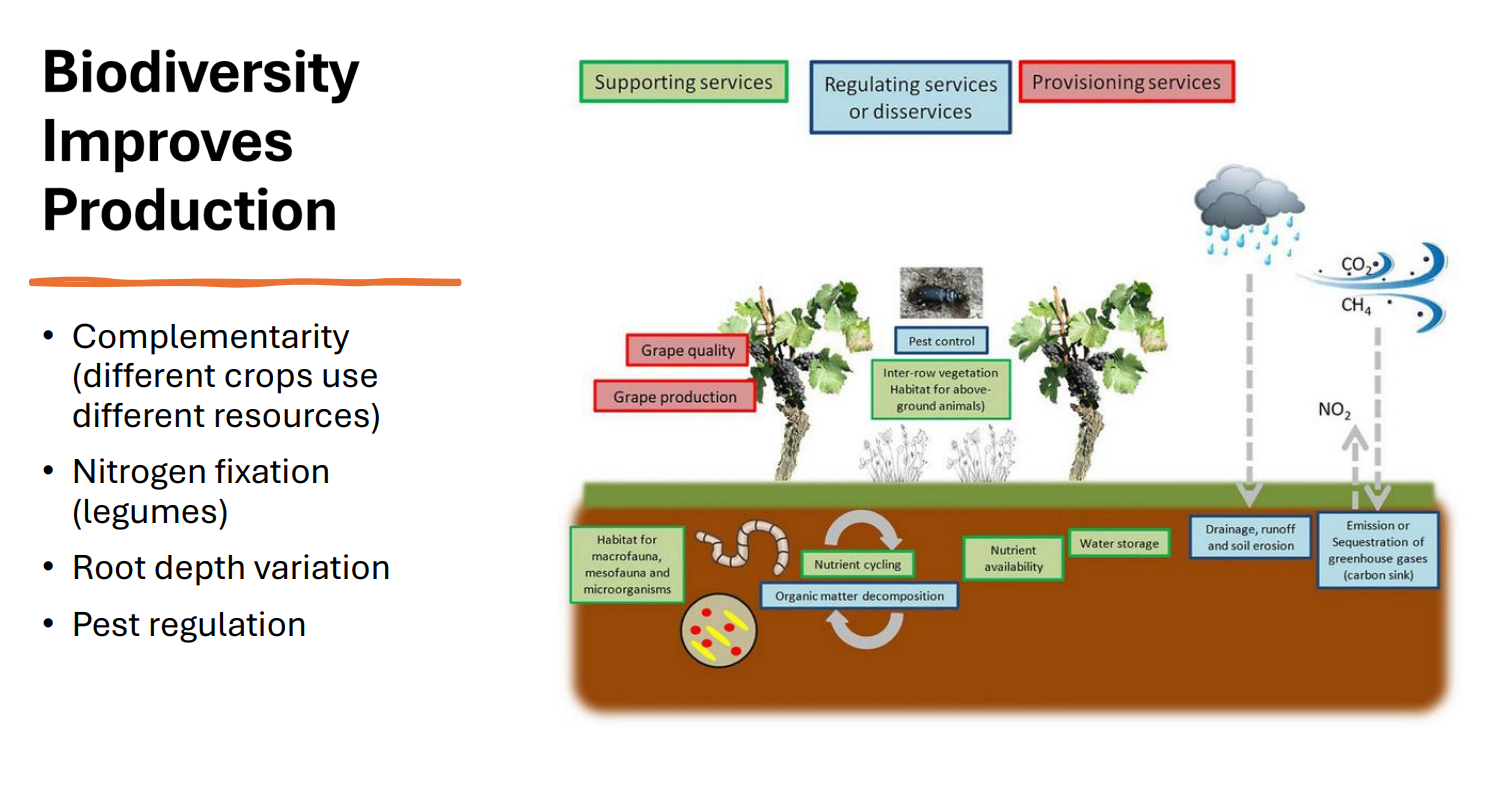
Biodiversity Improves Production
Ecosystem Services
A. Pollination (Provisioning/Regulating link)
~75% of global food crops depend on animal pollinators
Increases:
Crop yield
Genetic diversity of plants
B. Soil Fertility (Supporting Service)
Microorganisms (bacteria, fungi, earthworms):
Decompose organic matter
Recycle nutrients
👉 Drives biogeochemical cycling (N, P, C cycles)
C. Pest Control (Regulating Service)
Natural predators (birds, insects) suppress pest populations
Reduces reliance on chemical pesticides
D. Water Regulation (Regulating Service)
Healthy ecosystems:
Improve infiltration
Filter pollutants
Reduce flood risk
E. Resilience (System Property)
Biodiverse systems are more resistant to:
Drought
Floods
Climate variability
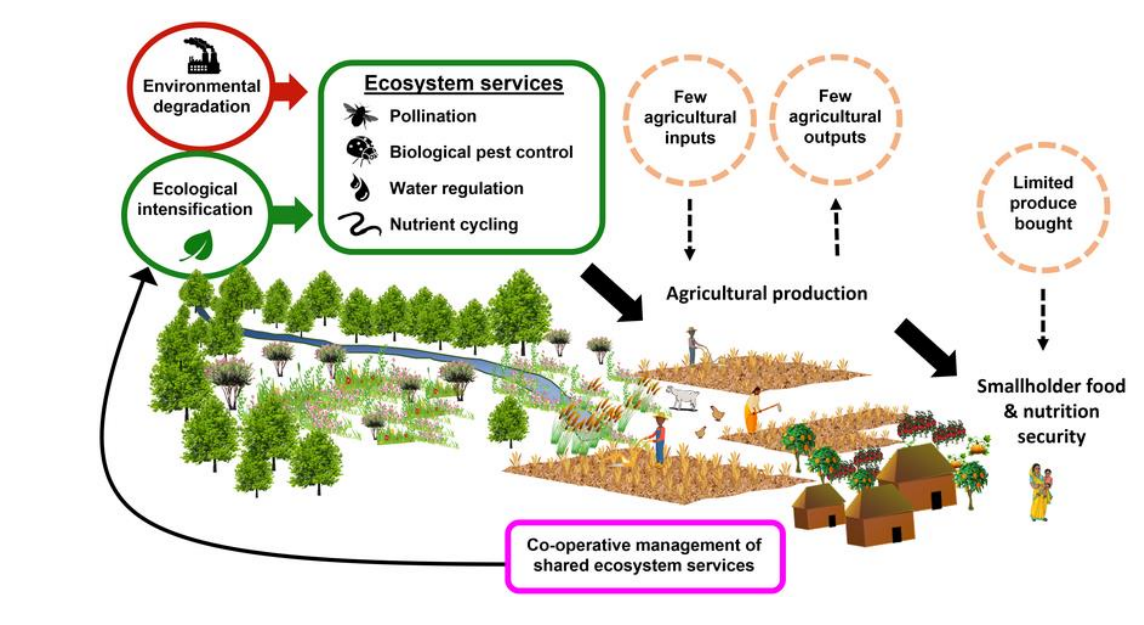
Agrobiodiversity
Shows two contrasting pathways:
Environmental degradation → reduced ecosystem services → poor outcomes
Ecological intensification → enhanced ecosystem services → sustainable production
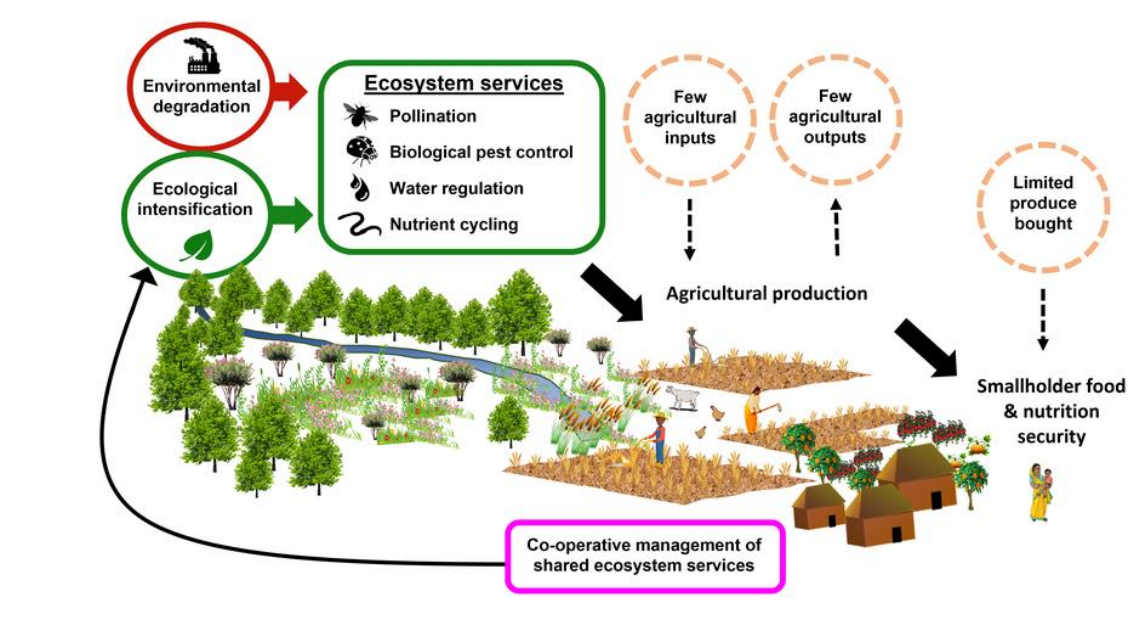
2. Negative Pathway: Environmental Degradation
2. Negative Pathway: Environmental Degradation
Intensive agriculture leads to:
Loss of biodiversity
Soil degradation
Disruption of ecosystem processes
Result
Reduced ecosystem services:
Pollination declines
Pest control weakens
Nutrient cycling disrupted
👉 Leads to:
Lower productivity
Increased dependence on inputs
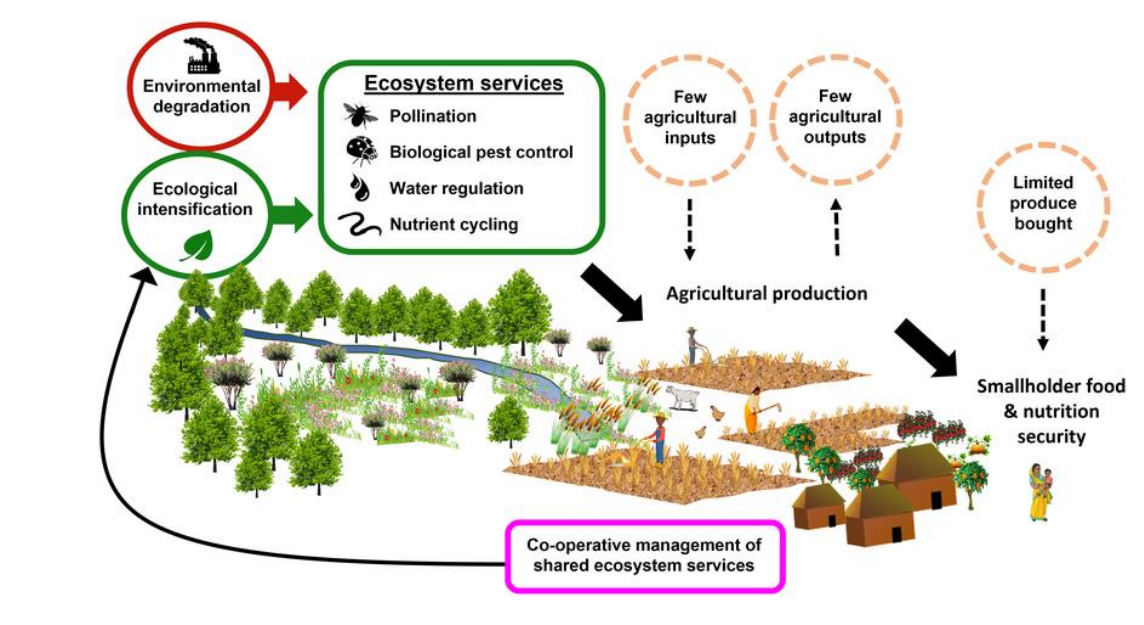
Positive Pathway: Ecological Intensification
Enhancing biodiversity instead of removing it
Key Ecosystem Services Restored
Pollination
Biological pest control
Water regulation
Nutrient cycling
👉 These processes are biologically driven, not input-driven
Benefits of Agricultural Biodiversity (food + climate change)
1. Provides Diverse and Nutritious Food
Biodiversity increases the range of crops and livestock, improving dietary diversity.
Different species supply:
Different micronutrients (vitamins, minerals)
Reduces dependence on monoculture systems, which are nutritionally limited.
👉 Technically: enhances nutritional security and dietary resilience
2. Enhances Adaptation to Climate Change
Genetic diversity allows crops and livestock to:
Tolerate drought, heat, salinity
Ecosystem diversity buffers against:
Extreme weather events
👉 Technically: increases adaptive capacity and system plasticity under climatic stress
Benefits of Agricultural Biodiversity: (producers + ecosystem)
3. Increases Resilience of Producers
Diverse systems are less vulnerable to:
Pest outbreaks
Crop failure
If one species fails, others compensate
👉 Technically: provides functional redundancy, stabilizing yield over time
4. Maintains Ecosystem Health
Biodiversity supports:
Nutrient cycling
Soil biological activity
Food web stability
👉 Prevents:
Ecosystem collapse
Loss of ecological balance
👉 Technically: maintains ecosystem integrity and trophic interactions
Benefits of Agricultural Biodiversity: 5
5. Improves Soil Fertility and Water Quality
Soil organisms:
Decompose organic matter
Enhance nutrient availability
Vegetation reduces:
Runoff
Nutrient leaching
👉 Technically:
Improves soil physicochemical properties
Enhances water filtration and retention capacity
The Agricultural Paradox
Agriculture depends on biodiversity, yet modern agriculture is the largest driver of biodiversity loss globally
👉 This contradiction is called the Agricultural Paradox
2. Why Agriculture Depends on Biodiversity
Crop production relies on:
Pollination
Soil microbes (nutrient cycling)
Natural pest control
These are ecosystem services provided by biodiversity
How Modern Agriculture Causes Biodiversity Loss
A. Land Use Change
Conversion of:
Forests
Wetlands
→ into monoculture farms
👉 Leads to habitat destruction
B. Agrochemical Overuse
Excess fertilizers → water pollution
Pesticides → kill non-target species (pollinators, predators)
👉 Disrupts ecological balance
C. Intensive Tillage
Plowing destroys:
Soil structure
Soil microbial communities
👉 Accelerates organic matter loss and erosion
D. Monoculture Systems
Single crop species over large areas
Reduces:
Genetic diversity
Species diversity
👉 Increases vulnerability to pests and diseases
Consequences of Agricultural Paradox
Decline in:
Soil fertility
Pollinators
Ecosystem stability
Increase in:
Input dependence (fertilizers, pesticides)
Environmental degradation
Greenhouse gas emissions
Conservation Biology
Focuses on protecting biodiversity, including:
Species
Habitats
Ecosystem processes
Technical Scope
Concerned with:
Preventing extinction
Maintaining ecological balance
Often applied in:
Protected areas (forests, wildlife reserves)
Conservation Agriculture
A farming system designed to achieve:
Sustainable and profitable agriculture
While conserving natural resources
Technical Scope
Focuses on:
Soil conservation
Water efficiency
Biodiversity within agricultural systems
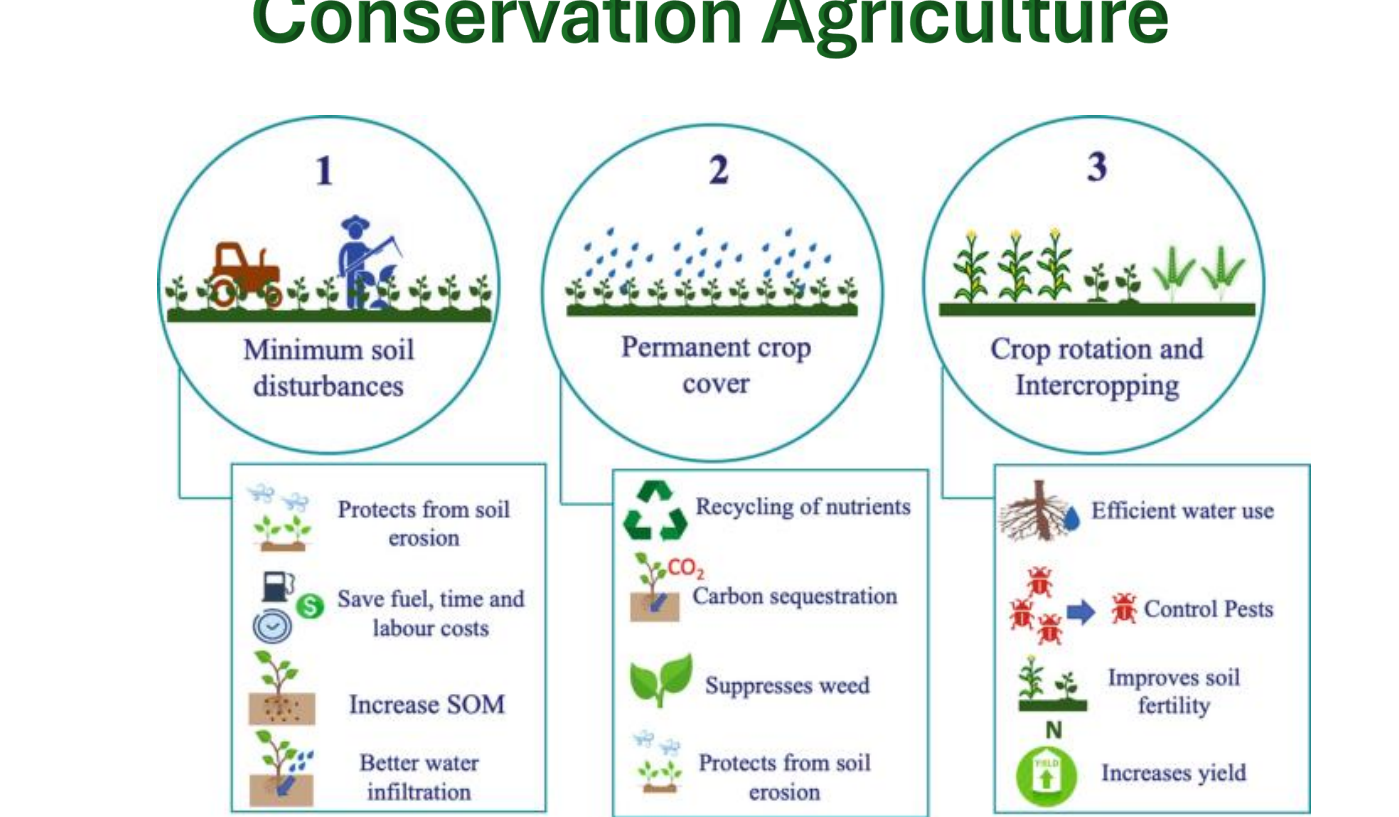
Conservation Agriculture (CA) – Principle 1
2. Principle 1: Minimum Mechanical Soil Disturbance (No-Till)
Tillage disrupts soil aggregates, exposing protected organic carbon to oxidation → CO₂ loss.
No-till preserves aggregate stability, allowing physical protection of organic matter within microaggregates.
Maintains fungal hyphal networks (especially mycorrhizae), which are critical for phosphorus uptake and soil structure formation.
Reduces macropore collapse, sustaining preferential flow paths → higher infiltration and reduced runoff.
Net effect: shifts soil from physically disturbed → biologically structured system.
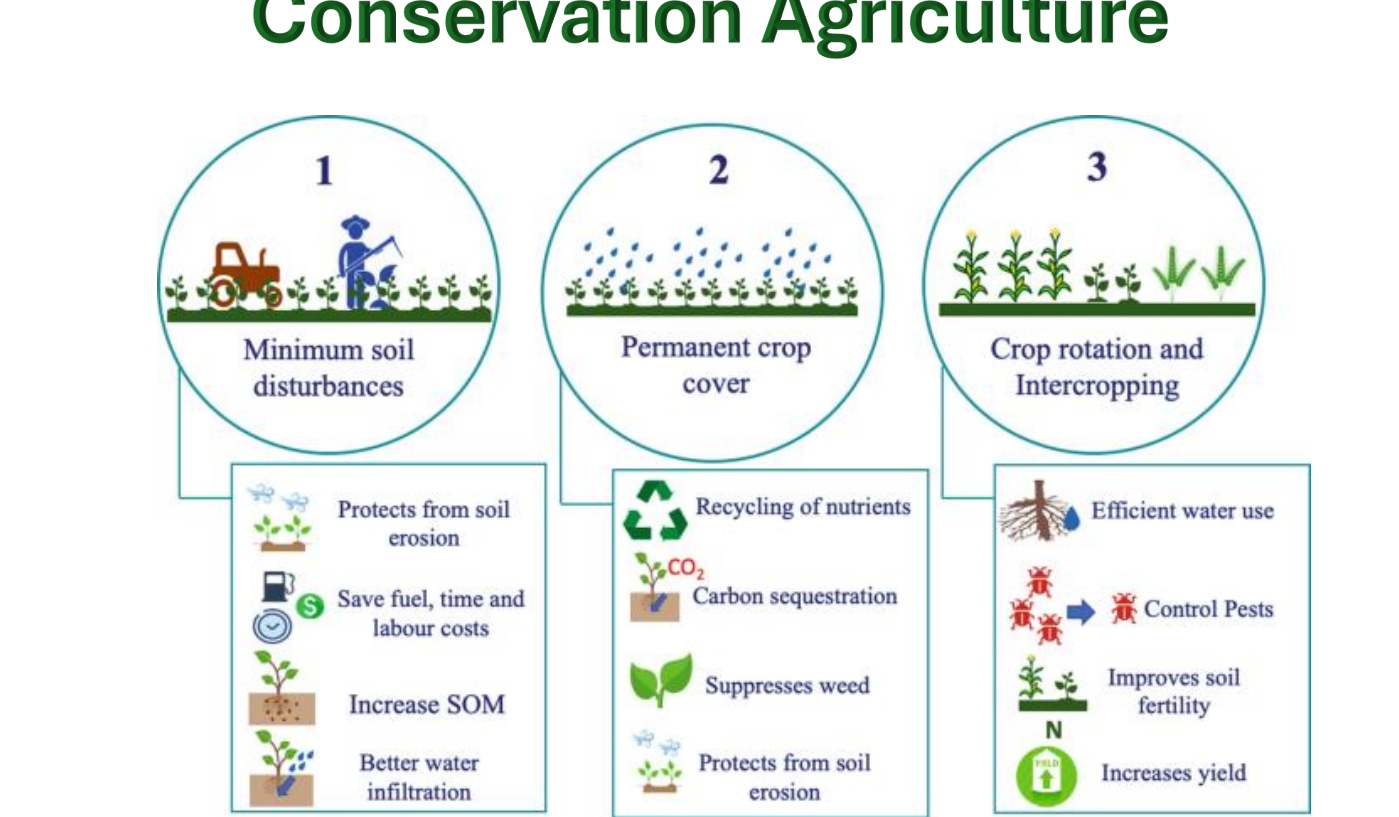
Conservation Agriculture (CA) – Principle 2
3. Principle 2: Permanent Soil Cover (Mulching)
Residue cover reduces raindrop kinetic energy, preventing detachment of soil particles (splash erosion).
Creates a diffusive barrier to evaporation, lowering soil temperature and conserving moisture.
Provides continuous carbon substrate for heterotrophic microbes, driving decomposition and humus formation.
Enhances cation exchange capacity (CEC) through organic matter buildup → better nutrient retention.
Net effect: converts soil surface from erosion-prone → buffered microclimate system.