Psychology part A, ch. 3 - Sensation and Perception
 Call Kai
 Learn
Learn Practice Test
 Spaced Repetition
 Match
Match Flashcards
 Knowt Play
1/36

There's no tags or description
Looks like no tags are added yet.
Name | Mastery | Learn | Test | Matching | Spaced | Call with Kai |
|---|
No analytics yet
Send a link to your students to track their progress
37 Terms
Bottom-up processing
taking sensory information and then assembling and integrating it
—>stimulus driven processing
Top-down processing
Using models, ideas, and expectations to interpret sensory information
—> conceptually driven processing
what boundaries does sensation have?
what is the weakest stimulus an organism can detect —> absolute threshold
what ways of measuring (psychophysics) is there to find the absolute threshold? 3
method of limits (ascending / descending intensities)
adaptive testing
method of the constant stimuli
treshold stimulus level
the lowest intensity level at which a stimulus is detected 50% of the time
In the method of constant stimuli detection why does detection vary? 2.5
Mental alertness
Internal “noise”
Other random influences
discrimination
weakest difference between two stimuli an organism can detect
—> differnece/differential threshold or just noticeable difference (JND)
weber fraction
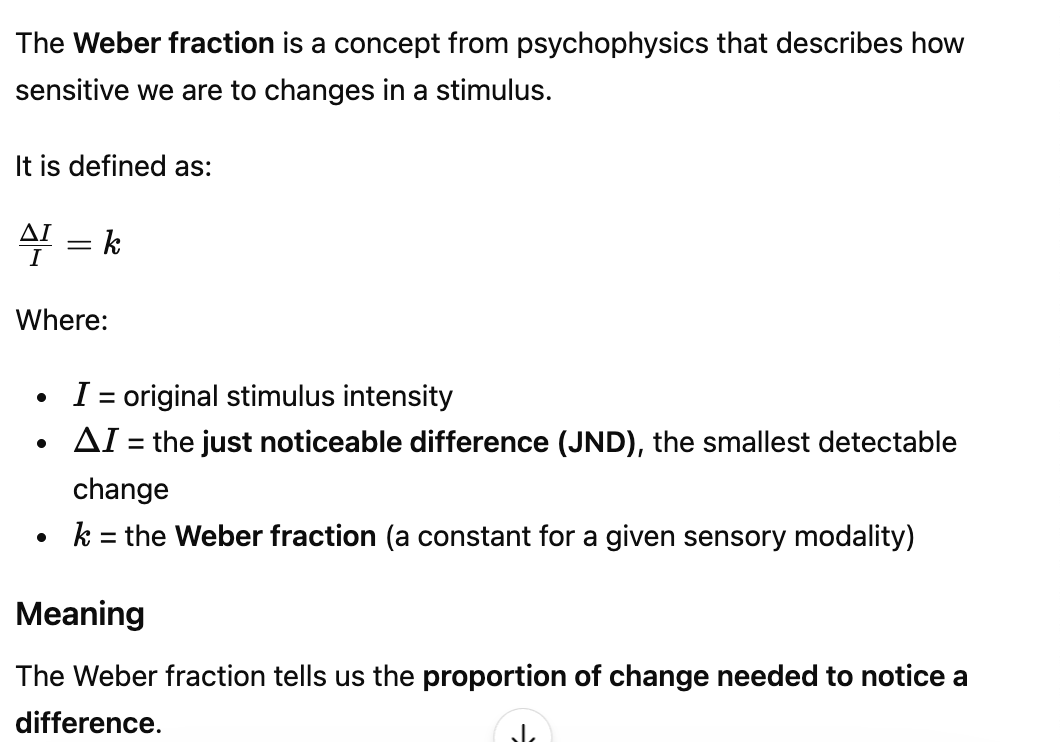
how is the weber fraction used in marketing
so that negative changes (e.g., reductions in product size or quality, or increase
in product price) are not discernible to the public (i.e., remain below JND) andso that product improvements (e.g., improved or updated packaging, larger size
or lower price) are very apparent to consumers without being wastefully
extravagant (i.e., they are at or just above the JND).
See Digging Deeper on Toledo: Applying Weber’s law to pricing
what problem does constant stimuli not account for
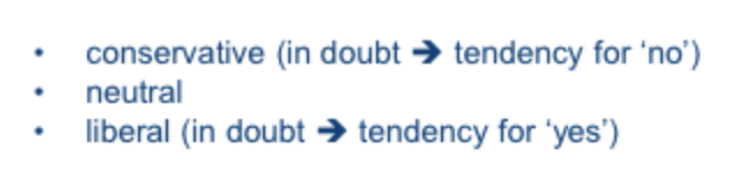
response bias
response bias
Response bias is the tendency of a person to respond in a particular way regardless of the actual stimulus.
In detection experiments, it reflects a participant’s decision strategy — whether they are more likely to say:
“Yes, I detected it” (liberal bias)
“No, I didn’t detect it” (conservative bias)
even when the sensory evidence is uncertain.
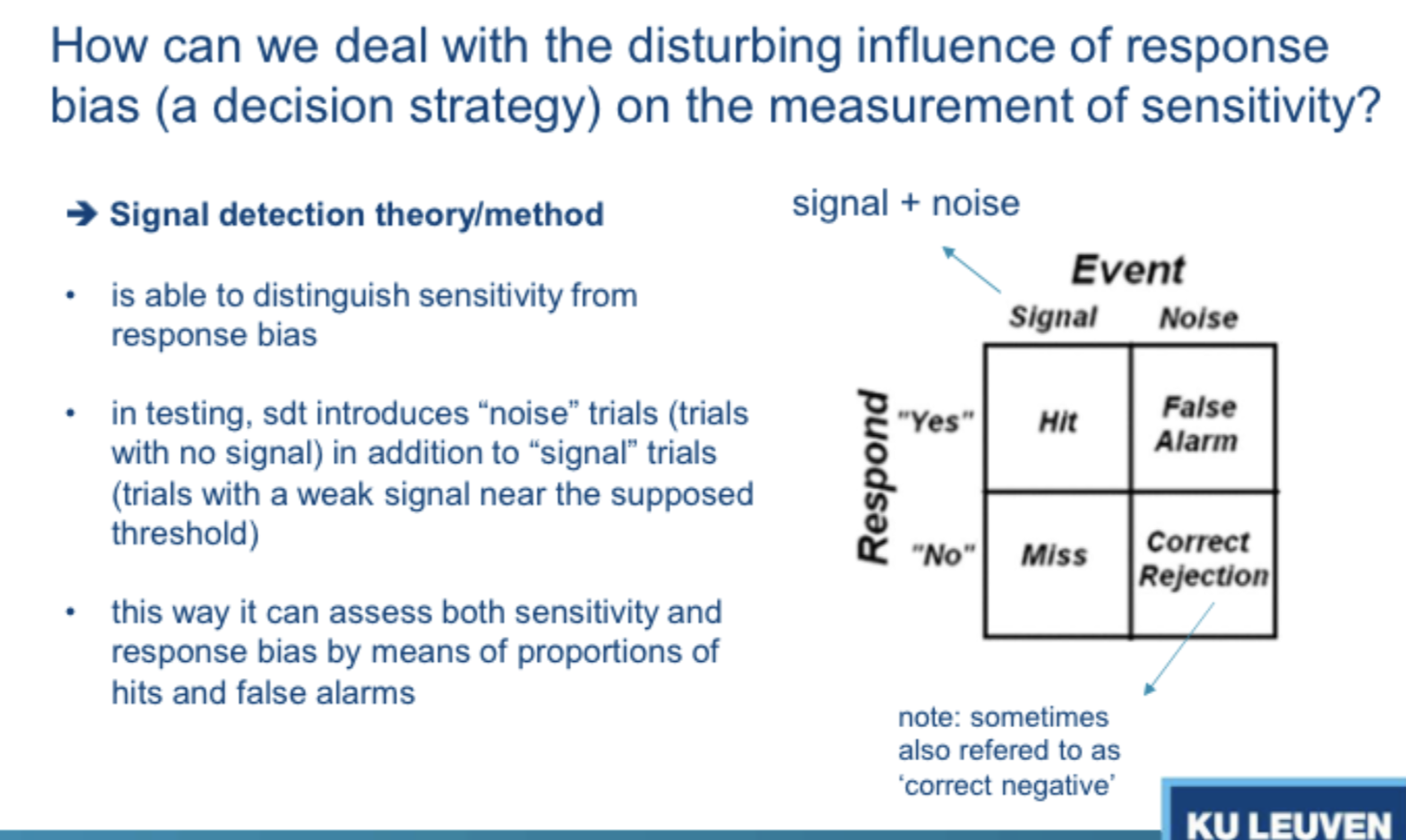
how can we deal with response bias?
when you are more sensitive to the signal, your internal response will be stronger (larger difference between noise+signal distribution)
what does the accessory structure in the eye do?
brings energy (stimulus) to receptors for transduction
sensory adaptation
loss of responsiveness in receptor cells after
stimulation has remained unchanged for a while.
Habituation
the tendency of the brain to stop attending to constant, unchanging information
what kind of casual information does your brain care about?
contrast - the relative difference in the amount (and type of light) coming from two nearby locations
how is the contrast signal received? 5
light
photoreceptors
bipolar cells
ganglion cells
optic nerve
percept
the meaningful product of (the process of) perception
often, a stimulus that has been associated with concepts, memories of events,
emotions, motives…
feature detection
brains detector cells respond to specific features - edges, lines, and angles
retinal processing
receptor rods and cones —> bipolar cells
—> ganglion cells
recognition
brain interprets the constructed image based on information from stored images
parallel processing
brain cell teams process combines information about color, movement, form and depth
what does the dorsal visual stream determine?
where is it?
what does the ventral visual stream determine?
what is it?
what are feature detectors?
specialised groups of cells in both pathways
feature binding problem
How does the brain combine (or ‘bind’) multiple features given that their
activation is distributed across many regions in the brain?
Gestalt theory
emphasizes how we organize incoming stimulation into meaningful perceptual patterns because of the way are brains are innately “wired”.
innate principles (“gestalt laws”) guide grouping of parts (of objects /figures) into perceptual ‘wholes’ or ‘gestalts’
figure ground
Figure–ground is the perceptual process where the visual system separates a scene into:
Figure = the object you focus on
Ground = the background behind it
Key idea: Your brain automatically decides what is “object” vs “background”.
common fate
Objects that move in the same direction or at the same speed are perceived as belonging together as a group.
Key idea: Motion signals grouping.
learning based inference
Learning-based inference is a concept in psychology and cognition that refers to how we use previous experience (learning) to make predictions, judgments, or interpretations about new situations.
perceptual interpretations
inferences – guesses – predictions about meaning of sensations
generated hypotheses about sensations
based on learning
perceptual set
A perceptual set is a cognitive bias where perception of a stimulus is influenced by expectations, prior experience, and context, leading individuals to interpret ambiguous information in a specific way.
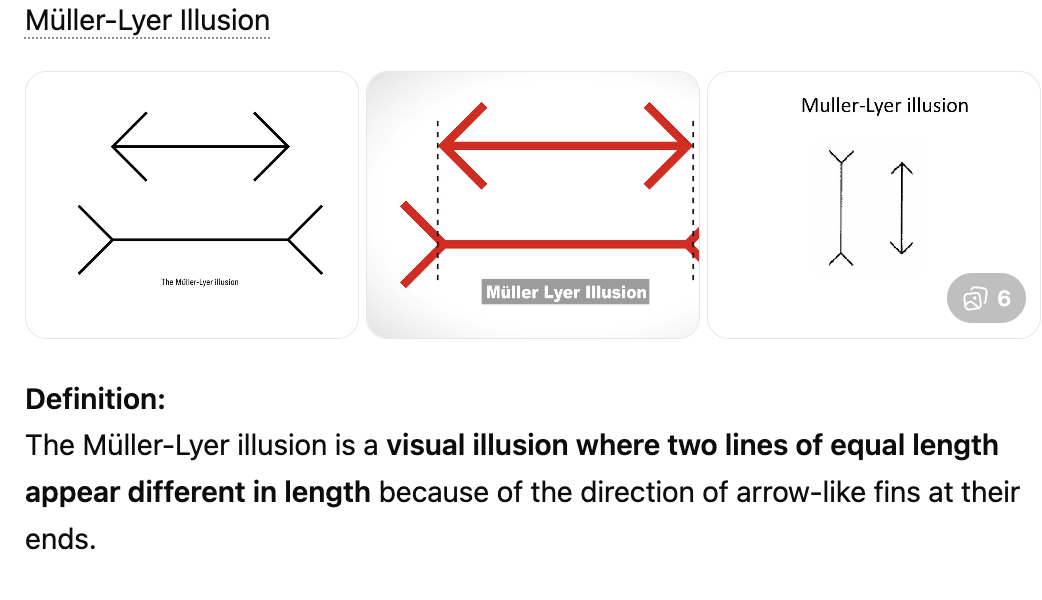
Muller-lyer illusion
perceptual constancies
the ability to recognize the same object under different conditions, such
as changes in illumination, distance, or location
e.g. shape constancy
multimodal perception
Multimodal perception is the brain’s ability to combine information from different sensory modalities (e.g., vision, hearing, touch) to create a single, coherent perceptual experience.
McGurk effect
What it is:
A perceptual illusion where visual information changes what you hear.
Example:
You hear “ba”
You see lips saying “ga”
You perceive “da”
👉 Shows that speech perception is multisensory, not purely auditory.
Rubber hand illusion
What it is:
An illusion where people feel that a rubber hand is their own when:
their real hand is hidden
both the rubber hand and real hand are stroked synchronously
Result:
They experience ownership of the fake hand.
👉 Shows how the brain integrates vision + touch + proprioception to construct body ownership.