Human Evol. Final Concepts to Know
 Call Kai
 Learn
Learn Practice Test
 Spaced Repetition
 Match
Match Flashcards
 Knowt Play
1/30

There's no tags or description
Looks like no tags are added yet.
Name | Mastery | Learn | Test | Matching | Spaced | Call with Kai |
|---|
No analytics yet
Send a link to your students to track their progress
31 Terms
changes to the human diet over time
Human diet has evolved from high-fiber, foraged plant foods and raw meat in the Paleolithic era to calorie-dense, processed diets in the industrial age, driven by technological, cultural, and environmental shifts. Key transitions include cooking (increasing energy intake), farming (introducing dairy and grains), and the recent explosion of ultra-processed foods, which have outpaced human evolutionary adaptation
Difference between forensic anthropology and bioarchaeology
Similarities:
– Focus on human remains
– Use of same methods
– Biocultural approach
Differences:
– Focus
Bioarch → population level
– How does this individual fit into the wider cultural context?
Forensic → individual
– Who is this individual?
components of the biological profile
Estimation of:
– The age of the individual
– The sex of the individual
– The stature of the individual
– The geographic background or ancestry of the individual
Always use as many points of reference as possible
Oldowan tools
Oldowan tools are the oldest known stone tool industry, dating back roughly 2.6 to 1.7 million years, characterized by simple, crudely flaked pebbles and cores (primarily choppers) alongside sharp-edged flakes. Used by early hominids like Homo habilis for butchery, wood processing, and smashing bones for marrow, this industry represents a major cognitive leap in human evolution
Acheulean tools
Hand Axes
Found all over the Old World
Distribution of Acheulean tools is that of H. erectus and its variations
Dispersed out of Africa
Had regional variations
Mousterian tools
Smaller, lighter, and thinner than Acheulean hand axes
Hafted onto handles - spears
Mousterian tools vary site-to-site
Different tool-making traditions between communities?
Disappeared from archaeological record with the extinction of Neanderthals
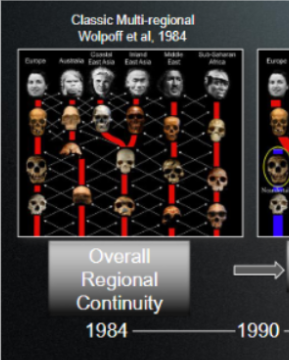
Models for modern human origins:
Multi-regional
The diagram shows many regions connected over time.
The red lines between populations represent continuous gene flow (interbreeding).
Fossils in different regions gradually change into modern humans.
👉 Meaning: Humans evolved in multiple places at once, staying connected through interbreeding.
👉 Labeled in image as: “Overall Regional Continuity”
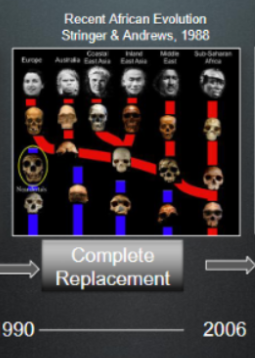
Models for modern human origins:
Recent African Origins
You see a strong origin in Africa, then movement outward.
The blue lines represent older human species dying off.
The red lines show modern humans spreading and replacing them.
👉 Meaning: Humans evolved only in Africa, then spread out and completely replaced other human species.
👉 Labeled as: “Complete Replacement”
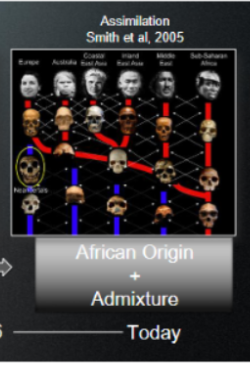
Models for modern human origins:
Assimilation
Starts like the African model (origin in Africa).
But now there are some connections (mixing) with other populations.
Not full replacement—some older populations contribute genetically.
👉 Meaning: Humans came from Africa but interbred with others (like Neanderthals).
👉 Labeled as: “African Origin + Admixture”
Fossilization
the rare, complex geological process by which biological remains (bones, shells) or traces (footprints) are preserved, usually turning into stone over thousands or millions of years, typically requiring rapid burial in sediment.
Difference between absolute and relative dating
and examples of each
Relative Dating
The law of superposition: in undisturbed stratigraphic sequences, objects that are in lower Strata are older than objects in upper strata.
Absolute Dating
Giving things a date. This is 100 years old
general anatomical characteristics of pre-australopithecines
Primitive (ape-like) traits
Very small brains (chimp-sized)
Strongly prognathic faces (face sticks out)
Large canines (often with honing complex)
Ape-like teeth (U-shaped dental arcade)
Long arms, short legs (arboreal adaptations)
Curved fingers and toes (tree climbing)
🔹 Early bipedal traits (limited)
Some evidence of bipedalism, but:
Not fully efficient or obligate
Still spent significant time in trees
👉 Big idea: Mostly ape-like, with the first signs of walking upright
Pre-Australopithecines = “mostly ape”
general anatomical characteristics of earlyaustralopithecines
Primitive traits (from your notes)
Small brains
Large, prognathic faces
Small bodies
Long arms
Relatively large canines
Ape-like dental formula (2.1.2.3)
🔹 Derived (more human-like) traits
Clear bipedalism (habitual/obligate)
Knee valgus angle
Pelvis and leg adaptations
Reduced canines (compared to earlier hominins)
Larger posterior teeth (molars)
Non-divergent big toe (in later forms like afarensis)
Foot arch & heel strike (Laetoli footprints)
Early Australopithecines = “walking ape”
general anatomical characteristics of robust australopithecines
Very large, broad face
Extreme cheek flare (wide, dish-shaped face)
Sagittal crest present (for large chewing muscles)
Huge molars and premolars (back teeth)
Small incisors (less emphasis on front teeth)
Highly specialized for heavy chewing (tough plant foods)
Key Similarities (Important!)
Postcranial skeleton nearly identical
Fully bipedal
Both have large back teeth (robust = larger)
Brain sizes similar (ape range)
Robust: ~500 cc
Gracile: ~450 cc
general anatomical characteristics of gracile australopithecines
Large face, but not as extreme as robust forms
Moderate cheek flare (less wide face)
No sagittal crest (no big chewing muscle ridge)
Large incisors (front teeth)
Less specialized teeth overall
Molar microwear suggests a more varied diet
Key Similarities (Important!)
Postcranial skeleton nearly identical
Fully bipedal
Both have large back teeth (robust = larger)
Brain sizes similar (ape range)
Robust: ~500 cc
Gracile: ~450 cc
anatomical signs of bipedalism
Non-divergent big toe
Heel strike
Well-developed arch
Lucy and why she is so important
“Lucy” (aka AL 288-1)
A. afarensis dating to ~3.2 mya
Hadar, Ethiopia
40% of skeleton complete
Female due to wider more rounded pelvic opening
Third molars erupted → adult
Arm and leg bone lengths → 3’3” and about 60 lbs.
Pelvic bones and femur indicate bipedalism
Riverine forest at the time
Proof of Early Bipedalism: Lucy’s pelvis and leg bones closely resemble those of modern humans, providing, at the time of discovery, the earliest definitive evidence that hominins walked on two legs, even while retaining some tree-climbing abilities.
Filling the Evolutionary Gap: As one of the most complete, oldest hominin skeletons ever discovered at the time, she filled a massive gap in the fossil record between apes and early humans.
"Missing Link" Icon: She became a "celebrity fossil" that made paleoanthropology accessible, highlighting that our origins began in Africa.
Redefining Ancestry: Her discovery supported the understanding that human evolution was a gradual process, placing A. afarensis as a key ancestor in our lineage.
Homo erectus and why they are so important (fire, leaving Africa, etc…)
Homo erectus (approx. 2 million to 117,000 years ago) is a pivotal human ancestor, recognized as the first to possess a modern body plan, use fire, and disperse out of Africa into Asia and Europe. Their ability to adapt, hunt, and create, particularly using Acheulean stone tools, enabled them to survive for nearly 2 million years—longer than any other species in our genus.
Why Homo Erectus is So Important:
Leaving Africa (First Human Migrant): H. erectus was the first hominin to leave Africa and populate vast areas of the Old World, reaching regions like Java (Indonesia) and Georgia by roughly 1.8–2 million years ago.
Mastery of Fire: They are likely the first human relative to control fire, possibly dating back over 1 million years. This allowed for cooking food (increasing protein intake), protection against predators, and warmth in colder climates.
Technological Advancements: They developed the Acheulean stone tool industry, creating sophisticated bifacial tools like handaxes and cleavers for butchery and other tasks.
Modern Body Plan: They were the first hominins with human-like body proportions: shorter arms and longer legs for long-distance walking/running, adapting to varied environments.
Brain Expansion: They displayed a significant increase in brain size compared to earlier ancestors, suggesting increased cognitive abilities
Neanderthals and their relationship to modern humans
Neanderthal genes found only in non-Africans
Interbred with modern humans AFTER they left Africa – likely soon after
Neanderthal genes detected in modern populations in W. Europe, E. Asia, and S. Pacific
Suggests the last common ancestor of Neanderthals and modern humans between 700 and 516 kya
Denisovan DNA also present in modern populations and in some Neanderthal individuals
Neanderthals and Denisovans likely both incipient species
Not fully distinct from H. sapiens
Evidence for Neanderthal culture
Brain is large and complex, and they likely needed speech to hunt.
Recently, a gene (FOXP2) related to speech in humans was identified in Neanderthal specimens, and it contained the same mutations we have, suggesting Neanderthals might have shared some basic language capabilities with modern humans
Mousterian tools
Smaller, lighter, and thinner than Acheulean hand axes
Hafted onto handles - spears
Mousterian tools vary site-to-site
Different tool-making traditions between communities?
Disappeared from archaeological record with the extinction of Neanderthals
Arboreal adaptation
Arboreal adaptation refers to the evolutionary, structural, and behavioral specializations of animals for living and moving within trees. These adaptations, crucial for survival in forest canopies, include grasping hands/feet, long limbs for balance, specialized claws, and enhanced vision to navigate complex 3D environments, often leading to reduced predation risks
Chimp and Gorilla locomotion
Opposable thumb/big toe
Nails instead of claws; tactile pads on ends of digits
Generalized skeletal structure
Tendency towards erect posture (vertically oriented)
vertebral column allows great range of motion
Lemur “Sunning” itself
Divergent thumb & big toe (opposable)
Nails on digits (instead of claws)
Grasping hands, dermal ridges
cost and benefits of being social (primates)
Costs? • Compete with group members for resources • Competition=>injury , death, more energy expenditure | Benefits? • Safety in numbers (predator defense) • Can outcompete smaller neighboring groups • Males attracted to groups of females • Females will tolerate familiar males |
language in non-human primates (how we do define human language- 8 ways)
1. Displacement
Human language can refer to past and future times and to different locations.
What does a mermaid look like? A werewolf?
What does love feel like?
2. Arbitrariness
No natural connection between linguistic form and its meaning.
E.g. in English word for “flower” , when written or spoken neither looks, smells, nor feels like a flower.
3. Productivity/creativity
Humans learning a language can form and produce utterances never heard before. Open-ended.
E.G. “on fleek” “Savage” “Netflix and chill”
4. Cultural transmission
Acquire language from listening to other speakers and participating. Passed on from one generation to the next.
5. Discreteness
Sounds in language are meaningfully distinct.
/pin/ vs. /bin/
6. Duality
Language is organized on two levels, the physical level and in our ability to produce sounds. And at the level of meaning, when we produce sounds in combination.
/c/, /t/, /a/
Can be organized into different words with different meanings. CAT, ACT, TACT, TACIT….
7. Semanticity
Language carries meaning.
The cats sing negatively.
Hay leche?
“Oh great. The cat threw up on our bed”
What does the word “crash” mean?
8. Structure dependence
Language is dependent on structure, syntactical rules.
The cats sing negatively.
Syntax/structure is correct- subject, verb, adverb- but does not make sense.
Primitive and derived primate characteristics
Primitive traits
Small brains
Large faces (prognathic and wideset)
Small bodies
Long arms and long curved fingers
Big canines
Ape-like configuration of teeth (2.1.2.3)
Derived traits
Diverse – varies by species
Some human-like, some not
Reduced canines and molars
Pelvic and leg morphology = biped
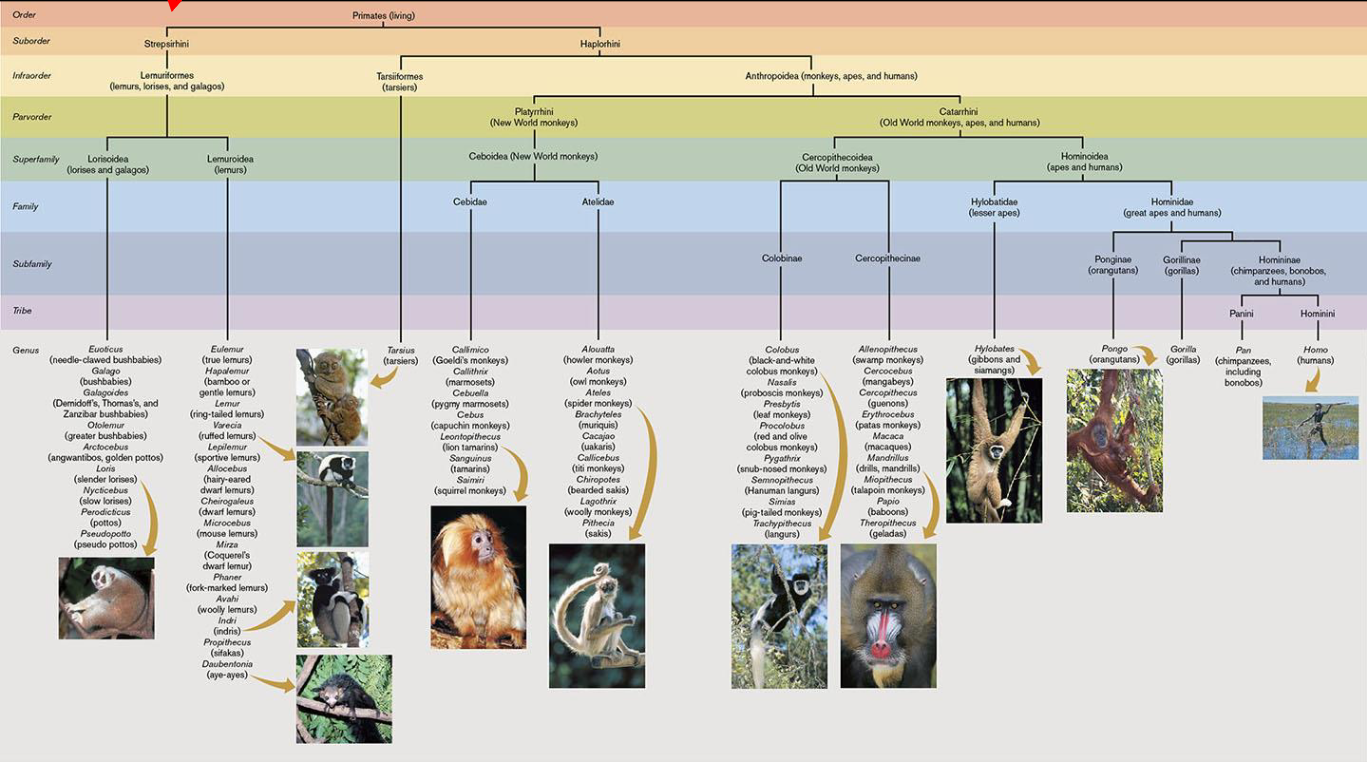
basic traits of the Strepsirrhines
Rhinarium - wet nose
Dental comb
basic traits of the haplorrhines
Anthropoidea: Monkeys, apes, humans
Diurnal
Vision
Often terrestrial
Social- more parental care, mutual grooming, etc.
Herbivorous and omnivorous
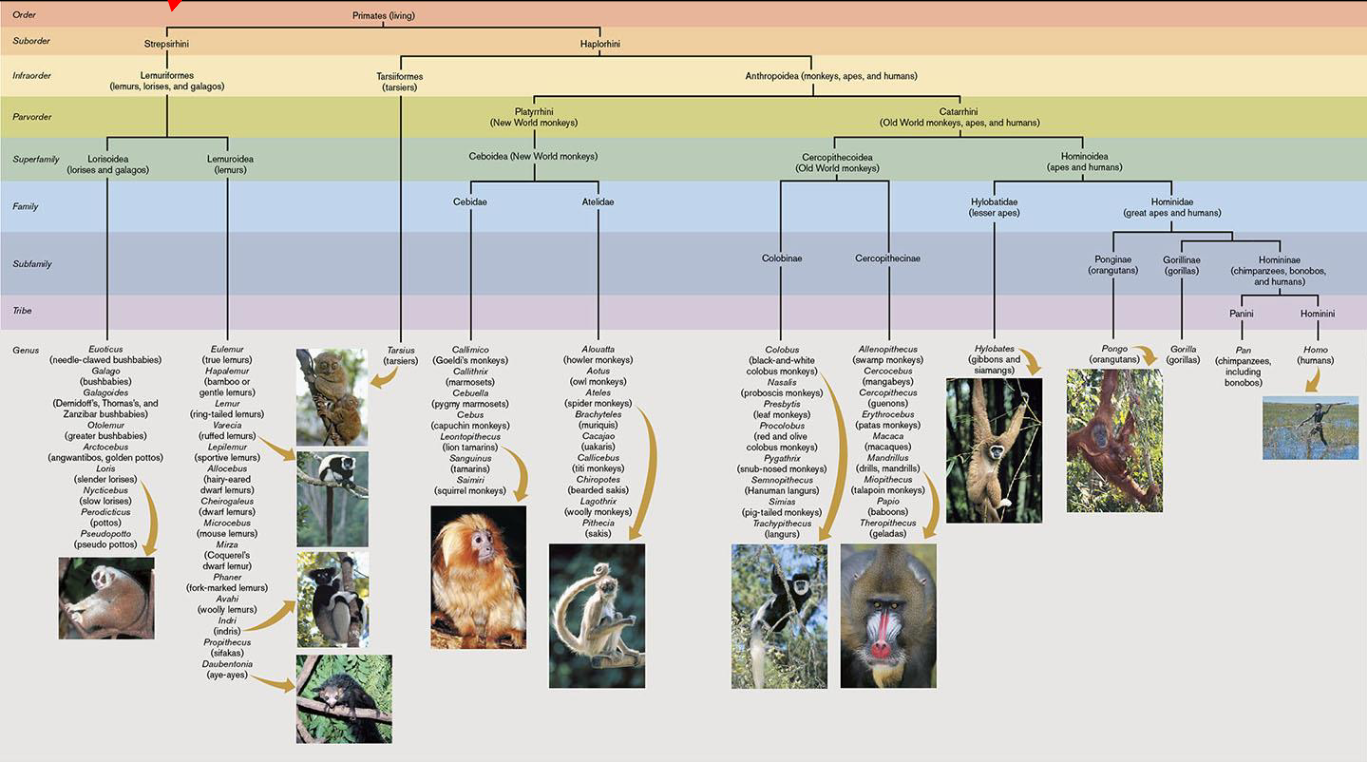
Difference between old (catarhines) and new world monkeys (platyrrhines)
Platyrrhini: New World Monkeys (NWM)
Cebidae
(e.g. Squirrel monkeys, Capuchin, marmosets, tamarins)
Atelidae
(e.g. howler monkeys, spider monkeys, uakaris, bearded sakis)
Pygmy Marmoset- smallest NWM
Example of the hairless patch of skin that enhances the grip of the prehensile tail. This tail is seen some of the New World Monkeys!
New World Monkeys:
Seven species of NWM inhabit different ecological levels of the Suriname tropical rain forest
Catarrhini: Old World Monkeys (OWM), Apes, Humans
Cercopithecoidea: OWM
Colobinae
E.G. colobus monkeys, langurs
Cercopithecinae
E.G. macaques, baboons, mandrills, vervets
Chimp vs. Bonobo behavior
Bonobos and chimpanzees exhibit strikingly different behaviors despite being closely related. Bonobos are generally peaceful, matriarchal, and utilize social sexual behavior to manage conflict, while chimpanzees are patriarchal, highly territorial, and prone to violent, lethal aggression. Bonobos show high tolerance toward strangers, whereas chimps are xenophobic
Tool use and culture in primates
Tool Use
Primates use objects to solve problems or obtain food.
Not just humans—seen in chimpanzees, capuchins, etc.
Examples:
Chimpanzee:
Use sticks to fish for termites
Use stones to crack nuts
Capuchin monkey:
Use rocks as hammers and anvils
Orangutan:
Use leaves as sponges or gloves
👉 Key idea: Tool use shows problem-solving and intelligence
🧠 Culture in Primates
Culture = learned behaviors passed socially, not genetically
Characteristics:
Learned through observation/imitation
Varies between groups of the same species
Examples:
Different chimp groups use different tools for the same task
Some populations have unique grooming rituals
👉 Key idea: Culture means “they learn from each other”
Primate reproductive strategies (infanticide, female reproductive strategies, etc…)
Infanticide
Killing of infants (usually by males)
Why it happens:
Brings female back into estrus faster
Male can pass on his genes
Seen in:
Lion (classic example, though not a primate)
Hanuman langur
👉 Key idea: It’s about reproductive advantage
👩 Female Reproductive Strategies
Females evolve behaviors to protect offspring and maximize survival
Strategies:
Paternity confusion
Mate with multiple males → reduces risk of infanticide
Form alliances
Social bonds with other females or protective males
Mate choice
Prefer strong/high-status males
Concealed ovulation (in some species)
Males can’t tell when fertile → stay around longer