BIOL 107 Part E - Enzymes and Photosynthesis (Terms)
 Call Kai
 Learn
Learn Practice Test
 Spaced Repetition
 Match
Match Flashcards
 Knowt Play
1/37

There's no tags or description
Looks like no tags are added yet.
Name | Mastery | Learn | Test | Matching | Spaced | Call with Kai |
|---|
No analytics yet
Send a link to your students to track their progress
38 Terms
Metabolism
The chemical reactions taking place within a cell/organism
First Law of Thermodynamics
Law of thermodynamics stating that the amount of energy in the universe is constant, so energy can only be transferred, not created or destroyed
Entropy
A measure of the disorder in the universe, representative of the unavailability of a system’s energy to do useful work
Second Law of Thermodynamics
Law of thermodynamics stating that the disorder in the universe is increasing, so energy transfers or transformations cause some useful energy to be lost as heat
Free Energy (G)
Amount of a system’s total energy available to do work
Exergonic Reaction
A reaction in which energy is lost as the reaction progresses, thus releasing energy and having a negative change in free energy
Endergonic Reaction
A reaction in which energy is absorbed as the reaction progresses, thus requiring energy and having a positive change in free energy
Sucrase
An integral membrane protein enzyme that facilitates the breakdown of sucrose via hydrolysis into two monosaccharides, glucose and fructose
Activation Energy
Initial input of energy needed to break the bonds and cause a reaction to begin
Alcohol Dehydrogenase (ADH)
A homodimer enzyme found in the cytosol of human liver cells that breaks down ethanol into acetaldehyde
Allergy
When white blood cells in the immune system react to a harmless molecule
Food Intolerance
Lacking the required enzyme needed to digest a molecule
Electron Carriers
Small organic cofactors that work with enzymes, with high and low energy forms that accepts and releases electrons in changing forms
Transpeptidase
An enzyme that synthesizes peptidoglycan in bacteria
Beta Lactamase
A protein encoded by some bacterial plasmids that cuts up penicillin
Antibiotics
Molecules that kill bacteria inside the human body, typically by inhibiting enzymes that are needed for bacterial cells to function
Antiseptics
Molecules that kill bacteria outside the human body, typically by physically damaging the cell wall of bacteria
Photosynthesis
The process by which plants create energy, using (solar energy + water + CO2 → sugar + O2)
Light
Radiation with a specific wavelength that travels as photons
Mesophyll
Internal tissue in the middle of leaves that contain chloroplasts and are connected to veins
Stroma Space
Space inside chloroplast filled with dense fluid that is encapsulated by the inner and outer membrane, containing ribosomes, chromosomes, and RNA polymerases
Thylakoid
System contained in the stroma in chloroplasts composed of sacs that are separate from the stroma space, where chlorophyll is found
Chlorophyll
A green pigment (absorbs red and blue) used in photosynthesis that is found in the thylakoid membrane of chloroplasts
Resonance Energy Transfer
A form of energy decay used by chlorophyll in which the excited state goes from molecule to molecule through movement of energy only, not movement of electrons
Electron Transfer
A form of energy decay used by chlorophyll in which the electron in the excited state is moved from one molecule to another
Photosystem (PS)
An molecular machine comprised of integral membrane proteins containing pigment molecules that capture light to excite electrons
Electron Transport Chain (ETC)
Chain structures made of membrane proteins and quinones that transport electrons and allow protons to move across a membrane
Water Splitting Enzymes
Peripheral membrane proteins that perform hydrolysis of water in order to supply electrons
NADP+ Reductase
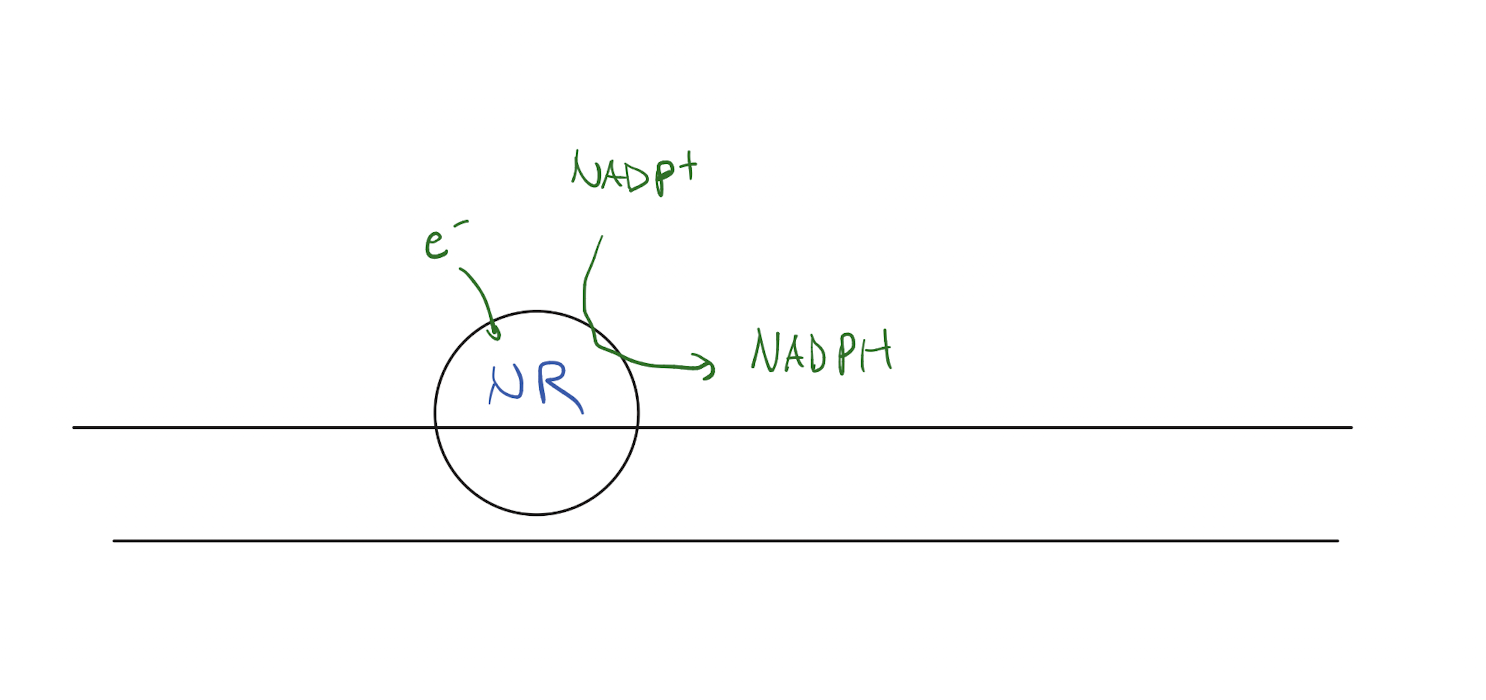
Peripheral membrane protein enzymes that catalyze the reduction of NADH+ to NADPH through the intake of an electron
ATP Synthase
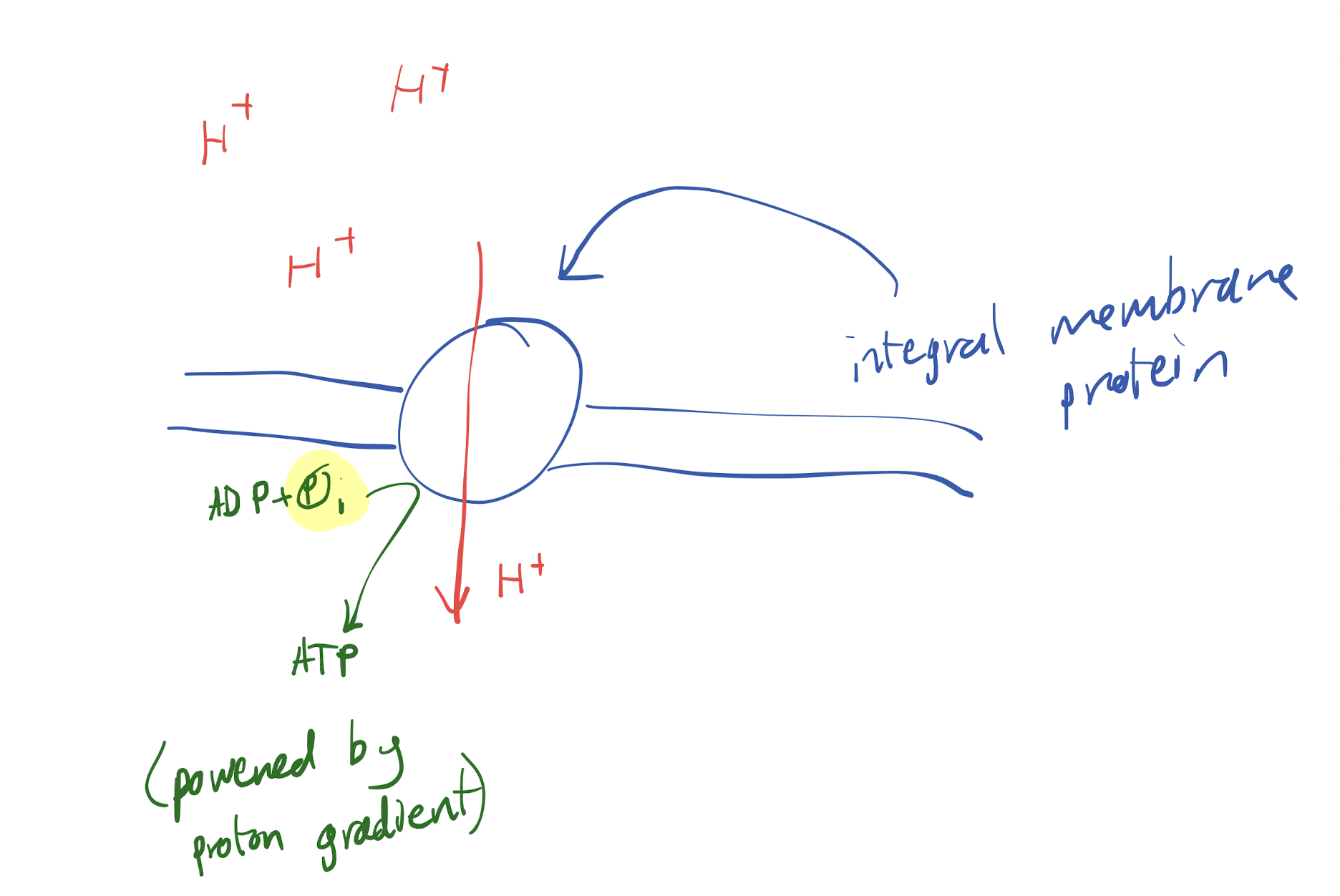
Enzyme made from peripheral and integral membrane proteins that catalyze the synthesis of ATP from ADP and an inorganic phosphate, powered by a proton gradient
Cyclic Electron Flow
The process that occurs in the thylakoid membrane that uses sunlight to make ATP
Linear Electron Flow
The process that occurs in the thylakoid membrane that uses sunlight to make ATP and NADH
Rubsico
A large polypeptide enzyme that fixes carbon into a useful form (C5 +CO2 → C6)
Calvin Cycle
One part of photosynthesis that transforms 3 carbon dioxide molecules into one G3P sugar molecule
Carbon Fixation
The first phase of the Calvin cycle in which 3 CO2 molecules enter and are fixed into a PGAs to be used for synthesis
3-Phosphoglyceric Acid (PGA)
A low energy 3-carbon molecule formed as the end product of carbon fixation
Synthesis of Sugar
The second phase of the Calvin cycle in which PGA molecules are transformed into G3P sugars powered by ATP hydrolysis
Glyceraldehyde 3-Phosphate (G3P)
A high energy 3-carbon molecule formed as the end product of the Calvin cycle