ECN 211 Final Exam Review (Marburger ASU)
 Call Kai
 Learn
Learn Practice Test
 Spaced Repetition
 Match
Match Flashcards
 Knowt Play
1/40

There's no tags or description
Looks like no tags are added yet.
Name | Mastery | Learn | Test | Matching | Spaced | Call with Kai |
|---|
No analytics yet
Send a link to your students to track their progress
41 Terms
cyclical unemployment
unemployment caused by a business cycle recession
frictional unemployment
short spells of unemployment when workers are in between jobs
structural unemployment
unemployment that results from the mismatch in skills, locations, or other important characteristics between job seekers and the available jobs
natural rate of unemployment
the unemployment rate that arises from the effects of frictional and structural unemployment
macroeconomics
The study of the economy as a whole
microeconomics
the study of the individual units that make up the economy
absolute advantage
the ability to produce more of a good than another producer
comparative advantage
the ability to produce a good at a lower opportunity cost than another producer
opportunity cost
what has to be given up to do something else
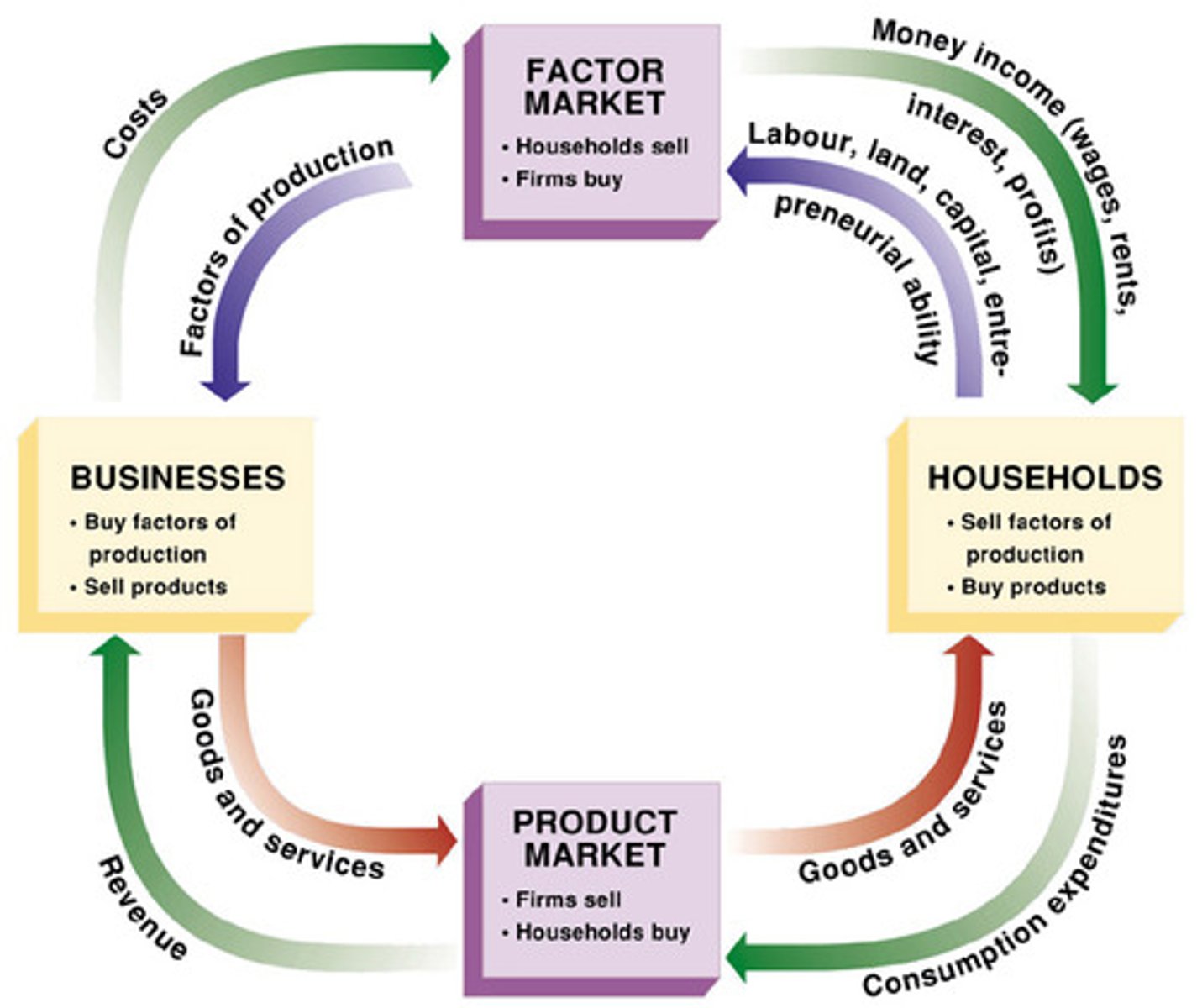
circular flow model
a diagram that shows the circular movement of money, resources, and goods and services among households and producers in an economy
tariffs
Taxes on imported goods
Smoot-Harvey act
Tariff in 1930, lead to massive tariff retaliation (made the depression worse)
nominal GDP
current prices x current quantity
real GDP
base year prices x current quantity
CPI
(current price x base quantities/base prices x base quantities) x 100
inflation
increase in prices
recession
period of reduced economic activity
depression
A long-term economic state characterized by unemployment and low prices and low levels of trade and investment
unemployment rate
# of unemployed/labor force x 100
bonds
Certificates of debt that carry a promise to buy back the bonds at a higher price (IOU)
stocks
shares of ownership in a company
The Fed
Federal Reserve System
How the fed increases money supply
1) decrease required reserve ratio
2) decrease interest rate on reserves
3) decrease discount rate
4) buy bonds
How the fed decreases money supply
1) increase required reserve ratio
2) increase interest rate on reserves
3) increase discount rate
4) sell bonds
How the government reduces inflation
1) decrease government spending
2) decrease money supply
3) increase taxes
How the government eliminates a recession
1) increase government spending
2) increase money supply
3) decrease taxes
functions of money
1) medium of exchange
2) unit of account
3) store of value
Money multiplier formula
1/reserve requirement x initial deposit
What affects aggregate demand?
1. Wealth effect (consumer incomes are constant, can't buy products at a higher price level)
2. interest rate effect (higher interest rates = less demand)
3. substitution bias
Government MPC
(1/1-MPC) x government spending
Tax MPC
(-MPC/1-MPC) x tax cut or increase
Phillips Curve
a curve that shows the short-run trade-off between inflation and unemployment
Quantity theory of money
M x V = P x Y
GDP
GDP = C + I + G + X - M
GDP Deflator
Nominal GDP/Real GDP x 100
Real GDP per capita
real GDP/population
labor force participation rate
(# of people in labor force/adult population) x 100
aggregate demand
the amount of goods and services in the economy that will be purchased at all possible price levels
aggregate supply
the total amount of goods and services in the economy available at all possible price levels
demand
the quantity of a good or service that consumers are willing and able to buy
supply
The quantity of something that producers have available for sale