Non-Visual Photoreception
 Call Kai
 Learn
Learn Practice Test
 Spaced Repetition
 Match
Match Flashcards
 Knowt Play
1/40

Earn XP
Description and Tags
Lecture 17
Name | Mastery | Learn | Test | Matching | Spaced | Call with Kai | Chat |
|---|
No analytics yet
Send a link to your students to track their progress
41 Terms
2 types of retinal input to the brain?
visual input
non-visual system
3 components regulated by the non-visual system in retinal input to the brain?
pupil size
terminate melatonin secretion
circadian effects
Non-Visual System
involves light detection, but no images
Visual Input
image forming system
2 main systems in the transfer of visual input from retina to the brain?
LGN
visual cortex
5 biological processes that light detection is important for (other than seeing)?
synchronizing the circadian clock
pupil size
inhibiting melatonin secretion
induction of sleep (in rodents)
negative phototaxis
Pupil size is regulated by _____ _____.
light intensity
2 main ways to test which photoreceptor is involved in non-visual responses?
spectral sensitivity assays
genetic mutations
How are spectral sensitivity assays used to test which photoreceptors are involved in non-visual responses?
see which wavelengths respond the best
3 things some blind people (non conscious light perception) retain?
synchronize to a light/dark cycle
phase shift to a light/dark cycle
suppress nocturnal melatonin levels with light exposure
Which photoreceptors match the spectral sensitivity of the circadian system?
rods
How did we determine that rods were involved in the non-visual responses?
tested phase shifts to different wavelengths & found they had maximal shifts to blue/green light; matches circadian system
In testing which photoreceptors match the spectral sensitivity of the circadian system, researchers found that the maximal shifts were to _____/_____ light, near ___nm. Later research found that this was between ___nm & ___nm.
blue/green
500
476
515
Contrary to what was guess using spectral sensitivity assays, research found that phase shifts persist in mice lacking _____ & _____.
rods
cones
Describe the phase shifts & melatonin levels in mice lacking rods & cods. Describe this in the mice lacking eyes. What does this suggest?
phase shifts persist & melatonin decreases when exposed to light
no phase shift & melatonin does not respond to light normally
suggests that eyes are important for the circadian cycle, but not rods & cones
How do birds & reptiles differ in their photoreceptor anatomy? What does this mean for their ability to synchronize without eyes?
pineal glands are photoreceptive (reptile have “parietal eye” that connects to glan); have deep brain photoreceptors
can synchronize to light/dark after eyes have been remove
What did researchers find when they applied light to the back of human knees? Has this withstood the test of time?
could reset circadian clock
no, widely discredited
How does enculeation affect mammalian circadian shifting? What does this tell us?
show no response to light exposure with eye removal
eyes are necessary
With rods & cones shown not to cause phase shifts, what other photoreceptor has been positioned to be responsible for the non-visual system?
melanopsin
Melanopsin
light-responsive ganglion cells
6 qualities of rods & cones?
medium to narrow receptive fields
fast responses
medium to high sensitivity
light hyperpolarizes cells (no APs)
adapt to continuous illumination
specialized for detail & contrast
6 qualities of melanopsin?
huge receptive fields
slow “on” & “off” responses
low sensitivity
light depolarizes cells (APs)
do not adapt to illumination
specialized for illumination
What is the max wavelength for rods? Cones? Melanopsin?
494
419
484
Mice lacking melanopsin have a diminished _____ _____ in response to bright light, but can still see.
pupillary response
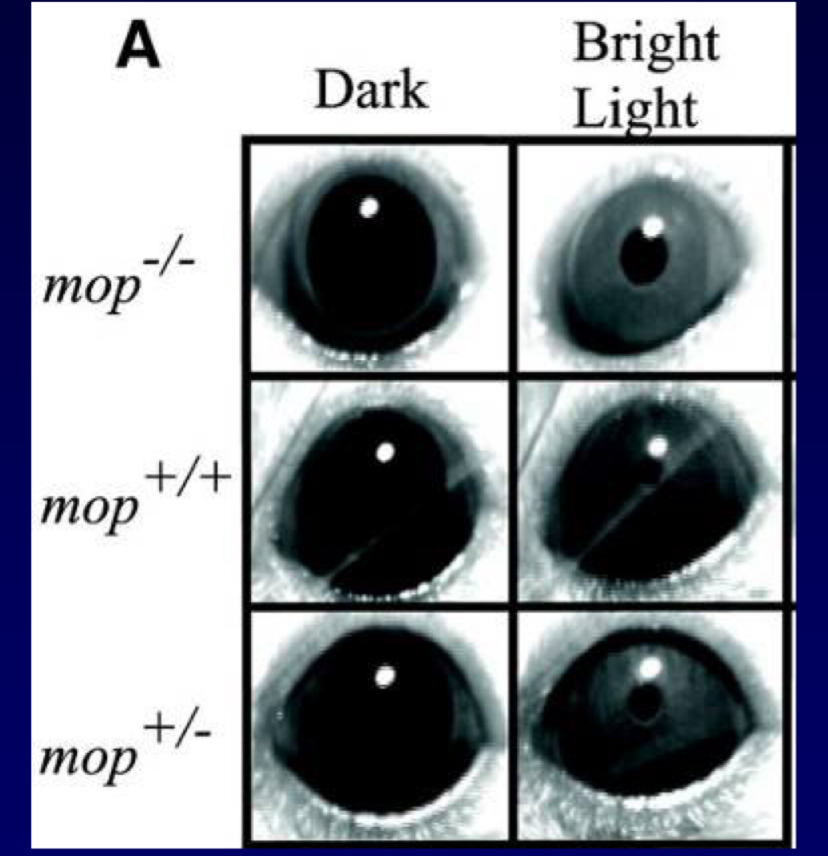
Mice lacking melanopsin have a diminished _____ _____ in their circadian rhythms in response to bright light.
phase shift
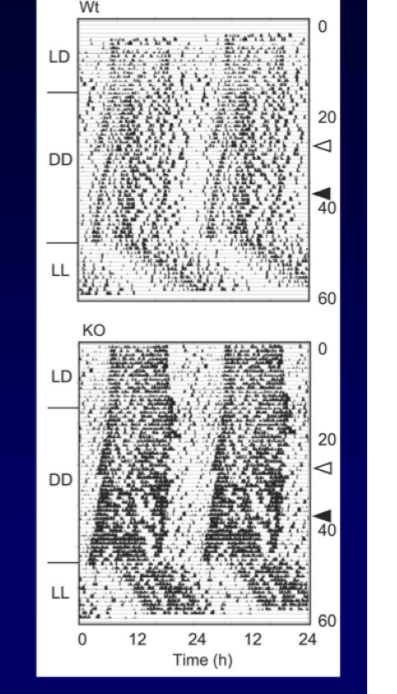
2 findings in melanopsin knockout mice in response to bright light?
diminished pupillary reflex
diminished phase shift in circadian rhythms
Compare responses to light in the following: rodless mice; rodless/coneless mice; melanopsin knockouts. What does this suggest?
full response
full response
smaller response, but there is still a response
perhaps there is a redundancy in the system?
3 things we see in response to light in triple knockout mice (i.e., rods, cones, melanopsin)?
no pupillary response to light
do not show a decrease in melatonin synthesis enzyme AA-NAT
do not synchronize to light/dark cycles (non-24)
Given that it takes the triple knockout to remove synchronization abilities, there may be overlap in _____ and _____ function.
RGC
ipRGC
2 reasons researchers tested the elimination of the ipRGCs?
tests if non-ipRGCs participate in non-visual responses
tests if ipRGCs participate in normal visual responses
3 findings following the selective elimination of ipRGCs? What does this suggest?
loss of pupillary response to light
loss of circadian responses to light
preservations of visual responses
ipRCGs are necessary for non-image forming responses
_____ contain melanopsin & are important for non-image forming photoreception.
ipRGC
_____ _____, _____ _____, and the _____ _____ are all regulated by non-image forming photoreception from the ipRGCs.
melatonin levels
circadian rhythms
pupillary reflex
_____ and _____ can activate ipRGc, compensating for the lack of melanopsin in melanopsin KO animals.
rods
cones
5 effects of using tablet/eBook at bedtime?
longer SOL
less REM
higher alertness before bed
sleepier the next day
more difficulty waking up
While effects of using tech before bed are often described in terms of blue light keeping the system awake, most of these effects are likely due to _____.
arousal
3 effects on melatonin secretion from room light?
delayed
shortened
decreased
Given the wavelengths of light impacting the circadian system, what has been suggested to avoid negative effects of tech at bedtime?
blue light blockers/filters
Given the literature as a whole, does blue light vs blue light blockers effect sleep?
no; not well replicated but mixed findings
3 major conclusions from the studies examining blue light at bedtime?
any effects are likely minor & will have minimal next-day effects anyways
habitual use of the blue filter might diminish any initial benefit
probably better to just avoid any significant light at night
How do we know visual responses are preserved when ipRGCs are selectively eliminated?
can still see the visual cliff when tested