PSYCH 417: EXAM 1
 Call Kai
 Learn
Learn Practice Test
 Spaced Repetition
 Match
Match Flashcards
 Knowt Play
1/38

There's no tags or description
Looks like no tags are added yet.
Name | Mastery | Learn | Test | Matching | Spaced | Call with Kai |
|---|
No analytics yet
Send a link to your students to track their progress
39 Terms
psychological views of the brain
monism
dualism
parsimony
monism (psychoneural identity hypothesis): mental states are identical to physical states of the brain, they exist as a single function
dualism: the mind and body are separate and function separately and independent entities
parsimony: the simplest explanation tends to be the most correct
allostatic load
cumulative physiological toll/prolonged adaptation on body’s major systems
accelerates bio aging through chronic stress
e.g., animals with higher metabolic rate —> shorter lifespan
3 dimensions of aging
biological: physiological functioning
psychological: cognitive & emotional functioning
social: milestones, “social clock”
aging terms
gerontology
geriatrics
lifespan
life expectancy
gerontology: study of aging across all 3 dimensions
geriatrics: diagnosis and treatment of age-related conditions; aging is not a disease
lifespan: max age attainable, under optimal conditions, “biological upper limit”
life expectancy: avg years expected to live, based on stats
4 factors that increase life expectancy
food prod & dist
sanitation & public health
medical advances
technology & living conditions
“The Twilight Zone": Long Live Walter Jameson”
Jameson: Civil War, over 2000 years old
Sam: dad
Susanna: daughter
difficulties of studying human aging
time: long-term tracking
variability: individual differences in aging
confounds
cohort effects
psychological aging studies
cross-sectional
longitudinal
pros vs cons?
cross-sectional: compare different age groups at one point in time
pros: fast, inexpensive, easy
cons: correlational (not causational), infer differences (not changes)
longitudinal: follow same individuals across multiple time points
pros: true within-person change, controls for cohort effect
cons: costly, time-intesive, attrition, cannot generalize easily
animal models in aging research
pros vs cons?
pros:
shorter lifespan
invasive procedures possible
minimize genetic variability
karger sample sizes
cons:
ethical issues
functions & theories of aging
inbuilt program theory + con?
disposable soma theory + con?
terminal drop model
inbuilt program theory: prevents overpopulation by clearing older individuals to make way for younger generations
con: most animals in the wild die before old age
disposable soma theory: body budgets limited energy resources
prioritizes reproduction
defers somatic cell maintenance/repair
con: difficult to test directly in humans
terminal drop model: before death in old age (~5 years), there is a terminal drop in life satisfaction and physiological function
3 levels of biological aging damage
tissue: loss of collagen protein → reduced elasticity
cellular: decline in mitochondrial function → less energy
molecular: DNA mutations accumulate over time
Don’t Die: The Man Who Wants To Live Forever
Bryan Johnson
Son: Talmage
Project Blueprint: Level 1, 2, 3 protocol
jobs
sandwich shop
entrepreneur
credit card salesman
Braintree: paypal, venmo, etc.
challenges in assessing cognitive function in older adults
increased individual variation
test anxiety; lab coat syndrome
test difficulty: designed for young adults, difficult for older adults
decreased stamina: fatigue during long tests
sensory & motor deficits: vision, hearing, etc., impairments
2 types of intelligence
crystallized
fluid
crystallized: accumulated knowledge and skills
associated with older adults
fluid: novel problem-solving abilities, mental flexibility
associated with younger adults
aging effects on life
attention
- simple
- complex
—sustained
—selective
—divided
—alternating
reaction time
creativity
language
executive functioning
attention:
simple: immediate memory, relatively stable with slight decline
complex: noticeable decline over time
sustained: focus on one task (e.g., driving a long time)
selective: focusing on relevant info (e.g., noisy room)
divided: multi-tasking
alternating: switching between tasks
reaction time: slows over time
creativity: declines with age
language: vocabulary intact, naming/recall and verbal fluency declines
executive functioning (EF): higher-order thoughts and control, declines with age
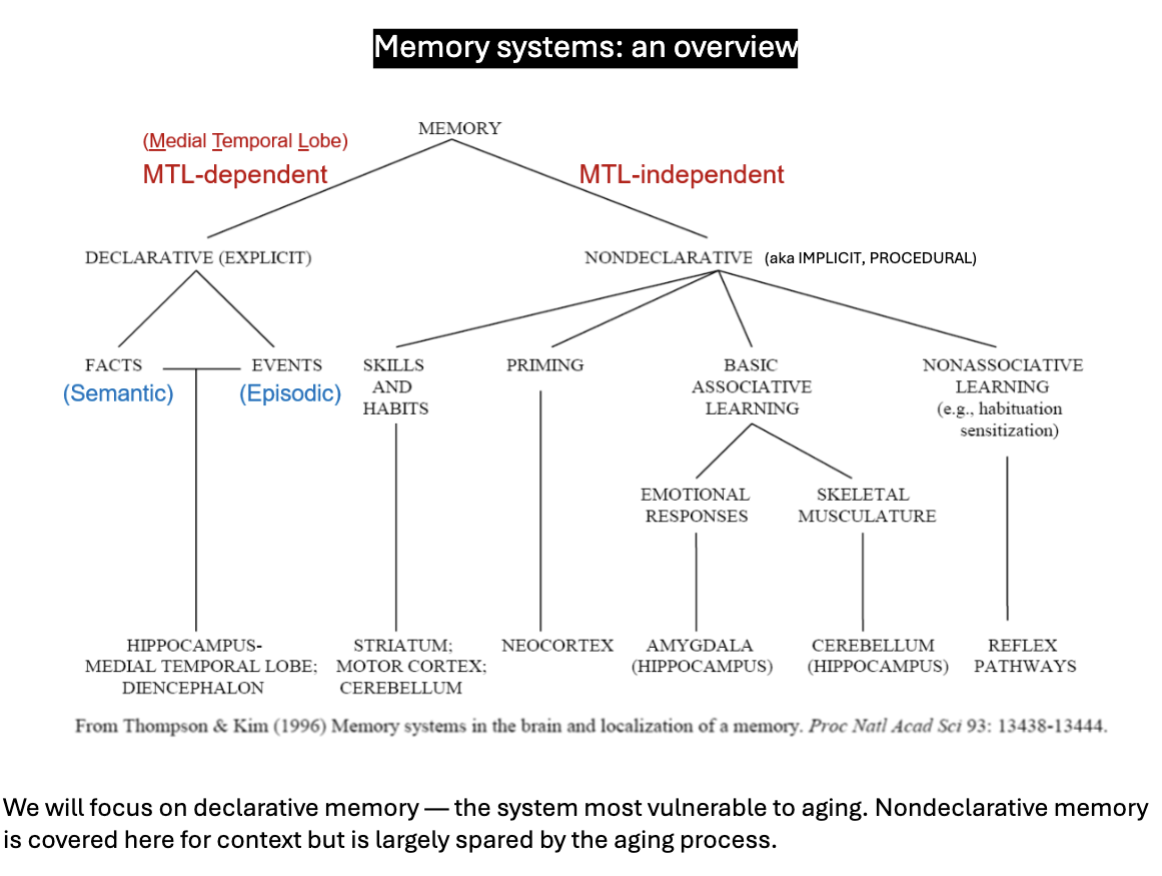
memory systems
declarative
- facts
- semantic
—hippocampus
—MTL
—diencephalon
medial temporal lobe (MTL) dependent
declarative (explicit)
facts (semantic)
events (episodic)
hippocampus
MTL
diencephalon
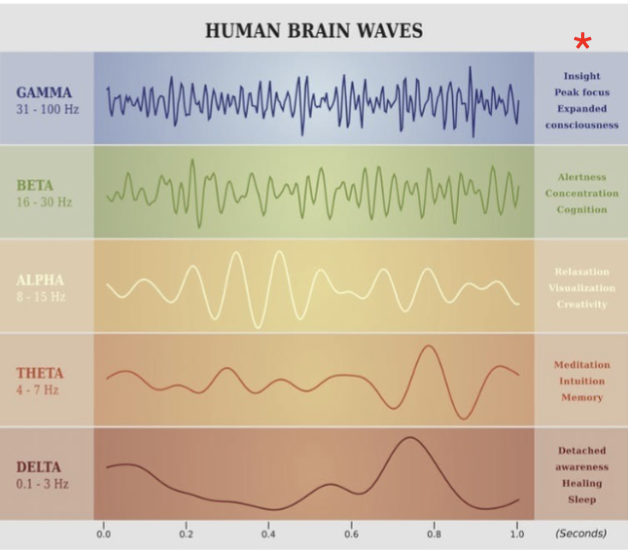
Electroencephalogram (EEG)
EEG: first non-invasice measure of brain function
detects pathologies (e.g., tumors)
tracks arousal states
high temporal resolution (high frequency of captures)
aging: ~10 Hz in younger adults, ~8 Hz in older adults
types of waves
gamma:
beta:
alpha:
theta:
delta:
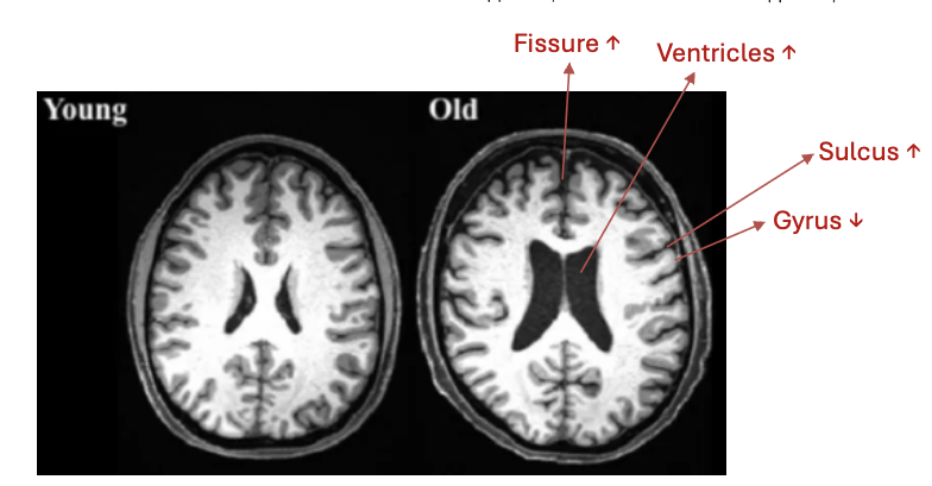
structural changes in the brain
decreased vs increased?
brain size, weight, volume
metabolic activity
neuron loss/shrinkage
ventricles
glial cells
decreased
brain size: gyrus shrinks, sulci expands
loss of white/gray matter
brian weight
brain volume: neocortex, hippocampus, amygdala
metabolic activity: PET scan
neuron loss & shrinkage
increased
ventricles
glial cells: increased activity
memory impairment cause
neuronloss?
synaptic restructuring (hippocampus)?
—SSB, MSB, NSB
not neuron loss (same # somas)
synaptic restructuring in hippocampus
young → aged brain
SSB (single-syn boutan) → NSB (non-syn)
MSB (multi-syn) → SSB
MSB → MSB
reduced dendritic spine density
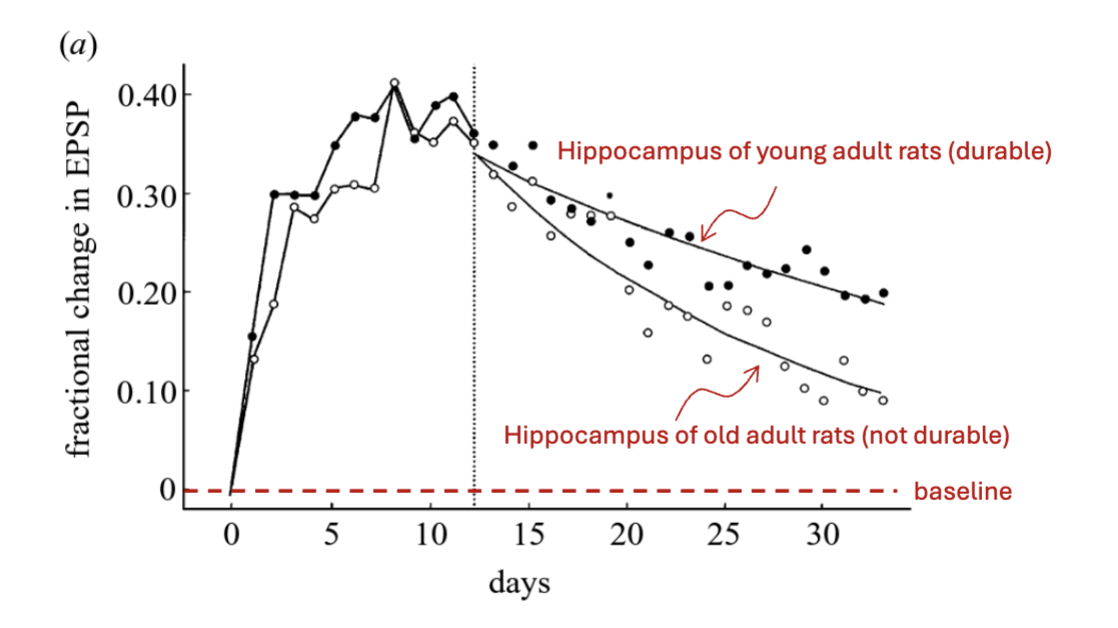
LTP (long-term potentiation)
what is it?
5 characteristics
LTP induction vs decay
does not only occur in hippocampus
persistent, activity-dependent increase in synaptic strength, serving as a cellular model for learning and memory
5 key characteristics
rapid induction: triggered by brief HFS (high-freq stim)
long-lasting: can last for weeks
activity-dependent strengthening: increases with repeated activation (eventual saturation)
input specific: potentiation of restricted → activated synapses
broad anatomical presence: key learning-related regions
i.e., hippocampus, amygdala, neocortex, striatum and cerebellum
LTP induction: rapid, activity-dependent strengthening of synaptic connections
comparable for young/aged hippocampus
LTP decay: gradual, often use-dependent weakening (reversal) of this synaptic strength back to baseline
faster in aged hippocampus → weakens memory (synaptic basis)
spatial view vs place cells
spatial view: fire when a specific part of the environment in is view
depends on what is seen
i.e., humans
place: fire when the animal is in a specific location
depends on where the animal is
i.e., rodents
hippocampal memory loss
reversible or irreversible?
—neurogenesis
—synaptic plasticity
—cognition
lifestyle factors
—exercise
—periodic fasting
—heterochronic parabiosis
not irreversible, can be partially restored
neurogenesis: exercise, caloric restriction, parabiosis
synaptic plasticity: exercise, caloric restriction, parabiosis
cognition: exercise, caloric restriction, plasma injection
exercise: very good! for dendrites, neurons, etc.
periodic fasting: reduces disease risk across species
heterochronic parabiosis: joining a young and old mouse’s circulatory system together
young brain ages, old brain rejuvenates
similar to blood transfusion for humans
counterclockwise study (Ellen Langer, 1979)
experimental group: immersed themselves in retreat, lived as if they were 20 years younger
outperformed control group (reminisced, not immersed) in all physical/cognitive measures
AD
AD: affects memory, cognition, from dementia
differs from typical aging sx in 3 ways
pattern
frequency
recovery
no definitive diagnosis: must rule out everything else first
amyloid plaques: beta-amyloid clusters between neurons that block signaling
extracellular
result of misfolded, aggregated amyloid precursor protein (APP)
amyloid hypothesis: AD not caused by foreign invader, result of brain’s own protein being cut the wrong way
begins decades before dementia diagnosis/sx
neurofibrillary tangles: twisted taue protein inside neurons → collapse cell structure
intracellular
normally stabilizes microtubules → instead detaches and collapses
tau hypothesis: healthy tau → hyperphos → tau detaches → microtubule disintegrate → tau tangles → neuron dies
disease progression stages
first: forgetfulness, memory loss
second: accelerated first stage sx, agitation, restless, repetition
final: complete d/o, loss of body function control, dependence
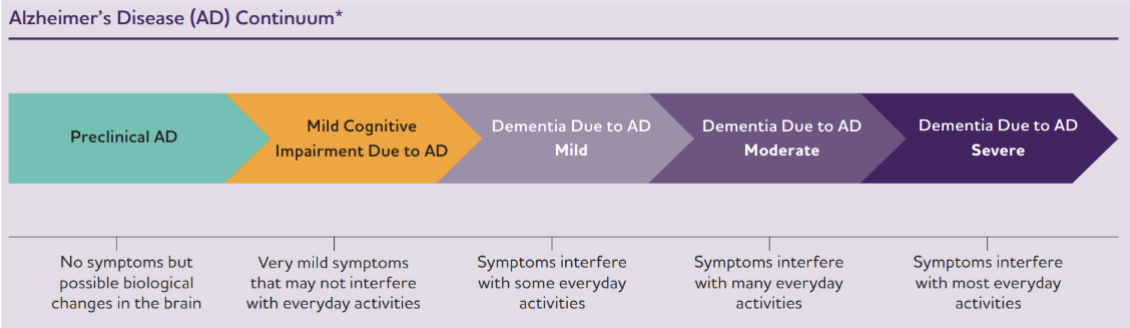
mild cognitive impairment (MCI): normal aging sx, not AD
note: AD continuum
disparity: disproportionately impacts black, hispanic, and female pops
lifestyle: physical inactivity, obesity, smoking, HT, high cholesterol, poor diet
still alice
Alice Howland (?)
linguistics professor
studied neurons, children, language
children, med school, law school, actress
began to forget her words at dinner and at a lecture, “lexicon”
forgot where her husband told her he would be
blurred vision while running
couldn’t remember bread pudding recipe
AD eyeblink conditioning
optogenetics
combining optical and genetic techniques to probe neural circuits as ms-timescale
AD → reduces brain waves
restoring brain waves → beneficial AD effects
non-genetic AD hypothesis
infectious agents:
environment toxins:
vascular:
neuroinflammation/oxidative stress:
cholinergic: degeneration of cholinergic neurons → project to hippocampus and neocortex
loss of ChAT
gut microbiome: microbiota-gut-brain axis
stress-AD connection: chronic stress →disrupts gut microbiome →neuroinflammation →accelerates AD
oral pathogen: periodontal bacteria → neuroinflammation
other emerging: BBB breakdown, viral triggers, mitochondrial dysfunction
PD
3 core/cardinal motor symptoms
resting tremor: present at rest only
muscular (cogwheel) rigidity: disruption of reciprocal inhibition
increased muscle tone
bradykinesia: slowness of voluntary movement initiation
note: finger tapping test
secondary signs
gait disturbance
hypomimia: vacant facial expression
mood disorders
sensory processing
monotonous speech
brain areas
substantia nigra: DA neuron loss, lewy body formation
basal ganglia: regulates voluntary movements, DA regulates direct-indirect pathways
paradoxical movement: visual/stress pathways bypass BG → complex motor during stress
DA loss weakens direct pathway → overactive indirect pathway
overactive indirect pathway → overactive ACh (opposite DA)
overactive ACh → bradykinesia & rigidity
PD treatments
PD: imbalance in ACh (increased) and DA (decreased)
DA needs to cross BBB to increase, needs precursor
tyr: cross BBB, converted into L-DOPA (which can convert into DA)
tyr → L-DOPA → DA (!) → NE → E
PD documentary
MPPP → MPTP
neurotoxic models (PD)
MPTP: converts to MPP+ → kills DA → EOPD
6-OHDA: selectively kills DA and NE neurons
note: genes play a minor role when compared to neurotoxic models
PD treatments
dopaminergic
L-DOPA: DA precursor, reduces tremors, negative side effects develop, drug becomes ineffective
MAO inhibitors: blocks DA breakdown, slows sx progression
COMT inhibitors: extends L-DOPA effect
DA agonists: stimulate DA receptors
surgical
deep brain stimulation (1990’s-present): stimulates STN, reduces overactive inhibition
controls sx, not a cure
stem cell therapy (1990s-ongoing)
fetal implantation (1980-90s)
pallidotomy (1950s)
super agers
cognitive ability comparable to 20 year olds
brain biology
greater cortical thickness
lower amyloid/tau accumulation
protective factors: positive, healthy lifestyle factors
aerobic exercise
cognitive engagement
3 trajectories of dying
cancer: short, predictable, terminal decline
chronic organ failure: long disability, unpredictable death
dementia: slow dissolution of self, no identifiable terminal phase
alpha & gamma waves
associated with high cognition
DECREASE in aging
becomes more evenly distributed in EEG scans
ALL brain waves surge immediately after cardiac arrest, before leveling out
hCO vs t-hCO
hCO: human corticoid organoid (neuron)
t-hCO: transplanted human corticoid organoid (neuron)
showed more “spikes” when injected with AP compared to hCO
closely resembles hCO, with larger soma
chimeric brain (TS model)
chimeric brain model: transplanting human cells in rodent brains
TS: tourette’s syndrome
shorter dendrites, higher spine density, reduced synaptic output
very excitable