principals of psych 3
 View linked note
 Call Kai
 Learn
Learn Practice Test
 Spaced Repetition
 Match
Match Flashcards
 Knowt Play
1/41

There's no tags or description
Looks like no tags are added yet.
Name | Mastery | Learn | Test | Matching | Spaced | Call with Kai |
|---|
No analytics yet
Send a link to your students to track their progress
42 Terms
Language
A system for communicating meaning according to rules of grammar.
Receptive Language
Infants' comprehension develops quickly.
They can understand words and phrases before they can speak them, indicating a strong grasp of language concepts.
Productive Language
Humans learn to communicate verbally very quickly.
Babbling Stage
Occurs around 4 months; involves spontaneous uttering like 'goo goo gaga'.
One Word Stage
Around 1 year, infants produce single words like 'ball' or 'no'.
Two Word Stage
Around 2 years, children form two-word sentences like 'go car'.
Critical Period for Language
Language must be learned by a certain age for fluency.
Sapir-Whorf Hypothesis
The theory that language determines thought and perception of the world.
Linguistic Determinism
The idea that the language one speaks determines how they categorize and understand concepts.
IQ Calculation
IQ = mental age / actual age x 100; 100 is the average intelligence score.
Motivation
A need or desire that energizes and directs behavior towards a goal.
Drive-Reduction Theory
Motivation arises from physiological needs that create aroused tension states.
Arousal Theory
The theory that humans seek to maintain an optimal level of arousal.
Hierarchy of Motives
Maslow's theory that not all motives are equal; some take priority over others.
Self-Actualization
The process of fulfilling one's potential and becoming all that one can be.
Emotional Intelligence
The ability to perceive, understand, manage, and use emotions effectively.
James-Lange Theory
The theory that physiological arousal precedes emotional experience.
Cannon-Bard Theory
The simultaneous occurrence of physiological arousal and emotional experience.
Schachter-Singer Theory
Emotions are derived from both physiological arousal and cognitive labeling.
Thin Slicing
Making quick conclusions about someone's personality based on brief observations.
Defense Mechanisms
Unconscious strategies used by the ego to deal with id desires and conflicts.
Repression
The defense mechanism that moves conflict into the unconscious mind.
Projective Tests
Psychological assessments that reveal unconscious thoughts through interpretation of ambiguous stimuli.
Cognitive Therapy
A psychotherapy that focuses on changing maladaptive beliefs.
Cognitive Behavioral Therapy (CBT)
Combines cognitive and behavioral techniques to change destructive thought patterns.
Anxiety Disorders
Marked by persistent anxiety and maladaptive coping strategies.
Generalized Anxiety Disorder
Characterized by persistent, excessive worry across various aspects of life.
Panic Disorder
Characterized by recurrent panic attacks of intense dread or terror.
Obsessive-Compulsive Disorder (OCD)
Characterized by unwanted thoughts (obsessions) and repetitive behaviors (compulsions).
Schizophrenia
A psychotic disorder characterized by disorganized thinking and abnormal behaviors.
Mood Disorder
A psychological disorder characterized by significant disturbances in mood.
Eating Disorders
Severe disturbances in eating behavior and body image perception.
Psychotherapy
Treatment involving emotional interactions between therapist and client.
Biomedical Therapy
Treatment focusing on the biological aspects of psychological disorders.
Humanistic Therapy
Focused on self-actualization and the client's subjective experience.
Cognitive Restructuring
A technique in cognitive therapy aimed at challenging and changing negative thought patterns.
Emotional-Focused Coping
Reducing stress by attending to emotional needs rather than changing the stressor.
Social Support
The perception of being cared for and valued, which can reduce stress.
Relative Deprivation
The perception of being worse off compared to others, impacting feelings of happiness.
Carl Rogers
Humanistic psychologist known for his client-centered therapy approach.
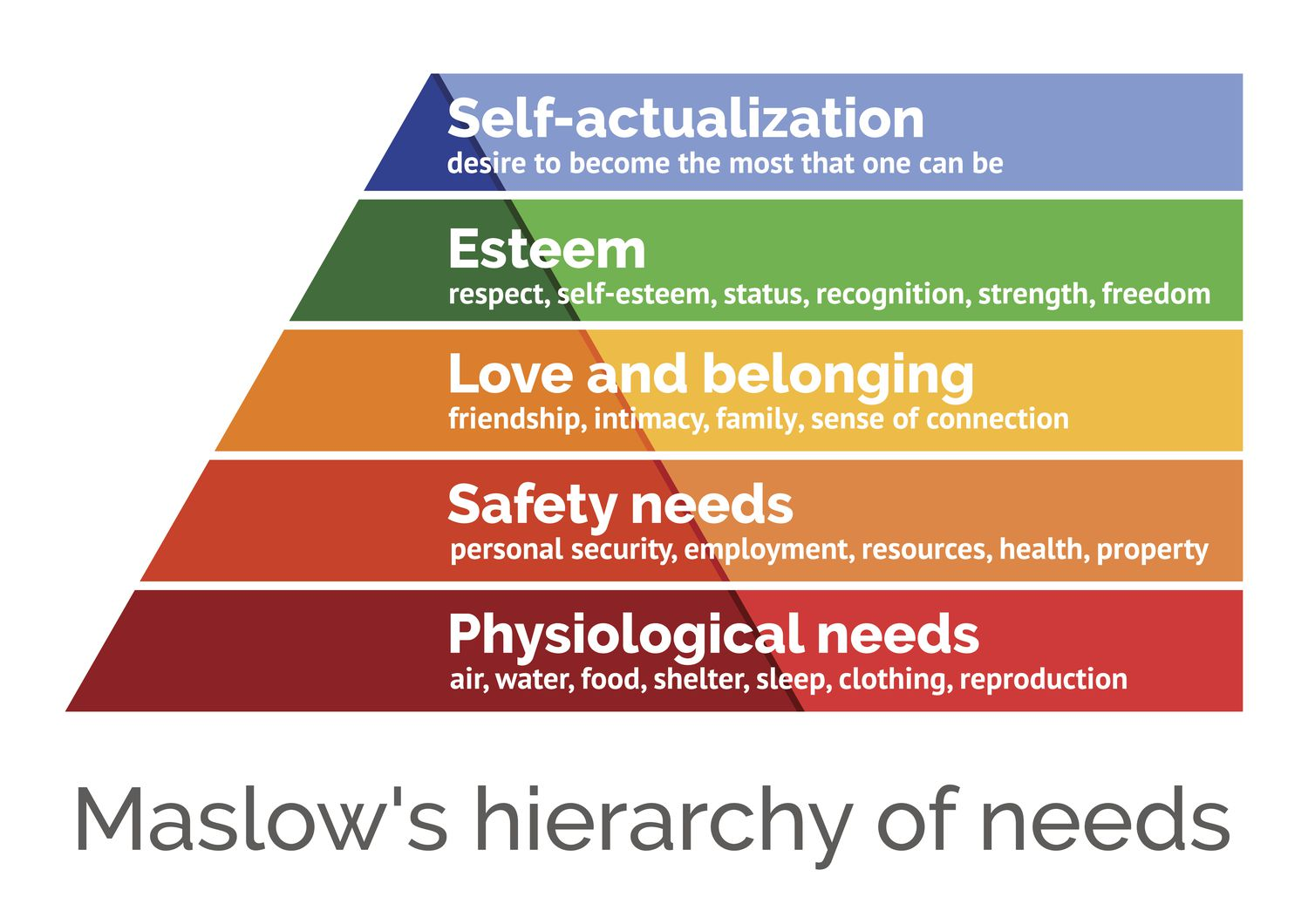
Maslow's Hierarchy of Needs
A pyramid of human needs
Theory that explains what motivates people and how they feel fulfilled.
It's based on the idea that people are driven to meet five basic needs in order to achieve well-being.
Arousals
Physiological activation that accompanies emotions.