LDH steady state kinetics
 Call Kai
 Learn
Learn Practice Test
 Spaced Repetition
 Match
Match Flashcards
 Knowt Play
1/26

There's no tags or description
Looks like no tags are added yet.
Name | Mastery | Learn | Test | Matching | Spaced | Call with Kai | Chat |
|---|
No analytics yet
Send a link to your students to track their progress
27 Terms
What biological molecules are used to control reaction rates within the body?
Enzymes
what is the michalis constant?
Km
Define Km of an enzyme
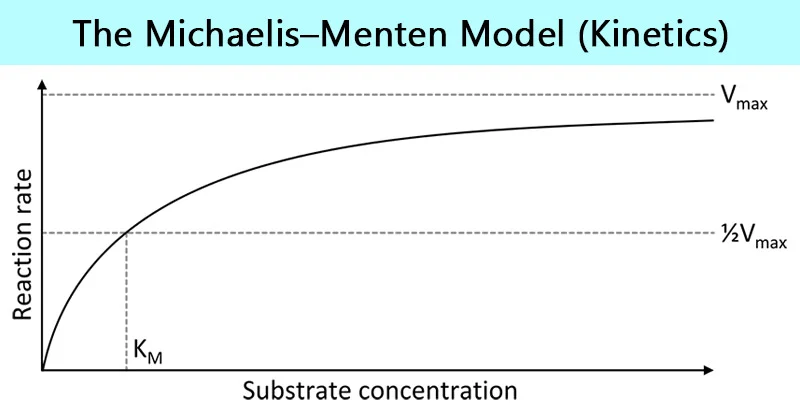
[S] required for the reaction rate to be half of Vmax
What is the Vmax of an enzyme?
The maximum reaction rate (at theoretical infinite substrate concentration)
What happens to Vmax and Km if you double the enzyme and add a competitive inhibitor?
Apparent Km increases
Vmax doubles
Draw and label a michaelis-menten graph
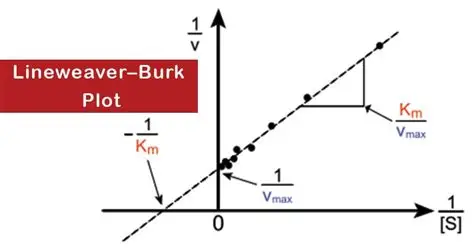
Draw and label a line-weaver burk plot
What is the Kcat (turnover number) of an enzyme?
The maximum number of substrate molecules a single enzyme can convert into product per second under saturating conditions.
Units for Km
Concentrations (eg. M)
Units for Vmax
mol.sec-1 or mol.min-1
Units for Kcat
Inverse time (s-1)
What enzyme parameyters vary with pH And type of substrate?
Km and Kcat
What is the equation for kcat
Kcat = Vmax/Et in s-1
Why do you need to measure the initial rate of reaction?
Because at the start of the reaction:
([S]) is effectively constant (hasn’t been used up)
([P] \approx 0) (no reverse reaction or product inhibition)
The steady-state assumption holds (([ES]) is constant)
→ This ensures accurate determination of Km and Vmax
Suppose you need to obtain a working (final) pyruvate concentration of 160 µM and a total volume of 3000 µL. How many µL of your 2 mM stock solution of pyruvate do you need?
240µL
At the start of the reaction, the rate of the reverse reaction (lactate to pyruvate) is [much greater than / much less than / the same as] the forward reaction rate.
At equilibrium the rate of the forward reaction (pyruvate to lactate) is much [greater than / much less than / the same as] the reverse reaction rate.
As the reaction proceeds the forward reaction rate [slows down / speeds up / stays the same]. This is because the [ substrate / enzyme] concentration drops.
At the start of the reaction, the rate of the reverse reaction (lactate to pyruvate) is much less than the forward reaction rate.
At equilibrium the rate of the forward reaction (pyruvate to lactate) is much the same as the reverse reaction rate.
As the reaction proceeds the forward reaction rate slows down. This is because the substrate concentration drops.
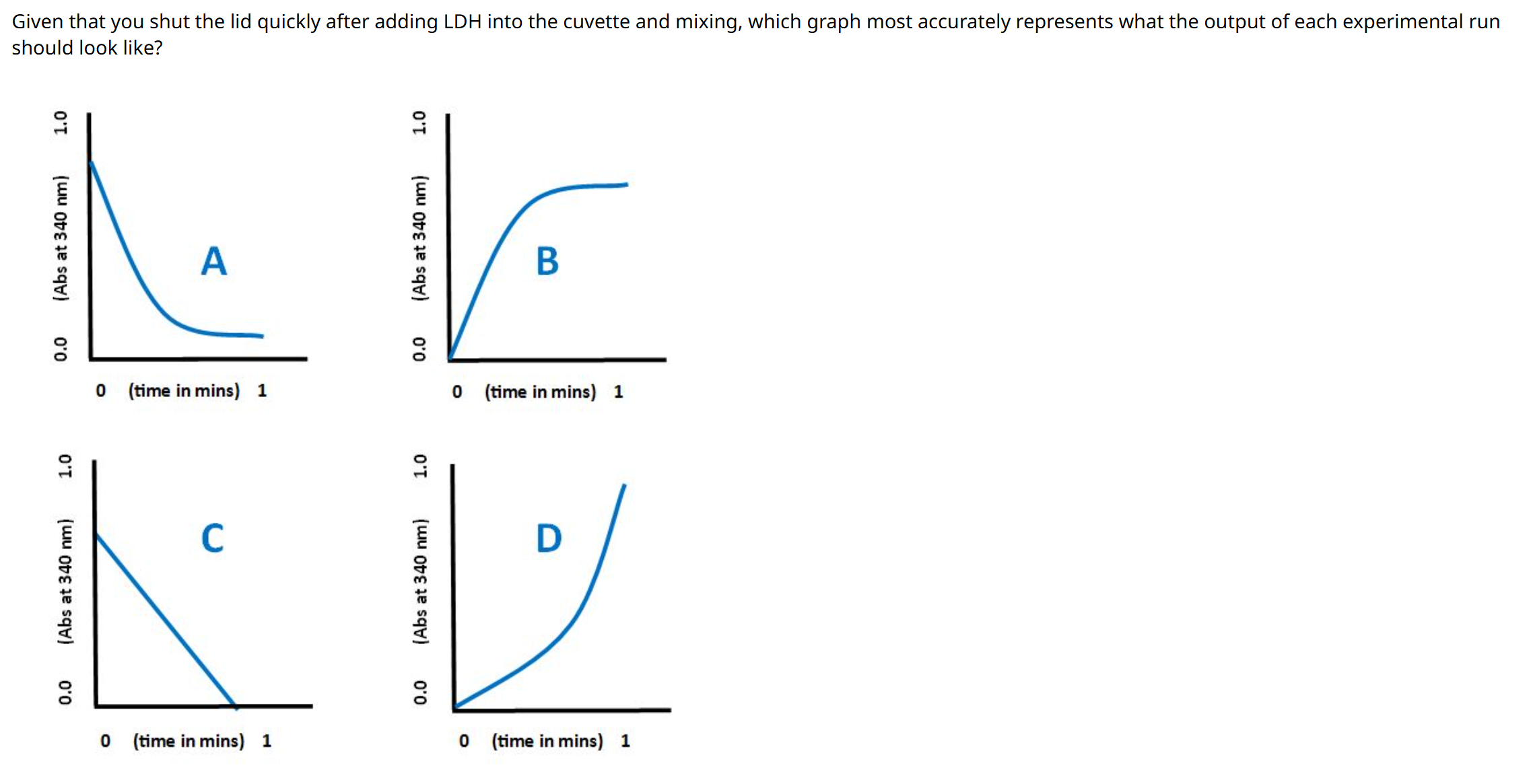
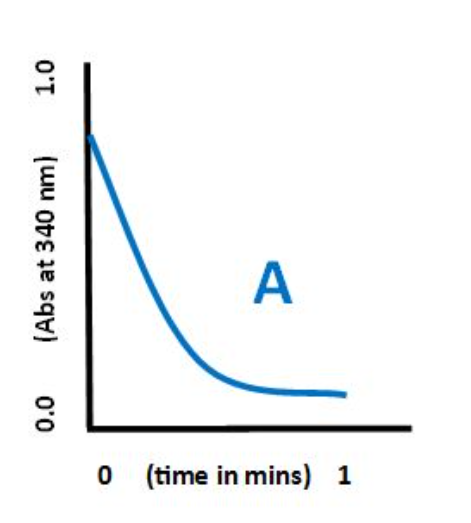
In this practical, you are adding 20 µL NADH into a total of 3040 µL in a cuvette. This gives a dilution factor of:
153
The NADH stock you are given has a concentration of 20 mM. Using the dilution factor (153) , what is the NADH concentration in the cuvette?
0.131mM
As you learned in the spectrophotometry practical, NADH absorbs light at 340 nm with an absorption coefficient (ε) of 6220 L·mol-1·cm-1. Use the concentration above (0.131mM) and the Beer-Lambert law to work out what absorbance this will give in the cuvette.
0.8
Match each potential problem with experimental runs (the line of which is called a trace) with a possible reason behind it.
No line visible
Trace starts low down the graph
Cuvette is not well mixed
No line visible - wrong wavelength or forgot to add NADH
Trace starts low down graph - Initial rate missed - too long adding + mixing
Trace is not a smooth line - cuvette is not well mixed
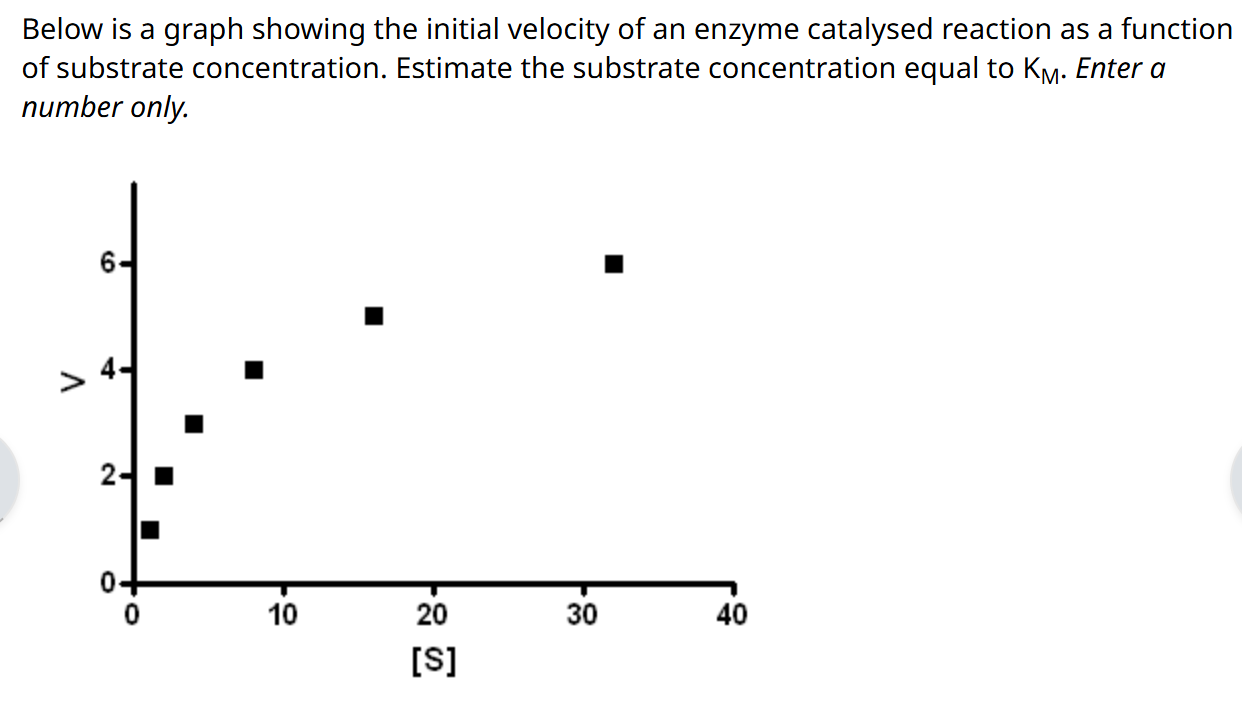
6
Continuing this graph onwards, it looks like it plateaus around 7.0 velocity units - this is the estimated Vmax. To estimate the KM of this reaction, find half the Vmax (3.5), then read across and down the graph. The Km is around 6 substrate units.
Looking at the trace from one experimental run, you note that your absorbance change is linear during the first ten seconds. At 0 seconds, A = 0.792. At 10 seconds, A = 0.568. What is the initial absorbance change per minute for this run? 3dp.
1.344
If in this experiment you obtain an initial change in absorbance of 0.26 per minute, what is the change in the concentration of NADH in µM per minute? The absorbance coefficient of NADH is 6220 L·mol-1·cm-1 at 340 nm.
42
Suppose your cuvette contained 3040 µL and the change in [NADH] was calculated to be 30 µM per minute. How many µmoles of lactate have been formed in that minute?
0.0912
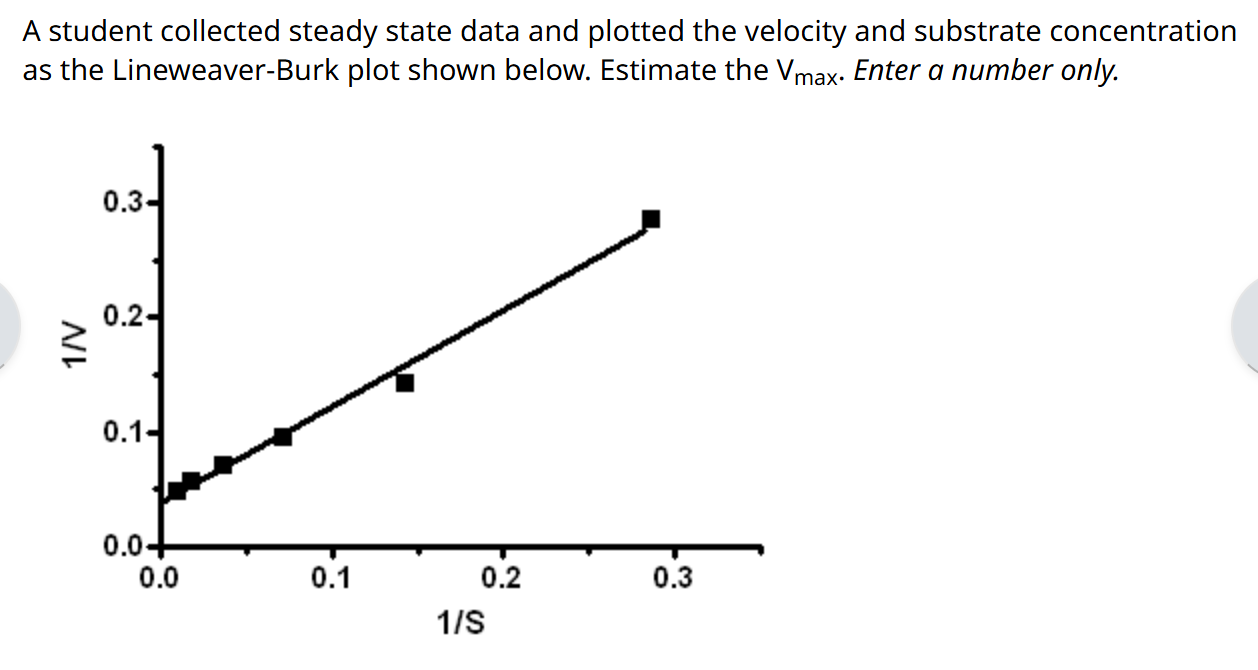
25
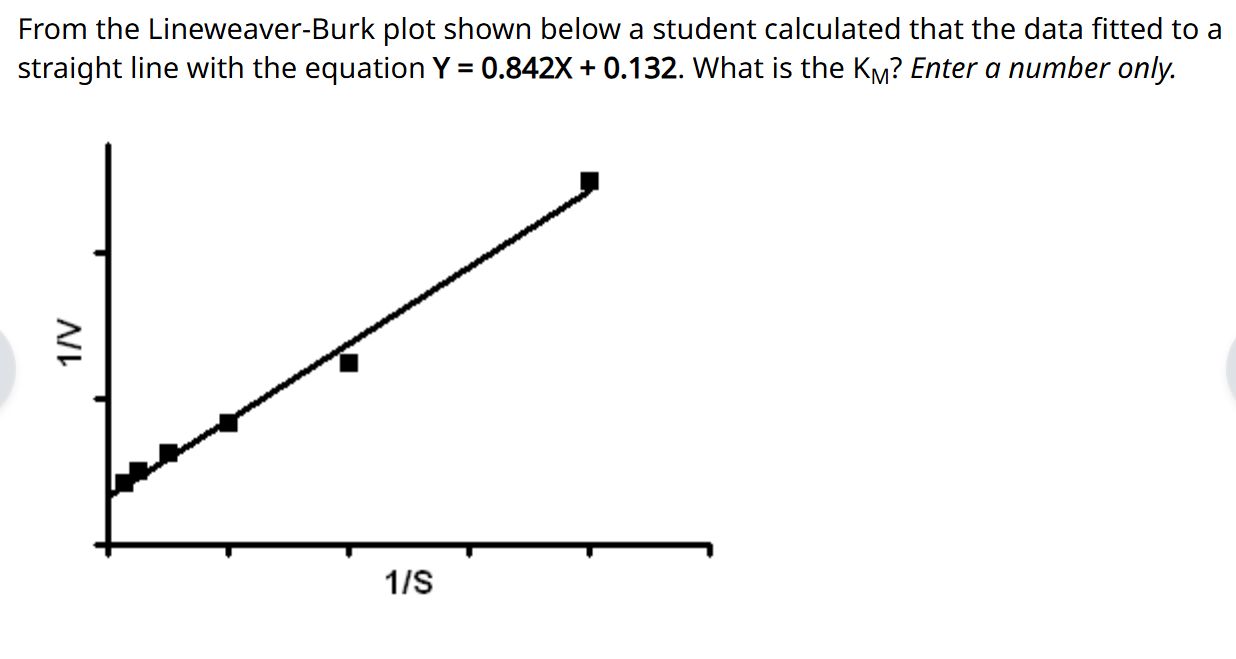
6.38