4. Oligopolistic Competition
 Call Kai
 Learn
Learn Practice Test
 Spaced Repetition
 Match
Match Flashcards
 Knowt Play
1/25

There's no tags or description
Looks like no tags are added yet.
Name | Mastery | Learn | Test | Matching | Spaced | Call with Kai |
|---|
No analytics yet
Send a link to your students to track their progress
26 Terms
Give 5 features of oligopolistic competition.
1. Few large, interdependent firms
2. High entry + exit barriers
3. High concentration ratio
4. Similar/ differentiated products
5. Stable prices (avoid price competition)
In an oligopolistic market, what must firms anticipate?
Why?
Their rivals actions. e.g. price vs non-price strategies.
They can then base their own actions on this.
What 3 key decisions must oligopolies make?
Whether to...:
1. Compete vs collude
2. Price competition vs non-price competition.
3. Be the first firm to implement a strategy vs waiting to see what rivals do.
Define 'collusion'.
When two or more firms enter into an agreement to restrict competition.
How is collusion usually done?
1. fixing prices
2. limiting output
3. sharing the market geographically
What are the 2 types of collusion?
1. Overt collusion. (formal)
2. Tacit collusion. (informal)
Define overt collusion. (formal)
What may it lead to?
An explicit agreement between firms to limit competition.
They meet and sign an agreement to fix prices/ output levels.
This leads to illegal cartels, resulting in fines.
Define tacit collusion. (informal)
Give an example.
When firms follow similar strategies without any formal/ explicit agreement to restrict competition.
e.g. dominant firm increases prices, and other firms follow to avoid price wars.
Name 3 price competition strategies used by oligopolies.
Which rivals do they affect?
1. Price wars. (existing rivals)
2. Predatory pricing. (existing rivals)
3. Limit pricing. (future rivals)
Define 'price war'.
When a firm repeatedly cuts their prices over time.
Define 'predatory pricing'.
When a firm deliberately sets prices low enough to force rivals out of the market, making a temporary loss.
Define 'limit pricing'.
When is it best achieved?
When firms set low prices and increase output to deter potential firms from entering the market.
(Best achieved by selling at price below ATC)
Give 6 non-price competition strategies.
1. Better quality customer service.
2. Longer opening hours.
3. Discounts.
4. Brand loyalty.
5. Variation in design, quality, service.
6. Contractual relationships with suppliers.
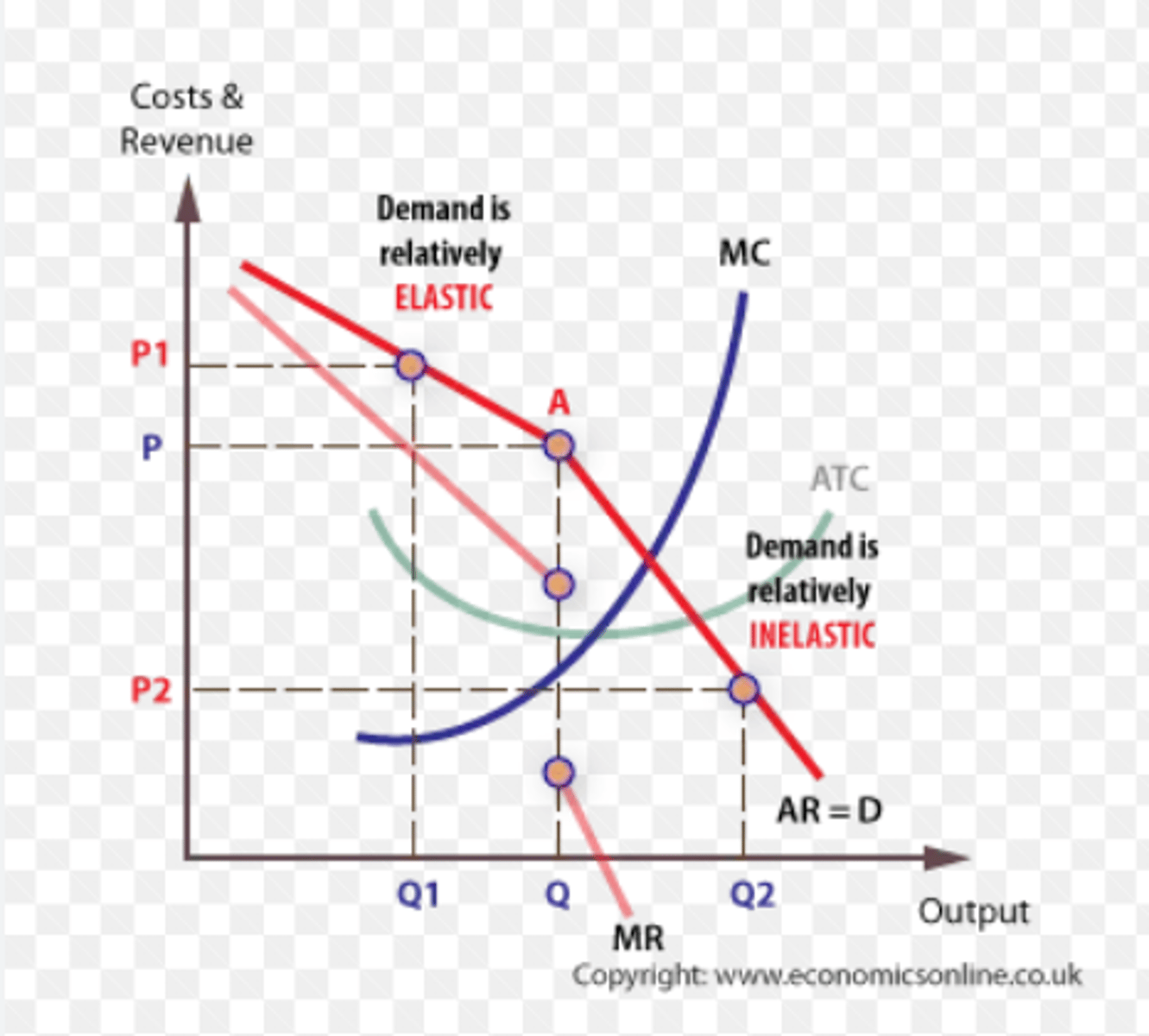
Draw an oligopolistic competition diagram.
Firms don't want to raise prices due to competition, or cause price wars.
Price of P always provided, even if MC rise within vertical gap.
Give 4 advantages of oligopolies.
1. Competitive: efficient, higher quality, potential good prices.
2. Collusion is not a big issue as it can lead to fines and is most likely temporary.
3. Non-price strategies improve market for consumers.
4. Firms may cut prices, benefiting consumers.
Give 4 problems with oligopolies.
1. Exploitation of consumers e.g. collusion, less competition.
2. Generally higher prices.
3. Lower output.
4. Allocative and productively inefficient.
What 4 factors make oligopolies more likely to compete?
When:
1. One firm has lower costs than the other.
2. There is many big firms in the market. (hard to observe)
3. Firms produce similar products.
4. Entry barriers are low.
What 4 factors make oligopolies more likely to collude?
When:
1. They have similar costs.
2. There is few large firms in the market. (easy to observe)
3. There is brand loyalty.
4. Entry barriers are high.
Give 3 reasons why oligopolies may want to compete.
1. Gain market share.
2. Avoid legal consequences.
3. Increase efficiency
Give 3 reasons why oligopolies may want to collude.
1. Joint profit maximisation
2. Avoid price wars, encouraging price stability.
3. Reduce risks
What is game theory?
A representation of oligopolies strategies and decision making regarding colluding or competing.
Draw the prisoner's dilemma/ payoff matrix.
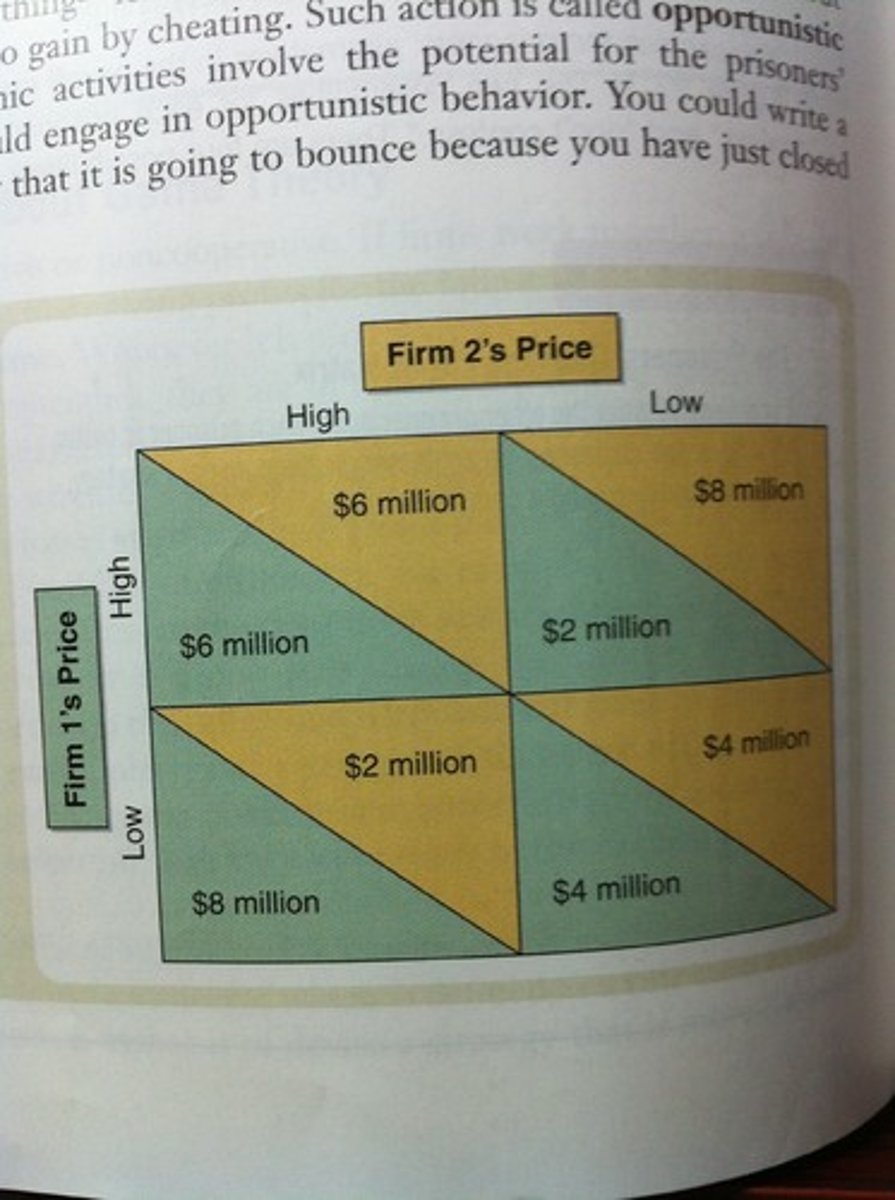
Define nash equilibrium as part of game theory.
When a firm cannot benefit from changing their strategy until another firm changes theirs.
What 'advantages' may occur for oligopolies?
1. 1st mover advantages.
2. 2nd mover advantages.
What is a 1st mover advantage?
The competitive edge gained by a firm when they are the first to introduce a new product of service, allowing them to generate head-start profit.
What is a 2nd mover advantage?
Advantages occuring when a firm enters a market after an initial mover has established their strategy.
(e.g. waiting to see which strategy is launched by rivals, then trying to improve or undermine them)