Bio Finals Sem 2
 Call Kai
 Learn
Learn Practice Test
 Spaced Repetition
 Match
Match Flashcards
 Knowt Play
1/183

Earn XP
Description and Tags
Ch 15-16, Ch 3-6, Ch 7 (blood typing, sex-linked genes, CRISPR, ecology) | *NOT on flashcards: Pedigrees
Name | Mastery | Learn | Test | Matching | Spaced | Call with Kai |
|---|
No analytics yet
Send a link to your students to track their progress
184 Terms
Ch 15
Ch 15
How many chromosomes in a human body (somatic) cell?
46
How many chromosomes in a human sex cell (gamete)?
23
What are sex chromosomes in humans?
X and Y, the 23rd pair
What are autosomes?
The non-sex chromosomes (everything except 23rd pair)
All eggs carry an __ chromosome, half of all sperms carry an __, and the other half carry an __ chromosome
Eggs: X
Sperm: Equal probability of X or Y
What happens when you mix two different blood types?
Blood coagulates (patient dies)
What are the blood types (antigens)?
A: contain only A antigen
B: contain only B antigen
AB: contain both A & B antigens
O: contain neither A or B antigents
What are Rh Groups? Who’s dominant?
Determined by a single 2-allele gene. Rh+ allele is dominant.
Rh+ Rh±: positive+ blood with Rhesus antigen
Rh- Rh-: negative- blood without Rhesus antigen
Genotypes of A, B, AB, and O bloods.
A: IAIA, IA i
B: IBIB, IB i
AB: IAIB
O: ii
i is recessive to the others, IA and IB are codominant with each other
Who can donate blood to who? Who can receive blood from who?
A: donate (A, AB), receive (A, O)
B: donate (B, AB), receive (B, O)
AB: donate (AB), receive (A, B, O)
O: donate (A, B, AB), receive (O)
+: donate (+), receive (+, -)
-: donate (-, +), receive (-)
What is a karyotype?
A person’s chromosomes, sorted and labeled by pair #
What is amniocentesis?
taking amniotic fluid from the uterus to determine baby’s karyotype
Describe nondisjunction.
Homologous chromosomes fail to separate during meiosis, so they’re distributed unevenly among the 4 haploid daughter cells. When one matures, it may have Klinefelter’s/Turner’s/Down (an uneven number of chromosomes).
Ch 16
Ch 16
Inbreeding (pros & cons, plus example)
Continued breeding of individuals with similar characteristics.
Pro: certain good traits are preserved
Con: certain recessive alleles can combine
Ex: Habsburg jaw in Spanish royalty
What can cause mutations? (how do breeders induce them?)
Chemical/radiation exposure.
How can polyploidy be induced?
With drugs that prevent chromosomal separation during meiosis (nondisjunction!)
How do animals vs. plants react to polyploidy?
Animals: Usually fatal
Plants: Grow larger and stronger than diploid version; can become new species
What are plasmids?
Short circular piece of DNA found in bacteria
What are restriction enzymes?
Proteins naturally produced by bacteria to ward off viral infections, that cut the viral DNA at precise locations
What is gel electrophoresis?
Process of size-sorting DNA fragments by running electricity through gel. The smallest fragments travel the farthest from the wells.
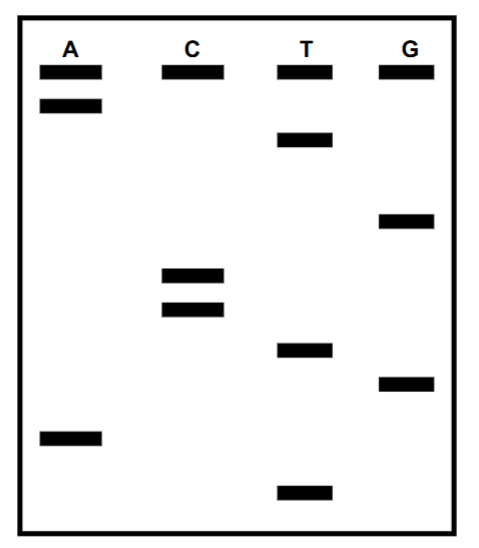
Sequence this (gel electro results)
ATG TCC GAT
For the polymerase to work in the high temperatures used in PCR, where did its bacteria come from?
Hot springs in Yellowstone
Recombinant vs. transgenic
Recombinant: The DNA altered
Transgenic: The organism with altered DNA
Types of stem cells. (What do they become?)
Totipotent: become ANY body cell (placenta + embryo)
Pluripotent: become MOST body cells (embryo)
Multipotent: LIMITED potential to differentiate into many body cells (adult)
How can stem cells be used after you get them from the donor? What are the controversies?
Can repair damage from heart attacks, strokes, spinal cord injuries
harvested from bone marrow and cultured
injected into damaged heart portion
would naturally differentiate into heart cells
Controversy:
Adult multipotent cells come from willing donors, but
harvesting embryonic toti/pluripotent cells destroys embryo
Ch 17
Ch 17
What is evolution?
Organisms changing over time
What is a theory?
Well suported & testable explanation of natural phenomena
What did Darwin observe about organisms across Galapagos islands? (give example)
They were different everywhere. (ex: tortoise shell shapes & finch beak sizes)
What was the prevailaing belief about Earth and its organisms in the 1700s?
Fixed World View - Earth and all its forms of life have only existed and remained unchanged for a few thousand years
What discovery challenged that view?
Fossils
some looked like modern organisms
others looked completely different
many had died out
Organism losing its disused structures
Whales have lost their “hind legs”
Why did Darwin decide to publish his theory?
Alfred Russel Wallace sent Darwin an essay about his almost identical thoughts on evolution
Adaptation noun def
Heritable trait increasing ability to survive
3 types of adaptations
Anatomical (physical)
Physiological (body functions)
Behavioral
What is fitness?
Organism’s ability to survive and reproduce - survival of the fittest
In what situations does natural selection occur?
- more individuals are born than can survive (struggle for existence)
- varying fitness
Artifical selection + example
Nature provided the variation, and humans selected those they found useful
Example: Selective domestic crops/animals
3 parts of Darwin’s evolution HYPOTHESIS
Struggle for existence
members of a population compete for finite supply
Survival of the fittest
individuals with certain inherited variation are better adapted to environment than others
Common ancestry
living species are descended from common ancestors, with changes over time
Struggle for existence example
Male booby with brightest blue feet “wins” female mate
Survival of fittest example
Polar bears with largest claws/teeth get most prey, and survive/reproduce the most
What is biogeography?
Study of where organisms and their ancestors lived
Evidence of evolution
biogeography
fossils
(this is also evidence for plate tectonics)
What are homologous structures?
Similar structures shared between related species, inherited from common ancestors
Vestigial organs
Organ with no useful function in an organism
Darwin’s hypothesis of how different finches came to be (and what assumptions did he make?)
common ancestors
1 finch arrived in Galapagos, evolving into 13
assumptions:
must be enough heritable variation in beak shape to produce “raw material for natural selection”
variation in beak shape must create differences in fitness
What happened when Peter & Rosemary Grant tested these Darwin’s assumptions?
Provided concrete evidence for Darwin’s theories
Found a great variation of heritable traits
Individual birds with different sized beaks had different chances of survival during a drought
Likely led to speciation
evolution can happen quickly
Ch 18
Ch 18
What is a gene pool?
Consists of all genes, including different alleles, in a population
What is allele frequency/relative frequency? (how do you express it? is it related to dominant alleles)
Number of times an allele appears in a gene pool compared to others - a percent
doesn’t have to be expressed, and does not relate to if the allele is dominant
3 sources of genetic variation
Mutation
heritable change in DNA
Crossing over
can create 8.4 million combinations from 23 chromosomes
Lateral gene transfer
transfer of genetic material to non-offspring organism
some bacteria do this
How do mutations affect organisms?
Most of them have no effect
How does crossing over/gene recombination affect populations?
creates genetic variation!
(8.4 million combinations from 23 chromosomes)
Single-gene vs polygenic trait
Single-gene traits:
1 gene
Polygenic:
multiple genes, often 2+ genes
many possible genotypes & phenotypes
What shapes do graphs of polygenic traits make, and why?
Bell curves, because it’s less probable to get all extreme alleles of one type than a mix of different alleles
How does natural selection help resistance to occur?
Some bacteria, by chance, have genetic variations that let them resist an antibiotic
Over time the allele frequency for this allele increases
(Natural selection - by chance, one can resist it, and they survive/reproduce more often)
Natural selection’s impact on single gene traits
changes in allele frequencies → changes in phenotype frequency
natural selection’s 3 different kinds of impacts on polygenic traits (name them)
Directional selection
Stabilizing selection
Disruptive selection
directional stabilization
one end of bell curve is fittest, so bell curve shifts in that direction
stabilizing selection
center of bell curve is fittest, so bell curve steepens
disruptive selection
extreme ends of bell curve are fittest - graph dips in middle
Founder effect
when a small group leaves to a new isolated location and establishes that location’s gene pool
What is speciation? (have we seen it?)
species changing so dramatically they can’t mate - haven’t seen it
Why is speciation the core theory of evolution?
Creates biodiversity and variety from which more speciation can happen (evolution). Speciation drives evolution
Species (singular) - how is it different from population?
species: group of organisms who CAN mate/produce offspring
population: group of organisms who DO mate
Types of isolation (name them)
behavioral isolation
geographic isolation
temporal isolation
behavioral isolation & example
two populations CAN interbreed, but WON’T because of mating rituals/behavior choices
ex: Eastern and Western meadowlark sing different courtship songs
geographical isolation & example
two population CAN mate, but are separated by water, mountain, etc.
ex: Abert’s and Kaibab squirrel across Grand Canyon
temporal isolation & example
two populations CAN mate, but mate at different times of the year
ex: orchids releasing pollen only one day
Ch 19
Ch 19
What is binomial nomenclature?
genus, species (2-word naming system)
Linnaeus’s 2 kingdoms
Plantae & Animalia
Name all the current kingdoms (okay if not know completely - on cheat sheet)
Eubacteria, Archaebacteria, Protista, Fungi, Plantae, Animalia
Name all the domains (which ones have peptidoglycan?)
Eukarya: protists, fungi, plants, animals
Bacteria: eubacteria WITH peptidoglycan
Archaea: archaebacteria WITHOUT peptidoglycan
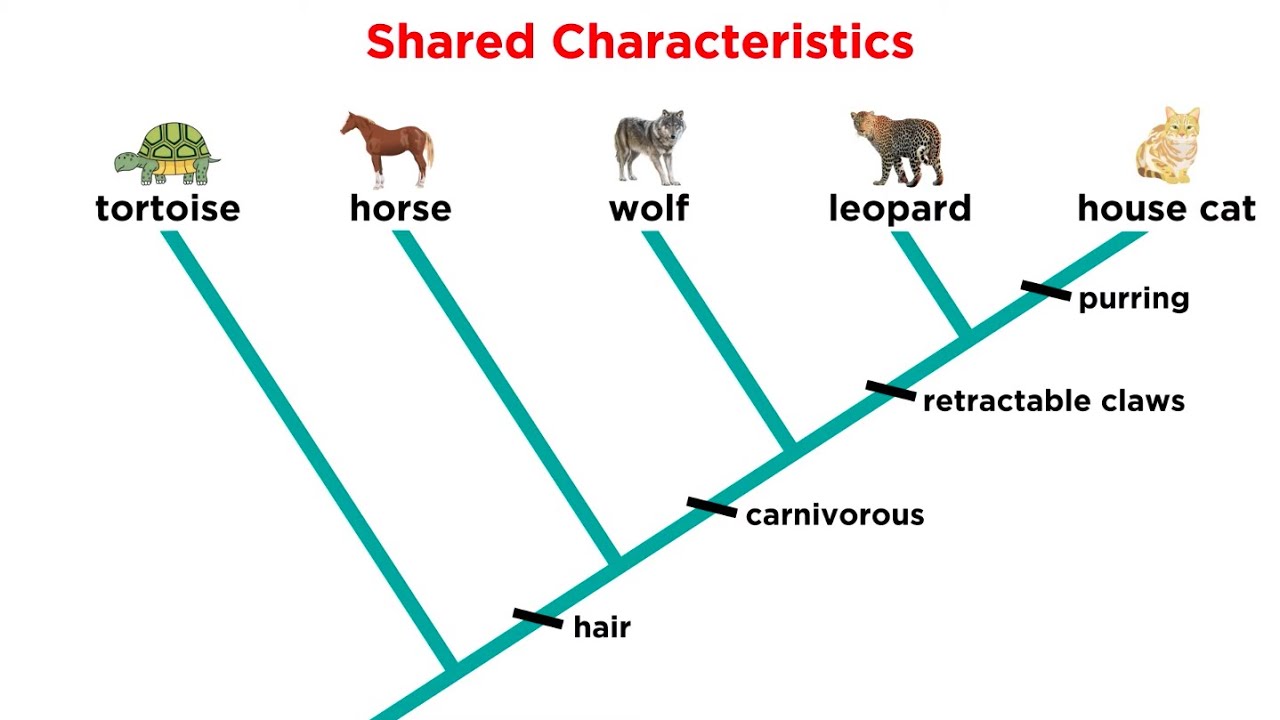
Who can purr?
House cats
Who is a carnivore?
Wolf, leopard, house cat
The tortoise’s closest relative is…
horse
Ch 20
Ch 20
Earth’s layers are… (okay if don’t know completely - on cheat sheet)
Crust
(lithosphere = crust/tectonic plates)
(asthenosphere = upper mantle/thing plates float upon)
Mantle
Outer Core
Inner Core
What are plates?
lithosphere divided into plates, carrying amounts of continental/oceanic crust, floating on asthenosphere
What drives plate tectonic movements? By how much?
convection currents within Earth - they move very slowly
weathering
breaking rocks chemically/physically into smaller pieces
erosion (by what medium?)
small pieces of rock are carried away by wanter, wind, or glaciers
deposition
small particles of sand, silt, or clay are carried by water where they settle out layers of sediments at the bottom
Weathering causes erosion causes deposition
know this
Igneous rocks
magma cools and hardens beneath the surface or after a volcanic eruption
Sedimentary rocks
sediments are compressed and cemented together into rocks
Metamorphic rocks
rocks change under extreme heat and pressure
How do fossils form?
dead organisms are buried under layers of sediment → usually found in sedimentary rock and as marine creatures
water seeps in, depositing minerals
Fossil quality varies (T/F)
true
What conditions are needed for fossil-ization?
Rapid burial in sediments immediately after death
types of fossils (know generally)
skeleton
imprint
amber
eggs
poop
Fossils are usually… complete or incomplete?
incomplete
Why will the fossil record never be complete?
We will never uncover every fossil that has formed
How does relative dating work?
put rock layers and their fossils into a time sequence, where lowest is oldest
use index fossils as timestamps
How does direct dating (radiometric dating) work?
measuring radioactive decay, especially carbon-14
What is half life?
The amount of time in which a sample halves
Describe the Miller-Urey experiments
simulated early Earth’s conditions
with hydrogen, methane, ammonia, & water for atmosphere and electricity as lightning
Results: after several days, 21 amino acids were produced
Helped show how organic compounds could have come from early Earth’s conditions