Civil War
 Call Kai
 Learn
 Practice Test
 Spaced Repetition
 Match
 Flashcards
 Knowt Play
1/23

Earn XP
Description and Tags
24 Terms
What were the North and the South fighting for?
The North was fighting to keep the union together and the South was fighting for keeping their traditions in the South (like slavery.)
War for Southern Independence
The name Southerners called the conflict, also known as the Civil War.
Context: The southerners called it this because they were fighting for their independance as a new country who had to protect their agricultural economy and keep their traditional way of life (including slavery)

Border States
The name given to slave states that did not secede from the Union: Delaware, Kentucky, Maryland, and Missouri.
Context: Lincoln didn’t flat out say that the Civil War was a fight for slavery because he wanted the border states, who had southern ideals, to stay and fight with the Union.

Robert E. Lee
A brilliant military officer from Virginia who declined President Lincoln’s request to fight for the Union. Instead, he became the military commander for the Confederacy.
Context: Lincoln requested for Lee to fight for the Union because he was the best military officer in the federal army. Lee, who went to West Point, was from the South and boys in the South were trained from a young age to ride horses and hunt. But Lee refused because he could not fight against his homeland (Virginia)
Martial Law
The act of removing power from an elected government and replacing it with the head of the military.
Context: Lincoln declared martial law on the border states (like Maryland) because they were untrustworthy states who had southern sympathizers for the South.
Industry and Transportation: North vs South
NORTH
More ports. (the south won’t be able to train with the North and cotton won't be able to get to the North.)
Made 90% of manufactured goods- can make supplies for the war
70% of nations rail lines- transport supplies and troops
A strong navy and large fleet of trading ships- can block southern ports.
SOUTH
Not many train stations
Not many factories or textile mills.
Few war ships, small merchant fleet
Few railroads that didn’t connect with one another- harder to transport things.
Government: North vs South
NORTH
Federal Government- make decisions quickly.
SOUTH
Believed States should have more rights then central government- so the southern states couldn’t make decisions quickly. Each state had to agree.
Population: North vs South
NORTH
Had almost twice as many people in the North. Free people. 22 million
4x as many free citizens as the south- Many soldiers to volunteer.
Many people growing food and working in factories.
SOUTH
9 million people
Slaves made ⅓ of the population and they couldn’t fight.
Not enough people to serve as soldiers.
Military: North vs South
NORTH
Strong navy.
Northern soldiers had to conquer a huge area to defeat the south
Instead of defending their home, they were on unfamiliar land.
Northern supply lines were longer and more prone to attack by South
SOUTH
Hunting was an important part of Southern life- good with guns
Some of the best US military officers came from military schools in the south.

Strengths: Lincoln vs Jefferson Davis.
North: Abraham Lincoln
Good sense of humor.
Took criticism well.
Gained respect.
South: Jefferson Davis
Attended West Point
Officer in the Mexican War and was respected for his honesty and courage.
Been through a war.
Secretary of war.
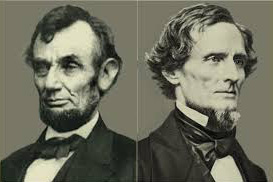
Weaknesses: Lincoln vs Jefferson Davis
North: Abraham Lincoln
No military understanding. No experience in war
Didn’t really have a strong understanding of national government.
Northerners doubted his ability to lead.
South: Jefferson Davis
Had a hard time giving up power and wanted to be in charge of military planning.
Had a difficult time understanding why anyone would think differently.
Would argue with his advisors.

Union
The name given to Northern states fighting in the Civil War.
context:

Confederate
The name of the new government comprised of the eleven Southern states that seceded from the Union, also called the Confederate States of America.
Context: South Carolina, Mississippi, Florida, Alabama, Georgia, Louisiana, Texas, Virginia, Arkansas, North Carolina, Tennesse

Union blockade
A Union strategy to cut off trade to Southern ports.
Context: a barrier of ships to cut off trade and army supplies. They wanted to do this because the southerners didn’t have a navy. If you blockade the southern ports, manufactured goods (supplies) wouldn’t get through. The south's economy would suffer.
Defensive war
Where at least one side is mainly trying to defend itself from another, as opposed to a war where both sides are trying to invade and conquer each other.
Context: Believed fighting a defensive war northerners would eventually become tired of fighting. Therefore, it would make the war unpopular in the North that president Lincoln would be forced into recognizing the South’s independence, thus ending the conflict.

Thomas Jackson
A Confederate general who fought in the Battle of Bull Run and stood his ground so defiantly he was given the nickname“Stonewall.”
Context: Threatened D.C. by going through the Shenandoah Valley. SO Lincoln kept a lot of Union soldiers in D.C. and only sent a few to Richmond. Died at the Battle of Antietam.

George McClellan
A general in Lincoln’s Union army who was able to organize and transform inexperienced young men into an army of well-trained soldiers, yet he had a hard time actually going into battle.
Context: Wasn’t great at going into battle. Would train but never advance. March 1862- by steam boat, McClellan finally advanced most for his soldiers by steamboat down the Potomac to go to Richmond. McClellan had to retreat from Richmond because he didn’t have enough soldiers.

Ironclad ships
Ships outfitted with thick metal to withstand and block incoming cannon fire.
Context: It was an Ironclad ship and the cannon shells would bounce off the walls. No one could penetrate it. Sunk two union ships. But the south never really mounted a serious attack on the Union Navy and the blockade was never broken.

Battle of Bull Run
Battle of Bull Run: United States (Union) vs. Confederate States
DATE: July 21, 1861
WINNERS: Confeds win!
LOCATION: Prince William Country, VA
UNION KILLED/WOUNDED: T: 2896. K: 460. W: 1,124 C/M: 1,312
CONFEDERATE KILLED/WOUNDED: T:1982 K: 387 W: 1,582 C/M: 13
COMMANDERS/LEADERS: Confed- Thomas “Stonewall” Jackson. Union- P.G Borugard.
IMPORTANT INFORMATION:
South played defense and stood their ground. Confederates won because the Union retreated (since they ran out of ammo)
Unions left things behind (muskets) so they could run and retreat.
North: Strategy for Victory
Blockade Southern ports
They wanted to do this because the southerners didn’t have a navy
If you blockade the southern ports, manufactured goods (supplies) wouldn’t get through. The south's economy would suffer.
NOT PART OF THE ANACONDA PLAN
Capture the Confederate government
Union generals wanted to seize Richmond, VA, and the confederate capital. By eliminating the south’s government the confederate army would suffer, leading to a swift surrender.
Seize the Mississippi River
So the confederacy could not use it to supply its soldier with food and ammunition
It would also eliminate Arkansas, Texas, and Louisiana from fighting with the confederacy.
NOT PART OF THE ANACONDA PLAN
The anaconda plan
Union General Winfield Scott’s plan to crush the confederacy. Basically suffocating the south by blockading their ports and separating the southern states by controlling the mississippi river.

Battle of Antietam
A battle occurring near Sharpsburg, Maryland on September 17, 1862, which was the bloodiest single-day battle in American history.
Context: Many people lost their lives in Miller’s Cornfield, during the Battle of Antietam. Confed Maj Gen Hill arrived from Harpers Ferry and launched a surprise counterattach. He was able to drive back the bridge, ending the battle. Bloodiest single-day battle in American history, with a combined tally of dead, wounded, and missing at 22, 717. Tactically neither side won, technically the south left first, so the Union won.
The Battle of Antietam (details)
WHO WON? Union (they only won because Lee left)
LOCATION: Near Sharpsburg, Maryland
DATE: Sept 17, 1862
UNION KILLED/WOUNDED: T: 12, 401 K: 2, 108 W: 9, 540 C/M 753
CONFEDERATE KILLED/WOUNDED: T: 10, 316 K: 1, 546 W: 7 752 /M 1, 018
COMMANDERS/LEADERS: George McClellan (Union) Robert E Lee (confed)
Miller’s cornfield
The site of some of the most savage fighting during
Context: