Bio Module 4
 Call Kai
 Learn
Learn Practice Test
 Spaced Repetition
 Match
Match Flashcards
 Knowt Play
1/82

There's no tags or description
Looks like no tags are added yet.
Name | Mastery | Learn | Test | Matching | Spaced | Call with Kai |
|---|
No analytics yet
Send a link to your students to track their progress
83 Terms
Phylogenies: __________________________
Systematics: A discipline that __________________________
____________ are a tool used in systematics
Phylogenies can scale depending on what type of system we’re looking at
____________ is the largest phylogeny
Phylogenies: the branching evolutionary history of organisms
Systematics: A discipline that reconstructs phylogenies and classifies organisms based on those relationships
Phylogenies are a tool used in systematics
Phylogenies can scale depending on what type of system we’re looking at
Tree of life is the largest phylogeny
What a Phylogenetic Tree Represents
Main point is showing patterns of __________
Branches: ____________________
Nodes: ____________________
Tips/Leaves: _____________________________________
Never ancestors of other tips
What a Phylogenetic Tree Represents
Main point is showing patterns of relatedness
Branches: populations through time
Nodes: Hypothetical common ancestor
Tips/Leaves: Living (current line) or extinct (finished species)
Never ancestors of other tips
Polytomy: __________________________________
Also represented by a _________ _________
_________ _________: Each other's closest relative, like A & B
Misconceptions: nothing present descends from _________ _________
Ex. We didn’t evolve from chimps. Humans and chimps both evolved from an ancient common ancestor
Species closer together on the tree are not necessarily more _________, it depends on how far back the _________ _________ is
Nodes can be flipped around and show the same thing
They’re _________, not facts
Polytomy: either two diverged at the same time, or representing that we don’t know specifically where/how they diverged
Also represented by a dotted line
Sister taxa: Each other's closest relative, like A & B
Misconceptions: nothing present descends from present lineages
Ex. We didn’t evolve from chimps. Humans and chimps both evolved from an ancient common ancestor
Species closer together on the tree are not necessarily more related, it depends on how far back the ancestor node is
Nodes can be flipped around and show the same thing
They’re hypotheses, not facts
Characters and Traits, Data Matrices
Heritable characters
______________
______________
______________
______________
Traits: Specific states of a character
(Character/Trait) = eye color
(Character/Trait) = green eyes
Characters and Traits, Data Matrices
Heritable characters (BMBD)
Morphological
Molecular
Behavioral
Developmental
Traits: Specific states of a character
Character = eye color
Trait = green eyes
Ancestral vs. Derived Traits, Synapomorphies
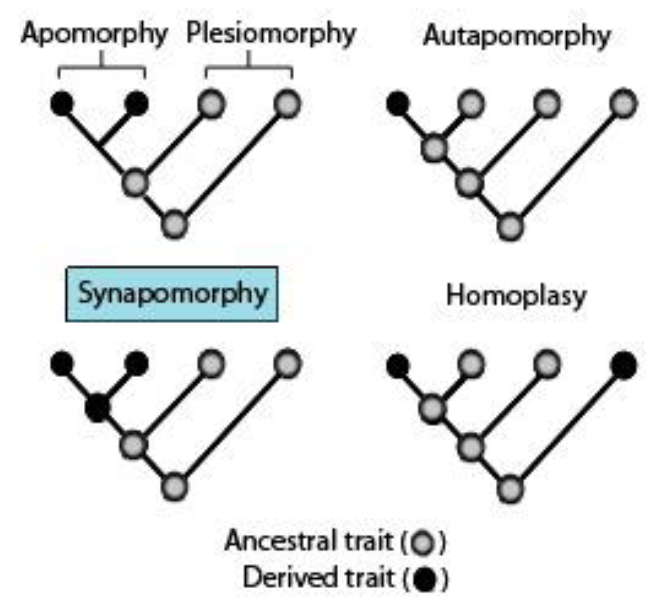
Apomorphy: _______________________
Plesiomorphy: _______________________
Autapomorphy: _______________________
Synapomorphy: _______________________
Homoplasy: _______________________
Which is most important and used to identify monophyletic groups? _____________
Ancestral vs. Derived Traits, Synapomorphies
Apomorphy: Derived trait
Plesiomorphy: Ancestral trait inherited from earlier ancestors
Autapomorphy: Derived trait unique to a single lineage
Synapomorphy: Shared derived trait
Homoplasy: Similarity not due to shared ancestry
Which is most important and used to identify monophyletic groups? Synapomorphy
Monophyletic vs Non-Monophyletic Groups
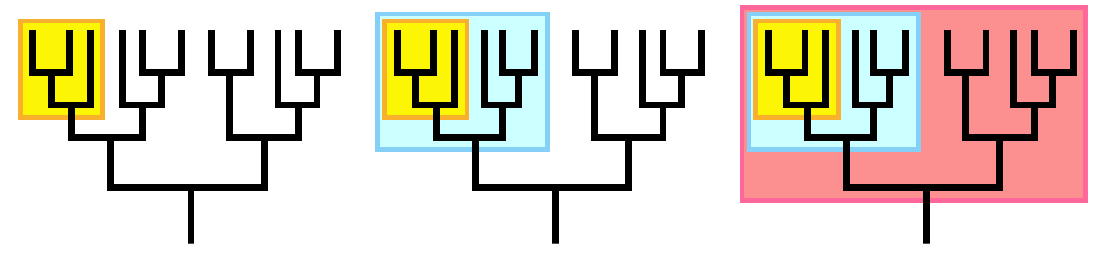
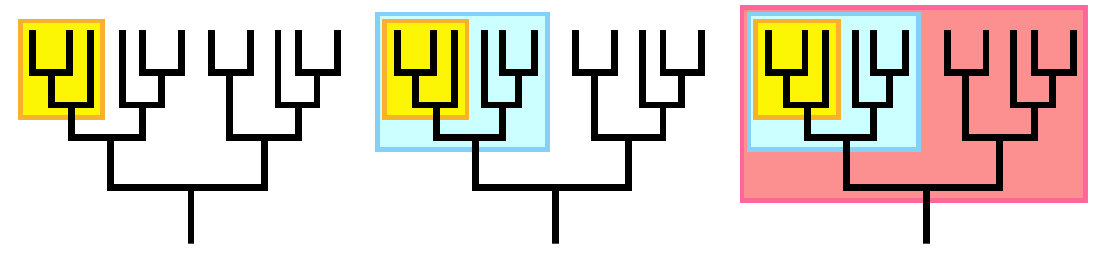
Paraphyletic group: __________________________
Polyphyletic groups: __________________________
Monophyletic groups: __________________________
Can scale (all three boxes are monophyletic)
Monophyletic vs Non-Monophyletic Groups
Paraphyletic group: Ancestor and some of its descendants (???)
Polyphyletic groups: Based on similar characteristics but not ancestry
Monophyletic groups: Common ancestor and all of its descendants (Clade)
Can scale (all three boxes are monophyletic)
Homology vs Homoplasy
Homology: Similarity (due/not due) to common ancestry
Homoplasy: Similarity (due/not due) to common ancestry
Common dolphin & Ichthyosaur
Convergent Evolution
Example of (homoplasy/homology)
Bat, bird, and insect wings evolved wings (together/independently)
Homology vs Homoplasy
Homology: Similarity due to common ancestry
Homoplasy: Similarity not due to common ancestry
Common dolphin & Ichthyosaur
Convergent Evolution
Example of homoplasy
Bat, bird, and insect wings evolved wings independently
Parsimony
Method used to reconstruct evolutionary trees by selecting the hypothesis requiring the __________ __________ __________
Better trees have fewer steps because we assume evolution takes __________ __________ __________
Not foolproof strategy
Parsimony
Method used to reconstruct evolutionary trees by selecting the hypothesis requiring the fewest evolutionary changes
Better trees have fewer steps because we assume evolution takes the fewest steps
Not foolproof strategy
Taxonomy of Living Things: (Dear King Phillip Came Over For Good Soup)
_________ → _________ → _________ → _________ → _________ → _________ → _________ → _________
Species name is: [_________] [_________]
Ex. Homo Sapiens
Taxonomy of Living Things: (Dear King Phillip Came Over For Good Soup)
Domains → Kingdoms → Phylum → Class → Order → Family → Genus → Species
Species name is: [Genus] [Species]
Ex. Homo Sapiens
Eukaryotes = ________
Prokaryotes = ________ + ________
________ are much simpler, have very similar cells, no nucleus, and circular dna
Estimated that there are 3 x 10^30 individual cells
________ dominate in numbers, but most are undescribed and relatively unstudied
Oldest known fossils are ________, and they were the only ones on the planet for a long time
Eukaryotes = Eukaryota
Prokaryotes = Bacteria + Archaea
Prokaryotes are much simpler, have very similar cells, no nucleus, and circular dna
Estimated that there are 3 x 10^30 individual cells
Prokaryotes dominate in numbers, but most are undescribed and relatively unstudied
Oldest known fossils are bacteria, and they were the only ones on the planet for a long time
Bacteria vs Archaea: Fundamental Differences
Shared features:
(Unicellular/Multicellular)
(Prokaryotic/Eukaryotic)
Generally (small/large) and morphologically (simple/complex)
(Bacteria/Archaea) have peptidoglycan in their cell wall, while (Bacteria/Archaea) don't, which makes targeting them with drugs challenging
Bacteria vs Archaea: Fundamental Differences
Shared features:
Unicellular
Prokaryotic
Generally small and morphologically simple
Bacteria have peptidoglycan in their cell wall, while archaea don't, which makes targeting them with drugs challenging
Studying Prokaryotes
Culture method: __________________________
Strengths: __________________________
Limitations: __________________________
Culture-Independent: __________________________
Allows us to discover new lineages
“Metagenetics”
Tells us about community composition & functional potential
Studying Prokaryotes
Culture method: Controlled conditions in a lab to grow microbes
Strengths: Allows for direct observations & experimental control
Limitations: Less than 1% of prokaryotes can be cultured in a lab, and need unknown or very specific conditions
Culture-Independent: Extract & Sequence DNA from something like soil.
Allows us to discover new lineages
“Metagenetics”
Tells us about community composition & functional potential
Phylogeny of Bacteria and Archaea
(#)S rRNA: Prokaryotes
(#)S rRNA: Eukaryotes
Morphological Diversity in Bacteria
________ varies
________ varies
________ varies
Phylogeny of Bacteria and Archaea
16S rRNA: Prokaryotes
18S rRNA: Eukaryotes
Morphological Diversity in Bacteria
Size varies
Shape varies
Motility varies
Genetic Variation via Lateral Gene Transfer
Hard to fight prokaryotes because of the amount and ______ of ______
Prokaryotes have no ______, ______, or whole ______ ______
Transformation: ______________________________
Transduction: _______________________________
Evolutionary consequence: _______________________________
Genetic Variation via Lateral Gene Transfer
Hard to fight prokaryotes because of the amount and spread of variation
Prokaryotes have no meiosis, gametes, or whole genome recombination
Transformation: Taking up loose DNA from the environment
Transduction: Viruses move DNA from cell to cell
Evolutionary consequence: Rapid acquisition of novel traits and antibiotic resistance can spread horizontally
Cell Wall Structure and Gram Staining
Gram Staining: ___________________________
Gram-Positive: Cells appear ________, and have a thick layer of _________ lining the cell wall
Gram-Negative: Cells appear _________ and don’t have this thick layer
Cell Wall Structure and Gram Staining
Gram Staining: Staining cells so they become visible
Gram-Positive: Cells appear purple, and have a thick layer of peptidoglycan lining the cell wall
Gram-Negative: Cells appear pink and don’t have this thick layer
Ecological and Global Impacts of Microbes
Lead to alterations of the ________, ________, and ________
___________: Transformed earth
First to perform oxygenic photosynthesis
Can learn a lot about early life
Ecological and Global Impacts of Microbes
Lead to alterations of the oceans, atmosphere, and sediments
Cyanobacteria: Transformed earth
First to perform oxygenic photosynthesis
Can learn a lot about early life
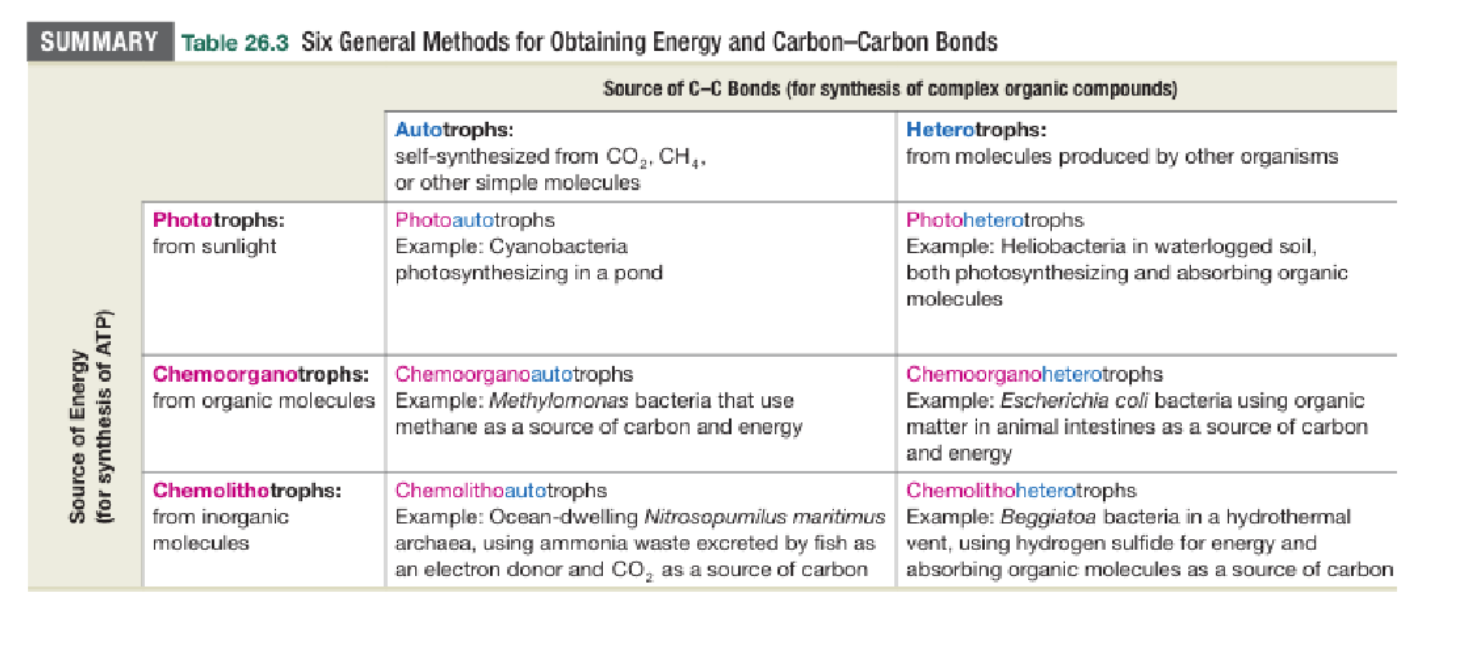
Prokaryotes: ________ ________
Eukaryotes: ___________
Range from ________ ________ organisms to ________ ________ organisms
Share: Nuclear ________, Mitochondria, Cytoskeleton, Mitosis & ________
Morphological and cellular innovations
Much more diversity in forms
Prokaryotes: bacteria and archaea
Eukaryotes: Eukaryota
Range from single celled organisms to complex multicellular organisms
Share: Nuclear envelope, Mitochondria, Cytoskeleton, Mitosis & Meiosis
Morphological and cellular innovations
Much more diversity in forms
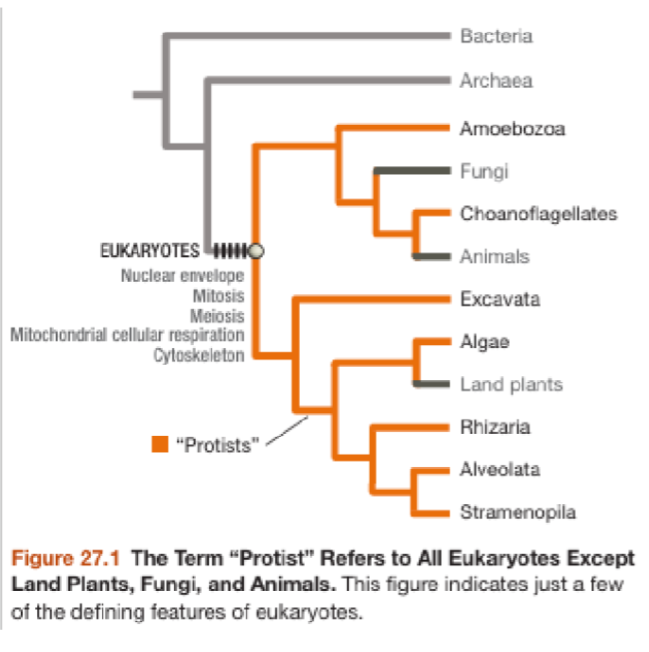
What are “Protists”?
A unique group of organisms because of the way it is classified
Has a common ancestor but not all of its descendants are protists → it is __________
General group of organisms, doesn’t have __________ __________ to unify the entire group of organisms
No defining __________ unique to the protists
The idea of protists is useful in discussing early evolution of __________
More about practical convenience
What are “Protists”?
A unique group of organisms because of the way it is classified
Has a common ancestor but not all of its descendants are protists → it is paraphyletic
General group of organisms, doesn’t have shared traits to unify the entire group of organisms
No defining synapomorphies unique to the protists
The idea of protists is useful in discussing early evolution of eukaryotes
More about practical convenience
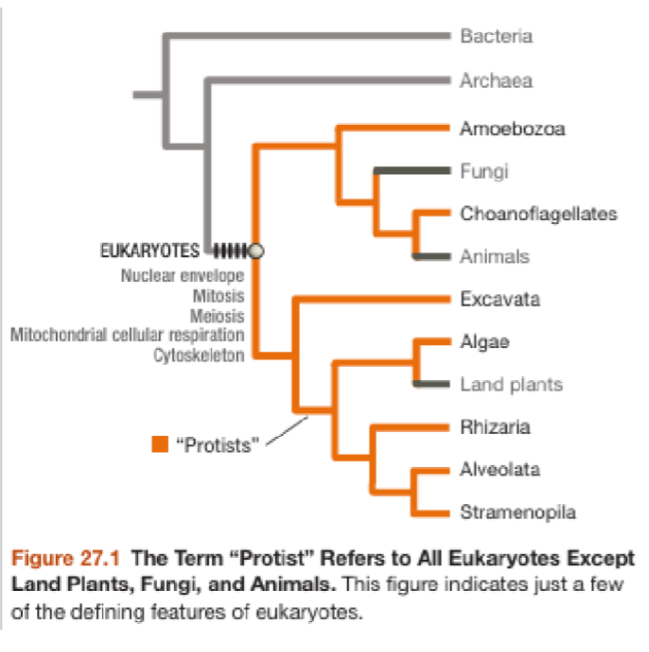
Why Biologists Study Protists
_________ importance similar to bacteria and archaea
Ex. malaria
Ecological importance
Dominant primary producers in _________ ecosystems
Form base of _________ food webs
Control nutrient cycling and energy flow
Evolutionary Importance
Provide insight into different processes
Origin of _________
Origin of _________
Early _________ diversification
Why Biologists Study Protists
Medical importance similar to bacteria and archaea
Ex. malaria
Ecological importance
Dominant primary producers in aquatic ecosystems
Form base of aquatic food webs
Control nutrient cycling and energy flow
Evolutionary Importance
Provide insight into different processes
Origin of multicellularity
Origin of organelles
Early eukaryotic diversification
Extremely high population densities of ________ in the water
Can dominate biomass in surface waters
Photosynthetic protists (________) fix approximately 50% of Earth’s ________
Energy flows from the protists to the ________ to the ________ ________
Can lead to harmful ________ ________ → involves dinoflagellates
Depletes oxygen
Deters predators
Big ecological and social impact
Extremely high population densities of protists in the water
Can dominate biomass in surface waters
Photosynthetic protists (phytoplankton) fix approximately 50% of Earth’s CO2
Energy flows from the protists to the consumers to the top predators
Can lead to harmful algae blooms → involves dinoflagellates
Depletes oxygen
Deters predators
Big ecological and social impact
Studying Protist Diversity: Morphology
Didn’t get full picture until ________ ________
Morphological synapomorphies: ________ structure, coverings, _______ grooves
As protists, not ________, but certain groups WITHIN the protists are monophyletic
________ ________ data used to define phylogeny of the protists → huge step, but still doesn’t give the full picture
________ ________: Using environmental DNA and sampling directly, not all can be cultured
Studying Protist Diversity: Morphology
Didn’t get full picture until electron microscopy
Morphological synapomorphies: Flagella structure, Cell coverings, Feeding grooves
As protists, not monophyletic, but certain groups WITHIN the protists are monophyletic
DNA sequencing data used to define phylogeny of the protists → huge step, but still doesn’t give the full picture
Direct sequencing: Using environmental DNA and sampling directly, not all can be cultured
Origin of the mitochondria (endosymbiosis)
Leading theory: ______________________________
Evidence:
______________
______________
______________
______________
Enabled efficient _______ ________
Supported increased cell _______ and _______
Origin of the mitochondria (endosymbiosis)
Leading theory: ______________________________
Evidence:
Size and structure
Circular DNA
Bacteria-like ribosomes
Double membranes
Enabled efficient aerobic metabolism
Supported increased cell size and complexity
Origin of the Nuclear Envelope
Also thought to have evolved from an ancestor of the ____________
Infoldings of plasma membrane surround the chromosomes → eukaryotic cell arises → forming nuclear envelope and endoplasmic reticulum
Led to separation of ____________ and ____________
Enabled ____________ processing & regulations
Origin of the Nuclear Envelope
Also thought to have evolved from an ancestor of the eukaryotes
Infoldings of plasma membrane surround the chromosomes → eukaryotic cell arises → forming nuclear envelope and endoplasmic reticulum
Led to separation of transcription and translation
Enabled RNA processing & regulations
3 Main Protist Feeding Strategies:
Ingestive feeding (aka _________): Cells engulf food particles (______________________________)
Absorptive feeding: ___________________________________
Photosynthesis
Some species will combine multiple strategies for feeding → allows them to ____________________ (Feeding innovations leads to ____________)
3 Main Protist Feeding Strategies:
Ingestive feeding (aka phagocytosis): Cells engulf food particles (Pulls solid objects in and then breaks them down)
Absorptive feeding: Cell absorbs dissolved nutrients directly through the membrane
Photosynthesis
Some species will combine multiple strategies for feeding → allows them to diversify food resources they’re using (Feeding innovations leads to diversification)
Movement and Locomotion
_________ motion
Flagella and _________
Feature of _________ evolution
Moving is important because they need to
_________ _________
_________ _________
_________ __ _________
Movement and Locomotion
Amoeboid motion
Flagella and cilia
Feature of convergent evolution
Moving is important because they need to
Locate food
Avoid predators
Position for photosynthesis
Protists can be __________ or __________
Multicellularity evolved __________ __________ in the eukaryotes
Common in some groups (e.g. algae, fungi, animals)
Multicellularity allowed us to reach ______________
Earlier stages
Cells would __________ __________ after division
Selection then favors __________ → could lead to the first origin of multicellular organisms
In addition to multicellularity, there’s other evidence of convergent evolution (___________________) in the eukaryotes
E.g. photosynthesis
E.g. parasitism
Protists can be unicellular or multicellular
Multicellularity evolved multiple times in the eukaryotes
Common in some groups (e.g. algae, fungi, animals)
Multicellularity allowed us to reach more complex forms
Earlier stages
Cells would stick together after division
Selection then favors cooperation → could lead to the first origin of multicellular organisms
In addition to multicellularity, there’s other evidence of convergent evolution (developing similar traits individually) in the eukaryotes
E.g. photosynthesis
E.g. parasitism
For most of earth’s history life was _________
Challenges associated with land
_________ (Drying out)
___ _________
Lack of _________ _________
Water provides buoyancy and less effect of _________
_________ without water
_________ were the first organisms to successfully colonize land
For most of earth’s history life was aquatic
Challenges associated with land
Desiccation (Drying out)
UV Radiation
Lack of structural support
Water provides buoyancy and less effect of gravity
Reproduction without water
Plants were the first organisms to successfully colonize land
What Defines a Plant?
Kingdom: _________
Characteristics
(Unicellular/Multicellular) (Prokaryotes/Eukaryotes)
Photosynthetic using _________
Cell walls made of _________
Alteration of generations
Evidence for evolution
Molecular _________
Cell _________
_________ Traits
What Defines a Plant?
Kingdom: Plantae
Characteristics
Multicellular Eukaryotes
Photosynthetic using chloroplasts
Cell walls made of cellulose
Alteration of generations
Evidence for evolution
Molecular phylogenetics
Cell Structure
Reproductive Traits
Life on Land (mechanisms to combat challenges)
________: Outer waxy layer that's used to reduce water loss
The trade off is that it limited the ability to __________________________
Stomata: ____________________________________
Multicellular embryos: Allows for more ___________________________
Life on Land (mechanisms to combat challenges)
Cuticle: Outer waxy layer that's used to reduce water loss
The trade off is that it limited the ability to exchange gases (can’t get carbon dioxide in if its sealed off)
Stomata: Have pores that allow gas exchange in photosynthetic tissues
Multicellular embryos: Allows for more investment in embryos early on
Alternation of Generations
Order of steps
Step 1:
Step 2:
Step 3:
Step 4:
Step 5:
Alternation of Generations
Order of steps (Dip happy game fer Z)
Step 1: Diploid sporophyte produces spores by meiosis
Step 2: Haploid spores grows into gametophyte
Step 3: Gametophyte produces gametes by mitosis
Step 4: Fertilization fuses gamete → zygote
Step 5: Zygote (2n) grows into sporophyte
Alternation of Generations
Evolutionary Importance:
Dispersal (_________)
Reproduction (_________)
Growth (_________)
Alternation of Generations turns these into _________ _________, allowing the plant to __________________________
Alternation of Generations
Evolutionary Importance:
Dispersal (spores)
Reproduction (Gametophyte)
Growth (Sporophyte)
Alternation of Generations turns these into separate stages, allowing the plant to dedicate more resources to each stage
Nonvascular Plants (Bryophytes)
Major Groups: Mosses, liverworts, hornworts
Key Traits:
Lack ________ ________
(Small/large) size
__________ dominant life cycle
Nonvascular Plants (Bryophytes)
Major Groups: Mosses, liverworts, hornworts
Key Traits:
Lack vascular tissue
Small size
Gametophyte dominant life cycle
Nonvascular Plants (Bryophytes)
Importance:
_________ Species
Important for ___________ (_______________________)
Helps with _________ _________ in the environments
Limitations
Transport constraints (relies on _________, which limits their height/size)
Reproductive constraint (sperm requires _________ to _________________, so they’re restricted to high _________ areas)
Nonvascular Plants (Bryophytes)
Importance:
Pioneer Species
Important for soil formation (breaking matters down and making them available for other organisms use)
Helps with moisture retention in the environments
Limitations
Transport constraints (relies on diffusion, which limits their height/size)
Reproductive constraint (sperm requires water to swim to the egg, so they’re restricted to high moisture areas)
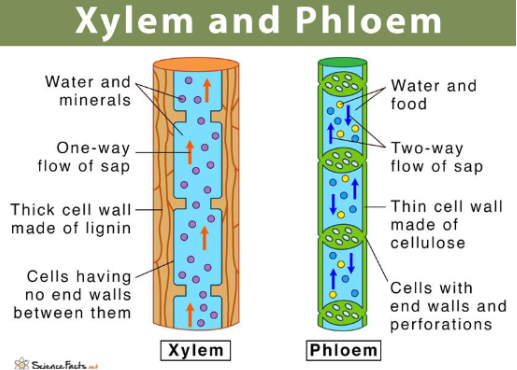
Evolution of Vascular Tissue
Xylem
Conducts ________ and ________
Contains lignin for ____________ (plants can _______ _______)
Phloem
Conducts ________ in ________ ________
Evolution of Vascular Tissue
Xylem
Conducts water and minerals
Contains lignin for structural support (plants can grow taller)
Phloem
Conducts sugars in organic compounds
Seedless Vascular Plants
Ex. ferns
Dominant _________ stage
Tends to be much _________ and _________ lived than gametophyte
Reproductive limitation: Requires _________ for fertilization
Seedless Vascular Plants
Ex. ferns
Dominant sporophyte stage
Tends to be much larger and longer lived than gametophyte
Reproductive limitation: Requires water for fertilization
Seeds as a Major Evolutionary Innovation
Seed: Embryo with a protective coating that contains _______ _______
Advantages:
_______ resistant (no longer need to be in a _______ _______ environment)
Allows for _______ (Can grow when ________________________)
Long distance _______ (Can _________________)
Seeds as a Major Evolutionary Innovation
Seed: Embryo with a protective coating that contains stored nutrients
Advantages:
Desiccation resistant (no longer need to be in a very wet environment)
Allows for dormancy (Can grow when conditions are favorable)
Long distance dispersal (Can colonize new areas)
Gymnosperms
“The _______ _______ _______”
Seeds are ________________________ (Ex. conifers)
Well adapted for _______/_______ environments
Pollen
Pollen grains: Used to transport the _______ _______
Dispersed by wind or animals
Wind: Don’t have to rely on _______ _______, but a lot of gametes need to be produced and where they go is random
Key advantage: Allows fertilization without _______ _______
Gymnosperms
“The naked seed plants”
Seeds are not enclosed in any kind of fruit (Ex. conifers)
Well adapted for cold/dry environments
Pollen
Pollen grains: Used to transport the male gametes
Dispersed by wind or animals
Wind: Don’t have to rely on animal populations, but a lot of gametes need to be produced and where they go is random
Key advantage: Allows fertilization without standing water
Angiosperms: Flowering Plants
Key traits: Flowers, fruits inclosing their seeds, double ________ (Plant only invests in ________ ________ ________ after ________ has occurred, not preemptively)
(#)% of modern plant species
Close relationship with ________
Flower structure is shaped by their pollinators and vice versa
________ (like honeybees) or ________ pollinators
________: More likely to get fertilized but if something happens to the pollinator there’s a direct effect on the plant
Angiosperms: Flowering Plants
Key traits: Flowers, fruits inclosing their seeds, double fertilization (Plant only invests in nutrient rich tissue after fertilization has occurred, not preemptively)
90% of modern plant species
Close relationship with pollinators
Flower structure is shaped by their pollinators and vice versa
Generalist (like honeybees) or specialist pollinators
Specialist: More likely to get fertilized but if something happens to the pollinator there’s a direct effect on the plant
Fruits and Seed Dispersal
Allows for further dispersal, reducing competition
If a plant drops seeds right under them, they’re creating competition for themselves
Seeds allow for transportation and then drop off with the fertilizer they need to grow (animal poop)
Ecological Impact of Plants
________ ________: Base of the terrestrial food webs
Important in habitat formation: Forest, grasslands, wetlands
Important in climate regulation: oxygen production and CO2 uptake
________ ________: important in soil formation, roots can break down rock, organic matter accumulation,
Sets stage for: Fungal ________, herbivore evolution, terrestrial animal ________
Ecological Impact of Plants
Primary producers: Base of the terrestrial food webs
Important in habitat formation: Forest, grasslands, wetlands
Important in climate regulation: oxygen production and CO2 uptake
Ecosystem Engineers: important in soil formation, roots can break down rock, organic matter accumulation,
Sets stage for: Fungal mutualisms, herbivore evolution, terrestrial animal diversification
Fungi are (eukaryotic/prokaryotic) organisms
Grow as _______ or _______
One of the three multicellular terrestrial lineages (_______, _______, _______)
Importance for study
Human health (fungi can infect humans)
Agriculture and food systems (both infecting food and producing foods like beer or cheese)
Ecosystem function (_______ _______)
Fungi are eukaryotic organisms
Grow as single-celled or multicellular
One of the three multicellular terrestrial lineages (Plants, animals, fungi)
Importance for study
Human health (fungi can infect humans)
Agriculture and food systems (both infecting food and producing foods like beer or cheese)
Ecosystem function (nutrient cycling)
Fungi as Decomposers
__________ Fungi are the decomposers
Important in __________ __________
(Not many organisms can)
And plants decomposition
(Can break down __________ & __________ which is a rare trait)
Fungi as Decomposers
Saprophytic Fungi are the decomposers
Important in wood decomposition
(Not many organisms can)
And plants decomposition
(Can break down cellulose & lignin which is a rare trait)
Fungal Growth Forms
Yeasts: _________________
Multicellular fungi have bodies called ________
The fungus itself is under the ground, the mushroom is only the ________ ________
Dimorphic: _________________
Environmental influences: Temperature, nutrient availability, host environment
Mycelia: _________________
Fungal Growth Forms
Yeasts: Single celled fungi
Multicellular fungi have bodies called mycelia
The fungus itself is under the ground, the mushroom is only the reproductive structure
Dimorphic: Can switch between single celled and multicellular
Environmental influences: Temperature, nutrient availability, host environment
Mycelia: Enormous surface area to volume ratio makes it very efficient
Predatory Fungi
Can trap microscopic animals (________) using modifications to the ________
Expands their range so that they’re not only restricted to ________ or ________
Reproductive Structures vs. Feeding Structures
Mycelium: ________ and ________
________ function
Reproductive Structures: Dense multicellular structures (like the ________)
Specialized for ________ ________
Predatory Fungi
Can trap microscopic animals (nematodes) using modifications to the hyphae
Expands their range so that they’re not only restricted to plant material or dead things
Reproductive Structures vs. Feeding Structures
Mycelium: Feeding and growth
Absorptive function
Reproductive Structures: Dense multicellular structures (like the mushroom)
Specialized for spore production
Fungal Diversity: Why It’s Hard to Measure
Hidden Diversity: ________________________________
Like only the mushroom reproductive structure being above ground
They also are too soft to ________
Studying Fungi
Morphological approaches (______________________)
Molecular approaching (Ex. ________________________)
Fungal Diversity: Why It’s Hard to Measure
Hidden Diversity: Many of them live in soil, or inside plants or animals, so we can’t make direct observations about them
Like only the mushroom reproductive structure being above ground
They also are too soft to fossilize
Studying Fungi
Morphological approaches (looking at the structures we can see)
Molecular approaching (Ex. DNA or direct env. sequencing)
Four Types of Fungi Sexual Reproductive Structures
__________________: Has flagella which allows for active dispersal
___________: Spore producing structures formed when hyphae are yoked
Allows them to __________________
___________: Club-shaped cells where meiosis occurs, forming four spores
Enhances __________________
___________: Sac-like cells where meiosis and one round of mitosis occur, forming eight spores
Shoots spores out from the structure, allowing for rapid and widespread ____________ (Like the puff mushrooms)
Four Types of Fungi Sexual Reproductive Structures
Swimming Gametes and spores: Has flagella which allows for active dispersal
Zygosporangia: Spore producing structures formed when hyphae are yoked
Allows them to survive harsh conditions
Basidia: Club-shaped cells where meiosis occurs, forming four spores
Enhances long distance spread
Asci: Sac-like cells where meiosis and one round of mitosis occur, forming eight spores
Shoots spores out from the structure, allowing for rapid and widespread colonization (Like the puff mushrooms)
Fungi Reproductive Structures
They can also be asexual, throwing out tons of ________ into the environment
No reliance on sexual reproduction means rapid ________ without reliance on a ________
Issue is the lack of ________ ________
Fungi Reproductive Structures
They can also be asexual, throwing out tons of spores into the environment
No reliance on sexual reproduction means rapid colonization without reliance on a mate
Issue is the lack of genetic variation
Phylogeny of Fungi
Evidence of similarity between _________ and fungi
Molecular evidence
Shared traits
_________ production
Posterior _________
_________ as storage carbohydrate
Fungi also evolved from an _________ _________
The close relationship with animals makes it difficult to treat (how to target fungi without targeting our own _________)
Phylogeny of Fungi
Evidence of similarity between animals and fungi
Molecular evidence
Shared traits
Chitin production
Posterior flagella
Glycogen as storage carbohydrate
Fungi also evolved from an aquatic ancestor
The close relationship with animals makes it difficult to treat (how to target fungi without targeting our own tissue)
Fungi as Symbionts
Most ________ interact with fungi
Relationships can be ________ or ________
Mycorrhizal Fungi: ____________________________________
Mutualistic exchange where plants provide ________ to the fungi, and fungi provide ________ (__, __)
Fungi as Symbionts
Most plants interact with fungi
Relationships can be mutualistic or parasitic
Mycorrhizal Fungi: Fungi that live in close association with plant roots
Mutualistic exchange where plants provide sugars to the fungi, and fungi provide nutrients (N, P)
The Wood Wide Web: Root networks between ________ and ________ can move ________ and ________ ________ around (resource sharing)
Larger plants can send nutrients to seedlings
Parent trees can send nutrients to shaded/stressed offspring
They can also communicate
They can warn other plants that they’re being attacked by herbivores
This causes the other plants to invest in defenses even though they’re not being attacked
Fungi can favor plants that provide more ________, and not give as much ________ to those who don't provide as much ________
The Wood Wide Web: Root networks between plants and fungi can move nutrients and chemical signals around (resource sharing)
Larger plants can send nutrients to seedlings
Parent trees can send nutrients to shaded/stressed offspring
They can also communicate
They can warn other plants that they’re being attacked by herbivores
This causes the other plants to invest in defenses even though they’re not being attacked
Fungi can favor plants that provide more sugar, and not give as much nutrients to those who don't provide as much sugar
Types of Mycorrhizae
EMF:
Hyphae that penetrate ________ ________
Form sheaths ________ ________
Common in ________ ________ (Mainly associated with ________)
Shape ________, ________ forest systems
AMF
Hyphae that penetrate ________ ________
Branch inside ________ ________
Extremely widespread in ________ (more than EMF)
Rapid uptake of ________ ________
Drive productivity and diversity in more ________ ecosystems
Types of Mycorrhizae
EMF:
Hyphae that penetrate between cells
Form sheaths around roots
Common in temperate forests (Mainly associated with trees)
Shape stable, nutrient-conserving forest systems
AMF
Hyphae that penetrate cell walls
Branch inside root cells
Extremely widespread in plants (more than EMF)
Rapid uptake of inorganic nutrients
Drive productivity and diversity in more dynamic ecosystems
Other Fungal Symbioses
Lichens: _________ species
Insect associations with fungi
_________ _________ that aid in digestion
Why Fungi Are Such Effective Decomposers
They have _________ _________
Can break down _________
Spores and Reproductive Strategy
Spores are _________ units
Spores can withstand _________ _________
Other Fungal Symbioses
Lichens: Pioneer species
Insect associations with fungi
Gut fungi that aid in digestion
Why Fungi Are Such Effective Decomposers
They have extracellular digestion
Can break down lignin
Spores and Reproductive Strategy
Spores are dispersal units
Spores can withstand harsh conditions
What is an Animal?
Animals are a monophyletic group (One common ancestor and all of its lineages)
Shared Traits
Multicellular eukaryotes
Cells lack cell walls
Extensive extracellular matrix
Heterotrophic
Multicellularity + Heterotrophy + Movement = purpose is consumption
Closest lineage is choanoflagellates (sister taxa)
What is an Animal?
Animals are a ___________ group (One common ancestor and all of its lineages)
Shared Traits
Multicellular eukaryotes
Cells lack ___________ ___________
Extensive ___________ ___________
Heterotrophic
___________ + ___________ + ___________ = purpose is consumption
Closest lineage is ___________ (sister taxa)
The Cambrian Explosion
Beginning of the Cambrian period, 541 million years ago
Beginning of first discovered _________ _________
Established _________ _________ in this time that have stayed very consistent across time
_________ spaces have been filled
Developing a brand new novel _________ is very rare
The Cambrian Explosion
Beginning of the Cambrian period, 541 million years ago
Beginning of first discovered animal fossils
Established body plans in this time that have stayed very consistent across time
Niche spaces have been filled
Developing a brand new novel structure is very rare
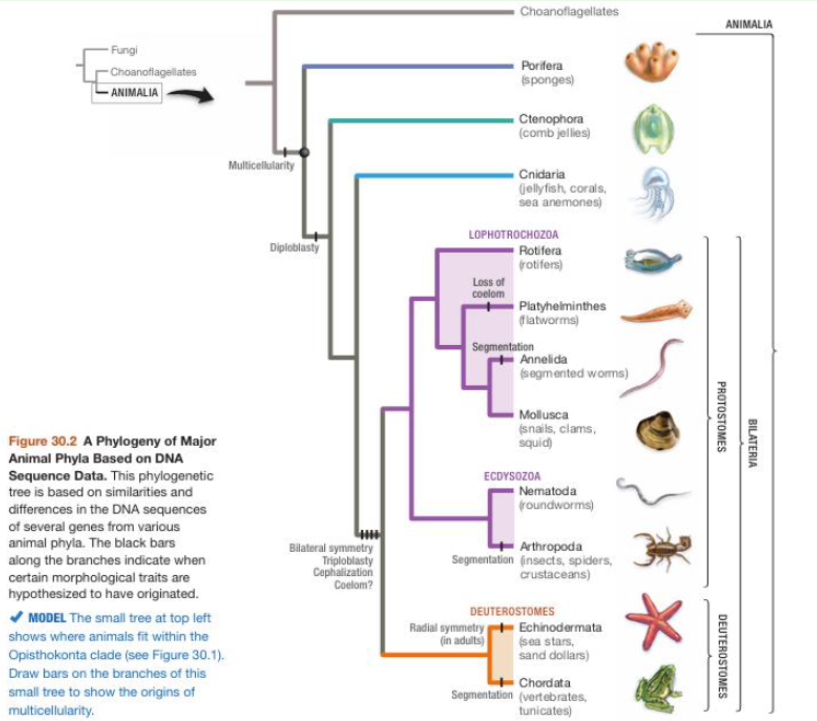
Major Animal Lineages
Animalia → _________ & _________ → _________ & _________
Other lineages are not less evolved than humans, they’re ___________________
Major Animal Lineages
Animalia → Bilateria & Non-Bilateria → Protosomes & Deuterosomes
Other lineages are not less evolved than humans, they’re on another evolutionary track
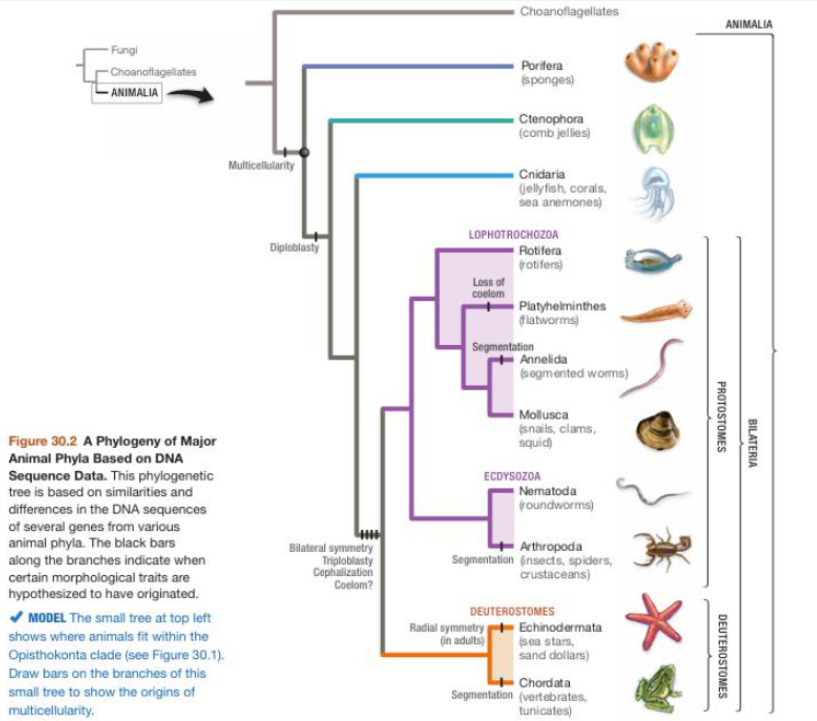
Origin of Multicellularity (Sponges-first hypothesis)
Animals are monophyletic (one common ancestor)
Sponges-first hypothesis:
Suggests that _______________________________
Living sponges are not ancestors, they’re a _________ _________ with a long independent history
Origin of Multicellularity (Sponges-first hypothesis)
Animals are monophyletic (one common ancestor)
Sponges-first hypothesis:
Suggests that sponges branched off first (earliest branching ancestor or animals)
Living sponges are not ancestors, they’re a modern lineage with a long independent history
Choanoflagellates and Sponges
Shared traits between Choanoflagellates and Sponges
______, ______ lifestyle
Similar ______ cells
Sponges:
Multiple ______ ______ ______
Organized tissue and extracellular matrix
Some possess a true ______
Sponges have genes for:
Cell ______
Signaling
Apoptosis
______ Immunity
Choanoflagellates and Sponges
Shared traits between Choanoflagellates and Sponges
Sessile, benthic lifestyle
Similar feeding cells
Sponges:
Multiple specialized cell types
Organized tissue and extracellular matrix
Some possess a true epithelium
Sponges have genes for:
Cell adhesion
Signaling
Apoptosis
Innate Immunity
Alternative Hypothesis: Ctenophores-First
Very strongly debated
______ ______ had to evolve more than once in evolution
Sponge-First has the most ______
Nervous system and ______ evolved once
Alternative Hypothesis: Ctenophores-First
Very strongly debated:
Nervous system had to evolve more than once in evolution
Sponge-First has the most parsimony
Nervous system and muscle evolved once
Body Symmetry
Radial symmetry: Appears in earlier groups
Ex. Jellyfish & ctenophores
Bilateral symmetry: Associated with directional movement and head first interactions w/ environment
Body Symmetry
Radial symmetry: Appears in ______ ______
Ex. Jellyfish & ctenophores
Bilateral symmetry: Associated with ______ ______ and ______ ______ interactions w/ environment
Bilateral Symmetry and the Nervous System
Radial symmetry: Usually means a _________ _________ is present
Bilateral symmetry: Concentration of the nervous system creates the _________ _________ _________
Cephalization: Concentration at the _________ end of the body
Located in the head because ____________________________
Bilateral Symmetry and the Nervous System
Radial symmetry: Usually means a nerve net is present
Bilateral symmetry: Concentration of the nervous system creates the central nervous system
Cephalization: Concentration at the anterior end of the body
Located in the head because animals lead with their head
Origin of the Gut and the “Tube-within-a-Tube” Plan
Earlier animals have a _____-like body plan (________ ________ where the food comes in and waste gets excreted)
Later animals evolved “Tube-within-a-Tube” (two openings, mouth and anus)
Allowed us to separate ingestion & excretion (________ ________)
Allowed for ________ ________
Origin of the Gut and the “Tube-within-a-Tube” Plan
Earlier animals have a sac-like body plan (one opening where the food comes in and waste gets excreted)
Later animals evolved “Tube-within-a-Tube” (two openings, mouth and anus)
Allowed us to separate ingestion & excretion (directional flow)
Allowed for regional specialization
Protostomes vs. Deuterostomes
Fate of the _________ determines whether something is a proto or deutero
Protostomes: _________________________________
Deuterostomes: ________________________________
_________ are more developmental flexibility → greater diversity
Protostomes vs. Deuterostomes
Fate of the blastopore determines whether something is a proto or deutero
Protostomes: Blastopore becomes the mouth and the anus develops second
Deuterostomes: Blastopore becomes the anus and the mouth develops second
Protostomes are more developmental flexibility → greater diversity
Segmentation
Repetition of body units along an axis
Likely due to a shared ______________
_________ also have a segmented body plan
Morphology evolved (independently/codependently)
Segmentation allowed for __________
Segmentation
Repetition of body units along an axis
Likely due to a shared genetic tool kit
Humans also have a segmented body plan
Morphology evolved independently
Segmentation allowed for diversification
What is a virus?
Classified as: ___________________
Rely on host for _________
Traits:
(Not made/Made) up of cells
(Don’t have/Have) metabolism
(Can’t exist/Exist) as infectious particles outside host cells
(Can’t/Can) replicate independently
(Don’t strongly/Strongly) shape life on earth
(Don’t evolve/Evolve) and have genomes
What is a virus?
Classified as: Obligate intracellular parasite
Rely on host for replication
Traits:
Not made up of cells
Don’t have metabolism
Exist as infectious particles outside host cells
Can’t replicate independently
Strongly shape life on earth
Evolve and have genomes
Why do biologists study viruses?
Medical importance: ______________________________
Evolutionary importance: ______________________________
Genetic importance: ______________________________
Why do biologists study viruses?
Medical importance: Can cause widespread disease in animals, plants, and humans
Evolutionary importance: Strong agent of natural selection on host (Developing resistance to viruses)
Genetic importance: Responsible for a lot of lateral gene transfer (Virus infects host A, may accidentally pick up some of host A’s DNA, infect host B, and inert the DNA into host A’s genome)
Viruses and Disease: Population-Level Effects
Epidemic: Widespread _________________
Pandemic: Widespread _________________
Are Viruses Alive? (TRUE OR FALSE)
No ribosomes ___
No ATP production ___
Independent transcription or translation ___
Viruses and Disease: Population-Level Effects
Epidemic: Widespread within a particular regions
Pandemic: Widespread across multiple regions
Are Viruses Alive? (TRUE OR FALSE)
No ribosomes (T)
No ATP production (T)
Independent transcription or translation (F)
Size and abundance of viruses
Incredibly small (20-300 nanometers)
Oceans contain ten times more viruses than they do ________
Two basic categories
Naked viruses (_________ only)
Enveloped viruses (________ + ________)
Size and abundance of viruses
Incredibly small (20-300 nanometers)
Oceans contain ten times more viruses than they do cells
Two basic categories
Naked viruses (protein capsid only)
Enveloped viruses (capsid + membranous envelope)
Transmission to New Hosts
Within organism pathways:
_____________
_____________
Between organism pathways:
_____________
_____________
_____________
This is the virus equivalent of _____________
Transmission to New Hosts
Within organism pathways:
Bloodstream
Lymphatic System
Between organism pathways:
Respiratory droplets
Bodily fluids
Vectors
This is the virus equivalent of dispersal
Viruses can go into types of dormant stages
Lysogeny - in bacteriophages (viruses in bacteria)
Go into a dormant state, and then can get activated)
Latency - in animal viruses
Virus persists silently to avoid detection
Viruses can go into types of dormant stages
Lysogeny - in bacteriophage viruses
Method: Go into a dormant state, and then can get activated
Latency - in animal viruses
Method: Virus persists silently to avoid detection
Viruses as Evolutionary Agents
_________ _________
Host evolves defenses
Virus evolves counter defenses (_________ _________ _________)
_________ _________
High mutation rates
Short generation times
Viruses as Evolutionary Agents
Natural Selection
Host evolves defenses
Virus evolves counter defenses (coevolutionary arms race)
Rapid Evolution
High mutation rates
Short generation times
Origins of Viruses (Hypotheses- no general consensus)
Escaped-genes hypothesis: _______________________
Degeneration hypothesis: _______________________
RNA-world hypothesis: _______________________
Origins of Viruses (Hypotheses- no general consensus)
Escaped-genes hypothesis: Viruses evolve from mobile genetic elements
Degeneration hypothesis: Viruses descended from parasitic cells
RNA-world hypothesis: Viruses predate cellular life
Emerging Viruses
New diseases infecting humans for the first time
Zoonotic jumps: Viruses moving from animal hosts to humans
Phylogenetics plays an important role in understanding which and how viruses might infect humans in the future
Emerging Viruses
New diseases infecting humans for the first time
Zoonotic jumps: Viruses moving from animal hosts to humans
Phylogenetics plays an important role in understanding which and how viruses might infect humans in the future
What is Global Ecology?
Ecosystem = __________ + __________
Linked by the ______ of energy and the ______ of nutrients
All connected in the biosphere
Ecosystem services: (4)
__________________________
__________________________
__________________________
__________________________
What is Global Ecology?
Ecosystem = Interacting species + abiotic environment
Linked by the flow of energy and the cycling of nutrients
All connected in the biosphere
Ecosystem services: (4)
Provisioning (Ex. Food, timber)
Regulating (Processes that regulate like flood control)
Cultural (Processes that help with recreation & mental/physical health)
Supporting (Ex. Primary Productivity, Nutrient Cycling)
Enable all other services
Energy Flow through Ecosystems
Energy enters via _________ _________
This happens mainly through _________, but some ecosystems use _________ (Ex. Thermal vents)
Energy is not created, it just _________ through the system
Primary Productivity
Gross primary productivity (GPP): _______________________
Net primary productivity (NPP): ________________________
NPP = _____ - _____
____ is respiration & Heat loss
Energy Flow through Ecosystems
Energy enters via primary producers
This happens mainly through photosynthesis, but some ecosystems use chemosynthesis (Ex. Thermal vents)
Energy is not created, it just flows through the system
Primary Productivity
Gross primary productivity (GPP): Total chemical energy produced by photosynthesis produced per unit area per time
Net primary productivity (NPP): Energy that gets stored as new biomass (energy that isn’t lost)
NPP = GPP - R
R is respiration & Heat loss
Reasons why photosynthesis is inefficient
Limited ___________ absorbed
___________ light variation
___________ sensitivity in enzymes (limits how much they can actually convert)
___________ stress limits CO2 uptake
Reasons why photosynthesis is inefficient
Limited wavelengths absorbed
Seasonal light variation
Temperature sensitivity in enzymes (limits how much they can actually convert)
Water stress limits CO2 uptake
Energy Dissipation
Energy flows (one direction/two directions)
___% transferred each step, ___% lost
Energy Dissipation limits the number of ________________ and ____________________
Pyramids of Productivity
More efficient for humans to feed at (lower/higher) tropic levels (feeding more people from rice then growing corn to feed chickens to feed humans)
Energy Dissipation
Energy flows one direction
10% transferred each step, 90% lost
Energy Dissipation limits the number of trophic levels and population sizes of top predators
Pyramids of Productivity
More efficient for humans to feed at lower tropic levels (feeding more people from rice then growing corn to feed chickens to feed humans)
Biomagnification: ______________________________
_____________ increases (Herring heats a lot of zooplankton, Salmon eat a lot of Herring, etc.)
________ ________ are most affected, including _________
Biomagnification: Pollutants become magnified as they move through the trophic levels
Concentration increases (Herring heats a lot of zooplankton, Salmon eat a lot of Herring, etc.)
Top predators are most affected, including humans
Global Patterns of Productivity
Terrestrial: Generally higher ________ ________ than marine environments
Limiting factors: ________ & ________ availability
Marine: Highest productivity is ________ ________ and ________ ________
Limiting factors: ________ & ________ availability
Human Appropriation of NPP:
We use about (#)% of NPP
Mechanisms: Direct ________, land-use change (ex. converting forests into agriculture), and disturbances (ex. forest fires)
Global Patterns of Productivity
Terrestrial: Generally higher net productivity than marine environments
Limiting factors: Nutrient & water availability
Marine: Highest productivity is coral reefs and algal beds
Limiting factors: Light & nutrient availability
Human Appropriation of NPP:
We use about 20% of NPP
Mechanisms: Direct harvesting, land-use change (ex. converting forests into agriculture), and disturbances (ex. forest fires)
Nutrient Cycling within Ecosystems
Uptake → assimilation → consumption
Death & Waste → detritus
Decomposition → break up of nutrients
Control Rate:
___________
___________ availability
___________ availability
Rapid cycling in places like ___________ ___________, slower cycling in places like ___________ ___________
Nutrient Cycling within Ecosystems
Uptake → assimilation → consumption
Death & Waste → detritus
Decomposition → break up of nutrients
Control Rate:
Temperature
Moisture availability
Oxygen availability
Rapid cycling in places like tropical rainforests, slower cycling in places like boreal forests
The Global Water Cycle
Four Major Reservoirs: _________, _________, _________, _________
_________ drives the entire water cycle → precipitation gives us fresh water system → transpiration (plants releasing water) controls _________ → runoff moves nutrients and shapes landscapes → percolation (_____________________)
The Global Water Cycle
Four Major Reservoirs: Ground water, atmosphere, ice, and ocean
Evaporation drives the entire water cycle → precipitation gives us fresh water system → transpiration (plants releasing water) controls climate → runoff moves nutrients and shapes landscapes → percolation (water soaking into soil)
The Global Nitrogen Cycle
Plants cannot consume _________ _________, so they go through nitrogen fixation to make it usable
Nitrogen fixation methods:
N2 → either ______ or ______ (_________ or _________)
_________ and _________ both drive nitrogen fixation
The Global Nitrogen Cycle
Plants cannot consume atmospheric nitrogen, so they go through nitrogen fixation to make it usable
Nitrogen fixation methods:
N2 → either NH4+ or NO3- (Ammonium or Nitrate)
Bacteria and lightning both drive nitrogen fixation
The Global Carbon Cycle
Four Major Reservoirs: _________, _________, _________, _________
___________ removes CO2, ___________ releases CO2
Global Climate Change
Interruptions to the carbon cycle are increasing ___________ ___________ and ___________ the planet
The Global Carbon Cycle
Major Reservoirs: Oceans, sediments/rocks, terrestrial biomass, atmosphere
Photosynthesis removes CO2, Respiration releases CO2
Global Climate Change
Interruptions to the carbon cycle are increasing greenhouse gasses and insulating the planet