Astronomy 2
 Call Kai
 Learn
Learn Practice Test
 Spaced Repetition
 Match
Match Flashcards
 Knowt Play
1/120

There's no tags or description
Looks like no tags are added yet.
Name | Mastery | Learn | Test | Matching | Spaced | Call with Kai |
|---|
No analytics yet
Send a link to your students to track their progress
121 Terms
geocentric
model of the solar system in which the Earth is in the center of the universe
heliocentric
model of the solar system with the Earth revolving around the Sun
Stonehenge
is the site of several henges, or ditches surrounded by banks, in England
Henges
ditches surrounded by banks
Mayan Civilization
flourished in present-day Mexico, Belize, Guatemala, El Salvador, and Honduras from about 2600 BCE, with its golden age spanning 300-900 CE
Aztec Civilization
thrived from between 1100 and 1521 CE, but descendants of the Aztecs still live and practice certain cultural traditions in Mexico
Century (Aztec)
a 52-year cycle in the Aztec calendar
Space Race
a competition between the US and USSR as to who could do what first in human space exploration
FAI
the international governing body overseeing aerospace records
re-entry
the moment when a space craft comes back into Earth’s atmosphere
Deep Space Network (DSN)
an international network of spacecraft communication services
rovers
space exploration vehicles designed to move about the surface of a planet
planetary system
a system of planets orbiting a central star
Solar System
a planetary system that includes the Sun, the planets, and many other smaller objects
solar nebula
the cloud of gas and dust from which the Sun and the rest of the Solar System was formed
planetesimals
rocky objects in space from which planets are created through the process of accretion
protoplanetary disk (proplyd)
the early stage of the development of a planet when it is growing because of collisions with planetesimals
extrasolar planets
planets located outside of our Solar System
protosun
the early, gaseous stage of the Sun’s formation
Mercury
first planet and 3.2 light minutes away from the Sun
Venus
second planet and 6 light-minutes away from the Sun; of all the terrestrial planets, has the densest atmosphere
retrograde rotation
when a celestial body spins in the opposite direction that it orbits the Sun; Uranus also does this
Terrestrial planets
highly dense and rock planets nearest to the Sun
Earth
Third planet and 8.3 light-minutes from the Sun; only planet currently known to sustain life
Prograde rotation
The counter-clockwise spin of a planet or moon as seen from above the planet’s north pole; rotation is in the same direction as the Sun’s rotation.
Earth’s atmosphere layers
troposphere, stratosphere, mesosphere, thermosphere, and exosphere
Jupiter
the largest and most massive of the planets
Juno
a spacecraft that conducts in-depth examinations of Jupiter’s chemistry, atmosphere, interior structure, and magnetosphere
Great Red Spot
A giant storm on Jupiter that has been observed since the 1800s
Little Red Spot
A spot comprised of three smaller storms on Jupiter
Gossamer ring
a third, transparent ring of Jupiter
Galilean satellites
Jupiter’s four largest moons: Io, Europa, Ganymede, and Callisto
Saturn
This planet is the sixth planet from the Sun, but it is the second largest, behind Jupiter
Titan
Saturn’s giant moon that has a thick atmosphere that is regarded by scientists as one of the most complex chemical environments in our solar system
Enceladus
Saturn’s moon that contains hydrogen in gas form and where scientists believe is the most likely home to life outside Earth
Centripetal force
a "center-seeking" net force acting perpendicular to an object's velocity, causing it to move in a curved or circular path
Uranus
The first planet discovered by a telescopic search of the universe; 7th planet in order
Neptune
The eighth farthest planet from the Sun
Turbulent convection
the chaotic transport of heat, momentum, and matter within celestial bodies, driven by buoyancy
Differential rotation
the phenomenon where different parts of a non-solid, rotating body—such as a star, gas giant, or accretion disk—move at different angular velocities
Orbital resonance
occurs when orbiting bodies (like planets or moons) exert regular, periodic gravitational influences on each other, usually because their orbital periods are related by a ratio of small integers
Volatiles
chemical elements or compounds with low boiling points that easily vaporize or sublime in planetary atmospheres and surfaces
Great Dark Spot
This storm on Neptune was as large as Earth, had winds of almost 750 mph, and rotated counter-clockwise
Triton
The largest of Neptune’s moons
Retrograde orbit
When a celestial body orbits opposite the direction of a planet’s orbit; Neptune’s Triton does this
Pluto
a dwarf planet that was classified as a planet from 1930 to 2006
Kuiper Belt
the region of space beyond Neptune which is similar to the asteroid belt between Mars and Jupiter
Eris
a dwarf planet found in the Kuiper Belt that is slightly larger than Pluto
Dwarf planets
celestial bodies that orbit the sun, have a relatively round shape, not a moon, but have not cleared out the area around their orbits
IAU
International Astronomical Union that is responsible for naming celestial bodies and defining astronomical constants.
What governing body reclassified Pluto as a dwarf planet?
IAU
Sidereal vs solar day
A sidereal day is a planet's true rotation period relative to distant stars, while a solar day is the time for the Sun to return to the same meridian
Sun
the center star of our Solar System, consisting of plasma and magnetic fields
Thermal columns
convective plumes in the Sun's interior that transport energy from deeper layers to the surface
Solar winds
streams of charged particles that blow out matter and energy
Core
the interior or center part of the Sun
Radiative zone
Located about one-third of the way from the surface of the Sun to the core; the plasma here is relatively calm compared to the surface of the Sun, but the visible light is much greater
Convective zone
The outer layer of the Sun before the atmosphere starts; it extends down from the surface to about 200,000 kilometers.
Photosphere
The Sun’s visible surface, or the lowest layer of the Sun’s atmosphere
Chromosphere
The middle layer of the Sun’s atmosphere; this layer is typically invisible from Earth, but its reddish color can be seen during a total solar eclipse
Corona
The outermost layer of the Sun’s atmosphere; larger than the Sun itself in volume
Nuclear fusion
occurs when two atomic nuclei combine, or "fuse," to form one heavier nucleus
Nuclear fission
process where the nucleus of an atom splits into smaller parts
Gravitational equilibrium
the balance of gravity pulling inward at the same time that pressure is pushing out
Proton-proton chain reaction
energy is created through this process of nuclear fusion
Deuterium nucleus
has one proton and one neutron
Neutrinos
subatomic particles with very little mass and no charge. Most common particles and can be found in radioactive decay and nuclear fusion reactions.
Positron
antimatter counterpart of an electron, featuring the same mass but a positive charge
Gamma ray
the highest-energy, shortest-wavelength, and most penetrating electromagnetic radiation
Newton’s law of universal gravitation
objects in space are attracted to each other with a force equal to the product of their masses, divided by the square of the distance between their centers
Kepler’s first law of planetary motion
Planets and moons orbit in elliptical, rather than circular, paths
Kepler’s second law of planetary motion
Explains why planets move faster when closer to the Sun
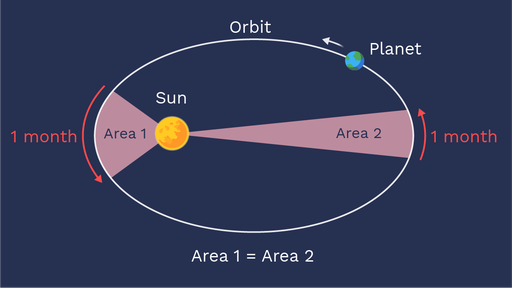
Kepler’s third law of planetary motion
The time a planet/satellite takes to make one orbit is proportional to its orbit size
Angular momentum
a measure of the "amount of rotation" an object has, taking into account its mass, shape, and speed of spinning; it is the tendency of a spinning object to keep spinning
Newton’s first law of motion
An object at rest stays at rest, and an object in motion stays in motion with the same speed and in the same direction unless acted upon by an unbalanced external force (Law of Inertia)
Newton’s third law of motion
For every action force, there is an equal and opposite reaction force
Newton’s second law of motion
force equals mass times acceleration; the more force applied to an object, the more it accelerates, but the more mass an object has, the harder it is to accelerate
Solar weather (solar activity)
disturbances on the Sun’s surface as energy from the core moves outward
Sunspots
cooler than the other areas of the Sun's surface, making the sunspots appear less bright or even dark; but have stronger magnetic fields
Solar prominences (filaments)
loops of trapped gas on the Sun’s surface
Sunspot cycle
a pattern of solar activity where the average number of sunspots gradually increases and decreases
Solar maximum and solar minimum
the times in the sunspot cycle when there are the most and fewest sunspots on average, respectively
Two main parts of a sunspot
umbra and penumbra
Solar granules
convection cells covering the Sun's photosphere, acting as the surface manifestation of heat rising from the interior
Coronal mass ejection
a large "bubble" of charged particles and gas from the corona that travels out from the Sun
Solar flares
magnetic storms on the surface of the Sun that create sudden and intense eruptions of charged particles and X-rays into space
Halo event
occurs when a coronal mass ejection is directed straight towards or away from the Earth; the CME looks like it forms a halo around the Sun
Solar eclipse
happens when the Moon passes between the Sun and Earth and blocks the Sun
Permian-Triassic extinction
Called the “Great Dying” and “the mother of all mass extinctions,” it was the most catastrophic of all the extinction events, with over 90 percent of the ocean’s species lost and up to 70 percent of the land mammal, insect, reptile, and plant species going extinct.
Comets
mixtures of frozen gases, rocks, and dust, and they can be the size of a small town
Halley’s Comet
Unique comet because it is visible to the naked eye each time it passes within the inner solar system. It can next be seen from Earth in 2061.
Oort Cloud
an area where there is a collection of comets; it is thought to be a spherical region that is located 100,000 AU from the Sun
Plasma tail (aka ion tail; gas tail)
gas escaping from the coma of a comet
Dust tail
dust escaping from the coma of a comet
Near Earth Objects (NEOs)
Asteroids or comets that intersect with Earth's orbit
Asteroid belt
area between Mars and Jupiter where thousands of asteroids orbit
Asteroids
small, rocky fragments mostly composed of rocks and metals, but some also contain a dark, carbon material. These fragments were left over from when the Solar System was created and most of them orbit between the Sun and Mars and Jupiter.
Trojan asteroids
Asteroids that share an orbit with Jupiter
Two planetary regions of the solar system
Inner solar system; outer solar system
Meteoroids
pieces of rock and other materials present in the solar system