Chm 142 exam 3
0.0(0)
Studied by 1 person Call Kai
 Learn
Learn Practice Test
 Spaced Repetition
 Match
Match Flashcards
 Knowt Play
Card Sorting
1/42

Earn XP
Description and Tags
Last updated 5:31 PM on 4/5/23
Name | Mastery | Learn | Test | Matching | Spaced | Call with Kai | Chat |
|---|
No analytics yet
Send a link to your students to track their progress
43 Terms
1
New cards
common ion effect
The common ion effect is a phenomenon in which the addition of a common ion to a solution shifts the equilibrium of a chemical reaction involving that ion. This effect is commonly observed in acid-base and solubility equilibria. The presence of a common ion reduces the solubility of a slightly soluble salt, and decreases the ionization of a weak acid or base.
2
New cards
If a solution contains a weak acid/base and its conjugate base/acid pair ion then….
the weak acid/base won’t dissociate as much as if it were alone in the solution
3
New cards
Buffer
solutions of a weak conjugate acid-base pair that **resist** drastic changes in pH are called buffers
4
New cards
a good buffer contains relatively ___ concentrations of **both** the acid and base. Their concentrations are ______________
high
approximately equal
approximately equal
5
New cards
How to make a buffer
1. mix a weak acid and a salt of its conjugate base
2. mix a weak base and a salt of its conjugate acid
3. add a strong acid and partially neutralize with a weak base
4. add a strong base and partially neutralize with a weak acid
6
New cards
Henderson-Hasselbalch equation
only applies to **buffers**
\[A-\] is the concentration of the conjugate base
\[HA\] is the concentration of the acid
\[A-\] is the concentration of the conjugate base
\[HA\] is the concentration of the acid
![only applies to **buffers**
\[A-\] is the concentration of the conjugate base
\[HA\] is the concentration of the acid](https://knowt-user-attachments.s3.amazonaws.com/fb2611ea67a04b1dbf061f42136c7f68.jpeg)
7
New cards
Buffer capacity
the amount of acid or base the buffer can neutralize before the pH begins to change to an appreciable degree
8
New cards
pH range of a buffer
range: pKa +/- 1 pH unit
9
New cards
The addition of a strong acid or base to a buffer is __________
neutralization reaction
First, calculate new values of \[HA\] and \[A-\] using naMbVb = nbMaVa or using an ICE table. Then, use the Henderson-Hasselbalch equation to find pH
First, calculate new values of \[HA\] and \[A-\] using naMbVb = nbMaVa or using an ICE table. Then, use the Henderson-Hasselbalch equation to find pH
10
New cards
Titration
an acid (or base) solution of **known concentration** is slowly added to a base (or acid) solution of **unknown concentration**
11
New cards
Equivalence point
when stoichiometrically equivalent quantities of acid and base have been brought together in a titration
12
New cards
For the titration of a **strong acid** with a **strong base**, at the equivalence point the pH will be _____
pH = 7.0
13
New cards
For the titration of a **weak acid** with a **strong base**, the pH will be determined by ______
Initial pH: will use Ka for the weak acid
**pH after initial but before equivalence point**: First, calculate the moles of weak acid, the moles of base added. Then, subtract moles of base from moles of acid. Finally, use the Henderson-Hasselbalch equation.
pH at equivalence point: use Kb for the conjugate base of the weak acid
**pH after initial but before equivalence point**: First, calculate the moles of weak acid, the moles of base added. Then, subtract moles of base from moles of acid. Finally, use the Henderson-Hasselbalch equation.
pH at equivalence point: use Kb for the conjugate base of the weak acid
14
New cards
For the titration of a **weak acid** with a **strong base**, the equivalence point will be reached at _______
pH > 7
15
New cards
When a polyprotic acid is titrated, there is an _____________ for each dissociation
equivalence
diprotic have two, triprotic have three
diprotic have two, triprotic have three
16
New cards
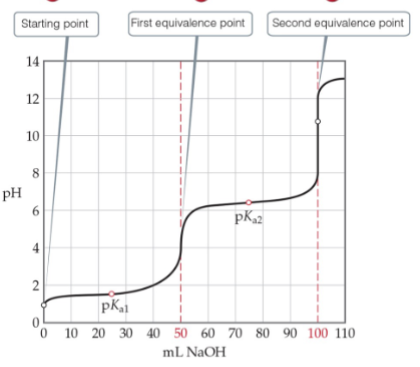
pH = pKa when ……..
you have reached halfway to the equivalence point
17
New cards
solubility product constant
\-Ksp
\-can be used when a strong electrolyte is dissociated
\-is NOT the same as solubility
\-is unitless
\-can be used when a strong electrolyte is dissociated
\-is NOT the same as solubility
\-is unitless
18
New cards
if one of the ions in a solution equilibrium is already dissolved in the solution, the solubility of the salt will _________
decrease
19
New cards
If a substance has a **basic ion**, it will be more soluble in _______ solution
acidic
20
New cards
the formation of complex ions ________ the solubility of the salt
increases
21
New cards
complex ion
an assembly of a metal ion and a lewis base
22
New cards
lewis acid
electron acceptor
23
New cards
lewis base
electron donor
24
New cards
amphoteric
can act as either an acid or a base
25
New cards
Q = Ksp
the system is at equilibrium and the solution is saturated
26
New cards
Q < Ksp
the solution is unsaturated and more solid can dissolve
27
New cards
Q > Ksp
the solution is supersaturated and a precipitate will form
28
New cards
Enthalpy (H)
is the heat absorbed by a system during a constant pressure process
is a state function
is a state function
29
New cards
Entropy (S)
is a measure of the randomness in a system
is a state function
is a state function
30
New cards
Gibbs Free Energy (G)
depends on both H and S. The sign reveals if a process is spontaneous.
is a state function
is a state function
31
New cards
spontaneous process
a process that proceeds without any outside assistance
can be either slow or fast
processes that are spontaneous in one direction are nonspontaneous in the reverse direction
can be either slow or fast
processes that are spontaneous in one direction are nonspontaneous in the reverse direction
32
New cards
Reversible process
we can restore the system to its original condition with no change to the surroundings
Hypothetical, there are no real processes that are reversible
Hypothetical, there are no real processes that are reversible
33
New cards
Irreversible process
the surroundings are somehow changed when the system is restored to its original state
34
New cards
Isothermal process
a process that occurs at a constant temperature
35
New cards
the entropy (S) of the **universe** _________ in any spontaneous process
increases
36
New cards
Standard enthalpy of formation (ΔH\*)
are measured under standard conditions
298 K and 1 atm
298 K and 1 atm
37
New cards
Microstate
a single possible arrangement of the positions and kinetic energies of the molecules when the molecules are in a specific thermodynamic state
38
New cards
Boltzmann’s equation
S = k ln(w)
where W represents the number of microstates
S is entropy
k is Boltzmann’s constant
where W represents the number of microstates
S is entropy
k is Boltzmann’s constant
39
New cards
things that result in increased entropy
\-increased volume
\-increased temperature
\-increased number of molecules
\-more atoms in a molecule
\-entropy of gases > entropy of liquids > entropy of solids
\-increased temperature
\-increased number of molecules
\-more atoms in a molecule
\-entropy of gases > entropy of liquids > entropy of solids
40
New cards
Third law of thermodynamics
the entropy of a pure crystalline substance at absolute zero is 0
41
New cards
For a spontaneous process, ΔG is ____
negative
42
New cards
For a system at equilibrium, ΔG is _______
0
43
New cards
For nonspontaneous reaction in the forward direction (but spontaneous in the reverse), ΔG is ______
positive