Language Development Exam 3 (Final)
 Call Kai
 Learn
Learn Practice Test
 Spaced Repetition
 Match
Match Flashcards
 Knowt Play
1/55

There's no tags or description
Looks like no tags are added yet.
Name | Mastery | Learn | Test | Matching | Spaced | Call with Kai |
|---|
No analytics yet
Send a link to your students to track their progress
56 Terms
Nativist Theory: Primary Theorist and Central Belief
Chomsky, Language is Innate
Behaviorist Theory: Primary Theorist and Central Belief
Skinnier, Language is Learned
Social Interactionalist Theory: Primary Theorist and Central Belief
Vygotsky, Language is the result of Social Interaction
Cognitive Interactionalist Theory: Primary Theorist and Central Belief
Piaget, Language is the result of Cognition
Semantic Interactionist Theory: Primary Theorist and Central Belief
Bloom, Study structure of early language in context of speaker’s intended message
Linguistic Universals
Language is a universal experience for all humans regardless of culture, language, or geography. There are underlying commonalities in all languages relating to syntax.
Commonalities in languages (Nativist)
rules for organizing words
distinguish between subject vs predicate
allow for embedding clauses
rules to indicate tense and plurality
some common sounds
What does LAD stand for?
Language acquisition device
Explain the LAD:
It is a mechanism or function of the brain. There is no specific location to the LAD. It is considered in terms of its function
The LAD supports language learning by serving as a reservoir of all the syntactic rules required by the child’s language environment
The LAD is active critical period of language learning. After this period the LAD specializes in the child’s primary language(s) and language learning becomes more difficult
Transformative Generative Grammar
Explains the ability to produce unlimited number of grammatical sentences
Every language has deep and surface structures
Phrase structure rules (deep): universal rules, Transformations (surface): language specific rules
Example of a Phrase Structure Rules (deep, universal rule)
The girl is going to hit the ball - question?
Example of a Transformational Rule (surface, language specific rule)
Is the girl going to hit the ball?
Operant
Any behavior whose frequency of occurence changes as a consequence of the response that follows it
Operant Conditioning:
Conditions voluntary behaviors through reinforcement when a behavior occurs
Consequences can increase or decrease the likelihood that similar behaviors occur under similar circumstances
Reinforcement
Occurs when frequency of behavior increases as a consequence of the response (+ or -)
Punishment
Occurs when frequency of behavior decreases as a consequence of the response. An averse stimulus that decreases the likelihood of a response
Positive Reinforcement
A stimulus that increases the frequency of a response when it occurs contingent on that response
Negative Reinforcement
A stimulus that increases the frequency of a response when it is removed contingent on that response
Example of Operant Conditioning and Language:
caregiver provides models
child imitates models
closest imitations are reinforced by the caregiver:
giving what child wants
responding with another comment
giving attention
What are the three major interactionist theories?
*think six (SCS)
Semantic
Cognitive
Social
Semantic Interactionism + Proponent
Study structure of early language in context of speaker’s intended message
Proponent: Lois Bloom
Social Interactionism + Proponent
A child’s intent to communicate (not passive) leads them to interact with people who can respond to that intent. Caregiver meets intent and provides appropriate language model.
Language acquisition is a product of early social interactions with caregivers who provide language models.
Proponent: Lev Vygotsky
Zone of Proximal Development
Opportunities that family/caregivers have to provide/help kids make steady progress in development
Scaffolding
A child learns a given task through guidance (i.e. puzzles). The adult will gradually withdraw supports and reintroduce supports if child is failing more than succeeding
The child and adult talk with one another, learning the skill of solving a problem
Language is learned; becoming; private speech
Draws upon what child already knows
Vygotsky’s Theory of Cognition:
Cognitive development is the result of the interaction between child’s factors (innate abilities, self-directed exploration) and environmental/cultural factors (social experiences)
Children’s cognition and language influence each other; language is a key factor
Private Speech
This is when children talk to themselves and use it to guide through interactions
How does Private Speech assist in cognitive development?
Language guides us through actions to help think through problems and tasks
Language helps children; pay attention, memorize, and recall information, formulate and execute plans to solve problems, think ponder, muse
Language moves from an external activity “out loud” becomes “silent” or internalized
This is observed in make-believe play and is linked to academic achievement
What are four Biological Factors that Vygotsky identified as precursors or innate biological skills required for cognition and language?
*think MAPS
Memory
Attention
Perception
Sensation
What are social and environmental factors promoting cognition?
Interactions with Other Who Knows More (OKM)
Cultural factors
Social Experiences
Cognitive Interactionism
Language emerges as a product of cognitive organization and development (not learned or innate). Although language is not innate, the cognitive precursors are innate
What is the premise of Piaget’s Theory of Cognitive Development?
Cognitive acts organize children’s environments and are result of their adaptations to their environments
Schemata + Example
Cognitive structures that help children process, identify, organize, and store information (a category)
ex) a small, furry, four-legged animal is a dog
Assimilation + Example
A cognitive process whereby a new stimulus is fitted into an existing schema
ex) a child sees a cat for the first time and calls it a dog
Accomodation + Example
A cognitive process whereby new schemas are created for information that does not fit existing schemata
ex) a child sees a cow and calls it a dog, but it is too big, and now creates a new category for a cow
Equilibrium
A cognitive process to maintain balance between existing schemata (assimilation) and the creation of new schemata (accommodation)
ex) a child sees a cat and because they can differentiate from dogs, recognizes it as a cat
Example of Equilibrium
Learning that not all four-legged animals are “dogs,” but that some are cats
Identify Piaget’s Four Stages of Intellectual Development:
*think specific (SPCF)
Sensorimotor: birth to two years
Pre-Operational: two to seven years
Concrete Operations: seven to eleven years
Formal Operations: eleven to fifteen years
Piaget’s Four Stages of Intellectual Development: Sensorimotor
birth to two years
primary skills: object permanence, means to ends
highly reflexive and motor orientate
does not manipulate ideas conceptually
Piaget’s Four Stages of Intellectual Development: Pre-Operational
two to seven years
child begins to think conceptually
categorize things in her environment
can solve physical problems
studies in conservation and egocentricity
Piaget’s Four Stages of Intellectual Development: Concrete Operations
seven to eleven years
primary skills: conservation and perspective taking
ability to think logically in concrete physical problems
can place stimuli into categories based on order and level
Piaget’s Four Stages of Intellectual Development: Formal Operations
eleven to fifteen years
cognitive abilities become fully developed
child can think abstractly, solve problems mentally, develop and test hypotheses
reasons and thinks logically, abstractly
Rules of Piaget’s Stages:
Stages are NOT independent
Ages attached to stages are not absolute
Distancing + Example
The child relates to new stimuli from a greater and greater distance
ex) consider representation of a play object (egg) from requiring a play object that looks, feels, and acts like an egg —> an object in shape of an egg —> a block representing an egg —> to an invisible egg until —> we reach the written form as the most distant
Representation + Example
The idea that the stimulus or object can represent something else
ex) while outdoors, grass and sticks can represent food during play
Object Permanence + Example
Understanding the existence of objects and people in their absence
ex) a child reaching for a toy hidden under a blanket
Causality
The understanding that events can cause other events
Means to Ends + Example
There are ways or means of obtaining a goal (end), this is related to causality
ex) a child cleaning their room in order to be allowed to play with their friends
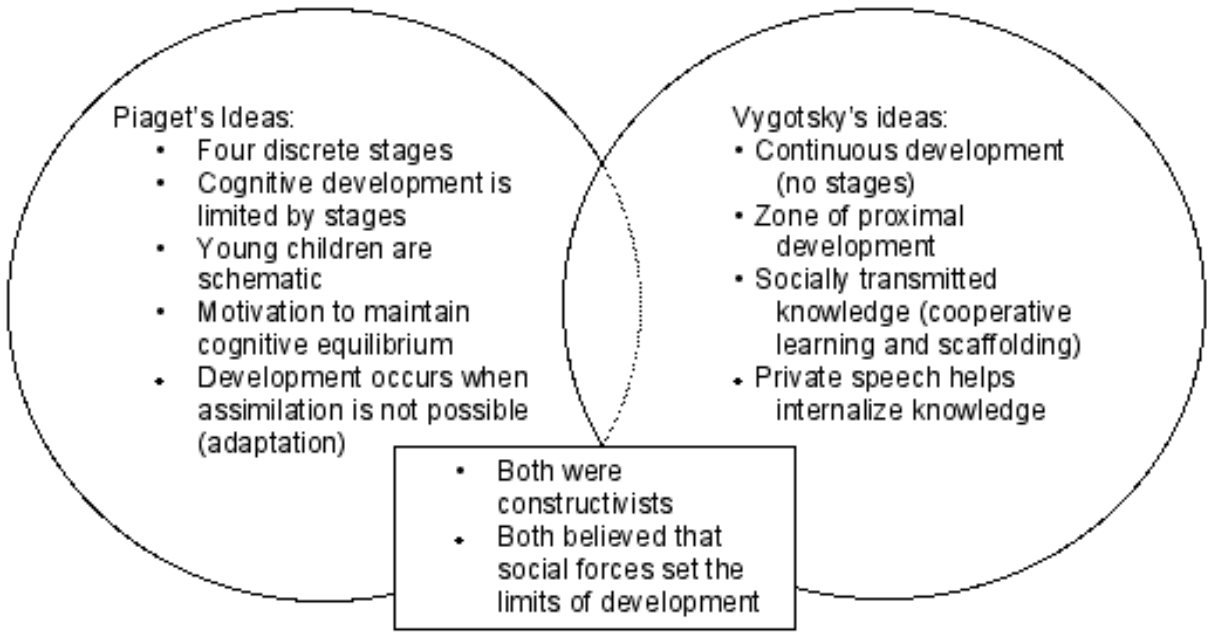
Compare and Contrast Piaget with Vygotsky
Cognition
The mental action or process of acquiring knowledge and understanding through thought, experience, and the senses
Perception
The processes by which a person selects, organizes, integrates, and interprets the sensory information s/he receives
Two primary modes of Perception that promote language development:
Visual (consider how social interactionists would relate to this)
Auditory (consider how nativists would relate to this)
Theory of the Mind
an understanding of mental states of oneself and of others
this understanding develops over time to assist us in considering other people’s thoughts, feelings, and knowledge
perspective taking
ex) a girl puts a ball in her basket and leaves the room. While she is gone, her friend moves the ball from the basket to a box. When the girl returns, where will she look for the ball?
Accent + Example
Relates to differences or variations in speech production or pronunciation
ex) American vs British: tomato vs to-mah-to
Dialect + Example
Both language and speech differences
ex) soda vs pop vs coke
Identify 7 variables that influence speech and language:
Region
Social class, education, and occupation
Race and ethnicity
Gender
Situation or context
Peer group association or identification
First language community or culture
Bilingualism
the ability to speak two language and/or frequent use (as by a community) of two languages